Dig a handful of soil from your garden and squeeze it. Whether it clumps solid, crumbles apart, or falls somewhere in between tells you more about your garden’s potential than any other test.
Soil is classified by the ratio of three mineral particle sizes — sand, silt, and clay — along with the organic matter woven through them. Shift those ratios and you get radically different growing conditions, from waterlogged clay that suffocates roots in winter to fast-draining sand that leaves plants thirsty by midsummer. Gardeners who understand their soil type spend less effort fighting it and more time growing in it.
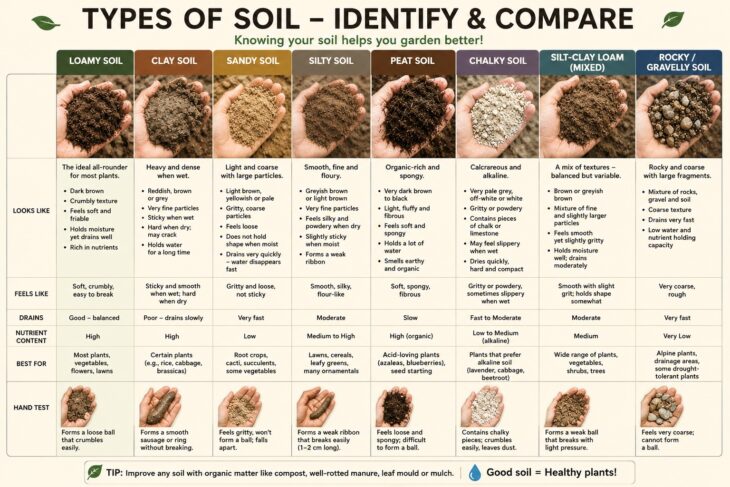
There are six recognized garden soil types: loam, clay, sandy, silt, peat, and chalk. Each has a different pH range, drainage rate, and nutrient profile. Most garden plants prefer a slightly acidic to neutral pH between 6.0 and 7.0, where the widest range of nutrients is chemically available. Step outside that window and even a fertile soil locks up what plants need.
Drainage is the most practical consideration of all. Soil that holds too much water starves roots of oxygen. Soil that drains too fast starves plants of moisture before they can use it. Organic matter — compost, leaf mold, aged manure — improves both extremes and is the single most useful amendment for every type on this list. This guide covers all six, from the easiest soil to grow in to the most specialized.
1. Loam Soil
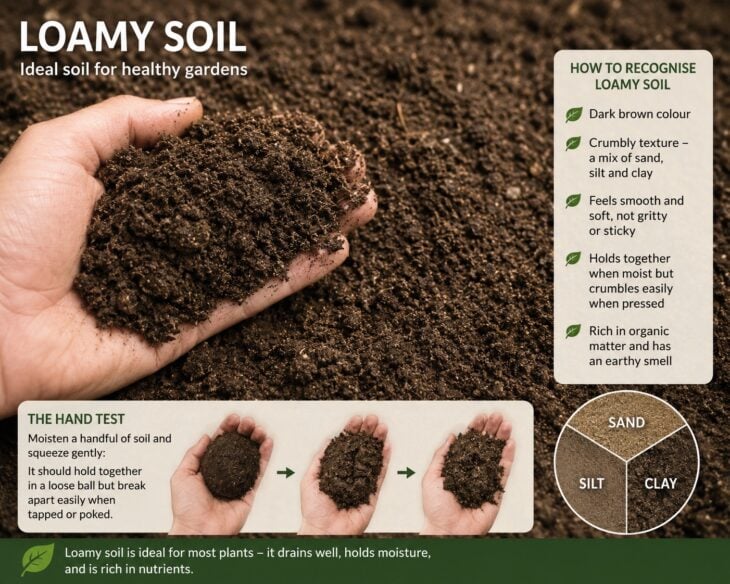
Loam is the benchmark. It is a balanced mix of roughly 40% sand, 40% silt, and 20% clay, and it behaves exactly as a gardener would want — it holds moisture without waterlogging, lets excess drain freely, and binds organic matter at a healthy rate. Squeeze a handful and it forms a loose ball that breaks apart with light pressure. It is dark, slightly crumbly, and not sticky to the touch.
Most vegetables grow well in loam without any special preparation. Tomatoes, peppers, radishes, leafy greens, roses, and the majority of annual and perennial flowers are all at home here. Loam’s natural pH tends to sit between 6.0 and 7.0, which is exactly where nutrient availability peaks for most crops. Fruit trees establish faster in loam than in any other native soil type.
Maintenance is straightforward. An annual top-dressing of compost keeps the structure open and feeds the microbial life that makes nutrients available to roots. Loam does not need grit added for drainage or clay added for water retention — it already has both. If you have loam, protect it. Avoid compacting it when wet and keep it mulched.
2. Clay Soil
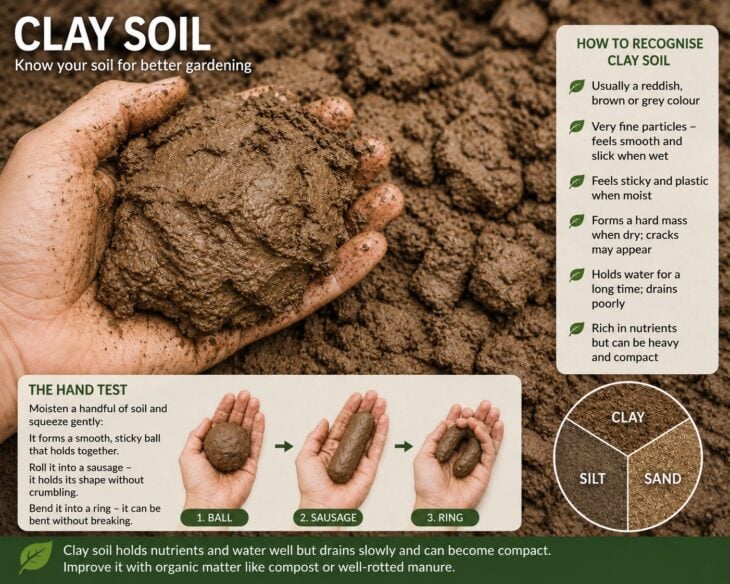
Clay soil is frustrating and rewarding in roughly equal measure. It is made of the finest mineral particles — smaller than 0.002 mm — which pack tightly together, leaving little room for air or water to move through. In wet weather it becomes sticky and plastic. In dry weather it bakes hard and cracks. Working it at the wrong moment can destroy its structure for an entire season.
What clay does have is extraordinary nutrient density. The tiny particles carry a natural electrical charge that holds onto minerals rather than letting them wash away. Brassicas — Brussels sprouts, broccoli, cauliflower — are traditional clay-garden crops precisely because they are heavy feeders that benefit from that stored fertility. Asters and flowering quince also do well, and established fruit trees thrive once their roots push through the density.
Improving clay takes patience. Dig in coarse grit and large quantities of organic matter each autumn. Avoid stepping on beds when the soil is wet, as compaction undoes any structural progress quickly. Raised beds filled with improved growing mix are the fastest route to productive clay-garden growing, while the native clay below slowly improves year by year.
3. Sandy Soil
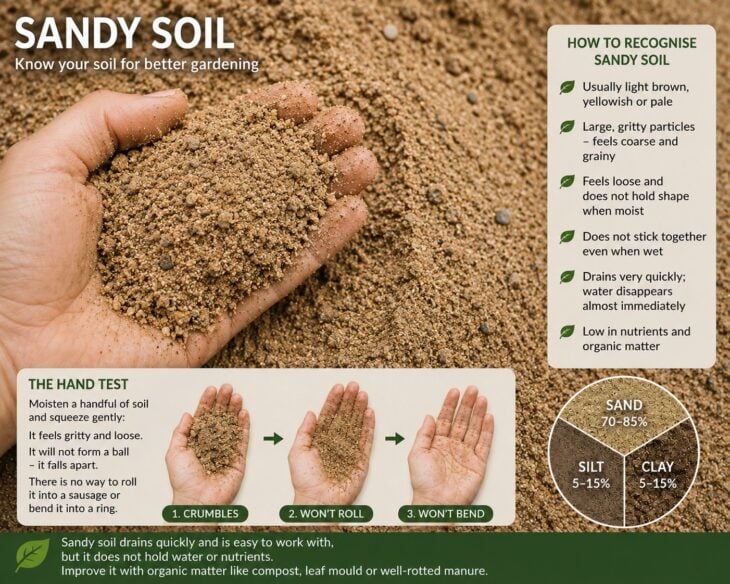
Sandy soil is defined by speed. Water passes through it quickly, taking dissolved nutrients along for the ride. The particles are large enough — 0.05 to 2.00 mm — that they cannot hold together without organic matter binding them. Rub a handful between your fingers and it feels gritty even when moist. It cannot be molded into a ball. It is light, pale, and warms up faster in spring than any other soil type.
That warmth is a genuine advantage. Sandy gardens in cool climates can plant a full two to three weeks earlier than neighboring clay plots. Lavender, rosemary, thyme, irises, and succulents reach their best in sandy soil because their Mediterranean origins prepared them for exactly this kind of fast drainage and heat retention. Root vegetables — carrots and parsnips in particular — grow straighter and longer in the loose structure than they ever would in denser soils.
The challenge is retention. Compost needs to be added in large quantities every year, and it breaks down faster than in clay, so the schedule is relentless. Smaller, more frequent fertilizer applications work better than a single heavy dose, since any nutrient surplus simply leaches away. Mulching heavily after planting slows moisture loss enough to reduce watering frequency through the heat of summer.
4. Silty Soil
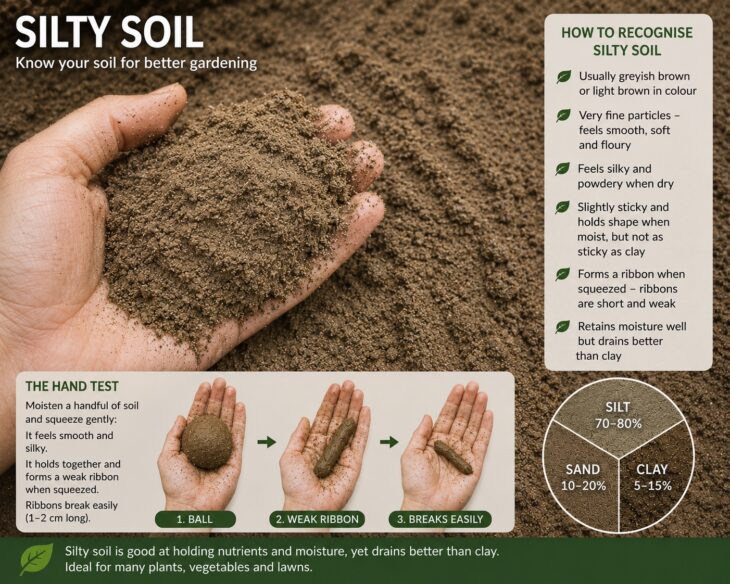
Silt occupies the middle ground between sand and clay — and it does so quietly, which is why it tends to be underestimated. Silt particles (0.05–0.002 mm) are fine enough to hold moisture and nutrients well but large enough that drainage does not fail the way it does in clay. Dry silt feels smooth and slightly flour-like. Wet silt feels slippery and soapy rather than sticky. It holds a shape briefly when squeezed but smears instead of rolling cleanly.
Silty soil is naturally fertile. Onions, lettuce, and most leafy vegetables grow well in it without significant amendment. Perennials, climbing plants, and moisture-loving trees such as willows and birch are at home in silt, especially near watercourses where silt deposits tend to be deepest. The pH usually sits close to neutral, which suits a wide range of plants without any adjustment.
The main risk with silt is surface crusting and compaction. Fine particles can settle into a dense layer that resists water infiltration and makes emergence harder for seedlings. Adding organic matter regularly keeps the structure open, and raised beds help in gardens where silt is particularly prone to compaction. Avoid walking on silt beds when they are wet.
5. Peat Soil
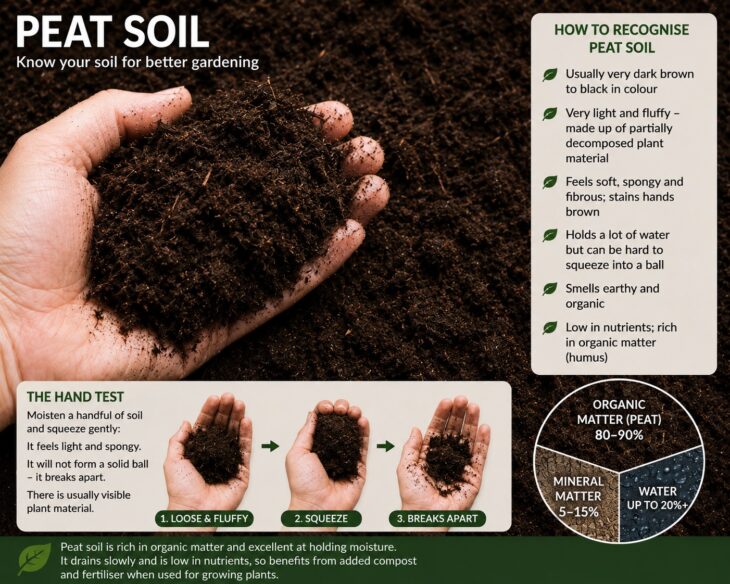
Peat soil is composed almost entirely of partially decomposed plant matter rather than mineral particles. It is dark brown to black, spongy when wet, and lightweight when dry. Its pH is naturally between 3.5 and 5.5, making it one of the most acidic growing environments a gardener will encounter. That acidity is the feature for certain plants — blueberries, cranberries, rhododendrons, azaleas, camellias, and heathers all require conditions that standard soils cannot provide without chemical intervention.
Peat soil retains water exceptionally well and has good aeration when managed correctly, making it a forgiving medium for the specialist plants it suits. In non-acidic regions, gardeners have historically built raised beds of peat-based compost to grow blueberries and ericaceous shrubs where the native soil is far too alkaline. For these crops, peat provides a reliable, long-lasting acidic environment that lime-rich alternatives struggle to replicate.
There is an important sustainability consideration. Peat bogs are protected habitats and significant carbon stores, and horticultural extraction is now widely discouraged. The RHS and most gardening bodies recommend peat-free alternatives — composted bark, coir, wood fiber, and green compost — for most uses. For acid-loving plants specifically, ericaceous peat-free composts have improved substantially and represent the practical forward path for most home gardeners.
6. Chalky Soil
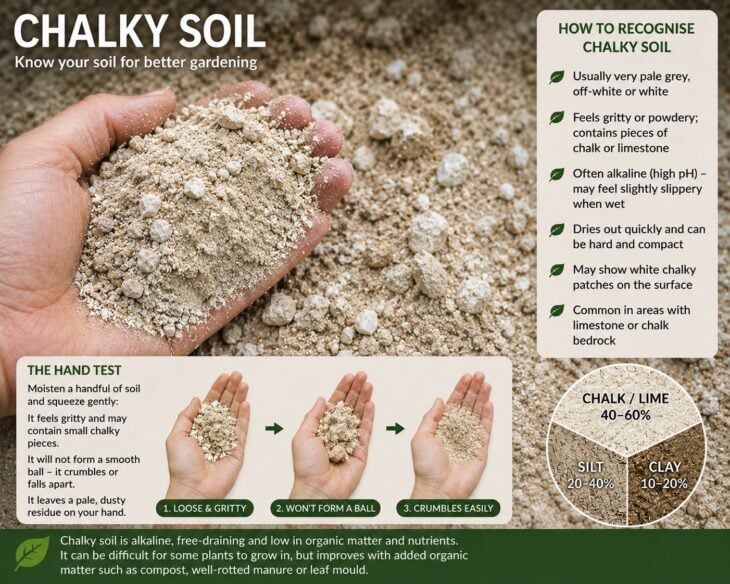
Chalky soil sits at the alkaline end of the spectrum, with pH readings between 7.1 and 8.5. It is formed over calcium carbonate (chalk or limestone) bedrock and is often shallow, stony, and pale in color. A simple test confirms it quickly — a drop of vinegar on a chalk-rich lump will fizz. Drainage is fast because chalk bedrock is porous and the mineral grains are large. Organic matter breaks down rapidly in the alkaline conditions, which means it needs constant replenishment.
The main frustration with chalk is iron and manganese lockup. Above pH 7.5, plants cannot absorb these nutrients even when they are present in the soil. The result is chlorosis — yellowing leaves with green veins — a common sight in gardens built on chalk. An annual application of sequestered iron in spring addresses this for most ornamental plantings. Choosing naturally chalk-tolerant plants avoids the problem entirely.
Lavender, thyme, rosemary, lilac, and mock orange are among the plants that genuinely prefer alkaline conditions, and they grow with more vigor on chalk than on amended neutral soil. Spinach, cabbage, and beets also do well. Breaking up the chalk subsoil to at least 30 inches (75 cm) gives roots room to establish. Adding organic matter each year keeps the surface fertile despite the fast breakdown rate. Chalk gardens reward a Mediterranean and cottage-style plant palette over forcing acid-lovers into an environment that will always resist them.