
Key Facts
- Evergreen medium to large tree native to southeastern Australia including Tasmania.
- Produces clusters of fragrant yellow puff flowers in late winter to spring.
- Valued for strong, decorative timber used in furniture and cabinetry.
- Tolerates a range of soils and establishes on poorer sites once established.
- Often planted as an ornamental tree shelterbelt or for restoration.
- Seeds usually need scarification or hot water treatment to germinate.
- Responds best to full sun and tolerates light frost in mild climates.
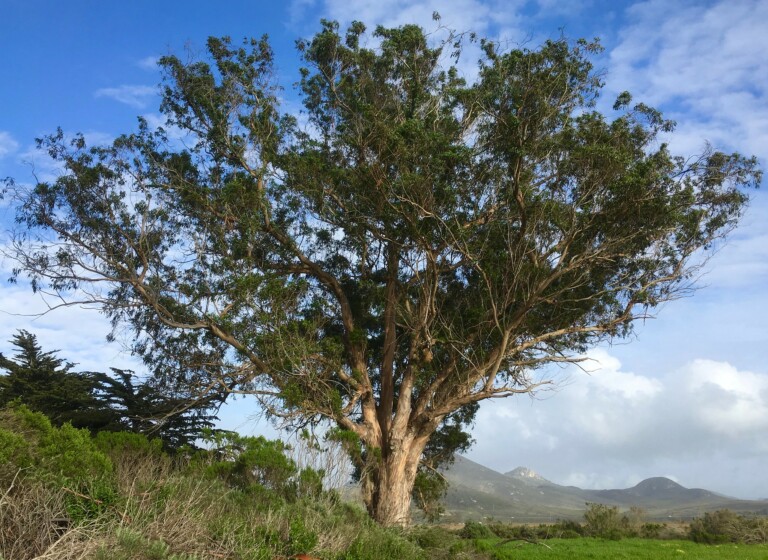
Australian Blackwood is a medium to large evergreen tree native to southeastern Australia including Tasmania. It is grown for clusters of fragrant yellow puff flowers and for strong decorative timber, though it needs room to reach its full size.
Identification
Evergreen foliage and rounded clusters of yellow puff flowers appear in late winter to spring. Mature trees typically reach about 10 to 30 meters tall with a spreading crown roughly 9 to 15 meters across in open plantings. The timber is highly valued which makes the species useful both as an ornamental and a forestry tree.
Where to grow and best uses
Plant Australian Blackwood as a specimen, in a shelterbelt, or for restoration projects where a large evergreen is wanted. It performs best in full sun and tolerates light frost in mild climates. Allow plenty of room for the crown and root system when using it in parks or large gardens.
Planting and spacing
Space trees to allow a mature crown spread of about 30 to 50 feet which translates to roughly 9 to 15 meters between trees. Plant during the cooler part of the year to reduce transplant stress and firm soil carefully around the root ball. Avoid planting where waterlogging is likely.
Soil and light
Well drained soils are preferred but the tree tolerates sandy, loamy and heavier substrates and can establish on poorer sites once established. It accepts a range of pH from mildly acidic to slightly alkaline. Full sun gives the best flowering and form while light shade is tolerated.
Watering and ongoing care
Provide regular water while the tree establishes and expect better drought tolerance after establishment. Avoid waterlogged conditions because poor drainage commonly causes decline. Monitor young trees for root competition from nearby plants and water deeply during extended dry periods to support steady growth.
After flowering and pruning
Prune lightly after flowering to maintain shape and to remove dead wood. Heavy pruning can be done sparingly but will affect timber quality if the tree is grown for wood. Watch for a spreading crown and prune early while branches are easy to manage.
Propagation
Seed propagation usually requires scarification or a hot water treatment to break dormancy. Semi hardwood cuttings can root with an appropriate rooting hormone. Follow a local native plant propagation guide for exact scarification temperatures and timings before large scale sowing.
Controlling spread and root considerations
Seeds can produce volunteers in favourable sites so remove unwanted seedlings to prevent naturalising in small gardens. The tree forms a substantial root system so avoid planting too close to buildings, drains or small garden beds that could be shaded out as the canopy expands.
Containers and urban planting
Australian Blackwood is not well suited to long term container culture because of its eventual height and spread. In urban settings select planting locations with room for a large canopy and consider root barriers if planting near paving or infrastructure.
Frequently asked questions
- How fast does Australian Blackwood grow?
- Growth rate varies with climate and soil. It can grow relatively quickly in warmer climates and more slowly in cooler areas while still reaching a large mature size over time.
- What size does Australian Blackwood reach at maturity?
- Mature trees typically reach about 10 to 30 meters tall with a crown spread around 9 to 15 meters in open plantings, but size depends strongly on site quality and climate.
- What soil and light does it prefer?
- It prefers well drained soils and full sun for best flowering, while tolerating a range of soil types and light frost in mild climates.
- How are seeds propagated?
- Seeds commonly need scarification or hot water treatment to germinate. Consult a local propagation guide for recommended temperatures and timings.
- Is Australian Blackwood poisonous to pets or people?
- Authoritative toxicity information is incomplete. If safety is a concern check with local poison control or veterinary toxicology resources before planting near children or pets.
Related Plants


Mentioned In (1)
Plants
7 Plants That Look Like Eucalyptus
Eucalyptus trees have a distinctive fragrance that is easily recognizable but can be tricky to identify visually. There are several…