
Key Facts
- Native to the Mediterranean basin.
- Adapted to dry, rocky, and calcareous soils.
- Prefers full sun.
- Drought tolerant once established.
- Commonly used for windbreaks, reforestation, and ornamentals in warm temperate climates.
- Reproduces readily from seed.
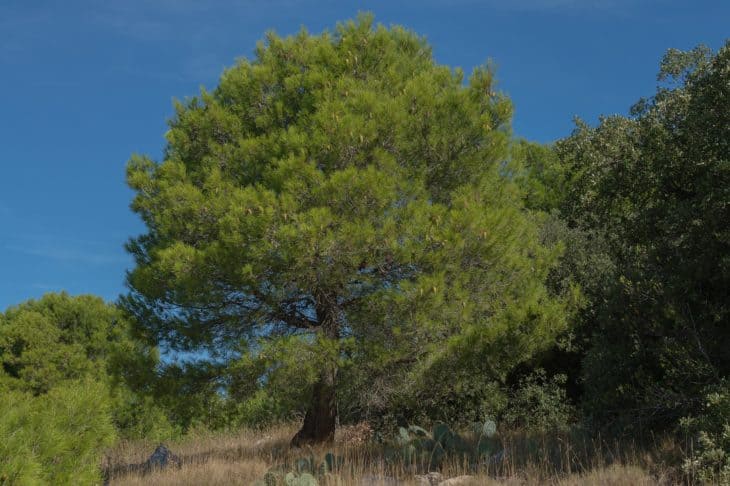
- Forms an open, irregular crown often with a single trunk.
- Cones and pollen are produced in spring in most climates.
Aleppo Pine (Pinus halepensis) is a Mediterranean pine valued for drought tolerance and use in warm temperate landscapes. It prefers full sun and well drained, rocky or calcareous soils and is most reliably grown from seed.
Identification
Aleppo Pine is a medium to large evergreen that commonly forms an open irregular crown with a single trunk. Mature landscape specimens typically reach roughly 50 to 80 feet tall with a spread of about 30 to 40 feet, though cultivated trees may be smaller depending on site stress and pruning. Cones and pollen are usually produced in spring.
Best uses and where to grow
Use Aleppo Pine for windbreaks, reforestation on dry sites, and as an ornamental in warm temperate climates. It is well suited to coastal and Mediterranean-style landscapes roughly matching USDA zones 8 to 10, depending on provenance and local microclimate. Avoid heavy, poorly drained soils to reduce risk of root decline.
Planting and spacing
Space trees roughly 30 to 40 feet apart to accommodate an open crown and mature spread. Plant when weather is cool to reduce transplant stress in warm regions and set the root ball level with the surrounding soil. Apply mulch to conserve moisture but keep it away from direct contact with the trunk to avoid rot.
Soil, light and watering
Aleppo Pine prefers full sun and well drained soils and tolerates poor, rocky, sandy and calcareous conditions, favoring neutral to alkaline pH. Water regularly during the first few seasons to establish roots. Once established the tree is drought tolerant and needs little supplemental irrigation, while poor drainage raises the risk of root decline.
Maintenance and pruning
Maintenance is generally low. Remove dead or crossing branches to maintain health and safety and preserve the tree’s open habit. Prune sparingly to avoid excessive wounds. Be mindful of eventual size when siting near buildings, utilities and paved surfaces.
Propagation and controlling spread
Seed is the reliable propagation method and Aleppo Pine reproduces readily from seed, which can allow naturalizing in similar climates. Cuttings and grafting are possible but difficult and usually done by specialists. To limit unwanted seedlings remove cones before they open or pull seedlings while small.
After cone and pollen season
After spring cone and pollen production there is typically little special care required. Monitor for seedlings if you want to prevent naturalizing and check soil drainage for signs of root decline after wet winters. Routine checks for dead wood and maintaining mulch are sufficient for most landscapes.
Frequently asked questions
- How fast does Aleppo Pine grow?
- Growth rate varies with provenance, soil and climate. In favorable, irrigated sites trees tend to put on steady growth while poor, dry sites slow development. Cultivated specimens often grow more slowly than trees in native stands.
- What are the best planting sites?
- Choose a sunny location with well drained, rocky or sandy soil. It performs well on calcareous sites and in coastal Mediterranean climates roughly corresponding to USDA zones 8 to 10, depending on local conditions.
- How far apart should I plant them?
- Space trees about 30 to 40 feet apart to allow for an open crown and mature spread. Closer spacing will require more regular pruning to manage form and competition.
- Can it naturalize or drop many seeds?
- Yes. Aleppo Pine reproduces readily from seed and can naturalize in similar climates. Remove cones before they release seed and pull seedlings early to limit self-seeding.
- Is Aleppo Pine safe for pets and children?
- Toxicity documentation for this species is limited. Before planting near pets or small children check with local poison control or veterinary sources for the most reliable safety guidance.
Gallery

Related Plants


Mentioned In (1)

Pine
51 Common Types of Pine Trees in North America (photos)
Wherever you go in North America, it is difficult not to see pine trees. These are tall, elegant trees that…