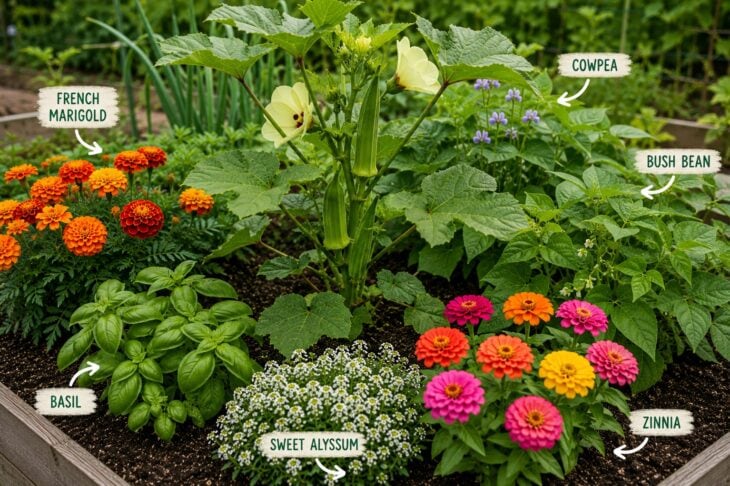
Root-knot nematodes, aphids, and pod-feeding stink bugs are the pressure points that make okra companion planting worth planning carefully. The best companions do not promise magic; they add nematode management, beneficial insect habitat, and warm-season diversity around a crop that needs heat, sun, and clean soil.
Contents
Companion planting for okra matters most because okra is a long-season, heat-loving crop that can sit in the same bed while pest populations build. Aphids can colonize tender growth, stink bugs and leaffooted bugs can distort pods, and root-knot nematodes can weaken the root system before you see much above ground.
The strongest companion roles in this research are soil support for nematode management, beneficial insect attraction for aphids, and warm-season intercropping that keeps the bed more diverse. Pollinator flowers can still help the garden ecosystem, but okra is self-fertile, so flower companions should be treated as insect-support plants rather than a requirement for pod set.
Choose companions that like the same conditions okra does: full sun, warm soil above 65°F (18°C), and well-drained soil around pH 5.8 to 6.8. Avoid crowding the main stems because okra needs airflow, harvest access, and enough space to keep producing pods through summer.
Best companion plants for okra
French marigold (Tagetes patula)
What it helps with
French marigold helps reduce root-knot nematode pressure in beds intended for okra.
Why it works with okra
We recommend dense marigold plantings as part of root-knot nematode management before planting susceptible crops such as okra. Peer-reviewed nematology studies show that Tagetes species can suppress Meloidogyne root-knot nematodes, although cultivar, soil temperature, and active root growth matter. This is one of the stronger evidence-backed companion strategies for okra, especially in beds with a nematode history.
Planting notes
For the strongest effect, plant marigolds densely, no more than 7 inches (18 cm) apart, and grow them for at least 2 months before turning them under. A few scattered flowers beside okra are less likely to affect nematodes meaningfully. If you are growing marigolds at the same time as okra, use them as a dense border in full sun without crowding okra stems.
Possible drawback or limit
Marigolds are not an instant nematode cure. Their effect is strongest as a planned bed-preparation crop, not as a decorative afterthought.
Sweet alyssum (Lobularia maritima)
What it helps with
Sweet alyssum attracts hoverflies and other beneficial insects that can help suppress aphids on okra.
Why it works with okra
Adult hoverflies use small flowers such as sweet alyssum for nectar, while their larvae feed mainly on aphids and other small insects. Since aphids are a common okra pest, alyssum supports the predator side of aphid management. This mechanism is well supported for beneficial insects generally, though not measured as a specific okra yield response.
Planting notes
Plant alyssum in low borders or small patches 8 to 12 inches (20 to 30 cm) from okra rows. Keep it blooming so hoverflies have a steady nectar source. In very hot climates, succession sow or place alyssum where it gets a little afternoon relief without shading okra.
Possible drawback or limit
Sweet alyssum may slow down in intense summer heat, just as okra is hitting peak production. Treat it as part of a broader insectary planting rather than the whole aphid plan.
Basil (Ocimum basilicum)
What it helps with
Basil supports natural enemies of aphids and fits okra’s hot-season growing window.
Why it works with okra
A greenhouse study found that basil improved lacewing colonization and helped aphid populations decline more quickly in tested systems. Okra often faces aphid pressure, so basil is useful as a functional plant for conservation biological control. The evidence supports aphid biocontrol, but the specific okra pairing is an evidence-informed application rather than an okra-only trial.
Planting notes
Plant basil 12 to 18 inches (30 to 45 cm) from okra stems or use it as a border. Harvest basil regularly so it stays compact and does not compete with young okra. Let a few plants flower once okra is established if your goal is beneficial insect support.
Possible drawback or limit
Basil should not be oversold as a direct pest repellent. Its strongest supported role is helping natural enemies, especially where aphids are already part of the system.
Zinnia (Zinnia elegans)
What it helps with
Zinnia brings pollinators and beneficial insects into the okra bed while sharing okra’s full-sun, warm-season conditions.
Why it works with okra
University extension sources describe zinnias as prolific summer bloomers that attract pollinators including bees and butterflies. Okra can set pods without insect pollination, so zinnias are not necessary for fruit set. Their practical value is keeping the vegetable bed active with flower resources that support a broader beneficial-insect community.
Planting notes
Plant zinnias on bed edges or row ends 18 to 24 inches (45 to 60 cm) from okra. Choose shorter or mildew-resistant varieties where humidity is high. Keep enough space between plants so okra leaves and zinnia foliage do not create a stagnant canopy.
Possible drawback or limit
Zinnias can develop powdery mildew where air circulation is poor. Do not tuck them tightly under mature okra.
Bush bean (Phaseolus vulgaris)
What it helps with
Bush beans add legume diversity and can improve soil nitrogen over time when roots and residues are left in the bed.
Why it works with okra
Extension companion-planting guidance notes that legumes can contribute nitrogen to soil over time as root nodules decompose. That makes bush beans useful in a soil-building rotation or mixed summer bed. The benefit is gradual, so do not count on bush beans to feed okra immediately during the same season.
Planting notes
Plant bush beans in adjacent rows or gaps at least 18 inches (45 cm) from okra stems. Keep bean growth low and accessible so it does not interfere with okra harvest. Leave roots in place after harvest where possible so nodules and residues can return organic matter to the soil.
Possible drawback or limit
Same-season nitrogen transfer is often overstated, especially if bean pods and plant residues are removed from the bed. Treat bush beans as a soil-building and diversity tool, not as instant fertilizer.
Cowpea (Vigna unguiculata)
What it helps with
Cowpea provides a heat-tolerant legume partner that can work in okra intercropping systems.
Why it works with okra
Okra-cowpea intercropping studies report productive mixed systems, especially where heat-tolerant summer crops are useful. Cowpea can contribute organic matter and nitrogen-rich residues when managed correctly. The practical benefit depends on spacing, water, and whether residues are returned to the soil.
Planting notes
Use one cowpea row for every 2 okra rows, with 18 to 24 inches (45 to 60 cm) between cowpea growth and okra stems. Keep vines directed away from harvest paths. If cowpea starts climbing into okra, trim it back or switch to a bushier variety next planting.
Possible drawback or limit
Cowpea can compete with okra if spacing is too tight or water is limited. Keep it managed as a companion row, not a vine mass running through the okra crop.
Plants to avoid with okra
Tomato should be kept out of okra beds where root-knot nematodes are a known problem. Tomatoes can also host stink bugs and other fruit-feeding pests that overlap with okra pod damage concerns.
Pepper is another nematode-susceptible crop to avoid near okra in problem beds. Keeping peppers out of the okra rotation helps prevent a continuous sequence of susceptible hosts. This is especially important in warm regions where nematode pressure can build quickly.
Squash can worsen nematode rotation problems. Squash vines also compete for space, light, and airflow around young okra. Keep it in a separate bed when harvest access and nematodes are concerns.
Sweet potato is a poor partner for okra where root-knot nematodes are present. Its spreading vines can make okra harvesting more difficult. Use a separate rotation block instead.