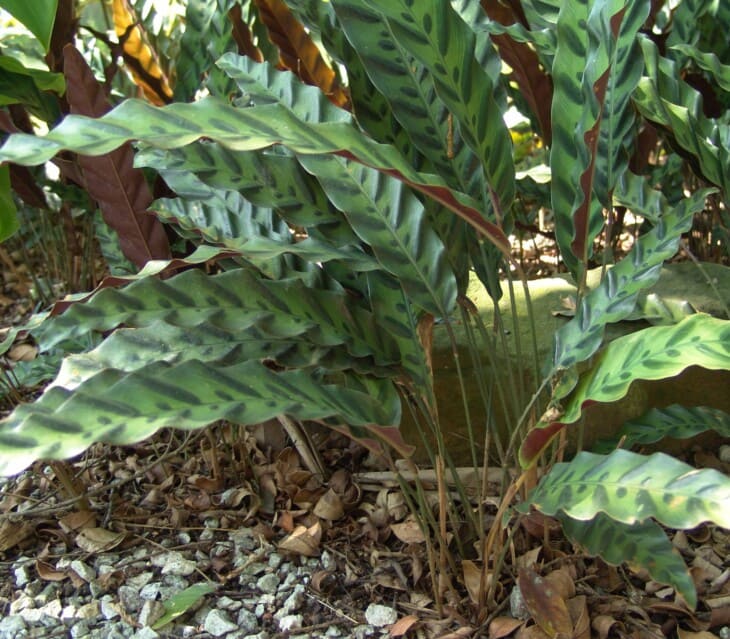
Prayer plants earn their common name from their distinctive leaf movement: the leaf blades fold upward along the midrib at night, resembling hands folded in prayer. During daylight hours, the leaves lie flat and open. They are widely grown as houseplants for their boldly patterned, colorful foliage and compact growth habit.
Contents
Prayer plants belong to the species Maranta leuconeura. They produce broad, oval-shaped leaves with a glossy surface displaying two shades of green. Markings or spots flank the central midrib and may appear in light green, dark green, brown, or charcoal gray. Certain cultivars feature red or pink midribs and veining throughout the leaf.
The leaf undersides range from white to pale green, red, or deep maroon. These undersurface colors become visible when the leaves fold upward at night, adding to the plant’s ornamental appeal.
Prayer plants growing outdoors in tropical climates may produce small white flowers. Indoor specimens rarely bloom under typical household conditions.
Several other houseplants share similar leaf markings, folding behavior, or growth habits with prayer plants.
1. Rattlesnake Plant (Goeppertia insignis)
Read our guide to Rattlesnake Plant

The rattlesnake plant (Goeppertia insignis, formerly Calathea lancifolia) belongs to the Marantaceae family, the same family as prayer plants. It is a herbaceous perennial native to tropical forests in Brazil. Rattlesnake plants typically reach two to three feet in height when mature.
Rattlesnake plants produce evergreen, lance-shaped leaves with distinctive patterning said to resemble a rattlesnake’s markings. The leaves are light green with darker green margins and edges.
A light-colored midrib runs the length of each leaf, flanked by alternating oblong splotches along the lateral veins. These splotches vary in size—one large, one small—creating a pattern that resembles individual leaflets arranged along a stem. The overall effect is striking and geometric.
Rattlesnake plant leaves have a burgundy to purple underside, similar to prayer plants. This coloration becomes visible when the plant folds its leaves upward in the evening. The leaf margins are slightly wavy. Rattlesnake plants may produce small tubular yellow or orange flowers indoors under ideal conditions.
2. Pinstripe Plant (Goeppertia ornata)
Read our guide to Pinstripe Plant

The pinstripe plant (Goeppertia ornata, formerly Calathea ornata) is another member of the Marantaceae family. Like other plants in this group, it is an evergreen herbaceous perennial native to the understory of tropical rainforests in South America. Its large leaves are adapted to capture filtered light beneath the forest canopy.
Pinstripe plants have thick, leathery, oval to lance-shaped leaves with smooth edges. The leaves are deep green to nearly black with a prominent central midrib. Fine white, pink, or cream-colored stripes run from the midrib to the leaf edge. The clarity and width of these pinstripes vary by cultivar, ranging from crisp lines to softer, brushstroke-like markings.
This attractive plant displays a deep purple to maroon underside, visible when the leaves fold upward at night. New leaves emerge tightly rolled, exposing their purple undersides. This creates an eye-catching contrast of purple young leaves against the dark, striped mature foliage.
Pinstripe plants grow two to three feet tall and are commonly grown as houseplants or outdoors in frost-free climates. Native to Colombia and Venezuela, they require warmth, high humidity, and indirect light similar to their rainforest origins.
3. Triostar Stromanthe (Stromanthe thalia ‘Triostar’)

Triostar (Stromanthe sanguinea ‘Triostar’) is a cultivar of a species native to the Brazilian rainforests. It belongs to the Marantaceae family but is in a different genus than Maranta. Triostar grows larger than prayer plants, reaching three to five feet in height indoors.
Like prayer plants, Triostar produces broad, elongated oval leaves with smooth margins. The leaves grow densely along upright stems, creating a full, bushy appearance. The glossy upper leaf surfaces display irregular splashes of dark green, light green, cream, and pale pink.
The underside of Triostar leaves is deep magenta to hot pink. New leaves emerge rolled, showcasing their vibrant pink undersides. The combination of the multicolored upper surfaces and vivid undersides makes Triostar a highly sought-after ornamental plant for indoor containers.
Triostar leaves can grow quite large, often reaching twelve to twenty inches long and four to six inches wide. The plant may produce small white flowers enclosed in red bracts during spring or summer. These flower structures can attract pollinators when grown outdoors in suitable climates.
Triostar spreads slowly via underground rhizomes, which can produce new shoots and allow for propagation by division.
4. Peacock Plant (Goeppertia makoyana)
Read our guide to Peacock Plant

The peacock plant (Goeppertia makoyana, formerly Calathea makoyana) is a herbaceous perennial in the Marantaceae family. Like other members of this group, it is popular as a houseplant and can be grown outdoors in warm, humid, frost-free climates.
Peacock plant leaves resemble prayer plant leaves in shape. They are broad, roughly oval with smooth margins. A clearly defined central midrib anchors the intricate patterning that covers the leaf surface.
The term variegated barely describes the complexity of the peacock plant’s leaf markings. The background color is pale green, cream, or silvery white.
The midrib is medium to dark green, and oval or teardrop-shaped blotches appear along the lateral veins. These blotches alternate in size—large then small—mimicking the appearance of small leaflets. Between the blotches, fine dark green lines radiate outward from the midrib toward the leaf edge.
The underside of the peacock plant leaf mirrors the upper pattern in shades of purple and cream or pale pink. These richly colored undersides are visible when the leaves fold upward at night. New leaves unfurl with their undersides on display, adding to the visual drama. The peacock-like array of colors inspired the plant’s common name.
Peacock plant leaves have a textured surface with slight variations in depth that correspond to the color patterns. The lighter sections of the leaf may appear translucent when backlit, earning the plant the nickname cathedral windows plant. Peacock plant leaves are thinner and more delicate than prayer plant leaves.
Peacock plants typically grow eighteen inches to two feet tall, making them somewhat larger than standard prayer plants.
5. Rose-Painted Calathea (Goeppertia roseopicta)
Read our guide to Rose-Painted Calathea

Rose-painted calathea (Goeppertia roseopicta, formerly Calathea roseopicta) is another member of the Marantaceae family. It is native to the rainforests of Ecuador, Colombia, Peru, and Brazil. It typically grows twelve to twenty inches tall, similar in size to prayer plants.
Rose-painted calathea has broad, dark green to blackish oval or nearly round leaves with slightly wavy margins. Lighter green streaks or bands radiate from the midrib outward, forming loose V-shapes or chevrons.
The midrib is often dark pink or rose-colored. A feathery pink or cream brushstroke pattern follows the leaf outline from base to tip, positioned about three-quarters of the way from the midrib to the edge. This leaves a consistent dark green margin around the leaf perimeter.
Some cultivars have pale green or cream centers bordered by the pink feathering and a dark green margin, creating the illusion of a smaller leaf layered onto a larger one. The undersides of the leaves are deep purple, burgundy, or red.
6. Copperleaf (Acalypha wilkesiana)

Copperleaf (Acalypha wilkesiana) is also called Jacob’s coat or beefsteak plant. It is a fast-growing evergreen shrub native to the South Pacific, including Fiji and surrounding islands. Copperleaf plants can reach six to ten feet tall and spread four to six feet wide in warm climates.
The leaves are large—four to eight inches long—with serrated edges and a slightly crinkled texture. They display mottled or splashed colors, including shades of green, yellow, orange, copper, red, burgundy, purple, pink, and white, often in combinations on a single leaf.
Copperleaf plants produce inconspicuous flowers. Male flowers grow on slender, upright spikes, while female flowers appear on shorter, less noticeable spikes.
Copperleaf plants require consistent moisture and perform best with regular watering. They can be grown indoors in bright light or outdoors in frost-free climates with adequate water and humidity.