
Key Facts
- Deciduous shade tree valued for outstanding fall color.
- Native to temperate Asia.
- Drought tolerant once established.
- Adaptable to a wide range of soils including clay and alkaline sites.
- Male and female flowers occur on separate trees.
- Produces small clustered drupes that attract birds.
- Best performance in full sun.
Chinese Pistache is a medium deciduous shade tree grown for drought tolerance and one of the best fall color displays among street trees. It adapts to a wide range of soils and is most striking when planted in full sun.
Identification
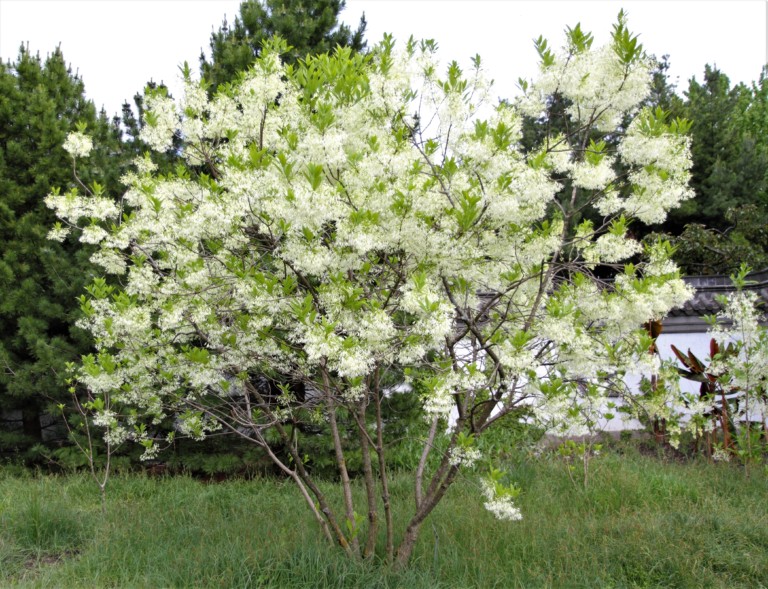
Chinese Pistache is a rounded tree native to temperate Asia that reaches roughly 20 to 40 feet tall with a similar broad canopy. It bears small yellow-green flowers in spring and produces clusters of small drupes that attract birds. The main ornamental feature is bright autumn foliage rather than showy flowers.
Best uses and siting
Plant Chinese Pistache as a specimen, shade tree, or street tree where a broad crown is wanted and roots have room to spread. It performs well in full sun and tolerates clay and alkaline soils that challenge many other trees. Avoid poorly drained spots where root decline can occur.
Planting and spacing
Set trees in the cooler part of the growing season to reduce transplant stress and give roots time to establish. Space trees according to the expected mature canopy, generally 20 to 35 feet between trunks. Do not plant deeper than the root flare and avoid sites that remain waterlogged.
Watering and after-flowering care
Chinese Pistache becomes drought tolerant once established but needs regular deep watering during the first two to three years to develop a strong root system. After flowering prune sparingly to maintain structure and remove crossing branches. Monitor for decline in wet soils and reduce irrigation if signs of root stress appear.
Pests, problems and climate notes
Few major pests commonly threaten Chinese Pistache but poor drainage raises the risk of root rot and decline. In cooler climates winter dieback and slower establishment are possible. Choose planting sites and cultivars suited to your USDA hardiness zone which is generally reported as zone 6 through 9.
Propagation and cultivars
Grow Chinese Pistache from seed when rootstock variability is acceptable. Named cultivars are preserved by grafting or vegetative methods such as cuttings. Seedlings can vary in form so grafting is usual when uniform appearance or specific traits are desired.
Frequently asked questions
- How fast does Chinese Pistache grow?
- Growth rate is variable. Trees tend to grow faster with warmer temperatures, regular moisture during establishment and good soil. Final mature height commonly falls between 20 and 40 feet.
- When does Chinese Pistache bloom?
- It blooms in spring with small yellow-green flowers. Bloom is generally brief and not the main ornamental feature of the tree.
- Is Chinese Pistache drought tolerant?
- Yes. Once established it tolerates dry conditions, but young trees need regular deep watering for the first couple of years to avoid stress and encourage root development.
- How far apart should I plant Chinese Pistache?
- Space trees about 20 to 35 feet apart to allow for the typical mature canopy spread and to reduce future crowding.
- Will the fruits attract wildlife?
- Yes. The tree produces small clustered drupes that commonly attract birds.
Related Plants


Mentioned In (3)

Trees
37 Most Common Trees in Texas
Texas is located in the Southernmost region of the United States and is bordered by New Mexico and other Mexican…
Trees
26 Most Common Trees in Oklahoma
The state of Oklahoma has many different ecoregions, including spruce-fir forests in the mountains, mesophytic forests in the eastern highlands,…

Trees
30 Most common Trees in Georgia
The North American state of Georgia lies in the southeastern region of the United States of America. As a whole,…