
Key Facts
- Deciduous to semi deciduous ornamental tree with standout golden trumpet shaped flowers.
- Native to eastern and central Brazil and planted widely as a specimen tree.
- Flowers appear before or with leaf flush producing a dramatic display.
- Attracts pollinators such as bees and hummingbirds.
- Prefers full sun and well drained soils.
- Tolerates drought once established but does not tolerate waterlogged soil.
- Commonly propagated by seed and by cuttings.
- Used as a street and specimen tree in warm temperate to tropical climates.
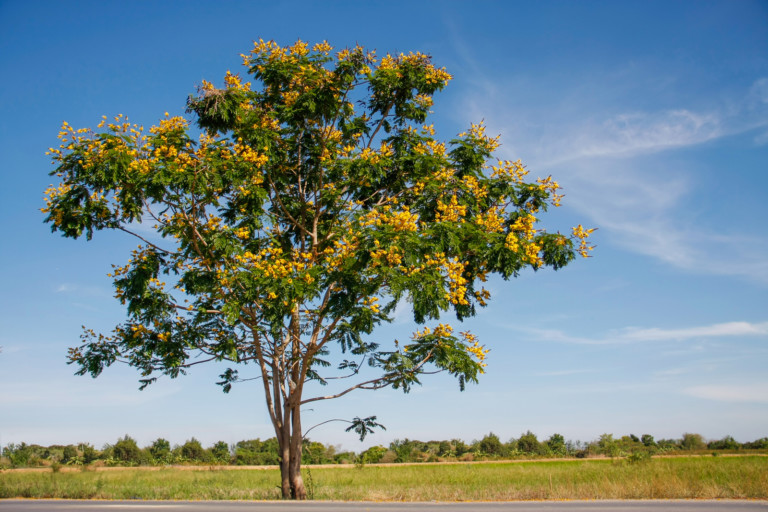
The Golden Trumpet Tree (Handroanthus chrysotrichus) is a medium deciduous to semi deciduous ornamental valued for masses of golden trumpet shaped flowers that appear before or with the leaf flush. It is planted as a specimen or street tree in warm temperate to tropical climates and draws bees and hummingbirds.
Identification
Handroanthus chrysotrichus is recognizable by its showy golden trumpet flowers and a small to medium tree habit. Leaves drop at least partially before flowering in many climates producing a brief, dramatic bloom display. The species is native to eastern and central Brazil and is commonly grown as a specimen.
Where to grow and best uses
Grow this tree in warm temperate to tropical settings where winter cold is mild. It performs best in full sun for the most reliable flowering and is commonly used as a specimen or street tree. Avoid low, poorly drained sites that encourage root decline and reduced flowering.
Size and spacing
Mature specimens commonly reach about 20 to 40 feet tall with a similar crown spread often 20 to 35 feet. Space trees at roughly the mature spread to allow a broad crown to develop without crowding sidewalks or structures. Urban sites may produce narrower crowns with pruning.
Soil and watering
The tree prefers well drained soils from sandy to loamy with average fertility. It tolerates drought once established but will suffer in waterlogged soil. Poor drainage leads to root decline and fewer flowers. Water regularly through the first two seasons to establish a deep root system and then reduce frequency.
Blooming and seasonal care
Blooms typically appear in late winter to spring in subtropical climates with flowers often preceding or coinciding with new leaves. Exact timing varies by local climate and hemisphere. Protect young trees from hard frost in marginal areas and allow the canopy to develop before heavy pruning that would remove next season’s flower wood.
After-flowering pruning and growth control
Prune lightly after flowering to maintain structure and remove dead or crossing branches. Pruning can limit spread and keep the tree suitable for street or smaller garden sites. Avoid heavy pruning during the bud formation window or you may reduce next season’s bloom display.
Propagation
Propagation by seed is common and generally reliable for this species. Vegetative methods such as stem cuttings or air layering are used when cultivar traits need to be retained, though cutting success varies with climate and timing. Consult local extension guides for rooting hormone and timing recommendations.
Containers and urban planting
Used frequently as a street and specimen tree in warm climates, the Golden Trumpet Tree can be grown in a large container while young but eventually outgrows pots as it reaches medium tree size. In urban planting allow room for a broad crown and choose sites with good drainage and full sun exposure.
Frequently asked questions
- How fast does Golden Trumpet Tree grow?
- Growth rate varies by climate and care. In favorable warm sites the tree reaches about 20 to 40 feet tall; establish roots with regular watering and expect moderate growth to reach mature size over several years.
- When does the tree bloom?
- Blooms occur in late winter to spring in subtropical climates with flowers appearing before or with new leaves. Exact months vary by local climate and hemisphere.
- Is the Golden Trumpet Tree drought tolerant?
- Yes it tolerates drought once established but does not tolerate waterlogged soil. Poor drainage reduces flowering and can cause root decline.
- Can it be used as a street tree?
- Yes it is commonly used as a street and specimen tree in warm temperate to tropical climates when given full sun and well drained soil.
- What is the easiest way to propagate it?
- Propagation by seed is the most common and reliable method. Cuttings and air layering are possible for vegetative propagation but success depends on timing and local conditions.
Related Plants


Mentioned In (2)

Trees
33 Most Common Trees in Los Angeles
Los Angeles may be a sprawling metropolis, but it's not without its natural beauty. In fact, the city is home…
Trees
24 Yellow Flowering Trees in Spring
Do you want to beautify your garden with distinctive, bright yellow flowering trees that bloom in spring? Well, you will…