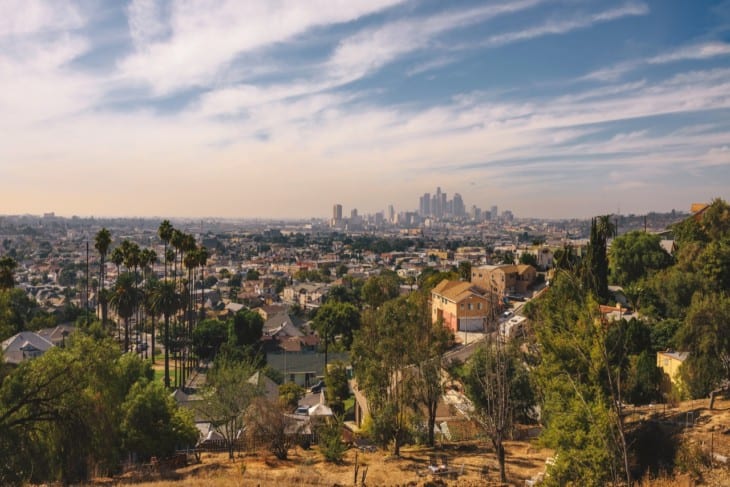
The most common trees in Los Angeles are street and yard trees from other warm-climate countries: jacaranda, coral tree, Indian laurel fig, camphor, southern magnolia, Canary Island pine, crape myrtle and the tall Mexican fan palms that line the city’s boulevards. The main native trees are coast live oak, California sycamore, toyon, western redbud and Southern California black walnut, in the canyons and foothills of the Santa Monica, San Gabriel and Verdugo mountains. The coral tree is the official tree of the City of Los Angeles, and toyon is its official native plant.
Contents
- Flowering Street and Yard Trees
- Jacaranda (Jacaranda mimosifolia)
- Coral Tree (Erythrina caffra)
- Floss Silk Tree (Ceiba speciosa)
- Tipu Tree (Tipuana tipu)
- Gold Medallion Tree (Cassia leptophylla)
- Golden Trumpet Tree (Handroanthus chrysotrichus)
- Purple Orchid Tree (Bauhinia variegata)
- Crape Myrtle (Lagerstroemia indica and hybrids)
- Chinese Flame Tree (Koelreuteria bipinnata)
- Chitalpa (× Chitalpa tashkentensis)
- Desert Willow (Chilopsis linearis)
- Silk Oak (Grevillea robusta)
- Bronze Loquat (Eriobotrya deflexa)
- Marina Strawberry Tree (Arbutus ‘Marina’)
- Shade and Evergreen Street Trees
- Indian Laurel Fig (Ficus microcarpa)
- Moreton Bay Fig (Ficus macrophylla)
- Camphor Tree (Cinnamomum camphora)
- Carob (Ceratonia siliqua)
- Evergreen Ash (Shamel Ash) (Fraxinus uhdei)
- Lemon-Scented Gum (Corymbia citriodora)
- River Red Gum (Eucalyptus camaldulensis)
- Ginkgo (Ginkgo biloba)
- Southern Magnolia (Magnolia grandiflora)
- Norfolk Island Pine (Araucaria heterophylla)
- Deodar Cedar (Cedrus deodara)
- Canary Island Pine (Pinus canariensis)
- Palms
- Native Trees of Los Angeles
- Planting a Tree in Los Angeles
Los Angeles has a Mediterranean climate, with mild, wet winters, long, dry summers and almost no frost near the coast. That lets people grow trees from Australia, South America, South Africa and Asia that wouldn’t survive anywhere else in the continental U.S. Many of them are spectacular in flower, but some were planted in the wrong places. Big figs and ashes have cracked sidewalks all over the city, and the old palms are nearing the end of their lives.

- Flowering Street and Yard Trees
- Shade and Evergreen Street Trees
- Palms
- Native Trees of Los Angeles
- Planting a Tree in Los Angeles
| Tree | Botanical name | Native to | Height |
|---|---|---|---|
| Jacaranda | Jacaranda mimosifolia | Argentina, Bolivia | 25–40 ft |
| Coral Tree | Erythrina caffra | South Africa | 30–50 ft |
| Floss Silk Tree | Ceiba speciosa | Brazil, Argentina | 30–50 ft |
| Tipu Tree | Tipuana tipu | Bolivia, Argentina | 30–50 ft |
| Gold Medallion Tree | Cassia leptophylla | Brazil | 20–25 ft |
| Golden Trumpet Tree | Handroanthus chrysotrichus | Brazil | 25–30 ft |
| Purple Orchid Tree | Bauhinia variegata | India, China, Southeast Asia | 20–35 ft |
| Crape Myrtle | Lagerstroemia indica and hybrids | China, Korea, Southeast Asia | 15–25 ft |
| Chinese Flame Tree | Koelreuteria bipinnata | China | 20–40 ft |
| Chitalpa | × Chitalpa tashkentensis | Garden hybrid | 20–30 ft |
| Desert Willow | Chilopsis linearis | Southwestern deserts, including Southern California | 15–25 ft |
| Silk Oak | Grevillea robusta | Eastern Australia | 50–80 ft |
| Bronze Loquat | Eriobotrya deflexa | Taiwan, southern China, Vietnam | 15–25 ft |
| Marina Strawberry Tree | Arbutus ‘Marina’ | Garden hybrid | 25–40 ft |
| Indian Laurel Fig | Ficus microcarpa | Southern Asia, Australia | 40–60 ft |
| Moreton Bay Fig | Ficus macrophylla | Eastern Australia | 60–80 ft |
| Camphor Tree | Cinnamomum camphora | China, Japan, Taiwan | 40–60 ft |
| Carob | Ceratonia siliqua | Eastern Mediterranean | 30–40 ft |
| Evergreen Ash (Shamel Ash) | Fraxinus uhdei | Mexico, Central America | 50–80 ft |
| Lemon-Scented Gum | Corymbia citriodora | Eastern Australia | 75–100 ft |
| River Red Gum | Eucalyptus camaldulensis | Australia | 80–120 ft |
| Ginkgo | Ginkgo biloba | China | 40–60 ft |
| Southern Magnolia | Magnolia grandiflora | Southeastern U.S. | 40–80 ft |
| Norfolk Island Pine | Araucaria heterophylla | Norfolk Island (South Pacific) | 60–100 ft |
| Deodar Cedar | Cedrus deodara | Himalayas | 50–80 ft |
| Canary Island Pine | Pinus canariensis | Canary Islands | 50–80 ft |
| Mexican Fan Palm | Washingtonia robusta | Baja California, Sonora | 80–100 ft |
| California Fan Palm | Washingtonia filifera | Desert oases of Southern California and Arizona | 40–60 ft |
| Canary Island Date Palm | Phoenix canariensis | Canary Islands | 40–60 ft |
| Coast Live Oak | Quercus agrifolia | Coastal California | 30–70 ft |
| California Sycamore | Platanus racemosa | California, Baja California | 40–80 ft |
| Western Redbud | Cercis occidentalis | California and the Southwest | 10–20 ft |
| Toyon | Heteromeles arbutifolia | California, Baja California | 6–15 ft |
| Southern California Black Walnut | Juglans californica | Southern California | 15–30 ft |
Flowering Street and Yard Trees
Jacaranda (Jacaranda mimosifolia)
Jacaranda is the tree that turns Los Angeles purple in late spring. From May into June its bare or nearly bare branches are covered in clusters of lavender-blue, bell-shaped flowers, and the fallen flowers carpet streets and cars. It has fern-like leaves and flat, round, woody seed pods. It grows 25 to 40 feet tall and wide, needs full sun and is fairly drought tolerant once established. Fallen flowers are sticky, so it is best planted away from driveways and pools.
Coral Tree (Erythrina caffra)

The coral tree was named the official tree of the City of Los Angeles in 1966. It is a broad, spreading tree, 30 to 50 feet tall and often wider, with thick, thorny branches and leaves of three broad leaflets. In late winter and early spring it drops its leaves and covers its bare branches in clusters of red-orange flowers. The best-known planting is the long row of coral trees in the median of San Vicente Boulevard in Brentwood. It needs lots of room and little water in summer: heavy watering makes the branches brittle. The seeds are poisonous.
Floss Silk Tree (Ceiba speciosa)

The floss silk tree has a bulging green trunk covered in thick, cone-shaped thorns. In fall, from about September to November, it drops many of its leaves and covers itself in large, pink, hibiscus-like flowers. Its pear-shaped pods split open to release seeds wrapped in fluffy, cotton-like floss. It grows 30 to 50 feet tall and wide, so it needs a big yard or park. Keep the spiny trunk away from paths where children play.
Tipu Tree (Tipuana tipu)

The tipu is a fast-growing shade tree with a wide, spreading, umbrella-shaped crown and leaves of many small leaflets. In late spring and early summer it is covered in apricot-yellow, pea-shaped flowers, followed by winged seed pods. It is a common street and parking-lot tree in Los Angeles. Since the late 2000s, many trees have been infested by the tipu psyllid, a small insect that drips sticky honeydew on cars and sidewalks below.
Gold Medallion Tree (Cassia leptophylla)

The gold medallion tree is a small, fast-growing, semi-evergreen tree that covers itself in large, bright yellow flower clusters in summer, from about July to September, when few other trees are in flower. Long, dark brown bean pods follow. It grows 20 to 25 feet tall and wide, suits smaller yards and parkways, and needs full sun and well-drained soil.
Golden Trumpet Tree (Handroanthus chrysotrichus)

The golden trumpet tree is a small, open tree that flowers in late winter and early spring, when it loses its leaves and covers its bare branches in clusters of bright yellow, trumpet-shaped flowers. The flowers last only a few weeks, but they make it one of the showiest trees in the city at that time of year. It grows 25 to 30 feet tall and needs full sun and regular summer water.
Purple Orchid Tree (Bauhinia variegata)

The purple orchid tree has unusual two-lobed leaves shaped like a butterfly or a camel’s hoof, and fragrant, orchid-like flowers in pink, purple or white from late winter into spring. Long, flat seed pods follow. It is semi-deciduous and grows 20 to 35 feet tall. The Hong Kong orchid tree (Bauhinia × blakeana), a sterile hybrid with larger, rose-purple flowers in fall and winter, is also planted around Los Angeles.
Crape Myrtle (Lagerstroemia indica and hybrids)

Crape myrtle is one of the most common small trees in Los Angeles yards and parkways. In summer it is covered in crinkled flowers in pink, red, lavender or white, and in fall some varieties have red or orange leaves. It has smooth, peeling bark in winter. It grows 15 to 25 feet tall and is drought tolerant once established. Near the coast, choose mildew-resistant hybrids, which have Native American tribal names such as ‘Natchez’ and ‘Tuscarora’.
Chinese Flame Tree (Koelreuteria bipinnata)

The Chinese flame tree has large, finely divided leaves and, in late summer, clusters of small yellow flowers. It is best known for what follows in fall: papery, lantern-shaped seed pods in salmon-pink to rose, which cover the tree for weeks and look like flowers from a distance. It grows 20 to 40 feet tall and tolerates heat, drought and poor soil. It drops a lot of seed and can seed itself into gardens.
Chitalpa (× Chitalpa tashkentensis)

Chitalpa is a hybrid of the southern catalpa and the desert willow, first bred in Tashkent, Uzbekistan. It combines the drought tolerance of desert willow with larger, frilly, trumpet-shaped flowers in pink, lavender or white, which it produces all summer. It grows 20 to 30 feet tall with narrow leaves. It is prone to leaf spot and can look ragged by late summer.
Desert Willow (Chilopsis linearis)

Desert willow isn’t a willow. It is a small, often multi-trunked tree in the catalpa family, native to desert washes in the Mojave and Colorado deserts and across the Southwest. It has long, narrow, willow-like leaves and, from late spring to fall, fragrant, trumpet-shaped flowers in pink, lavender or white that attract hummingbirds, followed by long, thin seed pods. It is deciduous and very drought tolerant, a good choice for water-wise gardens in the hotter inland valleys.
Silk Oak (Grevillea robusta)

Silk oak is a tall, fast-growing evergreen with fern-like, silvery-green leaves and, in spring, one-sided, comb-like clusters of golden-orange flowers full of nectar. It isn’t an oak but a relative of banksias and proteas. It grows 50 to 80 feet tall and has brittle wood that breaks in wind, so it is best in parks, not next to houses. Its leaves and flowers can cause a rash in sensitive people.
Bronze Loquat (Eriobotrya deflexa)

Bronze loquat is a small evergreen tree grown for its new leaves, which come out a bright coppery-red before turning green. In spring it has clusters of small white flowers, followed by small fruit that is less tasty than the regular loquat. It grows 15 to 25 feet tall and is often planted as a street tree under power lines. It is prone to fireblight, which blackens shoot tips.
Marina Strawberry Tree (Arbutus ‘Marina’)

‘Marina’ is a hybrid strawberry tree, first grown in San Francisco. It has smooth, peeling, cinnamon-red bark like its native relative, the madrone. From fall to spring it has hanging clusters of pink, urn-shaped flowers, followed by round, bumpy red fruit that birds eat. It grows 25 to 40 feet tall and is evergreen, drought tolerant once established and a good tree for smaller yards and parkways. The dropped fruit is messy on paving.
Shade and Evergreen Street Trees
Indian Laurel Fig (Ficus microcarpa)

Indian laurel fig was one of the most widely planted street trees in Los Angeles in the mid-20th century. It is a dense, rounded evergreen with small, glossy, oval leaves that can be clipped into hedges and formal shapes. It has aggressive surface roots, which have lifted and cracked miles of sidewalks across the city. It is no longer recommended as a street tree, and new plantings should be kept at least 20 feet from paving and pipes.
Moreton Bay Fig (Ficus macrophylla)

Moreton Bay fig is a huge evergreen with large, leathery, dark green leaves, a massive buttressed trunk and roots that snake across the ground for many yards. Old trees can be much wider than they are tall. It is planted in parks and large estates in Southern California, and some of the oldest were planted in the 1800s. It is far too big for a normal yard.
Camphor Tree (Cinnamomum camphora)

Camphor is a broad, dense evergreen shade tree with glossy, light green leaves that smell of camphor when crushed. The new spring growth is bronze-red, and in fall it produces small black berries. It is a common street tree in older Los Angeles neighborhoods and grows 40 to 60 feet tall and wide. Its roots can damage sidewalks, and the fallen berries stain paving. It is invasive in Florida.
Carob (Ceratonia siliqua)

Carob is a dense, rounded evergreen with glossy, leathery leaves divided into round leaflets. Female trees produce long, dark brown pods that are ground into carob powder, a chocolate substitute, and male trees have flowers with an unpleasant smell. It is very drought tolerant and has been planted as a street tree in Los Angeles for over a century. The fallen pods are messy, so choose a male tree for parkways.
Evergreen Ash (Shamel Ash) (Fraxinus uhdei)

Shamel ash, also called evergreen ash, was a popular Los Angeles street tree in the mid-1900s because it grows fast and stays mostly green in winter. It has leaves divided into five to nine glossy leaflets and grows 50 to 80 feet tall. Its roots lift sidewalks, and its wood is weak, so it is no longer recommended for streets. The smaller Himalayan ash (Fraxinus griffithii) is also sold as evergreen ash.
Lemon-Scented Gum (Corymbia citriodora)

Lemon-scented gum is a tall, slender eucalyptus with a smooth, powdery white to pinkish trunk and a light, open crown of narrow leaves that smell strongly of lemon when crushed. It is one of the most elegant eucalyptus trees in Los Angeles parks and large gardens, and it grows fast to 75 to 100 feet tall. Like other eucalyptus trees, it can drop large limbs without warning, especially in hot, still weather after watering.
River Red Gum (Eucalyptus camaldulensis)

River red gum is one of the eucalyptus trees planted widely across California in the late 1800s and early 1900s for timber and windbreaks. It has a thick trunk with smooth, mottled white, gray and tan bark and long, narrow leaves. It grows 80 to 120 feet tall, drops large branches and has seeded itself along some Southern California streams. It is too big and brittle for most yards.
Ginkgo (Ginkgo biloba)

Ginkgo is a living fossil, the only survivor of a group of trees that dates back more than 200 million years. It has fan-shaped leaves that turn bright gold in fall, even in the mild Los Angeles climate, and it tolerates heat, smog and poor soil. It grows 40 to 60 feet tall. Plant only male trees: female trees drop fleshy seeds with a strong smell of rancid butter.
Southern Magnolia (Magnolia grandiflora)
Read our guide to Southern Magnolia

Southern magnolia lines many Los Angeles streets, from Beverly Hills to the San Fernando Valley. It is a large evergreen with glossy, leathery leaves, often rusty brown underneath, and huge, fragrant, creamy white flowers from late spring through summer. Street trees grow 40 to 80 feet tall. For smaller yards, ‘Little Gem’ stays 20 to 25 feet tall. Its large leaves drop all year and are slow to break down.
Norfolk Island Pine (Araucaria heterophylla)

Norfolk Island pine isn’t a true pine. It comes from Norfolk Island, a small island between Australia and New Zealand, and has a perfectly symmetrical shape with flat tiers of branches covered in soft, curved needles. Small ones are sold as indoor Christmas trees. Outdoors in coastal Los Angeles it grows 60 to 100 feet tall, towering over the older houses and apartment buildings where it was planted decades ago.
Deodar Cedar (Cedrus deodara)

Deodar cedar is a large conifer with soft, blue-green needles in clusters, drooping branch tips and a broad, pyramid shape. It grows 50 to 80 feet tall. The best-known deodars in the Los Angeles area line Christmas Tree Lane, a mile of Santa Rosa Avenue in Altadena planted in 1885 and lit up for the holidays since 1920. It needs plenty of room and tolerates drought once established.
Canary Island Pine (Pinus canariensis)
Canary Island pine is one of the most common pines in Los Angeles streets, parks and schoolyards. It has long, drooping needles, 9 to 12 inches long, in bundles of three, a narrow shape when young and an open, rounded crown when old. It grows 50 to 80 feet tall and is very drought tolerant. In its native islands it survives wildfires by resprouting from its trunk.
Palms
The palms that define the Los Angeles skyline are mostly Mexican fan palms planted in the 1920s and 1930s. Palms give little shade, and many of these old trees are dying, so the city now favors shade trees for new street plantings.
Mexican Fan Palm (Washingtonia robusta)

Mexican fan palm is the very tall, very thin palm that lines streets across Los Angeles. It has a slender, slightly curving trunk, a small head of bright green, fan-shaped leaves and a “skirt” of dead leaves if they aren’t trimmed. It grows fast to 80 to 100 feet tall. It seeds itself into streams and canyons, where it crowds out native plants, and a skirt of dead leaves is a fire hazard and a home for rats.
California Fan Palm (Washingtonia filifera)

California fan palm is the only palm native to California. In the wild it grows only around springs and oases in the Colorado Desert, such as the palm canyons near Palm Springs, not along the coast. It is shorter and much stouter than the Mexican fan palm, 40 to 60 feet tall, with gray-green leaves that have white threads hanging from their edges. It is often planted along Los Angeles streets and in parks.
Canary Island Date Palm (Phoenix canariensis)

The Canary Island date palm has a thick trunk with a diamond pattern of old leaf bases and a huge, round crown of long, feather-like leaves. The base of each leaf has long, sharp spines. It is planted along grand avenues and in parks. Its dates aren’t worth eating. Many trees are dying from Fusarium wilt, a fungal disease spread on pruning tools, so tools should be disinfected between trees.
Native Trees of Los Angeles
The City of Los Angeles protects its native oaks, western sycamores, California bay laurels and Southern California black walnuts, and since 2021 also toyon and Mexican elderberry. You need a permit to remove or damage one, even on private land.
Coast Live Oak (Quercus agrifolia)

Coast live oak is the defining native tree of the Los Angeles hills and canyons. It is an evergreen oak with a broad, spreading crown of twisted limbs and small, cupped, holly-like leaves with spiny edges. It grows 30 to 70 feet tall and wider, and old trees can live for centuries. Established oaks shouldn’t be watered in summer or have lawn planted under them, because summer water causes root rot.
California Sycamore (Platanus racemosa)

California sycamore, or western sycamore, grows along streams and in canyons throughout Los Angeles County. It has striking bark that peels in patches of white, cream, tan and gray, large, deeply lobed leaves and round, bristly seed balls hanging in chains of two to seven. It grows 40 to 80 feet tall, often with leaning, twisting trunks. Since the early 2010s, many sycamores have been attacked by the invasive shot hole borer beetles.
Western Redbud (Cercis occidentalis)
Read our guide to Western Redbud

Western redbud is a small, often multi-trunked tree or large shrub of dry slopes and foothills. In early spring, before the leaves, its branches are covered in small, bright magenta, pea-like flowers, followed by rounded, heart-shaped leaves and flat, purple-red seed pods. It grows 10 to 20 feet tall and is very drought tolerant. It flowers best inland, where winters are cooler.
Toyon (Heteromeles arbutifolia)

Toyon was named the official native plant of Los Angeles in 2012, and Hollywood is often said to be named after its red-berried hillsides. It is an evergreen shrub or small tree with leathery, toothed leaves, flat clusters of small white flowers in early summer and big clusters of bright red berries in winter that feed robins, cedar waxwings and mockingbirds. It grows 6 to 15 feet tall and is very drought tolerant.
Southern California Black Walnut (Juglans californica)

Southern California black walnut is a small tree, often with several trunks, that grows on hillsides and in canyons from Santa Barbara to the San Gabriel Mountains. It has leaves divided into 11 to 19 leaflets and small, round nuts with very thick, hard shells. It is found only in Southern California, and much of its woodland habitat has been lost to development, so it is protected in the City of Los Angeles.
Planting a Tree in Los Angeles
- Free trees: the City Plants program gives free street and yard trees to residents of the City of Los Angeles, and will plant street trees for you.
- Street trees need a permit: planting, pruning or removing a tree in the parkway between the sidewalk and the street requires a permit from StreetsLA’s Urban Forestry Division.
- Choose for your parkway: in narrow parkways and under power lines, choose small trees such as western redbud, bronze loquat, crape myrtle or gold medallion tree, not figs, ashes or palms.
- Water deeply and rarely: most of the trees on this list need regular deep watering for the first two or three summers, then only occasional watering. Water native oaks only while young.
For trees across the rest of the state, see our guide to trees of California, and for the desert, trees of Arizona.