
Key Facts
- Native to eastern Australia.
- Evergreen to semi-evergreen tree in the myrtle family.
- Notable rough, fibrous bark on older trunks and branches.
- White clustered flowers appear in spring.
- Leaves are opposite and lance shaped.
- Attracts nectar feeding birds and insects.
- Propagated by seed and by cuttings with seed usually easiest.
Rough-Barked Apple is a medium to tall Australian native tree used in larger gardens and landscape plantings where its rough trunk bark and white spring flowers can be appreciated. It provides nectar for birds and insects but needs room for a broad canopy and a substantial root system.
Identification
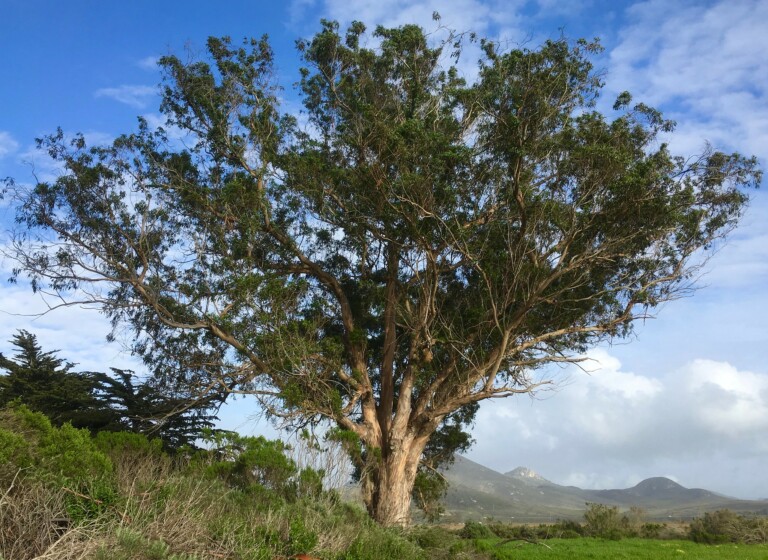
A medium to tall evergreen to semi-evergreen tree in the myrtle family native to eastern Australia. Older trunks and branches develop rough fibrous bark that defines the species. Leaves are opposite and lance shaped and spring brings clusters of white flowers that attract nectar feeding birds and insects.
Where to grow and best uses
Use this tree as a specimen, shade tree or in larger streetscapes where space permits. It suits parks and large gardens that can accommodate a broad canopy and open root area. The spring flowers make it a good choice where wildlife value is desired, provided mature size will not crowd structures or small plantings.
Planting and timing
Plant in spring or the local warm season to aid establishment. Set the root ball so the top of the root mass sits level with surrounding soil and firm the backfill to remove air pockets. Space young plants so mature canopy widths of about 20 to 65 feet 6 to 20 meters do not conflict with buildings or other trees.
Soil light and watering
Prefers well drained soils from loam to clay and does not tolerate waterlogging. Give full sun for best flowering while it will tolerate light shade. Water regularly during establishment until roots spread, then reduce frequency and avoid prolonged wet soil which will harm root health.
After flowering care and pruning
Prune young trees to develop a strong trunk and balanced scaffold branches. Light thinning after flowering improves airflow and reduces weight on heavy limbs. Remove dead or damaged wood as needed and avoid heavy late season pruning that could stress new growth.
Propagation
Propagate by seed or by vegetative cuttings. Seed is generally the easiest method for most growers. Semi-hardwood cuttings are used to clone selected plants but often require rooting hormone and careful handling to achieve consistent success.
Control and landscape considerations
Plan for a large mature canopy and substantial root spread when siting this tree. Avoid planting too close to foundations, paving or small garden beds where roots and trunk expansion will cause conflicts. Monitor for pests and fungal issues and consult local authorities for region specific advice.
Frequently asked questions
- How fast does Rough-Barked Apple grow?
- Growth rate varies by soil moisture and fertility. In favorable sites it can grow steadily and reach typical mature sizes of roughly 10 to 30 meters over many years.
- Is Rough-Barked Apple suitable for small gardens?
- No. The tree develops a broad canopy and large roots so it is not recommended for small yards or tight spaces.
- When does it flower?
- It flowers in spring. In the southern hemisphere this is roughly September to November and in the northern hemisphere roughly March to May, varying with local climate.
- How do I propagate Rough-Barked Apple?
- Use seed for the simplest propagation route. Semi-hardwood cuttings can produce clones of selected plants but tend to be slower and need careful rooting conditions.
- Is this tree safe for pets and children?
- There are no widely cited authoritative reports of major toxicity, but the species contains aromatic oils that can irritate sensitive individuals. Avoid ingestion and prolonged skin contact and check local poison control guidance for specifics.
Related Plants


Mentioned In (1)
Plants
7 Plants That Look Like Eucalyptus
Eucalyptus trees have a distinctive fragrance that is easily recognizable but can be tricky to identify visually. There are several…