
Key Facts
- Small bulbous perennial that blooms in late winter to early spring.
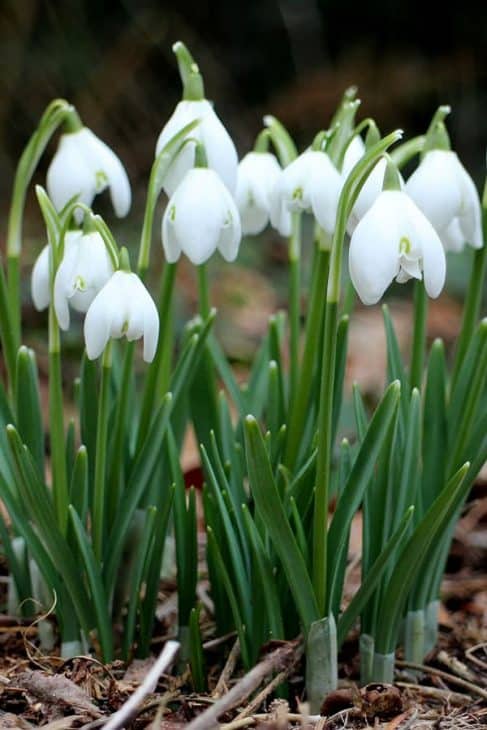
- Nodding white bell shaped flowers often marked with green.
- Naturalizes by forming colonies from bulb offsets.
- Prefers cool, moist sites with good organic matter.
- Does well planted under deciduous trees and shrubs.
- Tolerates a range of soils if they are not waterlogged.
- Contains alkaloids and is considered poisonous if eaten.
- Propagated easily by dividing bulbs and available from seed.
Snowdrops (Galanthus nivalis) are small bulbous perennials that bloom in late winter to early spring with nodding white bell shaped flowers often marked with green. They naturalize into colonies in cool, moist sites and are most often used as a spring groundcover under deciduous trees and shrubs.
Identification
Snowdrops are 3 to 6 inches tall with single nodding white, bell shaped flowers frequently showing green markings on the inner tepals. The plant grows from a bulb and has narrow grass like leaves. Bloom occurs in late winter to early spring, forming tidy clumps that expand over time by bulb offsets.
Best uses and where to grow
Use snowdrops for naturalizing drifts, spring interest at the front of borders and under deciduous trees where they get spring light then shade. They perform well in planting schemes that need early season groundcover and do best in cool, moist sites with good organic matter rather than hot dry locations.
Planting and timing
Plant bulbs in autumn in temperate climates so roots establish before winter. Space bulbs about 2 to 4 inches apart to allow clumps to form; individual spread per bulb is roughly that range. Follow supplier guidance for planting depth or match the bulb to the soil level to avoid planting too shallow or too deep.
Soil, light and watering
Snowdrops prefer moist, humus rich and well drained soil and tolerate a range of soils provided they are not waterlogged. They thrive in partial to full shade and tolerate sun only where soils remain cool and moist. Keep soil evenly moist while plants are active and avoid prolonged waterlogging which leads to bulb rot.
After flowering care and propagation
Leave foliage to yellow and die back naturally so bulbs can replenish energy for next year. Increase established drifts by dividing bulbs after flowering and replanting clumps. Seed propagation is possible but slow; seed raised plants typically take several years to reach flowering size.
Controlling spread and common problems
Snowdrops naturalize by forming colonies from offsets and will slowly expand into drifts. Control spread by lifting and dividing clumps if they encroach where not wanted. Bulbs are prone to rot in waterlogged soil and contain alkaloids that make all parts poisonous if ingested, so keep bulbs away from children and pets and consult local poison control for emergencies.
Frequently asked questions
- How fast does Snowdrops grow?
- Snowdrops multiply slowly by bulb offsets and form larger clumps over several years rather than spreading overnight. Growth to a substantial drift typically takes multiple seasons.
- When do Snowdrops bloom?
- They bloom in late winter to early spring. In the Northern Hemisphere this is roughly January to March and in the Southern Hemisphere roughly July to September, with local variation by climate and cultivar.
- Are Snowdrops poisonous?
- Yes. Snowdrops contain biologically active alkaloids and all parts can cause vomiting and other symptoms if eaten. Keep plants and bulbs away from children and pets.
- Can I grow Snowdrops under trees?
- Yes. They do well under deciduous trees and shrubs where spring light reaches them before the canopy leafs out and soils remain cool and moist.
- How do I propagate Snowdrops?
- Divide bulbs after flowering to increase drifts quickly. Seed can be used but seed raised plants usually take several years to flower.
Gallery

Related Plants


Mentioned In (2)
Plants
9 Plants That Look Like Lily of the Valley
Have you ever experienced the irresistible charm of the lily of the valley? This attractive groundcover is a hard match…

Plants
10 Plants That Look Like Bells
Bell-shaped flowers add graceful elegance to any garden, and they appear across a surprisingly wide range of plants—from delicate spring…