
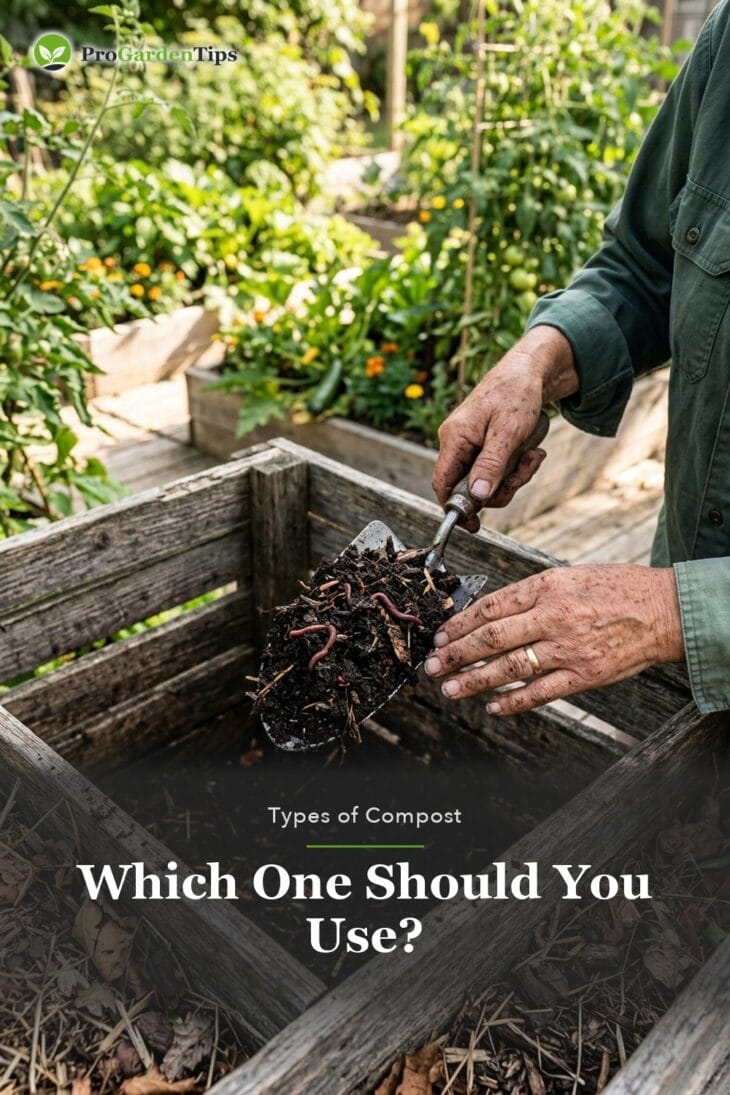
Search for “types of compost” and you get two different questions answered at once. Half the results explain composting methods — aerobic, anaerobic, vermicomposting, bokashi. The other half talk about the bags on the shelf at the garden center. If you are standing in front of those bags trying to work out which one your soil actually wants, that first group is no help at all.
Contents
- Quick comparison: seven types of compost
- Garden compost (the ordinary kind)
- Worm compost (vermicompost)
- Leaf mold (leaf compost)
- Manure compost
- Mushroom compost
- Peat-free compost
- Ericaceous compost
- Why a compost heap gets hot
- Using compost on a lawn
- How to compost fallen leaves
- What should never go in a compost heap
- So which one should you use?
This guide answers the second question. Seven kinds of compost, what each one is made from, what it is genuinely good at, and — the part most guides skip — when it will do more harm than good. Mushroom compost will quietly kill your rhododendrons. Fresh manure will burn your seedlings. Leaf mold will not feed anything. Knowing which is which is most of the battle.
Quick comparison: seven types of compost
| Type | Made from | Best for | Watch out for |
|---|---|---|---|
| Garden compost | Kitchen and garden waste you rot down yourself | General soil improvement — the everyday workhorse | Takes 6–12 months. Needs turning |
| Worm compost | Food scraps digested by worms (vermicompost) | Seedlings, potting mixes, a concentrated nutrient boost | Small volumes only. No meat, dairy or citrus |
| Leaf mold | Fallen leaves, rotted down on their own | Soil conditioning, moisture retention, mulch | Barely feeds anything. Takes 1–2 years |
| Manure compost | Livestock manure, aged for months | Hungry crops — brassicas, pumpkins, roses | Must be well rotted. Fresh manure burns plants |
| Mushroom compost | Spent mushroom substrate: straw, manure, chalk | Heavy clay soil, brassicas, tomatoes (calcium) | Alkaline and salty. Never near acid-loving plants |
| Peat-free compost | Coir, bark, wood fibre, composted green waste | Almost everything. The responsible default | Dries out faster. Usually needs feeding sooner |
| Ericaceous compost | An acidic mix, low pH by design | Blueberries, camellias, azaleas, rhododendrons | Only for acid-lovers. Wasted on anything else |
Garden compost (the ordinary kind)
This is the compost you make yourself: kitchen scraps and garden waste piled up and left to rot into dark, crumbly, sweet-smelling material. It is the most useful thing in the garden and it costs nothing.
The whole trick is the ratio of browns to greens. Browns are the dry, carbon-rich things — dead leaves, twigs, shredded paper, cardboard. Greens are the wet, nitrogen-rich things — grass clippings, vegetable peelings, coffee grounds. Aim for roughly three or four parts brown to one part green. Too many greens and you get a slimy, stinking heap. Too many browns and it just sits there doing nothing for a year.
Good things to add: coffee grounds, eggshells, fruit and vegetable scraps, grass clippings, leaves and pine needles, shredded paper, corrugated cardboard, tea bags, and dead plants as long as they were not diseased.
It needs three things to work: material, moisture and air. Turn it every few weeks to get air in, keep it about as damp as a wrung-out sponge, and it will be ready in six to twelve months. You will know it is done when you can no longer identify what went in.
Worm compost (vermicompost)
Worm compost is what comes out the back end of a worm. Food scraps go in, worms eat them, and the castings they leave behind are one of the richest soil amendments you can get hold of — high in nitrogen, phosphorus and potassium, and full of the microorganisms that make soil work.
It is a different proposition from a compost heap. You are keeping livestock. The worms you want are red wigglers, not the earthworms from your garden, and they live in a shallow bin rather than a deep pile. Give them bedding of shredded paper or cardboard, keep it moist and dark, and feed them scraps a little at a time.
What they will not eat: meat, dairy, oily food, and anything strongly acidic like large amounts of citrus. Overfeed them and the bin turns sour and starts to smell, which is the one failure mode to watch for.
Because it is so concentrated, worm compost is not something you spread by the wheelbarrow. Use it as a top dressing, mix a handful into planting holes, or blend it into a potting mix at around 10 to 20 percent. It is at its best with seedlings and container plants.
Leaf mold (leaf compost)
Leaf mold is what you get when you leave a pile of fallen leaves alone for long enough. It is not really compost in the usual sense — it is made by fungi working slowly and cold, rather than by bacteria working fast and hot, which is why it takes so long.
Be clear about what it does. Leaf mold is a soil conditioner, not a fertilizer. It holds water, it opens up heavy soil, it makes a superb mulch and a good seed-sowing medium. What it will not do is feed your plants — the nutrient content is low. If you are hoping for a growth spurt, this is the wrong material.
It is also the easiest compost there is to make, because you do almost nothing. Pile the leaves up, or stuff them into a trash bag with a few holes punched in it, keep them damp, and wait. One year gives you a rough, usable mulch. Two years gives you the fine, dark, crumbly stuff worth waiting for. Shredding the leaves first — running the mower over them works — will speed it up considerably.
Manure compost
Manure compost is livestock muck that has been left to rot down for several months until it is dark, crumbly and no longer smells of anything much. Properly composted, it is one of the best all-round soil improvers you can put on a vegetable patch — good for hungry crops like brassicas, pumpkins and roses.
The word “properly” is doing a lot of work in that sentence. Fresh manure is far too high in ammonia and will scorch roots and foliage — it burns plants rather than feeding them. Give it at least three to six months, covered with a tarp to stop the rain washing the nutrients out, and turn it occasionally. If it still smells strongly of ammonia, it is not ready.
Which animal matters. Horse, cow and chicken manure are the usual choices. Chicken is the strongest and the most likely to burn, so it needs the longest rotting. Horse manure often carries weed seeds, since horses do not digest them. Never use manure from cats, dogs or pigs — it can carry parasites that transfer to humans.
One modern warning worth taking seriously: manure from animals fed on treated pasture can carry aminopyralid herbicide residues straight through the gut and into your compost, where they will deform or kill tomatoes, beans and potatoes. If you are buying manure in, ask.
Mushroom compost
A common misunderstanding first: mushroom compost is not made of mushrooms, and it is not for growing mushrooms at home. It is the substrate left over after a commercial mushroom crop has been harvested — which is why it is often sold as “spent mushroom compost”. Mushroom farms have a great deal of it and sell it cheaply.
It is typically made from straw and horse or chicken manure, sterilized, with chalk or limestone added. That last ingredient is the key to everything that follows: it makes the finished compost alkaline, and it is also fairly high in soluble salts.
Used in the right place, it is excellent. It breaks up heavy clay, holds moisture well, and the calcium content genuinely helps with blossom end rot in tomatoes. Brassicas love the lime. It is a good, cheap way to add bulk organic matter to a tired vegetable bed.
Used in the wrong place, it does real damage. Keep it well away from anything that likes acid soil — rhododendrons, azaleas, camellias, blueberries, heathers. The lime raises the pH and the salt content stresses them, and you can lose established shrubs this way. It is also too salty for most seedlings. If your soil is already alkaline, you probably want to skip mushroom compost altogether.
Peat-free compost
Peat-free compost is simply potting compost made without peat moss — built instead from coir, composted bark, wood fibre, green waste or a blend of them.
The reason to care is that peat bogs are one of the most effective carbon stores on the planet, and they are extremely slow to form — a peat bog accumulates roughly about a millimeter a year. Digging one up to fill grow bags releases carbon that took millennia to lock away, and destroys a rare habitat in the process. Peat is a genuinely good growing medium, which is exactly why it was used for so long. That is not really the point any more.
Peat-free behaves a little differently and it is worth knowing how. It tends to drain faster and dry out sooner, so it needs watering more attentively — and the surface can look dry while it is still wet underneath, which catches people out. It also holds less nutrient reserve, so container plants will want feeding a few weeks earlier than you are used to.
Quality varies more than with peat, so it is worth finding a brand that suits you rather than writing the whole category off after one bad bag.
Ericaceous compost
Ericaceous compost is an acidic compost, made deliberately low in pH for plants that cannot take lime. If you are growing blueberries, rhododendrons, azaleas, camellias, heathers or Japanese maples in pots, this is the compost they need — in ordinary compost they will yellow between the leaf veins and slowly fail.
It is the exact opposite of mushroom compost, and the two should never be confused. For the full picture, see our guide to what ericaceous compost is and when to use it.
Why a compost heap gets hot
A working compost heap generates its own heat. That is not a curiosity, it is the whole process: billions of bacteria breaking down organic matter give off heat as they work, and a heap that is warm in the middle is a heap that is doing its job. A cold heap is a heap that has stalled.
The useful range is roughly 130 to 160°F (55 to 70°C). In that band the thermophilic bacteria are working fast, and it is hot enough to kill most weed seeds and pathogens — which is precisely why hot composting is worth the effort.
Above about 160°F you have a problem, not a success. The heat starts killing the microorganisms doing the work, and the process slows down rather than speeding up. Turn the heap to let the heat out and get air in. Very large piles can, rarely, get hot enough to be a genuine fire risk — this is a real phenomenon in commercial windrows, not a gardener’s myth.
If it will not heat up at all, it is almost always one of three things: not enough nitrogen (add greens — grass clippings, kitchen scraps), not enough moisture (it should feel like a wrung-out sponge), or simply not enough bulk. A heap much smaller than about a cubic yard struggles to hold its own heat, which is why small bins rarely get properly hot.
Using compost on a lawn
Compost is very good for grass, and top dressing is one of the most underrated things you can do for a tired lawn. Spread a thin layer — a quarter to half an inch, no more — and work it in with the back of a rake so the grass blades are not buried. Any thicker and you will smother what you are trying to help.
It works especially well combined with overseeding: the compost gives the new seed something to germinate into and holds moisture around it. On a patchy lawn, compost plus seed will fill bare areas far better than seed alone.
Timing matters. Do it in early fall or mid spring, when the grass is actively growing and can grow up through the dressing. Do not top dress in the height of summer or in the depths of winter. Make sure the compost is well rotted and screened — lumps of half-finished material will kill patches of grass underneath them.
How to compost fallen leaves
Every fall the garden fills up with leaves, and every fall people put them out with the trash. It is free soil conditioner and it is worth keeping.
The simplest possible bin: drive four stakes into the ground in a square, wrap chicken wire around them, and secure it. That is it. It does not need a base, a lid or a door. Put it somewhere out of the way but not so far that you will resent walking to it.
Rake the leaves up and — this is the step that matters most — shred them before they go in. Running the lawnmower over the pile is the easiest way. Whole leaves mat together into airless layers and can take two years or more; shredded leaves have far more surface area and rot down much faster.
Fill the bin, water it if the leaves are dry, and then leave it alone. Check it every month or so and add water if it has dried out. If you want to speed it up further, mix in some grass clippings for nitrogen and turn it a couple of times a year — that turns leaf mold into something closer to true compost.
What should never go in a compost heap
Meat, fish and bones. They rot slowly, they smell, and they will bring rats.
Dairy, oils and fats. Same problem.
Cat and dog waste. It can carry parasites that survive composting and transfer to humans. Livestock manure is fine; carnivore waste is not.
Diseased plants. A domestic heap rarely gets hot enough for long enough to reliably kill the pathogen, so you risk spreading it around the garden with the finished compost.
Perennial weed roots — bindweed, couch grass, ground elder. They will survive, and you will be planting them out with your compost.
Coal ash, treated or painted wood, and anything glossy or heavily printed.
So which one should you use?
If you are improving soil generally, use garden compost or well-rotted manure. If you are filling pots and seed trays, buy peat-free. If your soil is heavy clay, mushroom compost is cheap and effective — unless you are growing acid-lovers, in which case it is the one thing you must not use. If you are feeding blueberries or camellias, use ericaceous. If you have a bag of leaves and some patience, make leaf mold. And if you want the single richest amendment available and have somewhere to keep a bin, keep worms.
Most gardens end up using two or three of these. There is no single best compost — only the right one for what you are trying to grow.