
Key Facts
- Annual wildflower native to eastern North America.
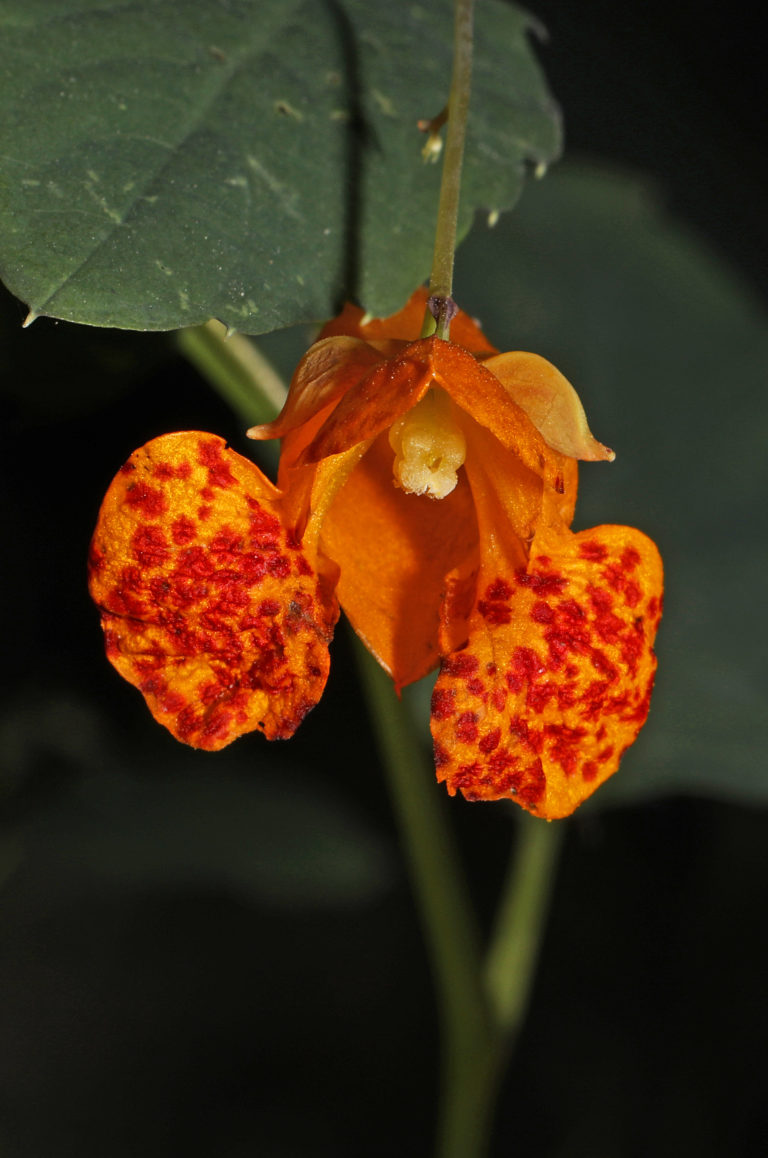
- Produces orange to yellow tubular flowers often spotted with red or orange.
- Ripe seedpods rupture on contact and eject seeds several feet.
- Prefers moist shaded sites such as streambanks, wet woods, and ditches.
- Attracts hummingbirds and bees.
- Spreads readily by self-seeding and can form dense colonies.
- Leaves are ovate with toothed margins and succulent stems.
Spotted Touch-Me-Not, Impatiens capensis, is an annual wildflower of moist shaded places with orange to yellow tubular flowers often spotted with red. It is useful for naturalizing streambanks and wet shade where quick cover and pollinator flowers are desired, but it self-seeds readily and can form dense colonies.
Identification
Plants grow about 2 to 4 ft tall in favorable moist sites, with ovate toothed leaves and succulent stems. Flowers are tubular and orange to yellow, frequently marked with red or orange spots. Ripe seedpods rupture on touch and eject seeds several feet, which produces new seedlings nearby.
Where to grow and best uses
Best planted in part shade to full shade and in rich consistently moist to wet soils. Typical sites include streambanks, wet woods and roadside ditches. Use it for naturalizing damp shady margins, creating a quick pollinator patch for hummingbirds and bees, or filling low wet spots where other ornamentals struggle.
Planting and propagation
Propagates primarily by seed. Seed pods burst and propel seed, so sow seed directly where you want plants to appear or transplant nursery seedlings into moist beds. It will reseed on its own and expand a patch over successive seasons.
Watering and soil
Requires consistently moist to wet soil to stay vigorous, and tolerates poorly drained sites. In drier soils plants become sparse and flower less. It can tolerate more sun only where soil moisture remains high.
After flowering and control
To limit spread remove or destroy seedpods before they ripen. Hand pulling young volunteers and cutting plants back before seeds form reduces reseeding. Where a dense colony is unwanted mow or clear the area after flowering to remove seed production.
Growing range and caution
Plants commonly establish from seed across USDA zones 3 to 9, with survival as seed through winter in colder zones. Sap can cause skin irritation in some people, so handle plants with gloves if sensitive and check an authoritative poison control source for pet or human ingestion guidance.
Frequently asked questions
- How fast does Spotted Touch-Me-Not grow?
- In moist shaded sites plants can reach the 2 to 4 ft range within a single season and generate many seedlings by the first flowering, so patches can expand quickly.
- When does it bloom?
- Blooms summer into early fall, generally July to October in the Northern Hemisphere, with exact timing varying by local climate.
- Will it tolerate sun?
- It tolerates sun only if soil moisture stays high. Best performance is in part shade to full shade.
- How do I stop it from taking over?
- Remove seedpods before they ripen, pull seedlings and cut plants back after flowering to reduce seed set and recruitment.
- Is it toxic to pets or people?
- Not widely listed as highly toxic, but sap can cause skin irritation in some individuals. Confirm pet and human toxicity with a local poison control source.
Related Plants


Mentioned In (4)
Plants
24 Poisonous Plants in Alabama
There are dangers lurking in the world of toxic plants, even those that look harmless. Many plants contain poisons that…

Plants
15 Poisonous Plants in New England
When handled or eaten, many of the exotic and native plants in our area can affect minor irritation or even death if…

Plants
14 Poisonous Plants in New York
You may find a variety of plants lurking in backyards, fields, forested areas, and hiking trails throughout New York. While…
Plants
22 Poisonous Plants in Ohio
Ohio is home to some of the most interesting and unique wildflowers as well as some of the most dangerous…