
Key Facts
- Compact trailing perennial grown mainly as a houseplant.
- Small round leaves have a tortoise shell pattern of light and dark green.
- Native to tropical South America and adapted to humid forest understories.
- Forms mats or long trailing stems suitable for hanging baskets.
- Produces slender, inconspicuous flower spikes typical of peperomias.
- Prefers bright indirect light and will tolerate lower light with slower growth.
- Needs a well draining potting mix and is susceptible to root rot if kept waterlogged.
- Considered non toxic to cats and dogs by common pet safety references.
String Of Turtles (Peperomia prostrata) is a compact trailing Peperomia prized for tiny round leaves patterned like a tortoise shell. It works well in hanging pots or on a high shelf indoors and needs bright indirect light plus a free draining potting mix to avoid root rot.
Identification
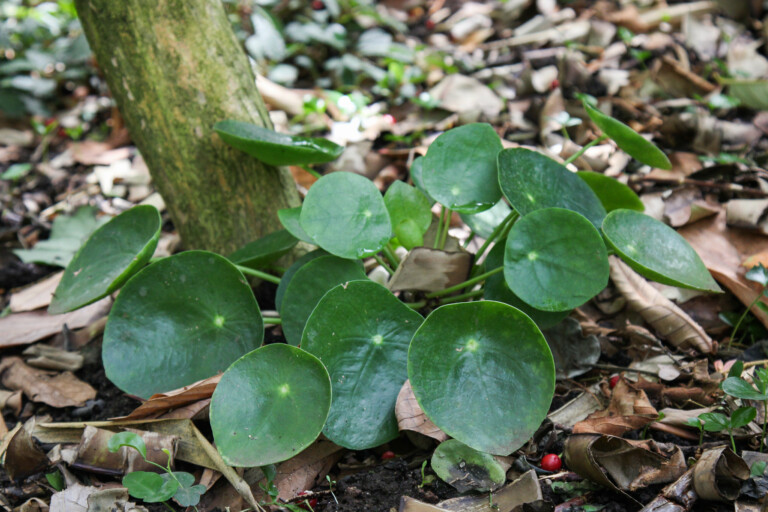
Peperomia prostrata has very small round leaves with a mottled light and dark green pattern and forms low mats or long trailing stems. Trailing stems commonly reach about 12 to 24 inches when mature in a hanging pot. Flowers are slender pale spikes that are inconspicuous and not the plant’s main feature.
Best uses and where to grow
This species is primarily an indoor ornamental and excels in hanging baskets or as a shelf plant where its trails can be seen. Outdoors it is appropriate only in warm frost free climates roughly USDA 10 to 12. In cooler regions keep it as a houseplant and move outdoors only when nights stay reliably warm.
Light and location
Place the plant in bright indirect light for best leaf contrast and growth. It tolerates lower light but will grow more slowly and produce less dense mats. Avoid prolonged direct sun which can scorch the thin leaves and cause brown patches.
Soil and watering
Use a light well draining potting mix or soilless blend with peat or coco coir plus perlite or bark to improve drainage. Keep the mix slightly moist but never waterlogged because excess moisture leads to root rot and yellowing or collapse of foliage. Allow the top of the soil to dry a little between waterings to reduce rot risk.
Containers and propagation
String Of Turtles performs well in shallow pots and hanging baskets that provide good drainage. It is easy to propagate from stem cuttings or leaf cuttings and will root in water or a moist, well draining medium. High humidity and warm temperatures speed rooting and establishment.
After flowering and maintenance
Flower spikes are small and sporadic so after flowering there is little special care required. Pinch or trim stray spikes and prune leggy stems to encourage a denser mat. Divide or pot up when the plant becomes crowded to refresh the mix and maintain vigor.
Controlling spread and naturalizing
Trailing stems can be pruned to control length and keep the plant tidy in containers. The species is typically confined to pots and is not known to aggressively naturalize in temperate gardens. Regular pruning and occasional division are effective ways to manage size and shape.
Frequently asked questions
- How fast does String Of Turtles grow?
- Growth is slow to moderate indoors. Trailing stems may reach 12 to 24 inches when mature under good light and care, but leaf canopy remains low.
- Is String Of Turtles toxic to pets?
- Peperomia species are reported non toxic to cats and dogs by common pet safety references. Avoid ingestion and contact your local poison control for any animal exposure concerns.
- Can I grow it outdoors?
- Grow outdoors only in warm frost free zones about USDA 10 to 12. In colder climates keep the plant indoors and move it outside only when temperatures are consistently warm.
- How do I propagate String Of Turtles?
- Propagate by stem cuttings, leaf cuttings or division. Cuttings root readily in water or a moist, well draining medium and will establish faster with warm temperatures and higher humidity.
- How often should I water?
- Allow the top of the potting mix to dry slightly between waterings. Avoid keeping the soil soggy because prolonged wet conditions lead to root rot and decline.
Related Plants


Mentioned In (1)
Plants
10 Plants That Look Like Pilea Peperomioides (Chinese Money Plant)
Pilea peperomioides got its common name, the Chinese money plant, from its leaves which are round and shaped like coins.…