Companion planting can significantly improve the health and yield of your tomato plants, but choosing the right partners is key to success. In this guide, we will discuss some of the top companion plants for tomatoes and explain why they work well together.
Tomatoes are frequently grown in garden beds, raised boxes, and large containers. They are susceptible to several growing challenges, including pests like hornworms and aphids, fungal diseases, and high space requirements.
When selecting companion plants for tomatoes, you need plants that deter insects, improve soil conditions, or use available space efficiently without competing for nutrients.
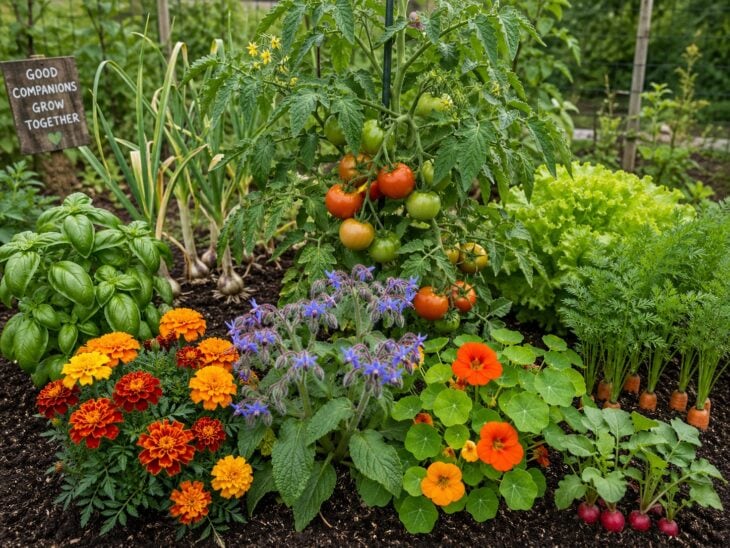
If space is limited, adding carrots and lettuce can maximize your overall harvest. Map out your garden beds before planting, ensuring that each plant has the space, sunlight, and water it needs to reach maturity.
Below, you will find a list of companion plants for tomatoes, each presented as a main section. Each listing provides a summary of its functional benefit, a practical explanation for why it works with tomatoes, detailed planting notes, and specific drawbacks to consider.
Herbs
Herbs are functional plants that may help with scent-based pest deterrence while taking up minimal garden space.
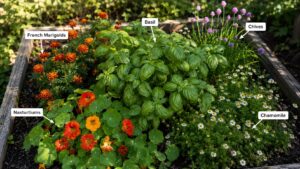
Basil
What it helps with
Basil is used primarily to deter pests and attract pollinators when allowed to flower.
Why it works with tomatoes
The strong scent of basil masks the smell of tomato plants, which may make it difficult for pests like tomato hornworms and aphids to locate their target. It shares the same requirements for heat, water, and sunlight as tomatoes.
Planting notes
Plant basil 12 to 18 inches away from the base of the tomato plant. It can be planted as a border or interspersed between individual tomato plants.
Possible drawback or limit
Basil requires frequent harvesting or pruning to prevent it from bolting and going to seed early in the season.
Garlic
What it helps with
Garlic is planted to repel pests through its strong odor.
Why it works with tomatoes
The sulfur compounds in garlic deter spider mites and aphids, which frequently target tomato leaves.
Planting notes
Garlic should be planted in separate pockets near the tomatoes rather than directly in the same root zone. It requires full sun and well-draining soil.
Possible drawback or limit
Garlic is usually planted in the fall and harvested in early summer. Harvesting garlic requires digging up the bulbs, which can disturb the root systems of established tomato plants if planted too closely.
Flowers
Flowers are grown mainly to attract pollinators or beneficial insects. This is a good option when your tomatoes benefit from insect activity for better fruit set.
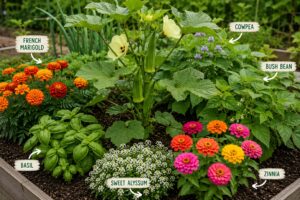
Marigolds
What it helps with
Marigolds are planted to control soil-borne pests.
Why it works with tomatoes
The roots of French marigolds release a chemical compound called alpha-terthienyl. This compound suppresses root-knot nematodes, a microscopic soil pest that damages tomato roots and limits water uptake.
Planting notes
Plant marigolds along the borders of the tomato bed or directly between rows. They require full sun and moderate watering.
Possible drawback or limit
While marigolds deter nematodes, their foliage can attract spider mites during prolonged periods of hot, dry weather.
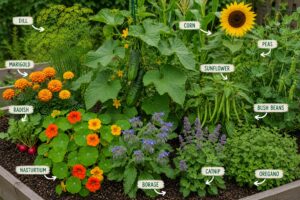
Borage
What it helps with
Borage is used to attract pollinators and beneficial predatory insects.
Why it works with tomatoes
Borage produces star-shaped blue flowers that draw bees and parasitic wasps. Parasitic wasps are a natural predator of the tomato hornworm, laying their eggs on the pest and ultimately killing it.
Planting notes
Plant borage near the ends of tomato rows. It grows up to two feet tall and requires space to spread.
Possible drawback or limit
Borage self-seeds aggressively. If the flowers are left to drop seeds, borage can become a weed in the garden the following year.
Nasturtium
What it helps with
Nasturtium serves as a trap crop for pests.
Why it works with tomatoes
Aphids and whiteflies prefer the taste of nasturtium over tomatoes. By planting nasturtium nearby, pests are drawn away from the main crop.
Planting notes
Plant nasturtium 18 to 24 inches away from tomato plants. It tolerates poor soil and acts as a sprawling ground cover.
Possible drawback or limit
Because it acts as a trap crop, the nasturtium plants may become heavily infested and die back. They must be removed if the pest population becomes too large.
Vegetables
Vegetable companions share similar growing conditions or help utilize nearby space efficiently.
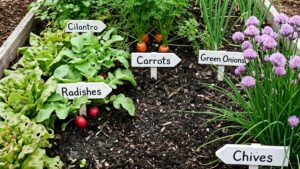
Carrots
What it helps with
Carrots improve the use of vertical space in garden beds.
Why it works with tomatoes
Tomatoes have deep, spreading roots and tall above-ground growth, while carrots grow downward into the soil with low top foliage. They occupy different physical spaces, allowing you to maximize yield in a single bed.
Planting notes
Sow carrot seeds directly into the soil between tomato rows. Carrots require loose, well-draining soil.
Possible drawback or limit
If the tomatoes grow too dense, they can block sunlight from reaching the carrot tops, which may stunt the growth of the carrot roots.
Lettuce
What it helps with
Lettuce acts as a living ground cover.
Why it works with tomatoes
Lettuce stays low to the ground and features broad leaves that shade the soil. This shading reduces weed growth and holds moisture in the ground. In return, the taller tomato plants provide afternoon shade that protects the lettuce from harsh sunlight.
Planting notes
Plant lettuce under the canopy of the tomato plants, leaving enough space near the base of the tomato for air circulation.
Possible drawback or limit
Lettuce requires more frequent, shallow watering than tomatoes. It will also bolt and turn bitter when temperatures remain consistently above 80 degrees Fahrenheit.
Radishes
What it helps with
Radishes are used for rapid harvest and soil loosening.
Why it works with tomatoes
Radishes grow quickly and are typically harvested within 30 days. Planting them near young tomatoes helps loosen the topsoil before the tomato roots expand into the area.
Planting notes
Sow radish seeds early in the season around the base of newly transplanted tomatoes.
Possible drawback or limit
If radishes are left in the ground too long, they will compete with the growing tomato roots for space and nutrients.