
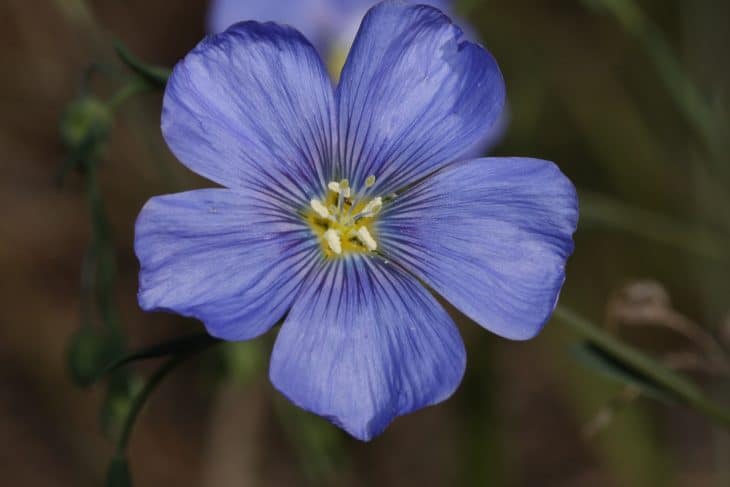
Blue is one of the rarest flower colors in nature—and it’s also a longtime favorite with gardeners. That sense of rarity is part of the appeal. Adding blue perennials can cool down hot color palettes, brighten shaded areas, and bring a fresh look to classic borders. Below is an extensive list of perennials that bloom in shades of blue.
Contents
- Blue Flowering Perennials
- 1. Monkshood (Aconitum Carmichaelii “Arendsii”)
- 2. Lily of the Nile (Agapanthus Africanus“Stevie’s Wonder”)
- 3. Pyramidal Bugle (Ajuga pyramidalis “Metallica Crispa Purpurea”)
- 4. Blue Star (Amsonia “Blue Ice”)
- 5. Amsonia tabernaemontana “Storm Cloud”
- 6. Bush Clematis “Stand by Me”
- 7. Ceanothus papillosus
- 8. Centaurea Montana
- 9. Clematis “Brother Stefan”
- 10. Gentiana “True Blue”
- 11. Geranium “Rozanne”
- 12. Guaiacum sanctum
- 13. Ipheion peregrinans “Rolf Fiedler”
- 14. Iris cristata
- 15. Iris japonica “Eco Easter”
- 16. Jeffersonia dubia
- 17. Linum lewisii
- 18. Lobelia siphilitica
- 19. Lupinus argenteus
- 20. Myosotis palustris “Southern Blues”
- 21. Nepeta “Walker’s Low”
- 22. Penstemon albertinus
- 23. Penstemon rydbergii
- 24. Perovskia atriplicifolia “Blue Jean Baby”
- 25. Phlox divericata “Blue Moon”
- 26. Creeping Phlox (Phlox subulata)
- 27. Platycodon “Fuji Blue”
- 28. Pulmonaria “Trevi Fountain”
- 29. Rosemary (Salvia Rosmarinus)
- 30. Salvia chamaedryoides
- 31. Salvia dorrii
- 32. Symphyotrichum puniceum
- 33. Veronica “Spike Speedwell”
- 34. Vitex divaricata
- 35. Vitex trifolia
Blue Flowering Perennials
To keep such a long list easy to use, everything is arranged alphabetically. You’ll find options for shade and full sun, along with several plants commonly used as ground cover. Read each description for details on bloom time, growing conditions, and what to expect in the garden.
1. Monkshood (Aconitum Carmichaelii “Arendsii”)
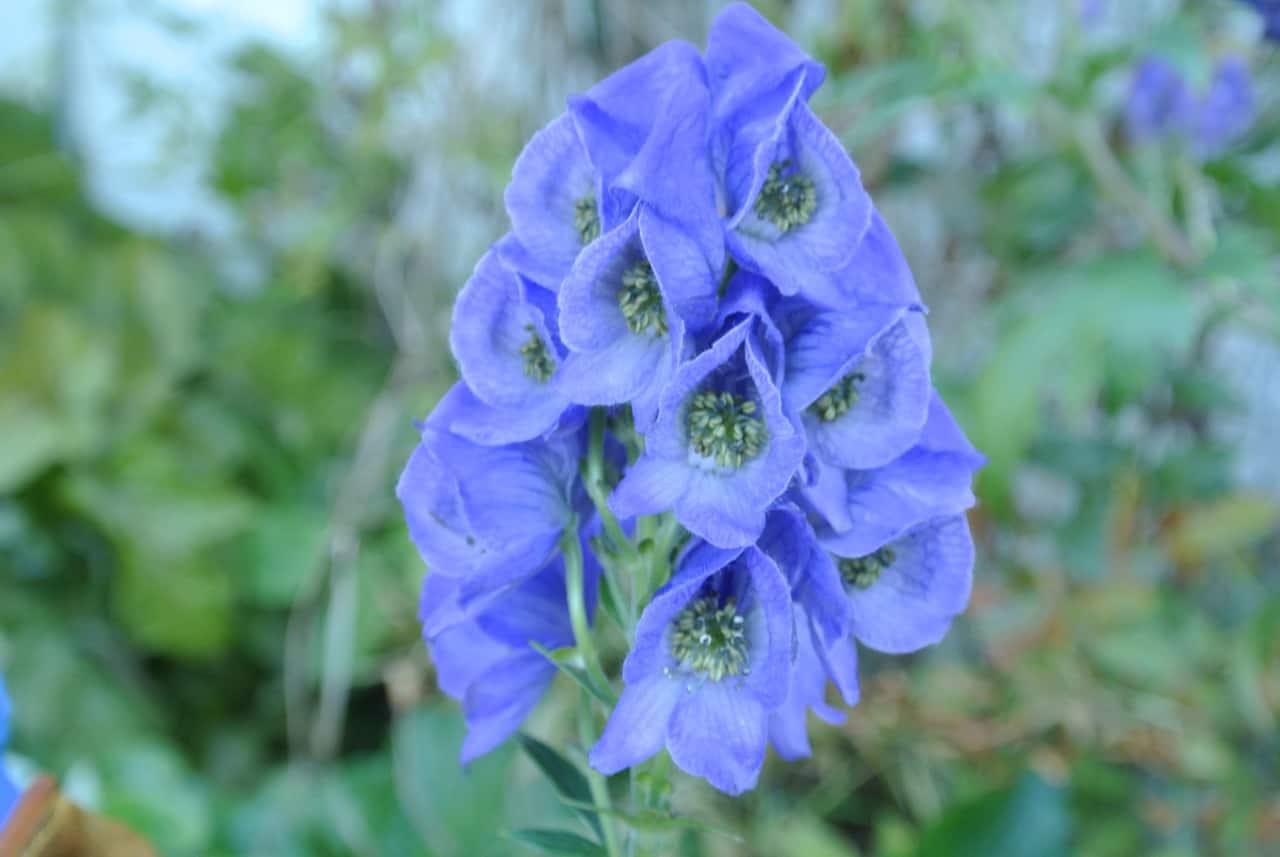
Winner of multiple international awards, this azure-blue perennial blooms from early to mid-fall and pairs beautifully with dark green foliage. It can reach about five feet tall and grows best in full sun to partial shade. It’s typically resistant to deer and rabbits, performs well in USDA zones 3–8, and is a strong choice for borders and beds. It tolerates a wide range of soil pH as long as drainage is reasonable.
2. Lily of the Nile (Agapanthus Africanus“Stevie’s Wonder”)
Read our guide to Lily of the Nile

This hybrid forms showy, spiky clusters of blue-violet flowers on stems that can reach about three feet tall. Best suited to warmer climates (generally zones 7–10), Agapanthus “Stevie’s Wonder” attracts hummingbirds and has long, strap-like leaves that highlight its rounded flower heads. It grows well in full sun to partial sun and stands out in beds, borders, and large containers for its bold, saturated color.
3. Pyramidal Bugle (Ajuga pyramidalis “Metallica Crispa Purpurea”)
Read our guide to Pyramidal Bugle

Native to Europe, this perennial forms deep purple rosettes with crinkled, spinach-like leaves. It produces masses of tiny blue flowers and is generally hardy in zones 3–8. One of its standout traits is its ability to tolerate heat and humidity better than many similar spring bloomers, making it a good option for warmer regions. It typically blooms in late spring and stays low, around three inches tall.
4. Blue Star (Amsonia “Blue Ice”)

With dark blue-lavender flowers and glossy leaves, ‘Blue Ice’ is a compact plant, typically reaching about 12–15 inches tall. Its foliage often turns a warm yellow-gold in fall, and it blooms from late spring into early summer. It’s a low-maintenance perennial that works well in containers or as a cut flower, and it’s commonly noted for deer resistance. It also attracts butterflies, which makes it a friendly choice for pollinator-focused gardens.
5. Amsonia tabernaemontana “Storm Cloud”

These periwinkle-toned flowers sit atop upright stems that can reach around 30 inches tall. It grows best in zones 4–9 and is generally deer-resistant and heat-tolerant once established. Amsonia tabernaemontana ‘Storm Cloud’ has deep green to olive-green foliage and blooms in late spring through early summer. It’s notably low-maintenance and fits well in borders, mixed beds, and naturalistic plantings—great for gardeners who prefer minimal fuss.
6. Bush Clematis “Stand by Me”

Best grown in zones 3–7, ‘Stand by Me’ reaches about 38 inches tall and produces nodding, bell-shaped blooms in deep bluish-purple with a lighter edge. It flowers from late spring into mid-summer and prefers neutral to slightly alkaline soil. A layer of mulch helps keep roots cool and evenly moist. It’s a good pick for containers, cut arrangements, or as a distinctive edging and border plant.
7. Ceanothus papillosus

Often grown outdoors in parts of California, this perennial (sometimes grown as a large shrub) produces clusters of bright blue flowers and has oblong, evergreen leaves. It can become quite large—up to about 16 feet—depending on the selection and climate. Bloom time is typically late winter into early spring. It’s generally low-maintenance, often deer-resistant, and works well as a hedge or for stabilizing slopes and banks.
8. Centaurea Montana

Also known as cornflower or bachelor’s button in some regions, this perennial has large violet-blue blooms with spiky, fringed petals. Centaurea montana typically reaches around two feet tall and blooms in late spring, often with repeat flowering if deadheaded. It does best in zones 3–8 and is valued as an easy, low-maintenance plant with thistle-like flowers and attractive foliage that can vary by cultivar.
9. Clematis “Brother Stefan”

With rich blue flowers and a golden center, this clematis climbs to roughly seven feet and is easy to train onto fences, arbors, and trellises. It needs full sun to flower heavily, with its roots shaded and cool for best performance. ‘Brother Stefan’ blooms in early to mid-summer and is generally grown in zones 4–10, depending on winter conditions. The flowers look striking on their own or mixed with contrasting colors, and the gently fluted edges add extra texture.
10. Gentiana “True Blue”

These sapphire-blue, upward-facing flowers have a tulip-like shape that stands out in summer borders. Their emerald-green foliage sets off the blooms well, and plants typically reach about 20 inches tall. ‘True Blue’ is often deer-resistant and combines nicely with other deep blues and purples. Bloom time usually runs from mid-summer into early fall; it prefers sun, but in hotter, humid climates it appreciates some afternoon shade and good air circulation.
11. Geranium “Rozanne”

Reaching roughly 20 inches tall, this long-blooming blue perennial has petals streaked with deeper violet and foliage that often turns red in fall. It can flower for months, especially when spent blooms are trimmed back and the plant is kept watered during heat. ‘Rozanne’ is easy to grow and performs best in fertile, well-drained soil amended with organic matter; consistent moisture helps it look its best. It’s also an excellent plant for attracting butterflies and other pollinators.
12. Guaiacum sanctum

Best grown in zones 10–11, this plant can reach up to about 12 feet tall and has showy blue flowers paired with evergreen foliage. Once established, it is fairly drought-tolerant and grows well in full sun to partial shade. The star-shaped flowers are small—around one inch across—and the plant’s naturally slower growth makes it suitable for containers when young. In warm regions it can be trained as an ornamental lawn tree or a large patio specimen.
13. Ipheion peregrinans “Rolf Fiedler”

Best grown in zones 5–9, Ipheion peregrinans ‘Rolf Fiedler’ produces soft lilac-blue flowers with a golden center. It performs well in partial sun to full sun, and its slender, light green leaves have a mild onion-like scent when crushed. Plants stay small, around six inches tall, and naturalize nicely under deciduous trees and in lawns or beds where spring bulbs are welcome. With little need for deadheading, it’s a low-maintenance choice for beginners.
14. Iris cristata

These showy deep blue flowers have broad petals in a lilac-blue range and wide leaves that complement the blooms. Plants stay low—often under six inches—and are typically deer-resistant. They usually flower in early to mid-spring (often around April) and feature distinctive gold-crested “falls.” Commonly called dwarf crested iris, they’re an excellent ground-cover option in well-drained soil.
15. Iris japonica “Eco Easter”

Native to Japan, Iris japonica ‘Eco Easter’ has lilac-toned flowers accented with white and gold markings at the center. It grows best in zones 7–10 and typically reaches about one foot tall. It’s a relatively low-maintenance iris that can handle partial shade and even brighter shade, making it useful for lightly shaded beds as long as the soil doesn’t dry out completely.
16. Jeffersonia dubia

Blooming from March through May, these perennials have large lilac-blue petals that deepen slightly toward the center. Plants typically reach about one foot tall and are adaptable when given humus-rich, consistently moist soil. Jeffersonia dubia is generally hardy in zones 4–9, and its distinctive lobed leaves provide attractive texture even after flowering.
17. Linum lewisii

Also known as Lewis flax or blue flax, this perennial is native to western North America and has delicate flowers in pale blue to lavender, sometimes appearing nearly white. The blooms have five distinct petals, and the plant’s narrow leaves can appear slightly spiraled along the stems. It’s well-suited to sunny, well-drained sites and can grow at high elevations—often up to about 11,000 feet—making it useful for mountain gardens and xeric plantings.
18. Lobelia siphilitica

Sometimes sold as ‘Blue Selection,’ this sturdy bluish-purple perennial produces large, rounded flower heads. It is generally deer-resistant and attracts hummingbirds and butterflies. It grows best in zones 3–9, especially in sites with consistently moist soil throughout the season. Plants can reach about three feet tall and bloom from mid-summer into early fall; it’s also found growing naturally along streams, ditches, and other damp areas.
19. Lupinus argenteus

Also called silvery lupine, Lupinus argenteus produces spikes of violet to blue, pea-like flowers above gray-green foliage. Plants are often low to medium in height, with flowering stems commonly around eight inches to taller depending on conditions and local forms. Bloom time is typically June and July. Butterflies visit the flowers, birds may use the plant for habitat and seed, and the foliage and seeds can be toxic if ingested—so use caution around people and pets.
20. Myosotis palustris “Southern Blues”

Best grown in zones 4–8, Myosotis palustris ‘Southern Blues’ produces tiny lilac-blue flowers with golden centers. It has relatively broad leaves and usually reaches about eight inches tall. As a type of forget-me-not, it makes lovely ground cover and is often deer-resistant. It can be grown at the edge of shallow water or in average soil that stays evenly moist; in warm climates, afternoon shade helps it perform better.
21. Nepeta “Walker’s Low”
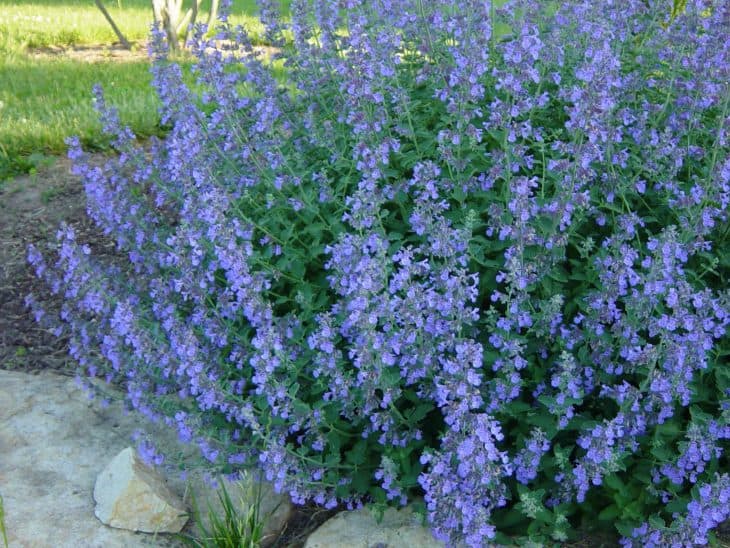
Despite its name, this perennial can reach about 30 inches tall. It produces many small blue-violet flowers and is popular with cats for its catnip-like effect. Hummingbirds and butterflies also visit it, and it typically blooms from early to mid-summer. ‘Walker’s Low’ grows best in zones 3–8 and is usually resistant to deer and rabbits. Its aromatic, greenish-gray foliage looks good even when the plant is not in bloom.
22. Penstemon albertinus

Native to western Canada and parts of the northern U.S. including Idaho and Montana, Penstemon albertinus prefers dry, rocky sites and can handle higher elevations. Also called beardtongue, it attracts hummingbirds and bees with tubular flowers that may appear in pink, blue, purple, or red tones. Plants can reach about three feet tall and are generally low-maintenance once established in well-drained soil.
23. Penstemon rydbergii

With purple, tubular flowers about a half-inch long, this perennial has elliptic leaves and noticeable basal rosettes. It blooms mainly through the summer and may reach around 28 inches tall in favorable conditions. It grows best in sun to partial shade; while it prefers evenly moist soil, it is fairly tolerant of drier conditions once established, especially in well-drained sites.
24. Perovskia atriplicifolia “Blue Jean Baby”

Also known as Russian sage, this blue-flowering perennial performs especially well in hot, sunny summers. It produces airy lavender-blue blooms over greenish-gray, aromatic foliage that stands out in the landscape. ‘Blue Jean Baby’ reaches about 34 inches tall and is generally hardy in zones 4–9. It’s heat- and drought-tolerant once established, often deer- and rabbit-resistant, and is a strong choice for banks, slopes, and low-water borders.
25. Phlox divericata “Blue Moon”
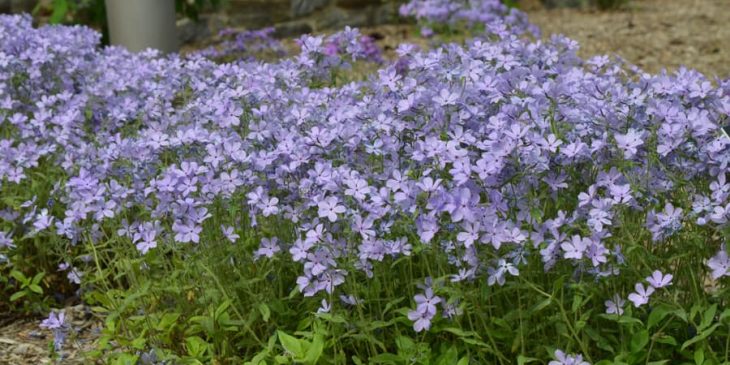
Also called wild sweet William, Phlox divaricata ‘Blue Moon’ has soft lavender-blue flowers and oblong leaves. Plants typically reach about 12 inches tall, and the petals overlap to create full-looking clusters. It’s an excellent choice for woodland gardens and shaded borders, attracting butterflies and offering a light, pleasant fragrance. For best results, grow it in moist, humus-rich soil that doesn’t dry out.
26. Creeping Phlox (Phlox subulata)
Read our guide to Creeping Phlox

Best grown in zones 3–9, Phlox subulata stays low, usually around six inches tall, and forms mats of bloom in shades including violet-purple, reddish-purple, and sometimes pink or white depending on the cultivar. Butterflies visit the flowers, and the plants are easy to grow thanks to their deer resistance and good drought tolerance once established. They prefer well-drained soil and typically bloom from March through May, making them a reliable spring ground cover.
27. Platycodon “Fuji Blue”
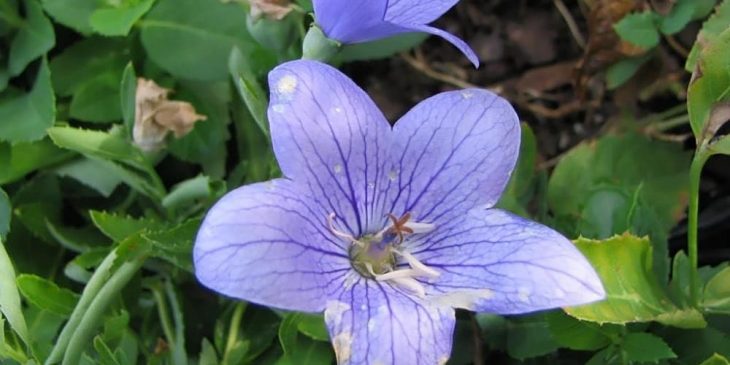
Deep blue and bell-shaped, ‘Fuji Blue’ flowers feature bright yellow centers and are generally trouble-free with few pest or disease issues. Plants can reach around 20 inches tall and grow best in zones 3–8. They adapt to many soil types, including less fertile soils, as long as drainage is decent. The vivid blooms look great in borders and also perform well in containers and cut arrangements.
28. Pulmonaria “Trevi Fountain”
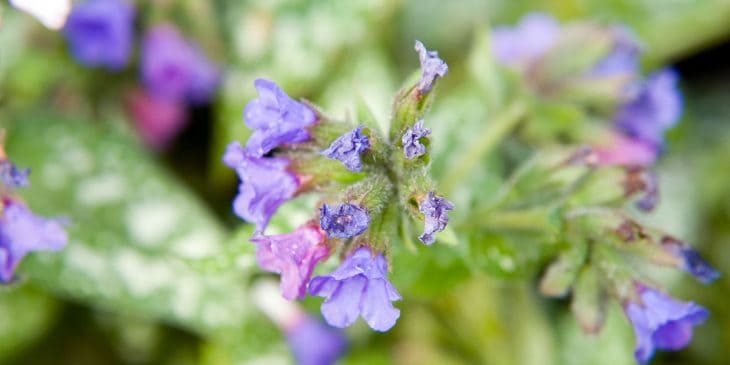
Pulmonaria ‘Trevi Fountain’ produces cupped, bell-shaped flowers in a rich, deep blue. Plants typically reach about 18 inches tall and are often deer-resistant. They can tolerate some heat and humidity better than many lungworts, but they still perform best with consistent moisture and shelter from harsh afternoon sun. Grow them in zones 4–9 in partial to full shade for the healthiest foliage and best flowering.
29. Rosemary (Salvia Rosmarinus)

These perennials can grow quite tall—up to about six feet—and produce pale blue to white flowers. They perform best in full sun in zones 8–10, and typically bloom in June and July. The flowers are showy, commonly deer-resistant, and attractive to butterflies. They also work well in containers and borders, and the plant can be used as an herb in stews, herbal butters, and breads.
30. Salvia chamaedryoides

With cup-shaped, deep blue flowers, these long-blooming plants can reach about two feet tall and grow in either sun or partial shade. They are only hardy to roughly 10°F, so they are best treated as warm-climate perennials or grown with winter protection in colder areas. They can attract hummingbirds and may spread to about four feet wide over time. Salvia chamaedryoides generally performs well in zone 8 and in sheltered parts of zone 7.
31. Salvia dorrii

Also called desert purple sage, this perennial blooms in late spring and produces flowers that are partly cup-shaped with spiky accents. It attracts hummingbirds and butterflies while usually resisting deer and rabbits. The purplish-blue flowers are showy, and plants can grow to about 18 inches tall and around three feet wide. It’s best suited to warmer regions, especially zones 8–10, in full sun and well-drained soil.
32. Symphyotrichum puniceum

Native to the eastern United States, Symphyotrichum puniceum is adaptable across many climates, especially zones 2–9. It can reach up to about eight feet tall and three feet wide, with long, narrow petals in a light blue shade around yellow centers. It’s highly attractive to butterflies and typically blooms from August into September. The glossy green foliage provides a strong backdrop for the late-season flowers.
33. Veronica “Spike Speedwell”

Spike speedwell is named for its narrow, spike-like flower stems. The blooms are a clear blue, and plants typically reach around six inches tall. Well-suited to zones 3–8, it can flower for much of the summer, especially with deadheading. It makes an excellent ground cover and is attractive to bees, hummingbirds, and butterflies. Grow it in full sun with soil around neutral (roughly pH 6.8–7.5) for best performance.
34. Vitex divaricata

Vitex divaricata is an evergreen tree rather than a flowering perennial, and it can reach about 65 feet tall. It is grown in some areas for timber and for traditional medicinal uses. Full sun encourages faster, denser growth. At certain times of year, it produces small blue flowers that contrast nicely with its bright green foliage.
35. Vitex trifolia

Vitex trifolia is a shrub best grown in zones 9–11 and is often used as a hedge or border plant. It can reach about 20 feet tall and 12 feet wide and is known for vigorous growth in warm climates. During summer, it produces small blue flowers and performs best in full sun. The leaves are variegated with blades about two to four inches long, and it tolerates a wide range of soils, including acidic to alkaline conditions and clay, loam, or sand.

Thanks for reading this list of 35 blue-flowering perennials. Consider it a starting point—specific cultivars and performance can vary by region, soil, and summer heat. I hope it helped you find a few reliable blue options that fit your garden and your growing zone.


Hello- thanks for this list! I just wanted to mention another blue flower (this one can be grown in shade and likes moist conditions): Corydalis. The variety I have is called Blue Line. Oh, speaking of shade, that reminds of the beautiful little blue flowers that appear on Brunnera.
I also have a geranium Rozanne and maybe it’s just the particular one I have, but it looks decidedly purple; not the least bit blue (not even lavender). To me, the Johnson’s blue variety is much more of a blue-ish purple.
Anyway, nice list- thanks!
And thank you for the suggestions Katie! I will add them to the list when I have the time.