Kale is one of the easiest crops to grow — until the aphids arrive, the flea beetles strike, and the cabbage worms move in. Being a member of the Brassicaceae family, kale carries chemical signals that specialist pest insects are hardwired to find. Without a strategy, you will spend the season reacting rather than preventing.
Contents
Companion planting is the practice of growing two or more species near each other so that each benefits from the other’s presence. For kale, the right companions do four things: they repel pest insects through scent, they attract beneficial predatory insects that eat pests, they enrich the soil to offset what kale’s heavy feeding depletes, and they cover bare ground to retain moisture and suppress weeds. The goal is to build an ecosystem around your kale that does much of the pest management work for you.
Before choosing companions, match them to kale’s growing requirements. Kale thrives in cool weather between 45°F and 75°F, prefers a soil pH of 5.5–6.8, and does best in full sun. Plants with similar needs will grow in sync with kale without competing for conditions neither can provide. The companions below all meet this standard — either directly sharing kale’s cool-season window, or filling a specific supporting role during it.
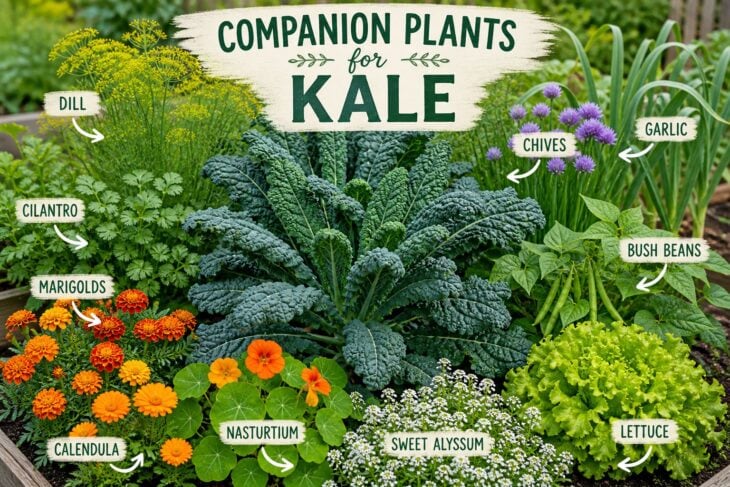
Dill
What it helps with
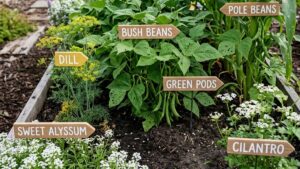
Dill attracts parasitic wasps and hoverflies that prey on kale’s most destructive pests, while also repelling aphids during its vegetative stage.
Why it works with kale
Dill’s open umbel flowers are rich in nectar and highly attractive to parasitic wasps, hoverflies, and lacewings — all of which prey on aphids, cabbage loopers, and diamondback moth larvae. A Brazilian entomological study found that intercropping with dill nearly doubled beneficial insect species richness and abundance over a 4-month cropping season. Its volatile essential oils also have a repellent effect on aphids before the plant flowers, meaning dill works as a pest repellent early in the season and as a beneficial insect magnet once it bolts — a timing that lines up almost exactly with kale’s peak pest pressure window.
Planting notes
Plant dill 12–18 inches from kale transplants. It can be interplanted through the bed or positioned along borders — both placements work. Succession-sow every 2–3 weeks rather than planting a single batch, so you maintain continuous bloom throughout the season. Resist pulling bolting dill plants; the flowers are the most valuable part of the plant for companion purposes.
Possible drawback or limit
Dill self-sows aggressively if seed heads are left to mature, and it can become a weed management issue in subsequent seasons. It also cross-pollinates with fennel — keep the two separated, and never plant fennel near kale regardless.
Cilantro / Coriander
What it helps with
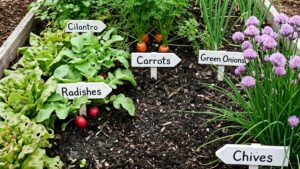
Cilantro’s fragrant foliage repels certain pest insects and attracts hoverflies, ladybugs, and lacewings once it flowers.
Why it works with kale
Cilantro’s strong scent masks kale’s own chemical signature, making it harder for aphids and other pests to locate the crop by smell. Once temperatures rise and the plant bolts, it produces flowers that draw hoverflies, lacewings, and ladybugs — predatory insects that target aphids and cabbage loopers. The plant moves through both phases during kale’s growing season, first masking kale’s scent, then calling in reinforcements as pest pressure builds. Both roles are well documented in organic horticultural practice.
Planting notes
Plant directly alongside kale or along bed borders. Allow a portion of your cilantro plants to bolt and flower rather than harvesting everything — the flowers are the mechanism, not the leaves. Succession-sow every 3–4 weeks to maintain a steady supply of plants in both the vegetative and flowering stages simultaneously.
Possible drawback or limit
Cilantro bolts rapidly in warm weather, shortening its vegetative pest-repellent phase just as summer pest pressure increases. In hot climates, it may need replacing mid-season with dill, which handles the heat transition better.
Marigolds
What it helps with
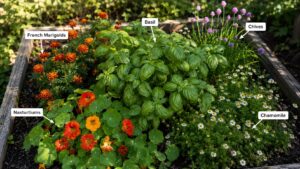
French marigolds suppress soil-dwelling root-knot nematodes through root exudates, and their flowers attract hoverflies and parasitic wasps that reduce aphid populations.
Why it works with kale
French marigold roots produce alpha-terthienyl, a thiophene derivative shown in multiple studies to suppress root-knot nematodes (Meloidogyne spp.) in surrounding soil — one of the most scientifically robust mechanisms in companion planting. Above ground, marigold flowers attract hoverflies and parasitic wasps that feed on aphids. It is worth noting that the scent-based above-ground pest repellence often credited to marigolds is less conclusively proven; gardeners widely report it, but controlled research is thinner than for the nematode mechanism. Plant marigolds for the nematode suppression and beneficial insect attraction — treat any additional pest-repellent benefit as a bonus.
Planting notes
Plant marigolds throughout the bed or along borders. Because they take 55–100 days to bloom from seed, start them 6–8 weeks before your kale transplant date, or use transplants to ensure they are flowering when kale is in the ground. French marigold (Tagetes patula) is the variety with the documented nematode-suppression mechanism — not all marigold species share this property.
Possible drawback or limit
Marigolds are warm-season plants and perform best in the warmer shoulder of kale’s growing season. In cool spring or fall conditions their effectiveness is reduced, and they will not survive frost. They are less useful for fall kale plantings unless started well in advance.
Pot Marigold (Calendula officinalis)
What it helps with
Calendula attracts syrphid fly larvae and parasitic wasps that prey on kale aphids, and acts as a trap crop by drawing aphids to itself rather than to kale.
Why it works with kale
A published study found that calendula grown near kale attracted significant populations of syrphid fly larvae and parasitic wasps — both of which parasitise and consume common kale aphids. Alongside this, field observation consistently shows calendula stems becoming heavily aphid-colonised while adjacent kale and lettuce remain clean, functioning as a reliable trap crop. The dual role — luring aphids to itself while sustaining predator populations that then spread through the wider bed — makes calendula particularly efficient.
Planting notes
Tuck calendula into kale rows, at row ends, or along bed margins. Allow 10–12 inches between calendula and kale plants. Sow 6–8 weeks before your kale transplant date so plants are established and flowering at the same time. When calendula stems become heavily aphid-loaded, you can leave them (if predator populations are present and active) or remove and destroy them to eliminate the aphid colony.
Possible drawback or limit
Calendula’s trap crop function requires monitoring. If beneficial predator populations are low in your garden, aphids concentrated on calendula can build to high numbers and begin migrating to kale. Check plants regularly and intervene if predator control is not keeping up.
Nasturtium
What it helps with
Nasturtium acts as a sacrificial trap crop, drawing aphids, flea beetles, and cabbage worms away from kale and concentrating them where they can be managed or destroyed.
Why it works with kale
Nasturtiums produce isothiocyanates — the same mustard oils responsible for their peppery flavour — which attract aphids, flea beetles, and cabbage loopers preferentially over kale and other brassicas. A Clemson University study found that border rows of nasturtium reduced aphid counts on nearby cole crops by 86%. Research also shows nasturtium is a more effective trap crop in spring than in fall, so plan its use accordingly. Nasturtiums simultaneously attract hoverflies and lacewings, adding a beneficial insect function on top of their sacrificial role.
Planting notes
Plant 5–6 feet away from kale — distance is critical. Nasturtiums planted too close concentrate pests near the crop rather than drawing them away from it. Yellow-flowered varieties are particularly attractive to aphids. Monitor nasturtium plants actively: if pest populations build beyond what predators can control, remove and destroy the plants (with pests attached) to eliminate the colony before it migrates.
Possible drawback or limit
Nasturtium’s trap crop function can backfire if not monitored. Without adequate beneficial insect populations or timely removal, it can build aphid or flea beetle populations large enough to overwhelm kale. It is a high-reward but hands-on companion that requires active management.
Chives
What it helps with
Chives emit volatile sulfur compounds that mask kale’s scent and disrupt the ability of aphids, flea beetles, and cabbage loopers to locate the crop.
Why it works with kale
Alliums including chives produce volatile organic compounds (VOCs) — primarily allicin and related sulfur derivatives — that interfere with the olfactory navigation of pest insects. A SARE-funded field trial at Washington State University confirmed that intercropping brassicas with spring onion reduced striped flea beetle pressure, replicating earlier findings with Chinese cabbage and green onions. Cornell University and Rodale Institute research suggests allium intercropping can reduce aphid colonisation by up to 68%. Chives offer this protection in a compact, perennial form that requires minimal maintenance once established.
Planting notes
Plant directly adjacent to kale or along bed borders. Chives are compact enough to interplant at 6–8 inch spacing without competing significantly for resources or light. As perennials, they persist across seasons and can remain in place around kale plantings year-round, providing continuous VOC output.
Possible drawback or limit
Chives flower and go partially dormant in heat, which reduces their VOC output during summer — the same period when pest pressure on kale peaks. Their effectiveness is highest and most reliable in spring and fall, in line with kale’s primary growing seasons.
Garlic
What it helps with
Garlic’s potent sulfur compounds repel aphids, spider mites, and cabbage moths, and are strong enough to mask kale’s own pest-attracting chemical signals.
Why it works with kale
Garlic produces allicin and a range of volatile sulfur compounds from both intact tissue and root exudates. These compounds are among the most studied pest-repellent mechanisms in any companion plant — garlic-derived compounds are used in commercial biopesticide formulations. Its scent profile is strong enough to interfere with the olfactory detection of kale’s glucosinolates, the compounds that guide specialist brassica pests to the crop. The pest-repellent mechanism is scientifically well-established.
Planting notes
Plant garlic in pockets adjacent to kale rather than directly in the same root zone. In most climates, garlic is planted in fall for summer harvest — plan your layout so that harvesting the bulbs does not disturb established kale roots. Garlic is best suited to fall kale plantings or growing systems where harvest timing can be managed cleanly around the kale crop.
Possible drawback or limit
Garlic’s seasonal cycle creates a practical challenge: harvesting bulbs in early summer requires digging, which can disturb nearby kale roots if planted too close. This timing conflict limits its value as a companion compared to chives, which offer similar sulfur-compound benefits in a non-disruptive perennial form.
Sweet Alyssum
What it helps with
Sweet alyssum attracts hoverflies whose larvae consume aphids, and its low spreading habit suppresses weeds and retains soil moisture around kale.
Why it works with kale
Sweet alyssum produces nectar that is highly accessible to small beneficial insects, particularly hoverflies (Syrphidae), whose larvae are voracious aphid predators. A single hoverfly larva can consume hundreds of aphids over its development. Alyssum’s dense, low-spreading growth also physically suppresses weed germination and reduces soil moisture loss — useful in the cool seasons when kale is most productive and soil moisture management matters.
Planting notes
Plant around the perimeter of kale beds or as a border. Its low height (6–8 inches) makes it suitable as underplanting beneath kale without competing for light. Interplant at 6–10 inch spacing. Deadhead spent flowers to encourage continuous bloom and sustained insect attraction.
Possible drawback or limit
Sweet alyssum wilts and dies back in heat, limiting its usefulness in warm climates or during summer gaps between kale’s spring and fall seasons. In regions with hot summers, it may need re-sowing for the fall planting window rather than persisting from spring.
Bush Beans (Phaseolus vulgaris)
What it helps with
Bush beans fix atmospheric nitrogen into the soil through root symbiosis, replenishing the nutrients that kale’s heavy feeding steadily depletes.
Why it works with kale
Legumes form symbiotic relationships with Rhizobium bacteria in root nodules, converting atmospheric nitrogen into plant-available ammonium. Kale is a heavy feeder that depletes soil nitrogen, potassium, and calcium rapidly; intercropping with beans, or leaving bean roots in the soil after harvest, adds measurable nitrogen back into the growing zone. Nitrogen fixation by legumes is one of the most thoroughly documented mechanisms in agriculture — this is not a gardening tradition but an established agronomic fact.
Planting notes
Plant bush beans alongside or between kale rows. Avoid pole beans, which may shade kale excessively. When bean harvest is finished, cut plants at the base and leave roots in the soil — this is where the nitrogen-fixing nodules are. The decomposing roots release nitrogen slowly as the next kale planting cycle begins.
Possible drawback or limit
Beans are warm-season crops and do not share kale’s cool-season preference. Timing compatibility is the main constraint — the two crops are rarely at their peak simultaneously. Bush beans work best as a preceding crop to fall kale, or grown alongside kale in late spring when temperatures are transitioning upward.
Lettuce
What it helps with
Lettuce provides fast-growing ground cover that retains soil moisture and suppresses weeds, and its different scent profile may help confuse pest insects searching specifically for brassicas.
Why it works with kale
Lettuce belongs to the Asteraceae family — entirely unrelated to brassicas — giving it a distinct chemical scent profile. When interplanted with kale, the mixed volatiles from two unrelated plant families are thought to make it harder for specialist brassica pests to isolate kale’s signature. This olfactory confusion mechanism is consistent with broader companion planting theory and widely reported by gardeners, though direct controlled trials specifically on lettuce-kale interplanting are limited. Lettuce’s ground cover function — retaining moisture and suppressing weeds between kale plants — is practical and well established regardless of the pest dynamic.
Planting notes
Interplant directly between kale plants, taking advantage of kale’s upright habit, which provides partial shade that lettuce appreciates. Harvest lettuce on a rotating basis before kale’s canopy fills in and shades it too heavily. Space at 8–10 inches between plants. Fast-maturing loose-leaf varieties are best for this use.
Possible drawback or limit
The scent-masking benefit for lettuce is plausible but not as well supported by direct research as the mechanisms behind alliums, dill, or cilantro. Do not plant lettuce as a primary pest-management strategy — treat it primarily as a space-efficiency and soil-cover companion, with any pest-confusion benefit as secondary.