In Biblical times, dill was valued highly enough to serve as payment for taxes. Today, dill remains a popular garden plant. Its fragrant, bright green foliage and cheerful yellow flowers create an attractive display, while its culinary and medicinal applications continue to make it a staple in home gardens.
Contents
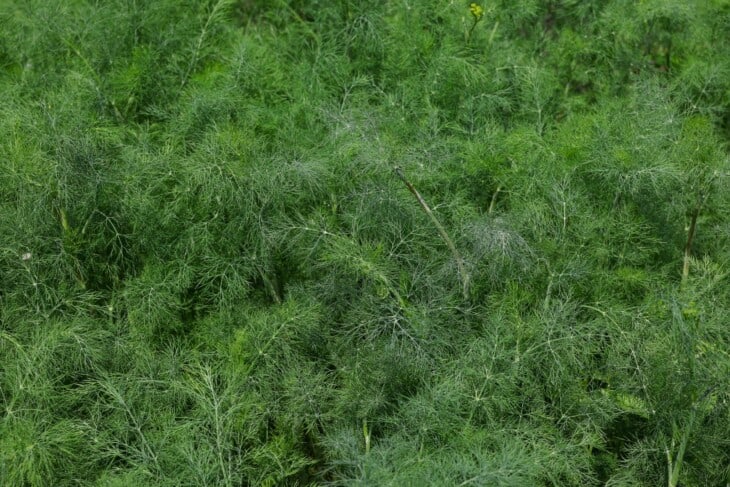
Dill (Anethum graveolens) belongs to the Apiaceae family, the same plant family as carrots and parsley. This slender annual typically grows sixteen to twenty-four inches tall. The leaves are thin, bright green to bluish-green, and finely divided with a feathery texture. Small yellow flowers appear in umbrella-shaped clusters called umbels atop long, hollow stalks.
Dill is an annual that completes its life cycle in one growing season and dies back after setting seed. Gardeners can maintain a continuous supply by allowing some plants to self-sow, producing new seedlings each spring. Dill thrives in full sun, requiring at least six to eight hours of direct sunlight daily for optimal growth.
The slender stems of dill are easily damaged by strong winds, so choose a sheltered location when planting. Dill is not frost-tolerant and will die when temperatures drop below freezing. It performs best in well-drained, slightly acidic to neutral soil with a pH between 5.5 and 6.5.
Several dill cultivars are available, varying in height, leaf color ranging from bright green to blue-green, and foliage density. A number of other plants share dill’s feathery foliage and umbel-shaped flower clusters, making them easy to confuse.
1. Cumin (Cuminum cyminum)

Cumin (Cuminum cyminum) is a flowering annual from the Apiaceae family, making it a botanical relative of both dill and carrots. Its narrow, finely divided leaves closely resemble dill foliage. Cumin plants are slightly more compact than dill, typically reaching twelve to twenty inches in height.
Cumin stems are grey to green in color, while the delicate leaves range from green to purplish. The flowers are most commonly pink or white, though some cultivars produce yellow or lilac blooms. Like dill, the flowers form in umbrella-like clusters known as umbels.
Cumin requires long, hot summers to thrive and performs best in sandy or loamy soils with excellent drainage. The plants are susceptible to fungal diseases when grown in overly moist conditions. While drought-tolerant once established, cumin must be protected from both frost and strong winds. Seed color and flavor profile vary among different cumin varieties.
2. Wild Fennel (Foeniculum vulgare)

Wild fennel (Foeniculum vulgare) is also called sweet fennel, common fennel, garden fennel, and large fennel. It belongs to the Apiaceae family and is closely related to dill. Experienced gardeners caution against planting dill and fennel near each other, as cross-pollination between the two species can occur and affect seed quality.
Wild fennel shares dill’s soft, feathery foliage but typically grows much larger, often reaching five to six feet tall. Clusters of small yellow flowers form in umbels similar to dill’s blooms. Unlike annual dill, fennel is perennial in USDA zones 5 through 10, dying back in winter but returning from the root crown each spring. The plant is easily identified by its strong anise or licorice scent.
Fennel is native to the Mediterranean region of Europe and western Asia but has naturalized widely across North America and Australia. It grows best in sandy or loamy soil with good drainage and moderate fertility. Fennel readily colonizes disturbed soils and is commonly seen along roadsides and in vacant lots.
Fennel makes an attractive, aromatic addition to the garden and works well as a vertical accent in the back of flower beds. Both the bulb and foliage are used extensively in cuisines worldwide, particularly Mediterranean cooking. Fennel has traditional medicinal applications, including use as a digestive aid, and the seeds have been chewed to suppress appetite.
3. False Dill (Eupatorium capillifolium)

False dill is also known as dog fennel or false fennel and goes by the botanical name Eupatorium capillifolium. Dog fennel belongs to the Asteraceae or daisy family, not the Apiaceae family like true dill. The seeds spread readily by wind, and false dill can become invasive and challenging to control once established.
Like dill and fennel, false dill has small, narrow leaves arranged alternately along the stem. The leaves are bright green with fine divisions that create a feathery appearance. Unlike aromatic dill, false dill has a sour, musty odor that becomes more pronounced when the foliage is crushed.
The stems are covered with fine hairs, while the leaves are smooth. False dill stems are soft and green when young but become tough and woody with age. Often considered a weedy species, the plant’s woody stems make it difficult to pull by hand once mature.
False dill is occasionally used as an ornamental filler plant in gardens. It ranges from six inches to three feet tall depending on growing conditions and available moisture. This plant grows best in well-drained, consistently moist soil. Full sun is ideal in temperate climates, but partial or afternoon shade is necessary in hot regions. False dill is toxic to humans and livestock and can cause serious liver damage. It is critical to accurately identify the differences between false dill, true dill, and fennel, as they are easily confused.
4. Absinthe Wormwood (Artemisia absinthium)
Read our guide to Absinthe Wormwood

Absinthe wormwood (Artemisia absinthium) belongs to the Asteraceae or daisy family. It is also known as grand wormwood or common wormwood. Native to temperate regions of Eastern Europe, Western Asia, and North Africa, absinthe wormwood has naturalized in many parts of the United States and Canada.
Absinthe wormwood foliage is silvery grey-green on the upper surface and white or silvery on the underside due to fine hairs. The deeply divided leaves spiral around upright stems. Like dill, absinthe wormwood produces small yellow flowers, though blooming occurs from early summer through fall in loose panicles rather than tight umbels.
Absinthe wormwood adapts to a variety of soil types but performs best in nitrogen-rich, well-drained soil. It can release allelopathic compounds that may inhibit the growth of nearby plants and should be sited carefully in mixed beds. Absinthe wormwood is a hardy perennial that tolerates full sun to partial shade and is drought-resistant once established.
5. Anise (Pimpinella anisum)

Anise goes by the botanical name Pimpinella anisum and is sometimes called aniseed. Like dill, it belongs to the Apiaceae family. Native to Egypt and the eastern Mediterranean region, anise has been cultivated for thousands of years. The flowers provide nectar for many butterfly and moth species.
Anise has bright green leaves that are finely divided into many segments, creating a feathery appearance similar to dill. Small white or pale yellow flowers form dense umbels at the top of the plant. Anise grows approximately two to three feet tall. It is an annual that grows best in well-drained, fertile soil and requires full sun—at least six hours daily—for proper seed development.
Anise is cultivated in many regions worldwide for its culinary and medicinal properties. The seeds have a strong, sweet licorice flavor and aroma. Anise is used to flavor sweets, pastries, breads, cookies, cheeses, and numerous traditional dishes across cultures. Beyond flavoring, it serves as a natural preservative and provides antioxidant benefits. Anise essential oil is a key ingredient in several alcoholic liqueurs, including ouzo and absinthe, and is widely used in perfumes and soaps.
6. Tarragon (Artemisia dracunculus)

Tarragon (Artemisia dracunculus) belongs to the Asteraceae or daisy family. It is sometimes called estragon. Originally native to southern Europe and central Asia, its range has expanded, and it now grows in Siberia, the Middle East, and North America. Tarragon is a perennial herb highly valued for its culinary and medicinal applications.
Tarragon has narrow, glossy green leaves with smooth edges. French tarragon typically has darker, more flavorful foliage than the Russian variety. Small sprays of greenish-yellow flowers may appear in summer, though French tarragon rarely flowers in cultivation. The plant grows three to four feet tall, with Russian tarragon generally taller and more upright than the French type.
Russian tarragon is extremely hardy and cold-resistant, growing well in poor to average soil, including sandy or low-nutrient conditions. French tarragon prefers richer, well-drained soil and is more sensitive to cold and wet conditions. It needs a warm, dry location in the garden and protection from hard freezes in zones colder than zone 5.
French tarragon rarely produces viable seed and is best propagated from cuttings, root divisions, or purchased plants from a reputable nursery. Russian tarragon grows readily from the abundant seeds it produces. Both types are susceptible to powdery mildew, rust, and root rot, especially in poorly drained or overly humid conditions.