
Key Facts
- Evergreen clumping perennial with upright variegated swordlike leaves.
- Leaves commonly reach 2–4 ft (60–120 cm) tall.
- Tolerates low light but variegation keeps best in bright indirect light.
- Prefers well drained soil and is prone to root rot in waterlogged conditions.
- Easily propagated by division or rhizome and by leaf cuttings.
- Rarely flowers in cultivation and blooms are small and inconspicuous.
- Common houseplant valued for low maintenance.
- Toxic to pets if ingested and may cause vomiting and diarrhea.
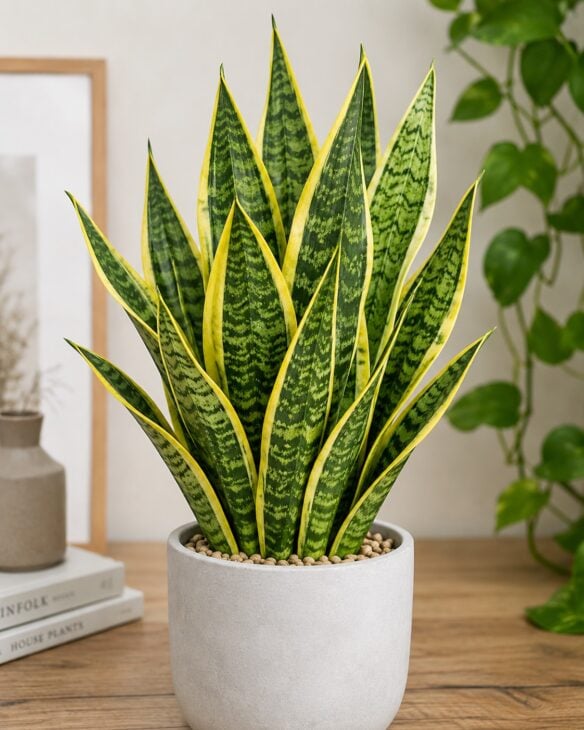
Variegated Snake Plant (Dracaena trifasciata ‘Laurentii’) is an evergreen clumping perennial grown for upright variegated swordlike leaves and easy care. It works as a low maintenance houseplant in low light and as an outdoor accent in warm climates where it will persist year round.
Identification and size
This cultivar forms upright sword shaped leaves with yellow margins and green banding and commonly reaches two to four feet tall. Plants form clumps from thick rhizomes and typically spread one to three feet as they age. Leaves are the main ornamental feature and flowers are rare in cultivation.
Where to grow and best uses
Use it as a durable indoor specimen for entryways and low light rooms or as a patio accent in warm climates. Outdoors it is suitable for USDA zones 9–11 where it can persist and slowly spread by rhizomes. Variegated forms need brighter light than plain green types to retain contrast.
Light soil and watering
Bright indirect light keeps variegation sharp while the plant will tolerate low light with reduced contrast. Grow in a free draining light mix such as a cactus or succulent potting medium and avoid waterlogged soil. Overwatering leads to root rot and yellowing leaves while allowing the soil to dry between waterings preserves healthy foliage.
Planting time depth and spacing
Divide or repot during the plant s active growth period to reduce shock and encourage establishment. Plant with the crown level with the soil surface and firm soil around roots. Space established divisions about one to three feet apart depending on how quickly a clumping mass is desired.
Containers and pot culture
Choose pots with drainage holes and a free draining mix to prevent soggy roots. A slightly snug pot restricts growth and keeps clumps compact while larger pots promote taller leaves. Allow the top few centimeters of soil to dry before watering again to prevent rot.
Propagation and dividing
Division of the rhizome is the fastest and most reliable propagation method and returns plants to a predictable form. Rhizome pieces root readily in a well drained medium and leaf cuttings can be used though they are slower. Let cut surfaces dry briefly before planting to reduce rot risk.
Maintenance and risks
Remove yellow or damaged leaves to keep the clump tidy and divide every few years to control spread. The plant is toxic to cats and dogs if ingested and can cause vomiting and diarrhea so keep it away from pets and children. Watch for signs of overwatering which cause soft bases and root loss.
Frequently asked questions
- How fast does Variegated Snake Plant grow?
- Growth is generally slow to moderate and depends on light pot size and temperature. Brighter light and larger pots produce faster leaf extension while low light slows growth.
- Is it safe around pets?
- No it is toxic to cats and dogs if eaten and can cause vomiting and diarrhea. Keep plants out of reach and seek veterinary help for significant ingestion.
- How often should I water it?
- Water sparingly and allow the soil to dry between waterings. Persistent wet soil leads to root rot and yellowing leaves while occasional drought is tolerated.
- Can I keep it outdoors year round?
- Only in warm climates within USDA zones 9–11. In cooler zones keep plants as indoor specimens or move containers indoors before frost to avoid freeze damage.
- What is the easiest way to propagate it?
- Division of the rhizome is the quickest method. Leaf cuttings work but take longer to produce a new clump.
Gallery
Related Plants
Mentioned In (1)

Plants
The Best Types of Snake Plant for Your Garden
Walk into almost any plant shop and you will find a snake plant, but the one on the shelf may…