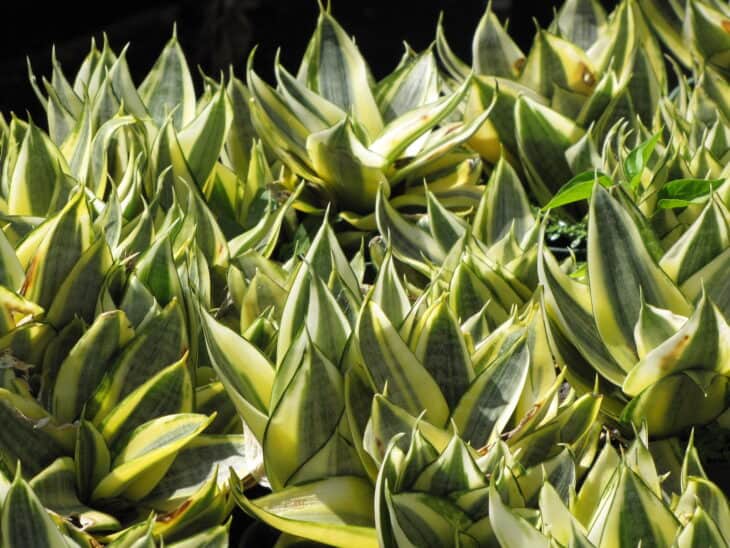
Walk into almost any plant shop and you will find a snake plant, but the one on the shelf may look nothing like the one on your windowsill. Tall or squat, silvery or striped, paddle-shaped or cylindrical — there are more distinct forms than most gardeners realize.
Contents
- 1. Common Snake Plant (Dracaena trifasciata)
- 2. Variegated Snake Plant (Dracaena trifasciata ‘Laurentii’)
- 3. Moonshine Snake Plant (Dracaena trifasciata ‘Moonshine’)
- 4. Bird’s Nest Snake Plant (Dracaena trifasciata ‘Hahnii’)
- 5. African Spear Plant / Cylindrical Snake Plant (Dracaena cylindrica)
- 6. Whale Fin Snake Plant (Dracaena masoniana)
- 7. Bantel’s Sensation (Dracaena trifasciata ‘Bantel’s Sensation’)
Snake plants belong to the genus Dracaena, a group of tough, drought-tolerant perennials native to tropical and subtropical West Africa, from Nigeria to the Congo, with some species extending into East Africa, Madagascar, and southern Asia. Until 2017, they were classified under Sansevieria, and that name still appears on plant labels across the trade. The common names “snake plant” and “mother-in-law’s tongue” apply loosely across the whole genus.
Most types are suitable for outdoor growing only in USDA Zones 10 through 12, where winters stay mild. In cooler climates, every type on this list thrives as a houseplant. All of them share broadly similar needs: very well-draining soil, infrequent watering, and a temperature range of 55 to 85°F (13 to 29°C). Overwatering kills far more snake plants than underwatering ever does.
Where the types diverge is in size, leaf form, and light requirements. A common snake plant can reach 4 feet (1.2 m) while a bird’s nest form tops out at 12 inches (30 cm). A moonshine cultivar needs more light than a standard green variety. These differences matter when you are choosing between a floor specimen, a desk plant, or a bold architectural statement. This guide covers seven types, from the most widely grown species to specialist collector’s plants.
1. Common Snake Plant (Dracaena trifasciata)
Snake Plant
Snake Plant is a drought tolerant evergreen often grown as an easy care houseplant. It tolerates low light and prefers well draining soil to avoid root rot.
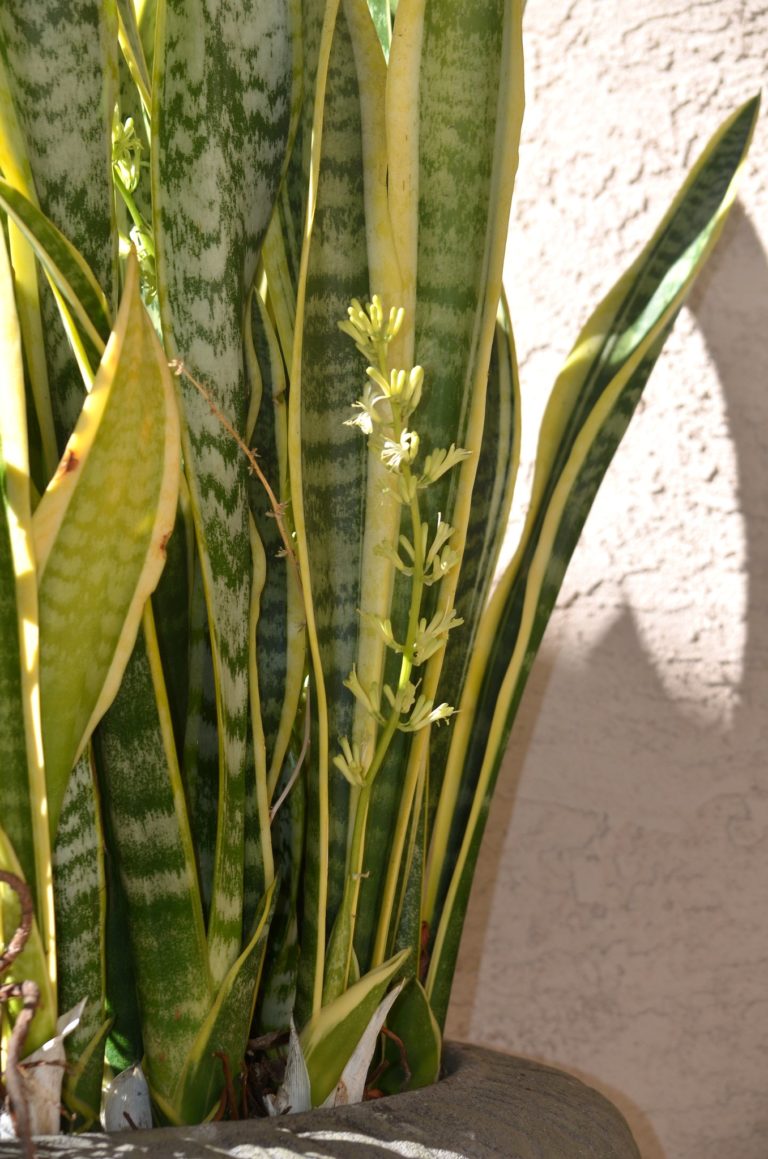
Read our guide to Snake PlantThis is the plant that earned the whole genus its reputation for near-indestructibility. Dracaena trifasciata produces upright, lance-shaped leaves with dark green banding on a lighter green background. It handles low light, erratic watering, and neglect with a tolerance that few other houseplants can match.
Indoors, plants typically reach 2 to 3 feet tall (60 to 90 cm) with a spread of 1 to 2 feet (30 to 60 cm). In warm outdoor conditions they can push to 4 feet (1.2 m). Flowering is rare indoors. Outdoors, mature plants occasionally produce fragrant greenish-white flowers on a slender spike in spring, followed by orange berries.
Useful cultivars include ‘Futura Robusta’, a compact gray-green form, and ‘Twist’, which has spiraling leaves edged in yellow. This is the right starting point if you want the most versatile, easily sourced snake plant with a proven track record.
2. Variegated Snake Plant (Dracaena trifasciata ‘Laurentii’)
Variegated Snake Plant
Variegated Snake Plant is a low maintenance evergreen houseplant with upright variegated leaves. It tolerates low light but performs best with bright indirect light and well drained soil.
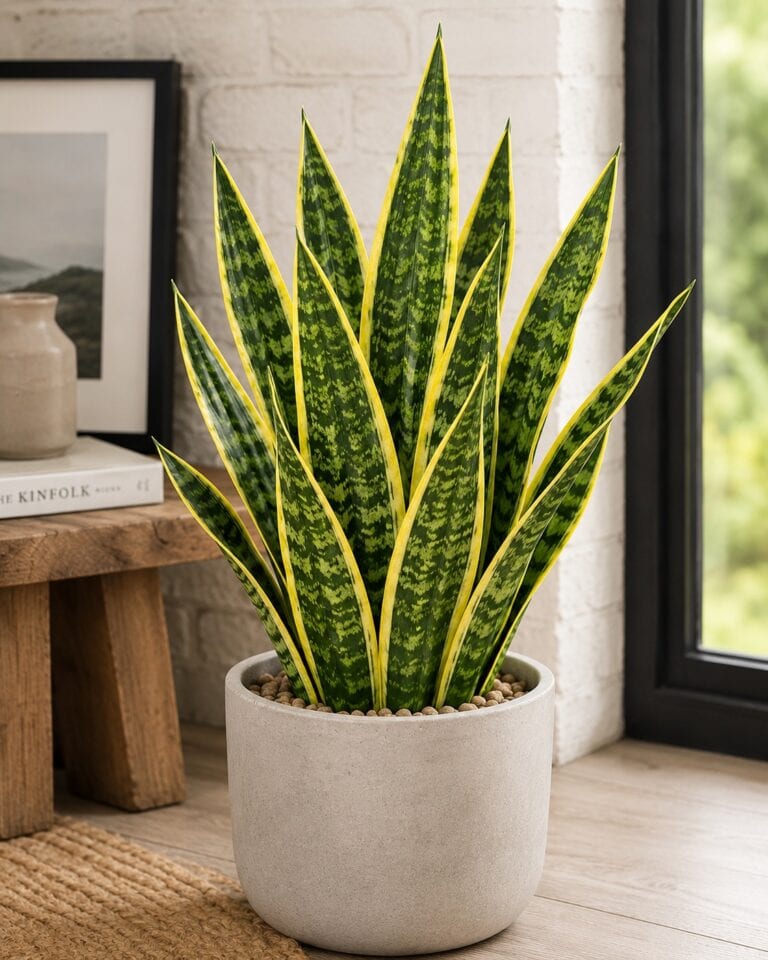
Read our guide to Variegated Snake Plant‘Laurentii’ is the most visually striking of the tall snake plants. It carries the same upright blade shape as the species but adds bold, solid yellow margins running the full length of each leaf. The central zone displays the characteristic dark and pale green horizontal banding of the species.
It reaches 2 to 4 feet tall (60 to 120 cm), making it a proper floor plant in a bright room. The yellow margins are brightest in good light. In lower light the variegation persists but becomes less vivid. A closely related cultivar, ‘Futura Superba’, offers the same coloring in a shorter, wider-leafed form that suits tighter spaces.
‘Laurentii’ is the go-to when the plain species feels too understated. It tolerates the same conditions as the species but rewards brighter placement with its most intense color.
3. Moonshine Snake Plant (Dracaena trifasciata ‘Moonshine’)
Moonshine Snake Plant
Moonshine Snake Plant is a silvery leafed cultivar grown for easy indoor care. It tolerates low light and drought but needs well draining soil to avoid root rot.
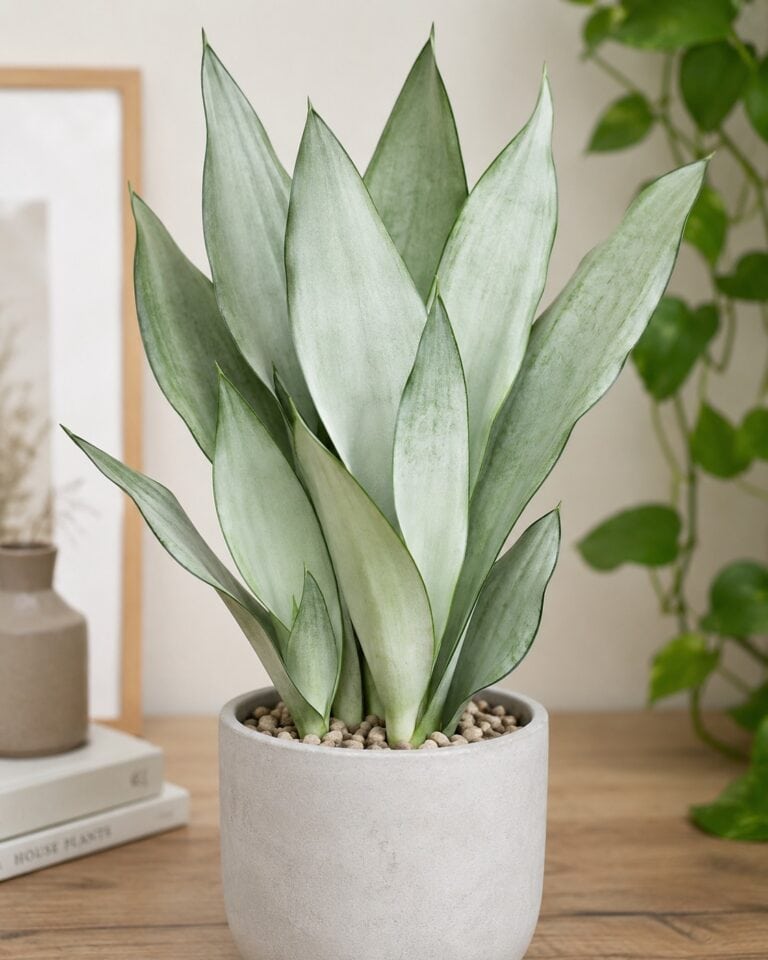
Read our guide to Moonshine Snake Plant‘Moonshine’ looks like a different plant entirely from the striped green forms. Its broad, upright leaves are a pale, almost luminous silvery-green, with only a faint dark edging. The effect is closer to pale jade or polished pewter than anything you would typically expect from a snake plant.
It grows up to 2 feet tall (60 cm) indoors, with wider leaves and a slightly shorter stature than ‘Laurentii’. That silvery coloring is light-dependent. In lower light, the leaves gradually revert to a darker, duller green. Bright indirect light is essential to keep the characteristic pallor. This makes it one of the few snake plant types where light placement genuinely changes what you get.
‘Moonshine’ suits modern or minimalist interiors well. The pale foliage is understated but refined, and the same forgiving watering habits as any other Dracaena trifasciata make it no harder to keep than the standard forms.
4. Bird’s Nest Snake Plant (Dracaena trifasciata ‘Hahnii’)
Read our guide to Bird’s Nest Snake Plant
Bird’s Nest Snake Plant
Bird's Nest Snake Plant is a compact rosette snake plant often grown indoors for its low maintenance habit. It tolerates low light and prefers a well draining potting mix.
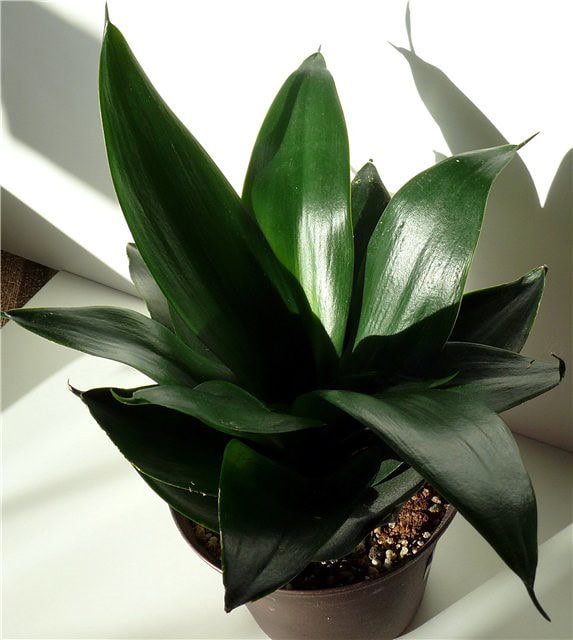
Read our guide to Bird's Nest Snake Plant‘Hahnii’ grows in a tight, cup-shaped rosette rather than sending up tall blades. The leaves are short and wide, arranged in a spiral that closely resembles a bird’s nest. The overall height stays between 6 and 12 inches (15 to 30 cm), which puts this type in an entirely different category from upright snake plants.
Hardy to USDA Zones 9b to 12, it is one of the tougher forms for marginally cooler outdoor climates. The main care note is to avoid letting water pool in the center of the rosette, where it promotes rot. Good cultivars include ‘Golden Hahnii’, which adds yellow margins to the rosette leaves, and ‘Silver Hahnii’, with silvery-banded foliage.
This is the right type for shelves, desks, and small windowsills where a full-size snake plant would be absurd. It carries the same tolerance for low water and indirect light as the larger forms, just in a fraction of the footprint.
5. African Spear Plant / Cylindrical Snake Plant (Dracaena cylindrica)

African Spear Plant
The African Spear Plant is a succulent houseplant with upright cylindrical leaves. It tolerates low light and drought but needs well drained soil to avoid root rot.
Read our guide to African Spear PlantDracaena cylindrica / Sansevieria cylindrica produces leaves that are round in cross-section rather than flat. Each dark green cylinder tapers to a sharp point and can reach 7 feet (2.1 m) tall in warm outdoor conditions, though plants grown indoors typically stay between 2 and 4 feet (60 to 120 cm). The leaves are often banded with lighter green variegation along their length.
This species tolerates brighter light than most trifasciata types and can handle periods of direct sun that would scorch flat-leaved cultivars. In retail it is frequently sold braided, fanned, or arranged in decorative patterns. Left to grow naturally, it develops a loose starburst or fan arrangement that is strongly architectural.
It suits modern, tropical, or desert-style planting schemes where a distinctive silhouette matters. The cylindrical form provides a texture and visual weight that no flat-leaved snake plant can replicate, and the care requirements are equally straightforward.
6. Whale Fin Snake Plant (Dracaena masoniana)
Read our guide to Whale Fin Snake Plant
Whale Fin Snake Plant
Whale Fin Snake Plant is a striking houseplant prized for its very wide upright leaves and easy care. It tolerates low light and drought but needs well draining soil and should be kept away from pets.
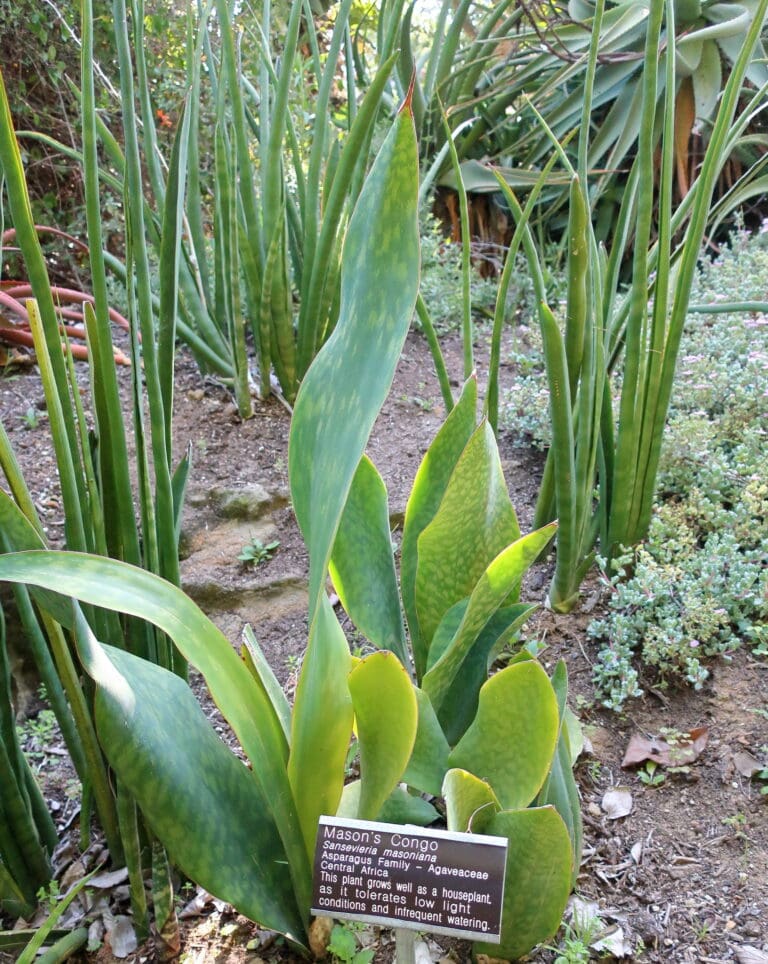
Read our guide to Whale Fin Snake PlantDracaena masoniana is the most dramatically scaled snake plant in common cultivation. It produces just one or two enormous paddle-shaped leaves at a time, each reaching 3 to 4 feet tall (90 to 120 cm) and up to 10 inches wide (25 cm). The leaves are dark green with lighter mottled patterning across the surface. The common name, whale fin, captures the shape well.
Because of the slow growth rate and low leaf count, it develops as a bold single-statement plant rather than a bushy specimen. It is hardy in USDA Zones 10 to 11 and grows best in bright indirect light. Direct midday sun can scorch the broad leaf surface. Watering requirements are even more minimal than other snake plant types.
A variegated form exists with yellow-edged leaves, but it is rarely found outside specialist collections. The standard form alone is striking enough to justify a prominent spot. This is the type for gardeners who want a plant that prompts questions.
7. Bantel’s Sensation (Dracaena trifasciata ‘Bantel’s Sensation’)
‘Bantel’s Sensation’ is the most refined of the trifasciata cultivars. Its leaves are narrow — approximately 1 inch (2.5 cm) wide — and carry bold vertical white stripes running from base to tip. The stripes are not horizontal bands but crisp lengthwise lines, giving the plant a sharp, graphic quality unlike any other snake plant.
It grows to around 3 feet tall (90 cm). The white stripes contain no chlorophyll, which means the plant has reduced photosynthetic capacity. That translates to a practical care requirement: ‘Bantel’s Sensation’ needs more light than most snake plants. Bright indirect light is not optional for this one — lower light leads to poor growth and dull coloring. Watering should be sparing, roughly once every ten days during the growing season.
It is harder to find than standard trifasciata types but not dramatically more difficult to grow once you place it correctly. The narrow, white-striped form suits contemporary interiors and makes a strong accent among other foliage plants where bolder leaf shapes provide contrast.