Bradford pear (Pyrus calleryana ‘Bradford’) is a deciduous tree that reached near-ubiquity in American neighborhoods between the 1970s and 1990s. The USDA released the ‘Bradford’ cultivar in 1963 as a tough, fast-growing ornamental suited to difficult urban sites, and nurseries embraced it for the next four decades. At maturity it typically grows 30 to 50 feet (9 to 15m) tall with a distinctive upright-oval form, and in early spring it puts on one of the most conspicuous white flower displays of any tree in its size class.
Contents
- Pros Of Bradford Pear Trees
- Bradford Pear Produces One of the Most Dramatic White Spring Displays of Any Ornamental Tree
- Fall Color Is Reliably Intense Even in Warm Southern Climates
- Bradford Pear Thrives in Urban Sites and Poor Soils Where Most Ornamentals Fail
- Fast Growth Delivers Substantial Landscape Presence Within Five Years
- Cons Of Bradford Pear Trees
- Is Bradford Pear Right For You?
- Frequently Asked Questions
Whether to plant one today is a genuinely complicated question. The spring bloom is real, the fall color is reliable in climates where other trees disappoint, and few ornamentals tolerate poor urban soils as well. But the cultivar has structural flaws that cause near-certain storm damage within 20 to 25 years, and its status as an invasive species across much of the eastern US has led to active bans in multiple states. This article covers all four sides of that equation so you can make an informed decision.
Pros Of Bradford Pear Trees
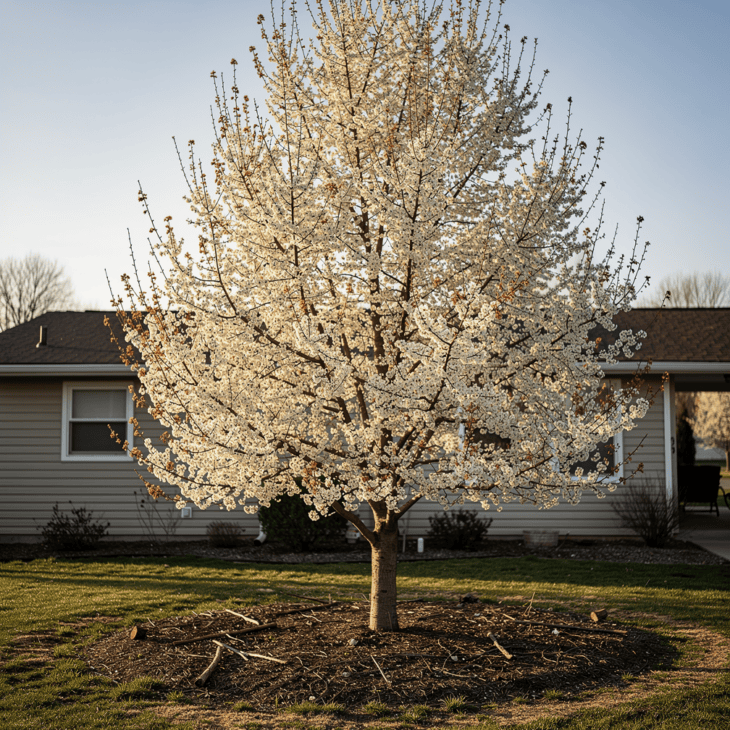
Bradford Pear Produces One of the Most Dramatic White Spring Displays of Any Ornamental Tree
Bradford pear blooms in late March to April across most of Zones 5 to 9, typically before leaf emergence, covering every branch in dense white flowers that create a cloud-white display visible from a block away. The bloom period lasts 1 to 2 weeks and, for sheer flower density at that time of year, it genuinely outperforms most comparably sized ornamental trees. The timing coincides with forsythia and redbud, making Bradford pear one of the marquee early-spring ornamentals in American neighborhoods from New England to the Carolinas. This bloom quality is the primary reason it was planted so widely, and it remains a real ornamental asset that should be acknowledged honestly.
Gardeners and developers who want the fastest and most visible early-spring statement from a large ornamental tree will find few competitors at a comparable price point and establishment speed. The display is best appreciated from 30 feet (9m) or more, which is worth keeping in mind when choosing a planting location.
Fall Color Is Reliably Intense Even in Warm Southern Climates
Bradford pear produces dependable fall foliage in orange, red, and burgundy-purple through late October and November. Unlike many ornamental trees that depend on sharp, early cold nights to trigger good fall color, Bradford pear turns reliably in Zones 7 to 9 where mild autumns frequently disappoint. In parts of the South where maple trees and other cold-dependent choices underperform for fall color, Bradford pear is among a short list of ornamental trees that deliver a meaningful autumn display most years.
Fall color peaks in late October to mid-November, and the orange-red-purple range is consistent across individual specimens rather than variable from tree to tree. This reliability is especially valuable for gardeners in the Gulf South and lower Piedmont who have tried and been disappointed by trees that need more dramatic temperature swings to perform.
Bradford Pear Thrives in Urban Sites and Poor Soils Where Most Ornamentals Fail
Pyrus calleryana tolerates an exceptional range of difficult conditions: compacted soil, alkaline pH, roadside salt spray, clay, urban air pollution, and periodic waterlogging. This adaptability made it the default street tree and commercial landscape tree for decades because it survives where more sensitive ornamentals die within a few years. Street tree pits with minimal soil volume, mall parking lots, highway medians, and new construction sites with stripped topsoil and compacted subsoil — Bradford pear establishes reliably in all of them. Few ornamental trees of comparable visual quality match that range of tolerance.
Its root system is not particularly aggressive, which made it safer for confined planting situations than alternatives like willows or poplars. For homeowners dealing with newly graded construction soil where most planting options are limited, Bradford pear establishes quickly and gives immediate results while slower alternatives are still struggling to root out.
Fast Growth Delivers Substantial Landscape Presence Within Five Years
At 12 to 24 inches (30 to 60cm) of growth per year, and up to 2 to 3 feet (60 to 90cm) per year on well-watered sites, Bradford pear reaches a meaningful landscape size faster than almost any ornamental tree in its class. A tree planted at 6 feet (1.8m) will reach 15 to 20 feet (4.5 to 6m) within 5 to 7 years, providing shade, visual screening, and ornamental value that slower-growing alternatives simply cannot match on the same timeline. Most native alternatives with equivalent ornamental quality, including serviceberry and redbud (Cercis canadensis), grow at 12 to 18 inches (30 to 45cm) per year or less.
For new construction landscapes, commercial properties, or rental housing where tree size in 5 years matters more than tree condition in 30, this growth rate has genuine practical value. It is the other side of the short-lifespan coin: Bradford pear gives up longevity in exchange for speed, and for certain situations that is a reasonable trade.
Cons Of Bradford Pear Trees
The Branch Structure Splits Apart, Predictably, by 20 to 25 Years
The ‘Bradford’ cultivar was selected for dense, upright branching that gives the tree its tidy oval form when young. Those branches attach at very narrow angles, often less than 30 to 45 degrees, with included bark at the unions. Included bark means the branch and trunk are not strongly bonded at the attachment point; as branches grow heavier with age, these unions fail. A Bradford pear in its second decade routinely loses major scaffold limbs in any significant storm, high-wind event, or ice accumulation. By 20 to 25 years, most specimens have experienced at least one catastrophic split. This is not a site problem or a management failure: it is a structural defect built into the cultivar and present in every single specimen.
Regular professional crown-thinning can reduce the load on the most vulnerable unions and may delay the first major failure by a few years. It cannot change the underlying branch angle geometry. There is no reliable cultural practice that makes a Bradford pear structurally sound for the long term. The only reliable solution is to plant a structurally sound alternative from the start, or to plan proactively for replacement before failure occurs.
Bradford Pear Is Invasive Across the Eastern US and Actively Banned in Multiple States
‘Bradford’ pear was originally marketed as sterile. This was incorrect. The cultivar is self-incompatible (it cannot pollinate itself) but cross-fertile with other P. calleryana cultivars and with wild Callery pear populations. As nurseries planted multiple cultivars — Chanticleer, Cleveland Select, Aristocrat, and others — across the landscape over decades, cross-pollination produced abundant fertile seed spread by birds. Pyrus calleryana is now listed as invasive in at least 24 states across the eastern US, where it forms dense thorny thickets (wild seedlings revert to the thorny wild-type form) that crowd out native vegetation in forest edges, roadsides, and natural areas. Ohio banned all P. calleryana cultivars effective January 2023; South Carolina enacted a ban in 2024; Pennsylvania, West Virginia, and other states are following.
A Bradford pear in any landscape with other Callery pear cultivars nearby, which is now essentially universal across the eastern US, is actively contributing seeds to invasive spread each spring regardless of how well-maintained the individual tree is. No amount of individual management changes this. For gardeners near natural areas, forest edges, or roadsides, this is both a meaningful environmental concern and a growing legal liability.
The Flowers Smell Like Fish for One to Two Weeks Every Spring
Bradford pear flowers produce trimethylamine and related volatile compounds that generate an odor widely described as fishy or similar to rotting organic matter. This is not a subtle background scent: it is detectable from 10 to 20 feet (3 to 6m) away during the bloom period and noticeable downwind at greater distances on warm, still days. The odor is not an accident or a disease symptom; it is the result of the tree’s pollination strategy. Pyrus calleryana evolved to attract flies and beetles as pollinators, and those insects are drawn to the scent of decay rather than sweetness. Many homeowners who planted Bradford pear for its spring display discovered the smell for the first time on a warm morning after planting and were genuinely surprised.
The bloom period lasts 1 to 2 weeks in March to April. For trees at the back of a large lot, the odor may be barely noticeable. For trees within 30 feet (9m) of a patio, frequently opened windows, or a primary entry path, it is a recurring annual nuisance that no cultural practice can reduce. The odor is a fixed trait of the species and is present in all P. calleryana cultivars.
A Bradford Pear Planted Today Will Almost Certainly Need Replacing Within 20 Years
When the structural failure timeline (near-certain by 20 to 25 years) is combined with the expanding state ban programs and the growing social pressure to remove invasive trees, a Bradford pear planted today has a predictable useful lifespan of roughly 15 to 20 years before either storm damage or voluntary removal makes replacement necessary. Most ornamental trees planted at the same time would be approaching their prime at 20 years and continue improving for decades. Bradford pear, by contrast, is a fast-depreciating landscape investment: high visual impact early, followed by significant property liability and replacement cost well within a typical homeowner’s time horizon.
The full cost of eventual replacement includes both removal, which can be substantial for a large, partially storm-damaged tree with included-bark scaffold failures, and replanting. Choosing a structurally sound alternative now avoids both costs. If a Bradford pear is already in the landscape, developing a proactive replacement plan before structural failure is considerably cheaper than emergency storm removal under pressure.
Is Bradford Pear Right For You?
Bradford pear is hardest to argue against in short-term commercial or transitional landscapes where quick visual impact over a 10 to 15 year window is the explicit goal. A new subdivision lot, a commercial property with a planned renovation in 15 years, a rental house where the next owner will manage eventual replacement: in these situations, its fast growth, tough site adaptability, reliable spring bloom, and low purchase cost have real value. Its ornamental qualities are genuine. The problem is not that Bradford pear has no merits; the problem is that its liabilities are serious, predictable, and not situational.
For a permanent residential planting, the case for Bradford pear is much weaker. If you live in Ohio, South Carolina, or another state with an active ban on Pyrus calleryana, purchasing one for new planting is illegal. If your planting site is within fragrance range of a patio, a primary outdoor seating area, or frequently opened windows, the spring bloom period will be a recurring annual problem. If your property or neighborhood borders natural areas, roadsides, or forest edges, the tree contributes to invasive spread each spring regardless of individual management. And in any setting, the near-certain structural failure within 20 to 25 years means you will need to make this investment again within your lifetime, plus pay to remove a large, partially failed tree.
If you want what Bradford pear does well — white spring bloom, reliable fall color, fast growth — the better alternatives deliver all of it without the liabilities. Serviceberry (Amelanchier × grandiflora ‘Autumn Brilliance’) was specifically recommended by Ohio’s Bradford pear ban program as a direct trade-in replacement: white flowers at the same early-spring timing, excellent fall color, edible fruit for birds, a native origin, and a structurally sound branching habit — all in a 15 to 25 foot (4.5 to 7.5m) form. The pros and cons of redbud trees are worth reading if you want a different but equally showy spring display, with deep-pink flowers in the same window across Zones 4 to 9, no invasive concerns, and no odor. For white bloom with ornamental fruit and strong wildlife value, native crabapple in disease-resistant cultivars such as ‘Prairie Fire’ or ‘Sargentii’ is the third strong option.
Frequently Asked Questions
How Long Do Bradford Pear Trees Live?
Bradford pear trees typically survive 15 to 25 years before structural failure, which is significantly shorter than most ornamental trees. The cultivar’s narrow branch angles create weak wood unions that split under storm loading, ice accumulation, or the tree’s own mature weight. Some specimens survive longer in sheltered sites with regular professional pruning, but structural failure by 25 years is the norm rather than the exception. Most ornamental trees planted at the same time, including serviceberries, redbuds, and oaks, would be approaching their prime at 25 years and continue improving for decades afterward.
Why Are Bradford Pear Trees Bad?
Bradford pear trees have two fundamental problems: structural failure and invasive spread. The cultivar’s narrow branch angles create weak wood unions that split apart, typically within 20 to 25 years, creating a storm-damage hazard near structures and vehicles. Separately, ‘Bradford’ is not truly sterile: it cross-pollinates with other Callery pear cultivars to produce fertile seeds that birds spread widely. Pyrus calleryana is now invasive in over 20 eastern US states, forming dense thorny thickets that crowd out native plants. A flowering Bradford pear contributes to this spread every spring regardless of how well the individual tree is maintained.
Are Bradford Pear Trees Banned?
Yes, in several states, and the list is growing. Ohio banned the sale of all Pyrus calleryana cultivars beginning January 2023, accompanied by a tree-swap program offering free native replacements to homeowners who removed existing trees. South Carolina enacted a ban in 2024. Pennsylvania, West Virginia, and other states have listed the species as invasive or restricted. Homeowners with existing Bradford pears are generally not required to remove them, but new planting is banned or restricted in a growing number of states, and the legislative trend is clearly in one direction.
What Should I Plant Instead of a Bradford Pear?
The best replacement depends on what you valued about Bradford pear. For similar spring bloom timing with white flowers, serviceberry (Amelanchier × grandiflora ‘Autumn Brilliance’) is the most widely recommended direct substitute and was specifically promoted by Ohio’s ban program as a trade-in alternative. For early spring color with pink rather than white flowers, redbud (Cercis canadensis) blooms at the same time, is structurally sound, and has no invasive concerns across Zones 4 to 9. Avoid other Callery pear cultivars such as Chanticleer or Cleveland Select: they are the same invasive species with slightly better branch structure but the same ecological problem.