Few trees stop traffic in spring the way a magnolia does. The genus Magnoliaceae contains some of the most primitive flowering plants on earth — magnolias were producing large, showy blooms before bees existed, relying on beetles as pollinators — and that ancient lineage shows in flowers that feel almost tropical in scale. Whether you are drawn to the deep-pink goblet blooms of saucer magnolia (Magnolia × soulangeana) bursting from bare branches in March, or the creamy-white, fragrant plates of Southern magnolia (Magnolia grandiflora) in June, the visual and sensory impact is difficult to match with any other temperate tree.
Contents
- Pros Of Magnolia Trees
- Magnolia Trees Produce the Most Spectacular Flowers of Almost Any Temperate Tree
- Southern Magnolia Gives the Garden Bold Evergreen Structure Year-Round
- Magnolia Flowers Carry Some of the Strongest Fragrance of Any Garden Tree
- The Genus Spans Sizes From Compact Garden Specimens to Large Shade Trees
- Magnolias Are Largely Free From Serious Pests and Diseases
- Cons Of Magnolia Trees
- Late Frosts Turn Saucer Magnolia’s Spring Flowers Brown Before You Can Enjoy Them
- Southern Magnolia Drops Leaves and Seed Pods Year-Round Without Stopping
- Magnolia Roots Are Brittle and Do Not Forgive Transplanting or Nearby Construction
- Large Magnolia Species Consistently Outgrow the Spaces They Are Planted In
- Is Magnolia Right For You?
- Frequently Asked Questions
The catch is that “magnolia trees” is not a single plant — it covers a genus with wildly different sizes, cold hardiness levels, and growth habits. The right magnolia for a large Southern estate is a completely different plant from the right one for a Chicago suburban yard. Getting that match wrong is the source of most magnolia disappointments: flowers browned by frost every spring, a tree that outgrows its site in fifteen years, or a leaf-drop problem that turns a pool area into a maintenance headache. This article covers five genuine advantages and four real limitations across the species most commonly planted in US gardens.
Pros Of Magnolia Trees
Magnolia Trees Produce the Most Spectacular Flowers of Almost Any Temperate Tree
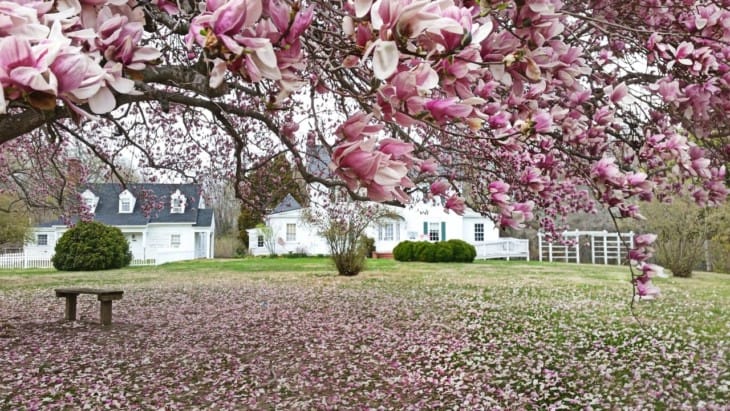
Magnolia flowers are genuinely in a class of their own. Saucer magnolia (M. × soulangeana) opens 5–10 inch (12–25cm) goblet-shaped flowers in white, pink, and deep purple before a single leaf has emerged in March and April, creating a display visible from the street on a tree that is otherwise bare and leafless. Southern magnolia (M. grandiflora) produces creamy-white blooms up to 12 inches (30cm) across from May through July, each flower lasting several days before dropping its petals cleanly. There is no other widely-grown temperate flowering tree that produces blooms of this scale with this consistency — cherries, crabapples, and dogwoods are beautiful, but none approach magnolia for sheer flower size.
Gardeners in Zones 4–9 have good options to choose from across the genus. For strong pink color, saucer magnolia cultivars ‘Alexandrina’ and ‘Lennei’ are well proven. For white blooms on a large Southern magnolia, ‘Samuel Sommer’ produces particularly large flowers, and ‘Little Gem’ delivers the same Southern magnolia look at a fraction of the standard size — topping out at 8–12 feet (2.4–3.6m).

Southern Magnolia Gives the Garden Bold Evergreen Structure Year-Round
Magnolia grandiflora is one of the few broad-leaved evergreen trees reliably hardy across Zones 7–9, and it provides dense, glossy dark-green foliage twelve months of the year. The large leathery leaves — up to 12 inches (30cm) long with a distinctive russet-brown underside — give the tree a bold, almost architectural presence in winter when every deciduous tree around it is bare. That year-round visual mass is something no saucer magnolia or cherry can provide, and it makes Southern magnolia the natural choice for large-property screening, windbreaks, and structural anchor plantings across the Gulf South and lower Mid-Atlantic.
The dense evergreen canopy also provides year-round wildlife cover — cavity-nesting birds use large Southern magnolias as shelter through winter — making it one of the more ecologically valuable large trees for the region. The cultivar ‘Bracken’s Brown Beauty’, selected for particularly intense russet indumentum and stronger cold hardiness (to Zone 5b), extends the range of this evergreen value north of the standard Zone 7 boundary.
Magnolia Flowers Carry Some of the Strongest Fragrance of Any Garden Tree
Magnolia flowers were producing scent for beetle pollinators long before bees or butterflies appeared in the fossil record — the fragrance is potent, genuine, and not a trait that has been diluted by ornamental breeding for appearance. Southern magnolia’s blooms carry a rich, sweet-lemony scent strong enough to be noticeable from 30–40 feet (9–12m) away on warm summer evenings. Star magnolia (M. stellata) has a lighter but distinctly sweet fragrance that makes it one of the better small-garden choices for planting near a patio or window. The Oyama magnolia (M. sieboldii) is specifically noted among smaller species for exceptional fragrance.
This is a meaningful practical advantage: most flowering trees (cherries, crabapples, ornamental pears) are planted entirely for visual effect. A magnolia near a terrace or bedroom window delivers both. In the Little Girl hybrid series, the cultivars ‘Ann’, ‘Betty’, and ‘Judy’ carry moderate fragrance combined with the late-blooming habit that reduces frost damage risk in Zones 4–7.

The Genus Spans Sizes From Compact Garden Specimens to Large Shade Trees
One of the practical strengths of the magnolia genus is the genuine size range available within it. At one end, Southern magnolia reaches 60–80 feet (18–24m) tall and 30–50 feet (9–15m) wide on a good site — a true large shade tree with ornamental bloom. At the other end, the Little Girl hybrid series (‘Jane’, ‘Ann’, ‘Betty’, ‘Judy’) tops out at 8–12 feet (2.4–3.6m) with a proportionally narrow spread, making it usable in small suburban yards, foundation plantings, and courtyard gardens. These hybrids were bred specifically by the US National Arboretum to combine small size, cold hardiness to Zone 4, and late bloom that avoids spring frosts.
Between these extremes, saucer magnolia sits at 20–30 feet (6–9m) tall and wide — a medium specimen tree appropriate for most standard residential lots. Sweetbay magnolia (M. virginiana) fills the gap for gardeners in Zones 5–10 who have wet or poorly drained soil, growing 10–35 feet (3–10.5m) depending on climate and handling conditions that would defeat most ornamentals. The practical message is that species selection matters enormously, and a well-matched magnolia can succeed on almost any lot size.
Magnolias Are Largely Free From Serious Pests and Diseases
Compared to dogwoods (anthracnose), crabapples and cherries (fireblight, powdery mildew, various leaf spots), and birch trees (bronze birch borer), magnolias carry a comparatively clean pest-and-disease record in North American gardens. There is no single systemic disease threat that has devastated magnolia populations the way dogwood anthracnose swept through eastern forests in the 1980s. Established magnolias on appropriate sites rarely require preventive spraying, fungicide applications, or insecticide treatment.
The main threats to know: magnolia scale (Neolecanium cornuparvum), an armored scale insect that appears as white waxy bumps on stems and is controlled effectively with dormant oil applied before new growth in late winter; and leaf spot fungi (Phyllosticta and relatives) that produce cosmetic brown patches on Southern magnolia leaves, rarely requiring treatment. Neither is a serious ongoing burden for a well-sited tree. For gardeners who have spent years managing fireblight on pears or spraying cherries for leaf curl, a magnolia’s clean bill of health is a genuine relief.

Cons Of Magnolia Trees
Late Frosts Turn Saucer Magnolia’s Spring Flowers Brown Before You Can Enjoy Them
Standard saucer magnolia and star magnolia bloom in late February to April — the same window in which late-season freezes are still a realistic possibility in Zones 5–7. When an open magnolia flower is exposed to temperatures below 28°F (-2°C), the petals collapse within hours and turn brown. The tree itself is entirely unharmed, but the ornamental event of the year is over. In climates with variable late winters, this happens in two or three years out of five. Gardeners who planted a saucer magnolia expecting a reliable annual spectacle often find instead a reliable annual lottery.
The most effective mitigation is choosing late-blooming cultivars. The Little Girl series — ‘Ann’, ‘Betty’, ‘Jane’, ‘Judy’, ‘Randy’, ‘Ricki’, ‘Susan’ — blooms 2–3 weeks later than standard saucer magnolia and clears the worst frost window in most Zone 5–7 climates. Planting against a south-facing wall or in a slightly sheltered spot can delay bloom by a few days, sometimes enough to matter. But no cultural practice reliably protects early-blooming types in the frost-prone zones where they are most commonly sold.
Southern Magnolia Drops Leaves and Seed Pods Year-Round Without Stopping
Magnolia grandiflora is technically evergreen but behaves as a continuous dropper rather than a tidy, stable tree. Old leaves are shed throughout the year — not in a single autumn dump, but in a rolling year-round cycle. The large, leathery leaves decompose slowly and build up into a thick, persistent mat that smothers lawn grass, prevents most ground covers from establishing, and looks untidy in any formal setting. The tree also produces large cone-like seed pods that fall in autumn, split open to release bright red seeds, and then require removal. Beneath the canopy of a mature Southern magnolia, a permanent mulched zone of leaf debris is simply the normal state of affairs.
This is one of the most commonly cited sources of buyer’s regret for M. grandiflora in suburban settings. A homeowner who plants it 15 feet from a pool or patio discovers within three years that the leaf and pod debris is a daily management task from spring through winter. The practical fix is to either accept the leaf zone as a natural mulched bed and plant shade-tolerant perennials within it, or to choose a compact cultivar like ‘Little Gem’ that produces debris proportional to a smaller tree.
Magnolia Roots Are Brittle and Do Not Forgive Transplanting or Nearby Construction
Magnolia roots are thick, fleshy, and sparsely branched — they look more like the roots of a perennial than the fibrous root mass of a maple or oak. When these roots are broken or severed, they do not regenerate readily, which has two practical consequences. First, transplanting established magnolias is difficult and often fails: a saucer magnolia over 5–6 feet (1.5–1.8m) tall that is dug and moved has a significantly lower survival rate than a comparably sized deciduous tree. Bare-root transplanting almost always fails entirely. Second, construction disturbance — trenching, grading, compaction from machinery — within the drip line of an established magnolia often causes delayed decline that appears months or years after the work is done.
The practical implication is straightforward: choose the permanent location carefully before planting and treat the magnolia as a fixed landscape feature once it is in the ground. Container-grown specimens purchased young (under 4–5 feet/1.2–1.5m) establish most reliably. Water deeply once or twice per week through the first three to five summers, and maintain a 3–4 inch (7.5–10cm) mulch layer over the root zone to protect fleshy roots from temperature extremes.
Large Magnolia Species Consistently Outgrow the Spaces They Are Planted In
Southern magnolia is sold at garden centers in 3-gallon and 5-gallon containers with labels that describe mature height as “30–50 feet,” which is accurate for stressed specimens in marginal conditions. On a good site in Zones 8–9, the realistic mature dimensions are 60–80 feet (18–24m) tall and 30–50 feet (9–15m) wide. Saucer magnolia, labeled as a “small tree,” develops a 20–25 foot (6–7.5m) spread that overhangs fences, driveways, and neighboring properties within 15–20 years on typical suburban lots. Because magnolia roots are fragile (making aggressive root pruning risky) and the trees respond poorly to heavy crown reduction, the options once overgrowth is a problem are essentially limited to living with it or removing the tree.
The solution is entirely in the planning stage: verify mature spread — not just height — against available space before purchasing, and choose the smallest species or cultivar that meets your aesthetic goals. Star magnolia (M. stellata) at 10–15 feet (3–4.5m) spread, or a Little Girl series hybrid at 8–10 feet (2.4–3m), are genuinely appropriate for typical suburban yards; standard saucer magnolia and Southern magnolia are not.
Is Magnolia Right For You?
Magnolias are among the most rewarding trees in the American garden when the species matches the site. A Little Girl hybrid magnolia in a Zone 5 suburban yard — planted in full sun with room to spread 10 feet (3m), away from overhead wires and formal lawn — will bloom reliably from late April onward for decades and never become a liability. A Southern magnolia on a large Zone 8 property with 50 feet (15m) of clear space delivers an irreplaceable combination of evergreen structure, massive summer flowers, and fragrance that no other tree in that climate zone matches. The key in both cases is making the match deliberately, before purchasing, rather than choosing based on a pot of flowers at the nursery and figuring out the consequences later.
Magnolias are a poor fit in a few specific situations: standard saucer magnolia in Zones 5–7 if you expect reliable annual bloom without frost interruption; Southern magnolia on any suburban lot where the 30–50 foot (9–15m) spread will become a problem within 20 years; any magnolia species near a pool, formal patio, or maintained lawn where continuous leaf drop is unacceptable; and any site where construction, trenching, or regrading is likely within the next 10–15 years.
If the frost problem is your main hesitation, the Little Girl series — specifically ‘Jane’ and ‘Betty’ — are worth considering before walking away from the genus entirely. They bloom 2–3 weeks later than standard saucer magnolia, bring the same deep-pink color and goblet-shaped flowers, and stay at a scale appropriate for most residential yards. For gardeners in Zones 3–8 who want reliable spring flowering tree impact at a manageable size with no frost-damage risk, serviceberry (Amelanchier × grandiflora) is the most practical alternative — it flowers slightly earlier, colors well in autumn, and handles a wider range of soil conditions. For wet sites in Zones 5–10, sweetbay magnolia (Magnolia virginiana) tolerates conditions that would kill most ornamentals and stays naturally smaller than Southern magnolia.
Frequently Asked Questions
When do magnolia trees bloom?
Bloom time varies by species. Saucer magnolia (M. × soulangeana) and star magnolia (M. stellata) bloom in late February to April, before the leaves emerge — among the earliest flowering trees of spring. Southern magnolia (M. grandiflora) blooms from May through July, with individual flowers lasting several days. The Little Girl hybrid series (‘Jane’, ‘Ann’, ‘Betty’) blooms 2–3 weeks later than standard saucer magnolia, typically in April to early May, reducing frost damage risk substantially in Zones 5–7.
How fast do magnolia trees grow?
Growth rate depends on species. Southern magnolia (M. grandiflora) grows 12–24 inches (30–60cm) per year in youth on a good site with adequate moisture and slightly acidic soil. Saucer magnolia adds 12–18 inches (30–45cm) per year. Star magnolia is one of the slowest at 6–12 inches (15–30cm) per year. All magnolias slow considerably after reaching roughly half their mature height. Adequate moisture, slightly acidic soil, and at least 6 hours of direct sun are the three factors that most reliably accelerate early growth.
Why did my magnolia flowers turn brown?
Brown, collapsed magnolia flowers in spring almost always mean frost damage — deciduous magnolias bloom very early, and open flowers are killed by temperatures below 28°F (-2°C). The tree itself is unharmed and will bloom normally the following year. If flowers on a Southern magnolia (M. grandiflora) are browning in summer, this is normal petal drop after the individual flower finishes, which takes only a few days per bloom. Brown leaf spots on M. grandiflora through the growing season are usually a cosmetic fungal leaf spot and rarely require treatment.
Do magnolia trees have invasive roots?
Magnolia roots are not invasive in the sense that willows or silver maples can be — they do not aggressively seek out pipes or crack foundations. However, surface roots of large Southern magnolias can heave nearby paving and prevent lawn grass from growing within the drip line. The real concern with magnolia roots runs in the opposite direction of invasiveness: the thick, fleshy roots are brittle and do not regenerate when damaged, making magnolias sensitive to construction disturbance and difficult to transplant successfully rather than a structural threat to nearby buildings.