
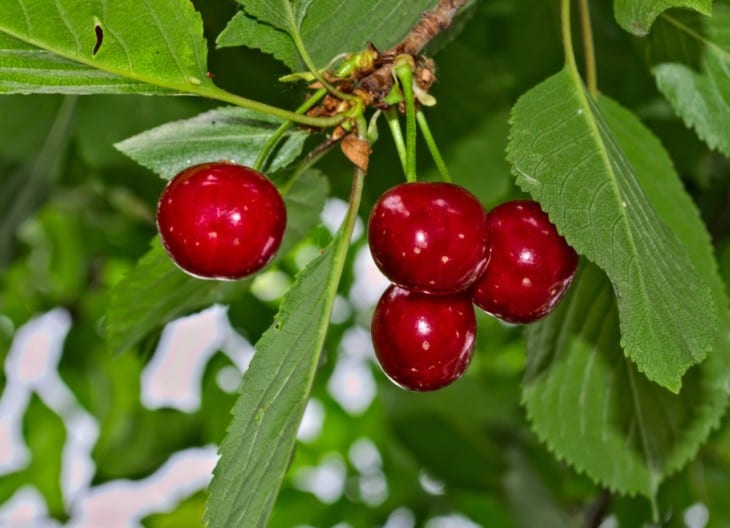
The first thing to know when choosing a sweet cherry is pollination. Most sweet cherries, including Bing, Rainier and Royal Ann, can’t pollinate themselves and need a second, compatible variety nearby. If you only have room for one tree, choose a self-fertile variety such as Stella, Lapins, Sweetheart or Blackgold. These also pollinate almost any other sweet cherry. After that, choose by fruit color (dark red or yellow with a red blush), ripening time and how well the fruit resists cracking in rain.
Contents
- Self-Fertile Sweet Cherries (One Tree Is Enough)
- Dark Red Cherries That Need a Pollinator
- ‘Bing’ (Prunus avium ‘Bing’)
- ‘Lambert’ (Prunus avium ‘Lambert’)
- ‘Van’ (Prunus avium ‘Van’)
- ‘Black Tartarian’ (Prunus avium ‘Black Tartarian’)
- ‘Chelan’ (Prunus avium ‘Chelan’)
- ‘Tulare’ (Prunus avium ‘Tulare’)
- ‘Utah Giant’ (Prunus avium ‘Utah Giant’)
- ‘Ulster’ (Prunus avium ‘Ulster’)
- ‘Kordia’ (Attika) (Prunus avium ‘Kordia’)
- ‘Regina’ (Prunus avium ‘Regina’)
- ‘Burlat’ (Prunus avium ‘Burlat’)
- ‘Coral Champagne’ (Prunus avium ‘Coral Champagne’)
- Yellow and Blush Cherries
- Tips for Growing Sweet Cherries
Sweet cherries (Prunus avium) grow best in zones 5 to 8, in full sun and deep, well-drained soil. On standard rootstock they become big trees, 25 to 35 feet tall. On dwarfing rootstocks such as Gisela 5 they stay 10 to 12 feet and start bearing in 3 or 4 years instead of 5 to 7. The heights listed by nurseries depend mostly on the rootstock, so they aren’t given for each variety below.

- Self-Fertile Sweet Cherries (One Tree Is Enough)
- Dark Red Cherries That Need a Pollinator
- Yellow and Blush Cherries
- Tips for Growing Sweet Cherries
| Variety | Botanical name | Fruit | Ripens | Pollination |
|---|---|---|---|---|
| ‘Stella’ | Prunus avium ‘Stella’ | Dark red, heart-shaped | Midseason | Self-fertile; universal pollinator |
| ‘Lapins’ | Prunus avium ‘Lapins’ | Dark red, large, firm | Late | Self-fertile; universal pollinator |
| ‘Sweetheart’ | Prunus avium ‘Sweetheart’ | Bright red, firm | Very late | Self-fertile |
| ‘Sunburst’ | Prunus avium ‘Sunburst’ | Dark red, large, soft | Midseason | Self-fertile |
| ‘Celeste’ | Prunus avium ‘Celeste’ | Dark red, large | Early | Self-fertile |
| ‘Blackgold’ | Prunus avium ‘Blackgold’ | Dark red | Late midseason | Self-fertile |
| ‘Bing’ | Prunus avium ‘Bing’ | Dark mahogany-red, heart-shaped | Midseason | Needs a pollinator; not Lambert or Royal Ann |
| ‘Lambert’ | Prunus avium ‘Lambert’ | Dark red, heart-shaped | Late | Needs a pollinator; not Bing or Royal Ann |
| ‘Van’ | Prunus avium ‘Van’ | Dark red, shiny | Midseason | Needs a pollinator |
| ‘Black Tartarian’ | Prunus avium ‘Black Tartarian’ | Purple-black, soft | Early | Needs a pollinator; pollinates most others |
| ‘Chelan’ | Prunus avium ‘Chelan’ | Dark mahogany | Early | Needs a pollinator |
| ‘Tulare’ | Prunus avium ‘Tulare’ | Dark red, heart-shaped | Early | Needs a pollinator |
| ‘Utah Giant’ | Prunus avium ‘Utah Giant’ | Dark red, very large | Midseason | Needs a pollinator |
| ‘Ulster’ | Prunus avium ‘Ulster’ | Dark red | Midseason | Needs a pollinator |
| ‘Kordia’ (Attika) | Prunus avium ‘Kordia’ | Dark red, heart-shaped | Late | Needs a pollinator |
| ‘Regina’ | Prunus avium ‘Regina’ | Dark red, firm | Very late | Needs a late-flowering pollinator |
| ‘Burlat’ | Prunus avium ‘Burlat’ | Dark red, medium | Very early | Needs a pollinator |
| ‘Coral Champagne’ | Prunus avium ‘Coral Champagne’ | Coral-red, very sweet | Early midseason | Needs a pollinator |
| ‘Rainier’ | Prunus avium ‘Rainier’ | Yellow with red blush | Early midseason | Needs a pollinator |
| ‘Royal Ann’ (Napoleon) | Prunus avium ‘Napoleon’ | Yellow with red blush | Midseason | Needs a pollinator; not Bing or Lambert |
| ‘Emperor Francis’ | Prunus avium ‘Emperor Francis’ | Yellow with red blush | Midseason | Needs a pollinator |
| ‘Early Robin’ | Prunus avium ‘Early Robin’ | Yellow with red blush | Early | Needs a pollinator |
Self-Fertile Sweet Cherries (One Tree Is Enough)
‘Stella’ (Prunus avium ‘Stella’)
‘Stella’ was released in 1968 by the Summerland research station in British Columbia and was the first self-fertile sweet cherry sold commercially. It bears large, dark red, sweet cherries a few days after Bing and is a reliable choice for a single backyard tree. It pollinates almost every other sweet cherry, so it is also the classic partner for Bing, Rainier and Lambert. The fruit can crack in heavy rain.
‘Lapins’ (Prunus avium ‘Lapins’)
‘Lapins’ is a Summerland cross of Van and Stella, released in 1983. It is one of the most popular self-fertile cherries, with large, firm, dark red fruit that resists cracking better than Stella. It needs fewer winter chill hours than most sweet cherries (about 400 to 500), so it also fruits in milder climates such as coastal California.
‘Sweetheart’ (Prunus avium ‘Sweetheart’)
‘Sweetheart’ is a Summerland variety released in 1994 that ripens about three weeks after Bing, extending the cherry season into late July or August in the North. The fruit is large, firm, bright red and mildly sweet. The tree crops very heavily and often needs thinning.
‘Sunburst’ (Prunus avium ‘Sunburst’)
‘Sunburst’ is another Summerland self-fertile cherry, with large, sweet, dark red fruit that ripens around the same time as Stella and Van. The flesh is softer than most, so it is better for eating fresh than for shipping. It is popular in the UK and Australia.
‘Celeste’ (Prunus avium ‘Celeste’)
‘Celeste’ (sold as Sumpaca) is a compact, upright Summerland variety that grows to about two-thirds the size of other sweet cherries. It is a good choice for small gardens and large containers. It ripens early, with large, dark red, sweet fruit.
‘Blackgold’ (Prunus avium ‘Blackgold’)
‘Blackgold’ was bred at Cornell’s research station in Geneva, New York, from Stark Gold and Stella. It flowers later than most sweet cherries, which helps its blossoms escape spring frosts, and it is hardy and resistant to bacterial canker. It is one of the best sweet cherries for the Northeast and Midwest.
Dark Red Cherries That Need a Pollinator
These varieties need a second, compatible sweet cherry within about 50 feet that flowers at the same time. Any self-fertile variety above will do.
‘Bing’ (Prunus avium ‘Bing’)
‘Bing’ is the most widely grown sweet cherry in the U.S. It was developed in 1875 in Milwaukie, Oregon, by nurseryman Seth Lewelling and named for his Chinese foreman, Ah Bing. The large, firm, very sweet fruit is dark mahogany when ripe. It cracks badly in rain, so it grows best in the dry summers of the West. It can’t pollinate or be pollinated by Lambert or Royal Ann. Good partners are Van, Black Tartarian, Stella and Rainier.
‘Lambert’ (Prunus avium ‘Lambert’)

‘Lambert’ is another 19th-century Oregon variety, once one of the main commercial cherries of the Pacific Northwest. It has large, dark red, sweet fruit that ripens about a week after Bing. The trees are big and vigorous. It is cross-incompatible with Bing and Royal Ann, so use Van or a self-fertile variety as its pollinator.
‘Van’ (Prunus avium ‘Van’)
‘Van’ was bred at Summerland in the 1930s and released in 1944. It is hardier than Bing, crops heavily and has shiny, dark red, firm fruit that resists cracking fairly well. It is one of the best pollinators for Bing, Lambert and Royal Ann, and it is a parent of Lapins, Sunburst and Sweetheart.
‘Black Tartarian’ (Prunus avium ‘Black Tartarian’)
‘Black Tartarian’ is an old variety that came to England from Russia in the 1790s. It ripens early, with medium-sized, purple-black, very sweet fruit that is too soft to ship, so it is a home-garden cherry. It flowers heavily and is one of the most reliable pollinators for other sweet cherries.
‘Chelan’ (Prunus avium ‘Chelan’)
‘Chelan’ was released by Washington State University in 1991. It ripens about 10 days before Bing, with firm, dark mahogany fruit, and it is more resistant to rain cracking and powdery mildew than Bing.
‘Tulare’ (Prunus avium ‘Tulare’)
‘Tulare’ is a California variety found as a seedling of Bing. It ripens about a week before Bing, with firm, heart-shaped, dark red fruit, and it needs somewhat less winter chill than Bing.
‘Utah Giant’ (Prunus avium ‘Utah Giant’)
‘Utah Giant’ has very large, firm, dark red, sweet fruit, similar to Bing but less prone to cracking. It is hardy and does well in the Intermountain West. Bing, Van, Black Tartarian and Rainier are good pollinators.
‘Ulster’ (Prunus avium ‘Ulster’)
‘Ulster’ was released by Cornell’s Geneva research station in 1964, bred from Schmidt and Lambert. It has large, firm, dark red fruit that resists rain cracking better than most, and it is hardy enough for New York and Michigan.
‘Kordia’ (Attika) (Prunus avium ‘Kordia’)
‘Kordia’, also sold as Attika, comes from the Czech Republic. It has large, firm, heart-shaped, dark red fruit with good crack resistance. It flowers late, so it needs a late-flowering partner such as Regina or Sweetheart. It is not a dwarf. Like any sweet cherry, its size depends on the rootstock.
‘Regina’ (Prunus avium ‘Regina’)
‘Regina’ was bred in Germany and is one of the latest and most crack-resistant sweet cherries. The fruit is large, firm and dark red. It flowers late, so plant it with another late bloomer such as Kordia or Sweetheart.
‘Burlat’ (Prunus avium ‘Burlat’)
‘Burlat’ is a French variety, found near Lyon in the early 1900s, and one of the earliest sweet cherries, ripening about two weeks before Bing. The fruit is medium-sized, dark red and softer than modern varieties.
‘Coral Champagne’ (Prunus avium ‘Coral Champagne’)
‘Coral Champagne’ is a California variety bred for mild winters. It needs only about 400 hours of winter chill, so it fruits in southern and coastal California, where Bing doesn’t. The fruit is medium to large, coral-red and very sweet. Black Tartarian or a self-fertile variety such as Stella makes a good pollinator.
Yellow and Blush Cherries
These have yellow skin with a red blush and pale flesh. They bruise easily, which is why they cost more in stores.
‘Rainier’ (Prunus avium ‘Rainier’)
‘Rainier’ was bred at Washington State University from Bing and Van, from a cross made in 1952, and released in 1960. It is the best-known yellow cherry, with large, very sweet, golden fruit with a pink-red blush and creamy flesh. Birds love it. Bing, Van and Black Tartarian are good pollinators.
‘Royal Ann’ (Napoleon) (Prunus avium ‘Napoleon’)
‘Royal Ann’ and ‘Napoleon’ are two names for the same old European variety. It has firm, yellow cherries with a red blush and pale, mildly sweet flesh, and it is the main cherry used for maraschino cherries and canning. It can’t pollinate or be pollinated by Bing or Lambert. Use Van or Black Tartarian instead.
‘Emperor Francis’ (Prunus avium ‘Emperor Francis’)
‘Emperor Francis’ (‘Kaiser Franz’) is an old German variety with firm, sweet, yellow cherries blushed with red. It is hardy, less prone to cracking than Royal Ann, and good for canning and maraschino cherries. Black Tartarian and Stella are good pollinators.
‘Early Robin’ (Prunus avium ‘Early Robin’)
‘Early Robin’ is a Rainier-type yellow cherry found in a Washington orchard in 1990. It ripens about a week before Rainier, with large, sweet, blushed fruit. Bing and Rainier are its usual pollinators.
Tips for Growing Sweet Cherries
- Check pollination first. Bing, Lambert and Royal Ann can’t pollinate one another. The simplest fix is to include one self-fertile variety, such as Stella or Lapins, which pollinates nearly all the others.
- Choose the rootstock. Mazzard or Mahaleb rootstocks give a full-sized tree, 25 to 35 feet tall. Gisela 5 keeps a tree around 10 to 12 feet and Gisela 6 around 12 to 15 feet, which makes netting and picking much easier.
- Match the chill hours. Most sweet cherries need 700 hours or more below 45°F in winter. In mild-winter areas, choose low-chill varieties such as Lapins, Coral Champagne, Minnie Royal or Royal Lee.
- Plan for rain and birds. Rain on ripening fruit makes cherries split. In rainy climates, grow crack-resistant varieties such as Regina, Kordia, Ulster or Chelan. Birds will take most of the crop unless you net the tree.
- Cold climates. Below zone 5, sweet cherries rarely survive. Grow a hardy tart cherry instead, such as ‘Evans’ or the University of Saskatchewan’s ‘Juliet’, which is sweet enough to eat fresh and hardy to zone 3.
- Planting. Plant bare-root trees in early spring in full sun and well-drained soil. Cherries don’t tolerate wet feet. Space standard trees about 25 to 30 feet apart and dwarf trees 8 to 12 feet apart.
Sweet cherries are also beautiful in bloom. See our guide to spring flowering trees for ornamental cherries.

