Daisies are among the most recognizable flowers in the world, known for their cheerful white petals and sunny yellow centers. But the classic daisy form—ray petals surrounding a central disk—appears across dozens of other plant species. Some are closely related members of the Asteraceae family, while others simply evolved similar flower structures that resemble the familiar daisy shape.
Contents
- 1. Purple Coneflower (Echinacea purpurea)
- 2. False Sunflower (Heliopsis helianthoides)
- 3. Blanket Flower (Gaillardia x grandiflora)
- 4. Alpine Aster / Blue Alpine Daisy (Aster alpinus)
- 5. Tickseed (Coreopsis verticillata)
- 6. German Chamomile (Matricaria chamomilla)
- 7. Cineraria (Pericallis x hybrida)
- 8. Sweet Black-Eyed Susan (Rudbeckia subtomentosa)
- 9. Ice Plant (Delosperma cooperi)
- 10. Shasta Daisy (Leucanthemum x superbum)
- 11. Oxeye Daisy (Leucanthemum vulgare)
- Final Thoughts
Whether you’re trying to identify a plant in your garden, looking for daisy alternatives for your landscape, or simply curious about similar-looking flowers, this guide covers plants that share the daisy’s distinctive appearance. We’ve removed plants that don’t truly resemble daisies and added key species that deserve a place on this list.
Below are plants commonly mistaken for daisies or that offer a similar aesthetic for gardeners seeking that classic daisy look.
1. Purple Coneflower (Echinacea purpurea)
Read our guide to Pink Coneflower

Purple coneflower is one of the most recognizable daisy-like plants in North American gardens. A member of the Asteraceae family, it shares the same composite flower structure as true daisies but with a more dramatic appearance.
Appearance: Each flower features 15 to 20 drooping pink, purple, or white ray petals surrounding a large, prominent cone-shaped center. The center disk is reddish-brown to orange and covered in spiky, pincushion-like florets. Flowers are 3 to 4 inches across.
Size and habit: Grows 2 to 4 feet tall with a clumping habit. Leaves are dark green, oval-shaped, and lightly hairy with serrated edges.
Bloom time: Mid-summer through early fall.
Growing conditions: Hardy in USDA zones 3–9. Prefers full sun and tolerates drought once established. Thrives in well-drained soil and is low-maintenance.
Best use: Excellent for pollinator gardens, prairie-style plantings, and cut flower arrangements. Also valued for medicinal uses.
Related: Are Daisies Poisonous?
2. False Sunflower (Heliopsis helianthoides)
Read our guide to False Sunflower

False sunflower, also known as oxeye sunflower, is a cheerful native perennial often described as having daisy-like flowers. Despite the name, it’s smaller and more delicate than true sunflowers but shares their sunny disposition.
Appearance: Bright yellow flowers with 20 to 30 narrow petals radiating around a darker yellow or brownish center. The center is made up of many small, cone-shaped disk florets. Flowers are 2 to 3 inches across.
Size and habit: Grows 3 to 5 feet tall. Leaves are triangular to lance-shaped, dark green, and have prominent veins and toothed margins.
Bloom time: Early summer through fall.
Growing conditions: Hardy in zones 3–9. Prefers full sun but tolerates light shade. Adaptable to a range of soils and moderately drought-tolerant.
Best use: Native wildflower gardens, pollinator plantings, and naturalized areas. Excellent cut flower.
Related: 9 Plants That Look Like Sunflowers
3. Blanket Flower (Gaillardia x grandiflora)

Blanket flower is a vibrant, heat-loving perennial in the daisy family known for its bold, multi-colored blooms. The flowers are unmistakably daisy-like in form but pack far more color than a traditional white daisy.
Appearance: Flowers feature warm hues of red, orange, and yellow, often with petals tipped in yellow and a red or burgundy base. The center is a brownish-red dome. Petals may be smooth-edged or slightly notched.
Size and habit: Grows 12 to 36 inches tall with a bushy, mounding form. Leaves are elongated, lance-shaped, and slightly fuzzy.
Bloom time: Late spring through frost with consistent deadheading.
Growing conditions: Hardy in zones 3–10. Thrives in full sun and well-drained soil. Highly drought-tolerant once established and performs well in heat.
Best use: Xeriscaping, cottage gardens, borders, and pollinator gardens. Long-lasting as a cut flower.
4. Alpine Aster / Blue Alpine Daisy (Aster alpinus)
Read our guide to Alpine Aster

Alpine aster, also called blue alpine daisy, is a compact perennial with classic daisy-form flowers. It’s often grown in rock gardens and alpine settings where its low stature and tidy habit shine.
Appearance: Flowers have 15 to 20 slender ray petals in shades of lavender, purple, pink, or white, surrounding a bright yellow center. Blooms are 1 to 2 inches across.
Size and habit: Grows 6 to 12 inches tall, forming low mounds. Leaves are narrow, lance-shaped, and sometimes slightly hairy.
Bloom time: Late spring to early summer.
Growing conditions: Hardy in zones 4–8. Prefers full sun and well-drained, slightly alkaline soil. Does not tolerate wet conditions.
Best use: Rock gardens, alpine troughs, edging, and containers. Works well in xeriscapes and dry sunny borders.
5. Tickseed (Coreopsis verticillata)

Threadleaf coreopsis is a cheerful, easy-care perennial with masses of small, daisy-like yellow flowers. It’s beloved for its long bloom period and airy, fine-textured foliage.
Appearance: Bright yellow flowers with 6 to 10 narrow petals and a small yellow or brownish-yellow center. Blooms are about 1 to 2 inches wide and produced in abundance.
Size and habit: Grows 1 to 2 feet tall with a mounding, bushy habit. Foliage is delicate and thread-like, giving the plant a feathery appearance.
Bloom time: Late spring through summer; reblooms with deadheading.
Growing conditions: Hardy in zones 3–9. Prefers full sun and tolerates poor, dry soils. Drought-tolerant and low-maintenance.
Best use: Borders, mass plantings, pollinator gardens, and naturalized areas. Excellent for erosion control on slopes.
6. German Chamomile (Matricaria chamomilla)
Read our guide to German Chamomile

German chamomile is a delicate annual herb with tiny, daisy-like flowers. It’s widely grown for its soothing herbal tea and medicinal properties, but the flowers are also charming in their own right.
Appearance: Small white flowers with 10 to 20 narrow petals surrounding a prominent, raised yellow center. Flowers are less than an inch across and resemble miniature daisies.
Size and habit: Grows 1 to 2 feet tall with a branching, open habit. Leaves are finely divided and feathery, similar to dill or fennel.
Bloom time: Late spring through summer.
Growing conditions: Annual, hardy to zone 4. Prefers full sun and well-drained soil. Self-seeds readily.
Safety note: Edible and used medicinally. Flowers are commonly harvested for tea.
Best use: Herb gardens, cottage gardens, and medicinal plantings. Also attracts beneficial insects.
Related: 9 Plants That Look Like Chamomile
7. Cineraria (Pericallis x hybrida)

Florist’s cineraria is a popular cool-season annual known for its densely packed clusters of daisy-like blooms in vibrant, often bi-colored hues. It’s a favorite for containers and indoor displays.
Appearance: Flowers come in shades of purple, blue, pink, red, and white, often with a contrasting white or pale center ring. Each bloom has 10 to 15 ray petals and a dark central disk. Flowers are 1 to 2 inches across and grow in dense clusters.
Size and habit: Compact plants grow 8 to 15 inches tall. Leaves are large, heart-shaped, and slightly fuzzy.
Bloom time: Late winter through spring in cool climates.
Growing conditions: Typically grown as an annual or houseplant. Prefers bright indirect light and cool temperatures (50–65°F). Does not tolerate heat or frost.
Best use: Indoor containers, shaded patios, spring color in cool-climate gardens. Often sold as a potted gift plant.
8. Sweet Black-Eyed Susan (Rudbeckia subtomentosa)
Read our guide to Sweet Black-Eyed Susan

Sweet black-eyed Susan is a tall, robust native wildflower with cheerful yellow blooms. While most people associate the name “black-eyed Susan” with Rudbeckia hirta, this species offers similar daisy-like flowers with a sweeter fragrance and taller stature.
Appearance: Golden-yellow flowers with 10 to 16 drooping ray petals and a dark brown to black cone-shaped center. Blooms are 2 to 3 inches across.
Size and habit: Grows 3 to 5 feet tall with a upright, branching form. Leaves are large, lance-shaped, and slightly rough to the touch.
Bloom time: Mid-summer through fall.
Growing conditions: Hardy in zones 3–8. Thrives in full sun and moist, well-drained soils. Tolerates clay and occasional flooding better than other black-eyed Susans.
Best use: Rain gardens, native wildflower meadows, back-of-border plantings, and pollinator habitat. Excellent cut flower.
9. Ice Plant (Delosperma cooperi)

Hardy ice plant is a succulent ground cover known for its brilliant, daisy-like blooms and extreme drought tolerance. Though not in the Asteraceae family, the flower structure closely mimics the daisy form.
Appearance: Vivid magenta-purple flowers with dozens of fine, needle-like petals radiating from a bright yellow center. Blooms are 1 to 2 inches across and have a shimmering, almost iridescent quality.
Size and habit: Low-growing, mat-forming perennial reaching only 3 to 6 inches tall but spreading 1 to 2 feet wide. Leaves are fleshy, cylindrical, and succulent-like.
Bloom time: Late spring through fall, with the heaviest flush in early summer.
Growing conditions: Hardy in zones 5–10. Requires full sun and very well-drained soil. Extremely drought-tolerant and ideal for poor, rocky, or sandy soils.
Best use: Rock gardens, xeriscapes, green roofs, slopes, and as a flowering ground cover in hot, dry sites.
10. Shasta Daisy (Leucanthemum x superbum)
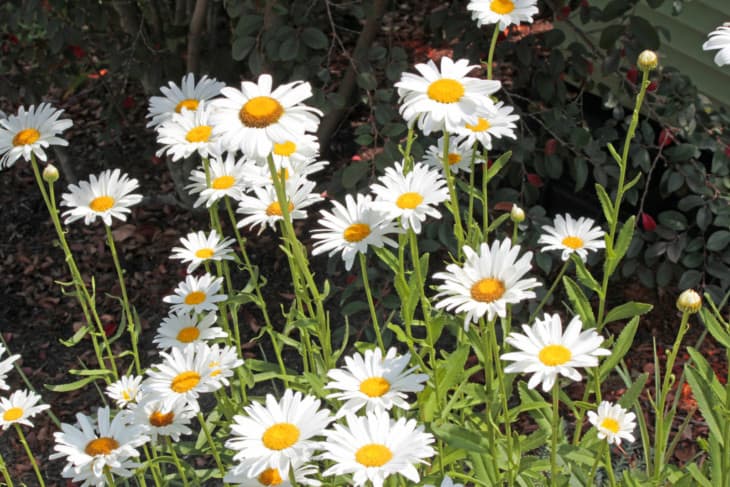
Shasta daisy is perhaps the most iconic “daisy” after the common English daisy. Developed by horticulturist Luther Burbank in the late 1800s, it’s a hybrid that embodies the classic daisy look gardeners expect: pure white petals and a sunny yellow center.
Appearance: Large white flowers with 20 to 30 crisp white ray petals surrounding a bright yellow central disk. Blooms are 3 to 4 inches across. Some cultivars feature semi-double or fully double forms.
Size and habit: Grows 1 to 3 feet tall with upright stems and dark green, lance-shaped leaves with toothed margins.
Bloom time: Late spring through summer; reblooms with deadheading.
Growing conditions: Hardy in zones 5–9. Prefers full sun and well-drained soil. Moderate water needs; does not tolerate drought as well as native species.
Best use: Cottage gardens, perennial borders, and cut flower gardens. A staple in traditional daisy bouquets.
11. Oxeye Daisy (Leucanthemum vulgare)

Oxeye daisy is a naturalized European wildflower that has become widespread across North America. It closely resembles the Shasta daisy but is smaller, more delicate, and often considered weedy in some regions.
Appearance: White flowers with 15 to 30 narrow ray petals and a flat yellow center. Blooms are 1 to 2 inches across and carried on slender, wiry stems.
Size and habit: Grows 1 to 3 feet tall with a spreading rhizomatous habit. Leaves are deeply lobed and dark green.
Bloom time: Late spring through mid-summer.
Growing conditions: Hardy in zones 3–9. Thrives in full sun and tolerates poor, dry soils. Spreads aggressively and is considered invasive in many U.S. states and Canadian provinces.
Best use: Wildflower meadows and naturalized areas only where not restricted. Check local regulations before planting, as it is banned or listed as a noxious weed in several regions.
Final Thoughts
From the bold purple cones of echinacea to the cheerful yellow of black-eyed Susans, daisy-like flowers bring brightness, pollinator support, and easy-care beauty to gardens across a wide range of climates. Whether you’re drawn to native wildflowers, heat-tolerant perennials, or compact annuals for containers, there’s a daisy lookalike to suit nearly every garden style and growing condition.
When choosing plants that look like daisies, consider bloom time, mature size, hardiness zone, and maintenance needs. Many of these species are excellent for attracting bees, butterflies, and beneficial insects, making them as functional as they are beautiful. With proper site selection and minimal care, these daisy alternatives will reward you with seasons of vibrant, sun-loving blooms.