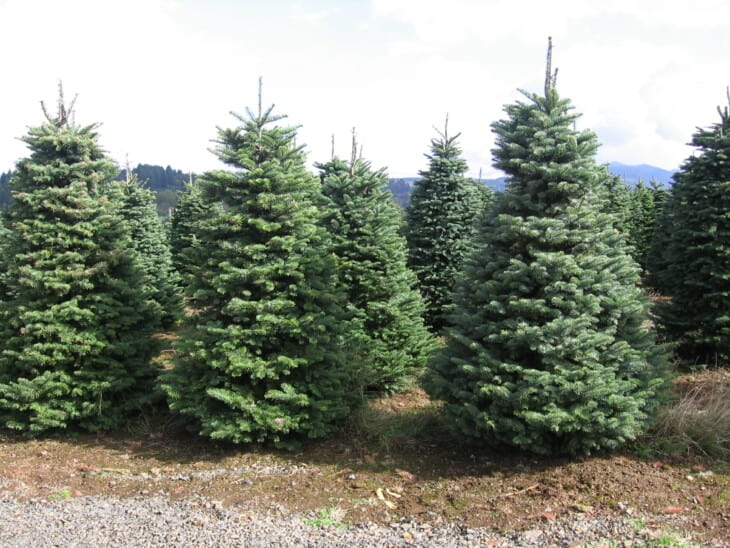
The trees that look like Christmas trees are the conifers with a single straight trunk and whorled branches that get shorter toward the top: firs, spruces, pines and a few members of the cypress family. Fraser fir, balsam fir, Douglas fir, white fir, Norway spruce, blue spruce, Scots pine and eastern white pine are the species actually grown and sold as Christmas trees in North America. Leyland cypress, eastern red cedar and Arizona cypress take their place in the South, where firs will not grow.
Contents
Douglas fir is the most widely grown Christmas tree in the United States, though Fraser fir is the one most often chosen in the East. Despite the name, Douglas fir is not a true fir: it has its own genus, Pseudotsuga, and you can recognize it by the three-pointed bracts sticking out between the cone scales, which no other conifer has.
- Firs
- Spruces
- Pines
- Cypress-Family Trees
- Trees That Look the Part but Are Not Conifers to Cut
- How to Tell Firs, Spruces and Pines Apart
- Choosing and Keeping a Cut Tree
| Tree | Botanical name | Needles | Hardiness | Grown as a Christmas tree? |
|---|---|---|---|---|
| Fraser Fir | Abies fraseri | Flat, ¾ in, dark green above, silvery beneath | Zones 4–7 | Yes, the premium choice |
| Balsam Fir | Abies balsamea | Flat, ¾–1 in, dark green, strongly fragrant | Zones 3–6 | Yes |
| White Fir (Concolor Fir) | Abies concolor | Flat, 2–3 in, blue-green, curved upward | Zones 3–7 | Yes |
| Douglas Fir | Pseudotsuga menziesii | Flat, 1–1½ in, soft, spirally arranged | Zones 4–6 | Yes, the most widely grown |
| Nordmann Fir | Abies nordmanniana | Flat, 1–1½ in, glossy dark green | Zones 4–7 | Yes, the standard in Europe |
| Norway Spruce | Picea abies | Four-sided, ½–1 in, sharp, dark green | Zones 3–7 | Yes, traditionally |
| Colorado Blue Spruce | Picea pungens | Four-sided, 1–1¼ in, stiff, very sharp, blue-gray | Zones 2–7 | Yes |
| White Spruce | Picea glauca | Four-sided, ½–¾ in, blue-green, musty when crushed | Zones 2–6 | Sometimes |
| Black Spruce | Picea mariana | Four-sided, ¼–½ in, blunt, dark blue-green | Zones 2–6 | Rarely |
| Scots Pine | Pinus sylvestris | In pairs, 1–3 in, twisted, blue-green | Zones 3–7 | Yes |
| Eastern White Pine | Pinus strobus | In bundles of five, 3–5 in, soft, blue-green | Zones 3–8 | Yes |
| Virginia Pine | Pinus virginiana | In pairs, 1½–3 in, twisted, yellow-green | Zones 4–8 | Yes, in the South |
| Leyland Cypress | × Cuprocyparis leylandii | Flat sprays of scales, feathery, gray-green | Zones 6–10 | Yes, in the South |
| Eastern Red Cedar | Juniperus virginiana | Scale-like, plus prickly juvenile needles | Zones 2–9 | Yes, traditionally |
| Northern White Cedar | Thuja occidentalis | Flat, fan-like sprays of scales, yellow-green | Zones 2–7 | Rarely as a cut tree |
| Arizona Cypress | Hesperocyparis arizonica | Scale-like, blue-gray, aromatic | Zones 7–9 | Yes, in the Southwest |
| Norfolk Island Pine | Araucaria heterophylla | Soft, curved, bright green, in tiers | Zones 10–11; a houseplant elsewhere | Sold as a living tabletop tree |
| Rosemary “Christmas Tree” | Salvia rosmarinus | Narrow, leathery, dark green, aromatic | Zones 7–10 | A clipped tabletop plant |
Firs
Fraser Fir (Abies fraseri)

Fraser fir is the tree most people picture when they picture a Christmas tree: a narrow, dense pyramid with stiff branches that hold heavy ornaments, short dark needles with two white bands underneath, and excellent needle retention indoors. In the wild it grows only on a handful of high peaks in North Carolina, Tennessee and Virginia, where the wild population has been devastated by the balsam woolly adelgid. Nearly every Fraser fir sold is farm-grown, most of them in the North Carolina mountains.
Balsam Fir (Abies balsamea)

Balsam fir is the most fragrant Christmas tree, and the smell most people mean by “Christmas tree smell”. It grows from Newfoundland west to Alberta and south into the Appalachians, in cold, damp woods and along bog edges. Its bark is studded with resin blisters, and its purple cones stand upright on the branches like candles and disintegrate on the tree. It drops needles faster indoors than Fraser fir, so it wants a cool room and a full water reservoir.
White Fir (Concolor Fir) (Abies concolor)

White fir has the longest needles of any Christmas tree species, up to 3 inches, in a soft blue-green, and they smell distinctly of citrus when crushed. It is a western mountain tree, native from Colorado and New Mexico to Oregon and California, and it is the best of the firs for a hot, dry garden. In the landscape it reaches 40 to 70 feet with a symmetrical pyramidal crown, though wild trees in the Sierra can exceed 150 feet.
Douglas Fir (Pseudotsuga menziesii)

Douglas fir is not a true fir and not a pine, despite also being called Oregon pine. Its needles are soft and stand out all round the twig, its buds are sharply pointed and brown, and its hanging cones carry a distinctive three-pointed bract between every scale. There are two varieties: the coastal form, which grows enormous and is less cold-hardy, and the Rocky Mountain form, which is smaller, bluer and hardy to zone 4. Coastal trees over 300 feet tall are on record, making it one of the tallest species on Earth.
Nordmann Fir (Abies nordmanniana)
Nordmann fir is the dominant Christmas tree in Britain and much of Europe and is increasingly grown in the Pacific Northwest. It comes from the Caucasus, has glossy, soft, non-prickly needles that are excellent for households with small children, and it holds its needles longer than almost any other species. It grows slowly, which is why it costs more, and it makes a handsome, broad landscape tree to 60 feet.
Spruces
Norway Spruce (Picea abies)

Norway spruce is the traditional European Christmas tree and the one raised each year in Trafalgar Square and at Rockefeller Center. It is fast-growing, reaching 40 to 60 feet in a garden, with branches that sweep upward and hanging branchlets that give it a drooping, curtained look, plus the longest cones of any spruce at 4 to 6 inches. Indoors it drops its needles quickly, within a week or two in a warm room, which is why the firs have largely replaced it.
Colorado Blue Spruce (Picea pungens)

Blue spruce has the most striking color of any Christmas tree, a waxy silver-blue, and a rigid, perfectly symmetrical pyramid. Its needles are genuinely sharp, so wear gloves to handle it. It is native to the central and southern Rocky Mountains, in Colorado, Utah, Wyoming, Arizona and New Mexico, and it is the state tree of both Colorado and Utah. In humid eastern gardens it suffers badly from needlecast and canker diseases, so it is a better plant in the West.
White Spruce (Picea glauca)

White spruce is the Christmas tree of the Canadian prairies and the far north, hardy to zone 2 and tolerant of cold, wind and poor soil. It makes a neat, dense, blue-green cone 40 to 60 feet tall. Its drawback as a cut tree is the smell: crushed needles have a sour, musty odor, which is why it is sometimes called cat spruce. Its dwarf form, dwarf Alberta spruce, is sold everywhere as a living miniature Christmas tree.
Black Spruce (Picea mariana)

Black spruce is the narrow, spire-shaped spruce of northern bogs, from Alaska to Newfoundland, and it looks like a Christmas tree drawn by someone with a very thin pencil. It is often stunted, with a tuft of branches at the top, and it grows extremely slowly in the peat where it lives. It is not a commercial Christmas tree, but it is the tree most people are looking at when they see a perfect little conifer in a northern bog.
Pines
Scots Pine (Pinus sylvestris)

Scots pine was for decades the most planted Christmas tree in the United States, because it holds its needles even when dry and its stiff branches carry heavy ornaments. Sheared plantation trees are dense cones; a mature wild Scots pine looks nothing like a Christmas tree, developing a flat-topped, open crown on a bare orange trunk. That orange, flaking upper bark is the easiest way to identify it in any season. It is native across Europe and Asia and is naturalized in parts of North America.
Eastern White Pine (Pinus strobus)

Eastern white pine makes the softest Christmas tree, with long, flexible blue-green needles in bundles of five, and it causes fewer allergic reactions than most conifers. Its branches are too weak for heavy ornaments, so it suits lights and light decorations. It is the tallest conifer in eastern North America, reaching 80 to 100 feet or more, and it was the mast tree of the colonial navy. In the landscape it is fast, beautiful and intolerant of road salt.
Virginia Pine (Pinus virginiana)

Virginia pine is the Christmas tree of the Deep South, because it tolerates heat and poor red clay where firs and spruces cannot grow. It responds so well to shearing that farm-grown trees are dense and full, though wild trees are scraggly, short-lived pioneers of abandoned fields. Its needles are short, twisted and yellow-green, and its small prickly cones often stay on the branches for years.
Cypress-Family Trees
Leyland Cypress (× Cuprocyparis leylandii)

Leyland cypress is the most popular Christmas tree in the Southeast. It has no strong scent, which suits people who react to conifer resin, it sheds almost nothing, and it grows to a sellable size in three or four years. It is a sterile hybrid of Monterey cypress and Nootka cypress, first raised in Wales in 1888, and it is propagated entirely from cuttings. As a landscape tree it is far less successful: it grows 3 feet a year to 60 feet and is plagued by canker and bagworms.
Eastern Red Cedar (Juniperus virginiana)

Eastern red cedar was the original American Christmas tree across the South and Midwest, cut from fencerows and old fields. It has a dense, dark green, narrowly conical crown, prickly foliage, shredding reddish bark and powdery blue berry-like cones on female trees. It is the toughest tree on this list, growing in drought, clay, sand and salt from Maine to Texas. Its foliage is sharp to handle and its pollen is a major spring allergen.
Northern White Cedar (Thuja occidentalis)

Northern white cedar, or arborvitae, forms a narrow, dense, yellow-green cone and is the most planted hedge conifer in North America. It grows wild in eastern Canada and the northern United States on limestone cliffs and in swamps, where some cliff-face trees are over a thousand years old. It is rarely sold as a cut Christmas tree because its foliage dries and browns quickly indoors, but living potted plants are often used.
Arizona Cypress (Hesperocyparis arizonica)
Arizona cypress is the Christmas tree of Texas, New Mexico and Arizona: a blue-gray, drought-tolerant conifer that grows well on thin, alkaline soil where nothing else will. The cultivars ‘Blue Ice’ and ‘Carolina Sapphire’ are the ones grown on farms, both with striking silver-blue foliage and a light lemon scent. In the landscape it reaches 30 to 40 feet and needs full sun and sharp drainage; it rots in heavy, wet soil.
Trees That Look the Part but Are Not Conifers to Cut
Norfolk Island Pine (Araucaria heterophylla)

Norfolk Island pine is the potted “Christmas tree” sold in supermarkets in December, and it is not a pine at all. It comes from a single small island in the South Pacific and grows into a 100-foot tree with branches in perfectly regular tiers. Indoors it wants bright light, humidity and even moisture; dry air makes the lower branches brown and drop, and they never grow back. It is listed as toxic to cats and dogs.
Rosemary “Christmas Tree” (Salvia rosmarinus)
The little cone-shaped rosemary plants sold in December are ordinary rosemary sheared into shape, and most die within weeks because they are kept too warm, too dark and too dry at the roots. If you want to keep one, put it in the brightest cool window you have, water when the top inch of the pot is dry, and never let it dry out completely, which kills it outright. Plant it outdoors in spring in zone 7 or warmer.
How to Tell Firs, Spruces and Pines Apart
- Roll a needle between your fingers. A spruce needle is four-sided and rolls easily. A fir needle is flat and will not roll. It is the fastest test there is.
- Look at where needles attach. Fir needles leave a smooth, round scar on the twig; spruce needles leave a small woody peg, which makes a bare spruce twig feel rough.
- Count the needles in a bundle. Pines carry needles in bundles of two, three or five held by a papery sheath. Firs and spruces carry them singly.
- Look at the cones. Fir cones stand upright and fall apart on the tree, so you almost never find a whole one on the ground. Spruce and pine cones hang down and drop intact.
- Check for bracts. Three-pointed bracts poking out between the cone scales mean Douglas fir, and nothing else.
Choosing and Keeping a Cut Tree
- Test for freshness by running a branch through your hand. Green needles should stay on. Bounce the trunk on the ground: a few dead inner needles are normal, green ones falling are not.
- Make a fresh cut of about half an inch off the base before the tree goes in water, even if the lot cut it that morning. Resin seals the cut within hours.
- Water it the first day. A fresh tree can drink a gallon in the first 24 hours. Never let the water drop below the cut, because the seal re-forms and the tree cannot be revived.
- Keep it cool. Away from radiators, wood stoves and sunny windows. Warmth is what makes a tree drop its needles.
- Skip the additives. Plain water works as well as aspirin, sugar, bleach or commercial preservatives in published tests.
- Choose by branch strength. Fraser fir, blue spruce and Scots pine hold heavy ornaments; white pine and Leyland cypress do not.
For more on identifying conifers, see our guides to the most common trees in North America and trees similar to Italian cypress.