Grapes have been growing on Earth for approximately sixty-five million years, and humans have cultivated them for over eight thousand years. These glistening, juicy fruits are prized not only for their flavor but also for their ornamental beauty in the garden and landscape.
Contents
Grapes belong to the genus Vitis, which includes about eighty species. Each species contains different cultivars that vary in hardiness, fruit flavor, berry color, and cultural requirements. Grapes originated in regions around the Mediterranean, central Europe, and southwestern Asia, but they are now cultivated commercially and ornamentally in temperate and subtropical climates worldwide.
Botanically, grapes are classified as berries. They come in a wide range of colors including yellow, green, black, purple, red, pink, orange, and blue. Soil composition, climate, and viticultural practices influence both flavor and pigmentation. The skin of grapes naturally harbors wild yeast, which led to the ancient discovery of fermentation and wine production.
Grape cultivars are selected and bred for specific uses: fresh eating (table grapes), drying (raisins, sultanas, currants), or fermentation (wine, juice, and spirits). Each category requires distinct fruit characteristics such as sugar content, skin thickness, seedlessness, and cluster architecture.
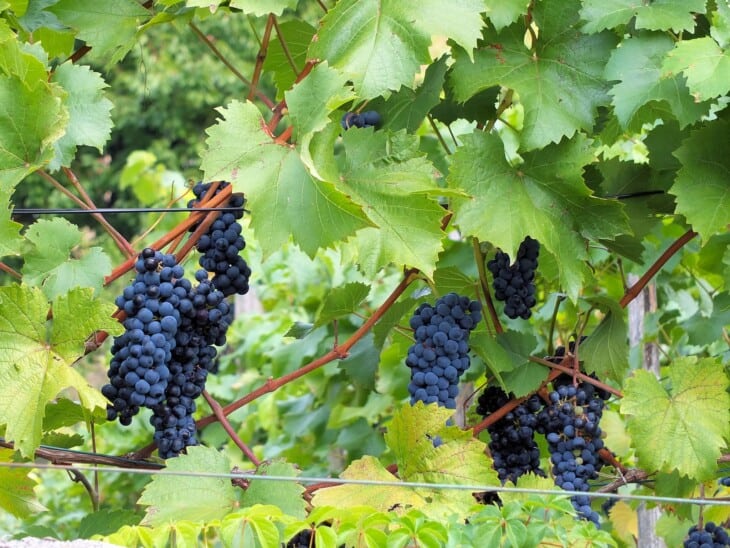
Grapes are typically elongated spheres that form in pendulous clusters on the vine. Many gardeners appreciate the visual appeal of these hanging fruit clusters, especially when grown on arbors or trellises. While most grapes contain seeds, seedless cultivars have been developed through selective breeding and are widely available.
Grapes grow on deciduous woody vines that require support structures such as trellises, arbors, or fences. Historically, grapes thrived only in regions with mild winters and warm, dry summers, but modern breeding has produced cold-hardy cultivars suited to USDA zones 4 through 10, depending on the variety.
1. Pokeberry / Pokeweed (Phytolacca americana)
Read our guide to American Pokeweed

Pokeberry (Phytolacca americana) is commonly known as American pokeweed, pokebush, or pokeroot. Native to eastern North America and naturalized in parts of Europe and Asia, this plant contains phytolaccatoxin and other toxic compounds in all parts—roots, stems, leaves, and berries. Ingestion can cause vomiting, diarrhea, abdominal pain, hypotension, and gastrointestinal bleeding.
Pokeberry produces purple-black berries in hanging clusters that closely resemble grapes, especially to children and inexperienced foragers. A key identifying difference is the distinctive red or magenta stem of pokeweed, whereas grape vines have brown, gray, or green woody stems. It is critical to teach children not to eat pokeberries, as they are frequently mistaken for edible grapes.
American pokeweed typically reaches six to ten feet tall, though under ideal conditions it can exceed twenty feet. This herbaceous perennial develops a large taproot and sends up one or more thick, smooth stems each season. The stems are pink to magenta, and the leaves are large, smooth-edged, and bright green. Small white to greenish flowers appear in early summer, followed by dark purple berries in late summer and fall.
Pokeweed commonly grows at forest edges, in disturbed areas, and along fence lines or under power lines where birds perch and deposit seeds in their droppings. It spreads readily and can become weedy in gardens, pastures, and roadsides.
2. Riverbank Grape (Vitis riparia)

Vitis riparia, commonly called riverbank grape, frost grape, or wild grape, is a native North American vine found throughout Canada and the eastern United States. This vigorous climber prefers moist, non-saline soils and is commonly found along riverbanks, streams, wetlands, and forest edges. It also thrives in disturbed areas such as roadsides and railroad embankments.
Like cultivated grapes, riverbank grape has woody stems that exfoliate in long, peeling strips. Clusters of small purple to blue-black berries hang from short stalks in late summer. Yellowish-green flowers bloom in spring. The grapes are technically edible but are often sour or astringent, though they can be used for jelly or wine with added sugar.
Riverbank grape leaves are alternate, broadly heart-shaped, and typically three-lobed with coarsely serrated margins. Young leaves emerge with a light fuzz and a yellowish tint, maturing to smooth, dark green by midsummer. Fall color can range from yellow to burgundy.
Riverbank grapes tolerate a wide range of soil types and moisture levels, from wet to moderately dry. They prefer full sun but will grow in partial shade. Hardy to USDA zone 2, this long-lived vine can dominate other vegetation if left unchecked and is considered invasive in some managed landscapes.
3. Grape Hyacinth (Muscari armeniacum)
Read our guide to Grape Hyacinth

Grape hyacinth (Muscari armeniacum) belongs to the Asparagaceae family, not the true hyacinth family, despite its common name. Native to southeastern Europe and western Asia, grape hyacinth has been widely naturalized and is a popular early-spring bloomer in gardens across temperate regions. It is occasionally called bluebell in some areas, though it is distinct from other plants sharing that name.
Grape hyacinth grows from small bulbs and reaches six to nine inches tall and three to six inches wide. The foliage consists of narrow, grass-like green leaves that emerge in fall or early spring. In early to mid-spring, dense flower spikes appear, covered with tightly packed, urn-shaped florets that resemble tiny grapes. Flower color ranges from pale blue to deep cobalt, with some cultivars appearing nearly black or white.
Grape hyacinth bulbs should be planted in fall, ideally in September or October, in well-drained soil to prevent rot. They perform best when planted in large groups or drifts for visual impact. Space bulbs about three inches apart and plant them three inches deep. Once established, grape hyacinths naturalize readily and require little care.
Water newly planted bulbs to encourage root development in fall. Once growth begins in spring, grape hyacinths need only moderate moisture. Avoid overwatering, especially in heavy soils. These bulbs require a cold dormancy period in winter to bloom properly; warm winters can result in sparse foliage and few flowers. Grape hyacinths are hardy in USDA zones 4 through 8.
4. Canadian Moonseed (Menispermum canadense)
Read our guide to Common Moonseed

Canadian moonseed (Menispermum canadense), also called common moonseed or yellow parilla, belongs to the Menispermaceae family. It is native to eastern North America, ranging from Canada south to Georgia and west to Oklahoma.
Canadian moonseed is a twining, woody vine that can grow up to twenty feet or more. It has palmately lobed leaves, usually with three to seven pointed lobes, though some leaves may be rounded and unlobed. In late summer, it produces clusters of purple-black berries that closely resemble wild grapes. Each berry contains a single crescent-shaped seed, which gives the plant its common name.
Canadian moonseed is often mistaken for wild grape due to similar foliage and fruit appearance, but this is a dangerous error. All parts of the plant are toxic, containing the alkaloid dauricine, which can cause severe pulmonary edema, internal hemorrhaging, convulsions, and cell death. Ingestion can be fatal, and the plant should be kept away from children and pets.
Canadian moonseed is a vigorous grower and can become invasive in favorable conditions. It thrives in moist, loamy soils with partial to full shade and is often found in floodplains, thickets, and woodland edges. It is hardy across a wide range, from coastal lowlands to foothill elevations, and tolerates occasional flooding.
5. Cape Grape (Rhoicissus tomentosa)

Cape grape (Rhoicissus tomentosa) is also known as African wild grape, bush grape, forest grape, and monkey rope. It is native to southern and eastern Africa, occurring from the Cape Peninsula through the Eastern Cape, KwaZulu-Natal, Mpumalanga, Limpopo, and into Malawi and Zimbabwe. It typically grows along forest margins and along wooded streams and riverbanks.
Cape grape is a vigorous evergreen liana that can climb over sixty-five feet into the forest canopy. It uses tendrils to ascend trees and often loops dramatically between treetops. The bark is brownish-gray, and young stems are covered with rusty hairs. It produces dark purple to reddish-black berries that resemble small grapes.
Cape grapes are edible but often quite acidic and tart. The flesh inside is white to pinkish. Small greenish-cream flowers appear before the berries develop. The leaves are simple, unlobed, and leathery, with a dark olive-green upper surface and a dense covering of rusty-brown hairs underneath.
The berries are eaten by a variety of birds and mammals in their native habitat. Humans can consume Cape grapes fresh, though they are better suited to making preserves, jellies, or traditional homemade wines due to their tartness.