If you like the look of a weeping willow but don’t have room for one, the best alternatives are smaller weeping trees. For small yards, try a weeping Japanese maple, a ‘Snow Fountains’ cherry, a weeping redbud or a Kilmarnock willow. These stay under 15 feet. If you want a larger tree with branches that hang to the ground, the weeping Higan cherry, weeping katsura and ‘Purple Fountain’ beech are good choices. There are weeping evergreens, such as weeping Norway spruce and weeping giant sequoia, and in frost-free climates weeping bottlebrush and peppermint willow give a similar soft, drooping look.
Contents
A weeping willow is a big tree for a big space. The trees sold as weeping willows are Salix babylonica or, more often, its hybrid, golden weeping willow (Salix × sepulcralis ‘Chrysocoma’). They grow fast to 30 to 50 feet tall and as wide, and their long, thirsty roots seek out water and can crack drains, septic systems and foundations. Plant one at least 50 feet from pipes and buildings. They are also short-lived for a tree, often 30 to 50 years, with weak wood that drops branches in storms.

- Small Weeping Trees (Under 15 Feet)
- Larger Weeping Trees
- Weeping Evergreens
- Weeping Trees for Warm Climates
- Tips for Planting Weeping Trees
| Tree | Botanical name | Height | Zones | Why choose it |
|---|---|---|---|---|
| Weeping Japanese Maple | Acer palmatum Dissectum group | 6–10 ft | 5–8 | Lacy leaves; red or green varieties |
| Kilmarnock Willow | Salix caprea ‘Kilmarnock’ | 4–8 ft | 4–8 | A real willow, small enough for any yard |
| Weeping Redbud | Cercis canadensis ‘Covey’ and others | 5–10 ft | 5–9 | Pink flowers in spring; heart-shaped leaves |
| ‘Snow Fountains’ Weeping Cherry | Prunus ‘Snofozam’ | 8–15 ft | 5–8 | White spring flowers; fits small gardens |
| ‘Summer Cascade’ River Birch | Betula nigra ‘Summer Cascade’ | 6–10 ft unless staked | 4–9 | Peeling bark; tolerates heat and wet soil |
| Weeping Higan Cherry | Prunus subhirtella ‘Pendula’ | 20–30 ft | 5–8 | The classic weeping cherry; pink spring flowers |
| Weeping Katsura | Cercidiphyllum japonicum ‘Pendulum’ | 15–25 ft | 4–8 | Heart-shaped leaves; fall leaves smell of caramel |
| ‘Purple Fountain’ Weeping Beech | Fagus sylvatica ‘Purple Fountain’ | 15–25 ft tall, 8–10 ft wide | 4–7 | Narrow; dark purple leaves |
| Weeping Norway Spruce | Picea abies ‘Inversa’ | Depends on staking | 3–7 | Very hardy; can be trained to any height |
| Brewer Spruce | Picea breweriana | 20–40 ft in gardens | 5–8 | Long curtains of hanging branchlets |
| Weeping Giant Sequoia | Sequoiadendron giganteum ‘Pendulum’ | 30–50 ft tall, 6–10 ft wide | 6–8 | A narrow, twisting tower |
| Weeping Bottlebrush | Melaleuca viminalis | 15–25 ft | 9–11 | Red bottlebrush flowers; drought tolerant |
| Peppermint Willow | Agonis flexuosa | 25–35 ft | 9–11 | Willow-like leaves that smell of peppermint |
Small Weeping Trees (Under 15 Feet)
Weeping Japanese Maple (Acer palmatum Dissectum group)
Read our guide to Weeping Japanese Maple

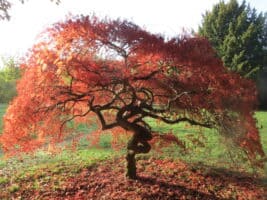
Weeping laceleaf Japanese maples have finely cut, feathery leaves on branches that cascade down into a mound. Green varieties such as ‘Viridis’ and ‘Waterfall’ turn gold to orange in fall. For red leaves all season, choose ‘Crimson Queen’ or ‘Tamukeyama’. They grow slowly to 6 to 10 feet tall and wider than tall, so they suit small yards, patios and large containers. Give them shade in the afternoon in hot climates and shelter from drying wind.
Kilmarnock Willow (Salix caprea ‘Kilmarnock’)
The Kilmarnock willow is a weeping form of goat willow, a pussy willow, grafted onto a straight trunk. Its stiff branches hang straight down to the ground, and in early spring they are covered in silvery, furry catkins before the leaves come out. It only grows as tall as the trunk it was grafted on, usually 4 to 8 feet, so it gives you a true willow in a very small space. Prune it right after the catkins fade to thin out crowded branches, and remove any shoots from the trunk below the graft.
Weeping Redbud (Cercis canadensis ‘Covey’ and others)
Weeping redbuds are dwarf, weeping forms of the native eastern redbud. In early spring, before the leaves, their bare branches are covered in rosy-pink, pea-like flowers. Then they fill in with heart-shaped leaves that overlap like shingles down the hanging branches. ‘Covey’ (sold as Lavender Twist) has green leaves, ‘Ruby Falls’ has purple leaves and ‘Pink Heartbreaker’ has green leaves and bright pink flowers. Most stay 5 to 10 feet tall and wide.
‘Snow Fountains’ Weeping Cherry (Prunus ‘Snofozam’)

‘Snow Fountains’ is a small weeping cherry with branches that fall straight down like a curtain and reach the ground if you don’t trim them. In early spring it is covered in pure white flowers, and in fall the leaves turn gold and orange. It grows 8 to 15 feet tall, depending on how high it was grafted or staked. Like other flowering cherries, it needs full sun and well-drained soil.
‘Summer Cascade’ River Birch (Betula nigra ‘Summer Cascade’)

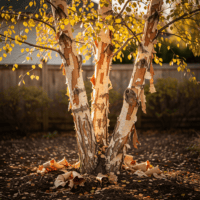
‘Summer Cascade’ is a weeping form of river birch, the birch that does best in hot, humid summers and wet soil. Its thin branches arch and hang down, with small, glossy leaves that turn yellow in fall. On its own it forms a low, spreading mound. Tie the leader to a tall stake while it is young to build a taller tree. The bark peels in salmon and cinnamon-colored curls. River birch resists the bronze birch borer that kills most white-barked birches in the South and Midwest.
Larger Weeping Trees
Weeping Higan Cherry (Prunus subhirtella ‘Pendula’)

Weeping Higan cherry is the large, classic weeping cherry seen in parks and front yards. In early spring its long, arching branches are covered in pale pink flowers. It grows 20 to 30 feet tall and just as wide, and as it matures it has the full, hanging-to-the-ground shape of a small weeping willow. It is one of the more heat-tolerant and long-lived flowering cherries.
Weeping Katsura (Cercidiphyllum japonicum ‘Pendulum’)
Weeping katsura has rounded, heart-shaped leaves that open reddish-purple in spring, turn blue-green in summer and change to yellow and apricot in fall. The branches cascade down in layers, like a green waterfall. As the leaves fall, they give off a sweet smell of burnt sugar or cotton candy. It grows 15 to 25 feet tall and needs steady moisture, because the leaves scorch in drought.
‘Purple Fountain’ Weeping Beech (Fagus sylvatica ‘Purple Fountain’)

‘Purple Fountain’ is a weeping form of European beech with a strong, upright leader and short side branches that hang straight down. That makes it tall and narrow, only 8 to 10 feet wide, so it fits spaces where a round, weeping tree won’t. The leaves open deep purple and hold their color well into summer, and dry, coppery leaves often hang on the tree through winter. Beeches grow slowly and live a long time. For a huge, green weeping tree with a willow’s presence, the old weeping European beech (F. sylvatica ‘Pendula’) eventually reaches 50 feet or more.
Weeping Evergreens
Weeping Norway Spruce (Picea abies ‘Inversa’)
Weeping Norway spruce has branches that hang straight down against the trunk. Left alone, it sprawls along the ground as a groundcover. Stake the leader upright as it grows, and it becomes a narrow, draped column, as tall as you train it. It is one of the hardiest weeping trees, down to zone 3, and does best in full sun with moist, well-drained soil. ‘Pendula’ is a similar form.
Brewer Spruce (Picea breweriana)

Brewer spruce, also called weeping spruce, is a rare spruce native to the Klamath and Siskiyou Mountains of Oregon and California. It has stiff, horizontal branches hung with long, curtain-like branchlets that sway in the wind. It grows slowly, and it takes about 10 years before the weeping habit develops. It needs cool, moist summers, so it does best in the Pacific Northwest and similar climates.
Weeping Giant Sequoia (Sequoiadendron giganteum ‘Pendulum’)

Weeping giant sequoia is a very narrow form of the giant sequoia. Its leader often bends and twists in unexpected directions, and its short branches hang flat against the trunk, so each tree has its own odd shape. It can grow 30 to 50 feet tall but only 6 to 10 feet wide. It needs full sun and well-drained soil.
Weeping Trees for Warm Climates
Weeping Bottlebrush (Melaleuca viminalis)
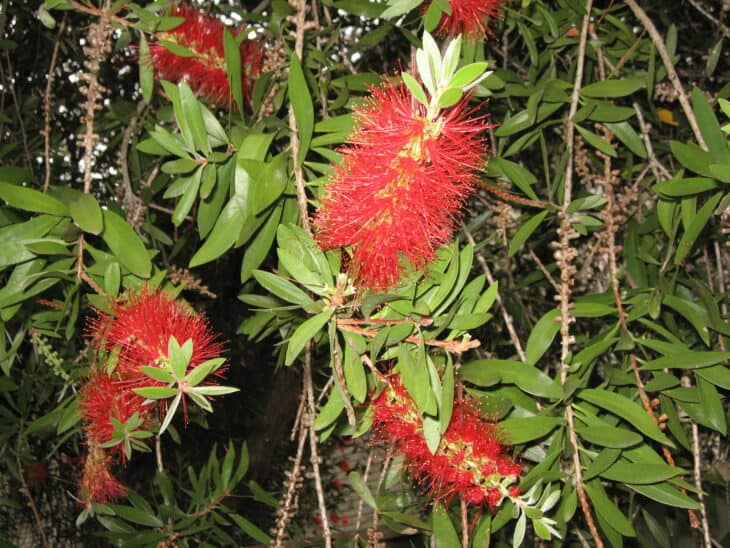
Weeping bottlebrush is an Australian evergreen with long, drooping branches and narrow leaves, a lot like a willow, and bright red, bottlebrush-shaped flowers that bring hummingbirds. It flowers mainly in spring and on and off through the year. It grows 15 to 25 feet tall, tolerates heat and drought and does well in southern California, Arizona, Texas and Florida. It was long known as Callistemon viminalis.
Peppermint Willow (Agonis flexuosa)
Peppermint willow, also called willow myrtle, is an evergreen tree from Western Australia with long, narrow leaves on weeping branches, the closest look to a weeping willow in a frost-free, dry climate. The leaves smell of peppermint when crushed. It has small white flowers in spring and grows 25 to 35 feet tall. ‘After Dark’ has deep burgundy leaves. It is popular in coastal California.
Tips for Planting Weeping Trees
- Give them room to hang. Plant weeping trees where their full spread won’t be crowded by paths or walls, and away from narrow walkways, where the branches will need constant trimming.
- Check the graft height. Many small weeping trees are grafted onto a straight trunk, and they won’t grow taller than the graft. Buy the height you want.
- Stake the leader. Weeping spruces, birches and beeches grow taller if you tie the main shoot to a stake while they are young.
- Prune the suckers. Remove straight, upright shoots from the trunk or the base right away. They come from the rootstock and can take over.
- Near water: if you have a pond or a wet corner and plenty of room, a weeping willow can still be the right tree. Just keep it well away from pipes and buildings.
See also trees similar to wisteria.