The most dangerous plants that look like Queen Anne’s lace are poison hemlock and water hemlock, which can kill if eaten, and giant hogweed, cow parsnip and wild parsnip, whose sap can cause blistering burns in sunlight. Less dangerous lookalikes include bishop’s flower, cow parsley, hedge parsley, yarrow, elderberry and golden Alexanders. To identify Queen Anne’s lace, check the stem: it is solid green and covered in short, stiff hairs, with no purple spots. Look also for the three-forked, lacy bracts under the flower head, the single dark purple floret often in its center, and the carrot smell of the crushed root.
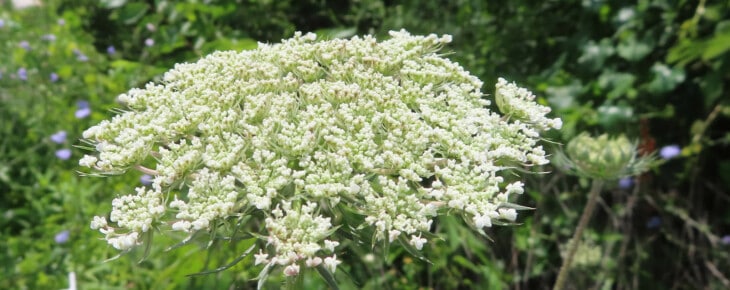
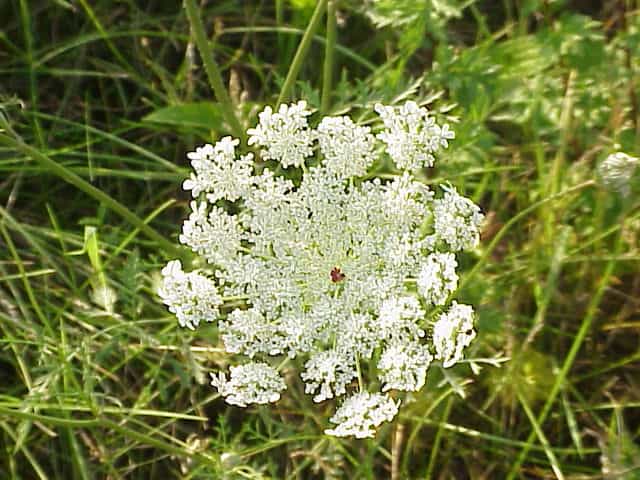
Queen Anne’s lace (Daucus carota) is the wild ancestor of the garden carrot. It is a biennial from Europe and Southwest Asia that now grows along roadsides and in fields and pastures all across North America. It grows 1 to 4 feet tall, with finely divided, fern-like leaves, and from about June to September it has flat, lacy, white flower heads 3 to 5 inches across. As the seeds ripen, the flower head curls inward into a cup, which gives it the name bird’s nest. It is in the carrot family, which also includes some of the deadliest plants in North America, so never eat any wild plant from this family unless you are completely sure what it is.
| Plant | Botanical name | Dangerous? | How to tell it from Queen Anne’s lace |
|---|---|---|---|
| Poison Hemlock | Conium maculatum | Deadly if eaten | Smooth, hairless stem with purple blotches; 6 to 10 feet tall; musty smell |
| Water Hemlock | Cicuta maculata | Deadly if eaten | Grows in wet places; leaf veins end in the notches between teeth; domed umbels |
| Giant Hogweed | Heracleum mantegazzianum | Sap causes severe burns | Huge: 8 to 15 feet tall, with flower heads up to 2½ feet across and leaves up to 5 feet |
| Cow Parsnip | Heracleum maximum | Sap can cause burns | 5 to 8 feet tall; huge, maple-like leaves; hairy stem |
| Wild Parsnip | Pastinaca sativa | Sap causes burns | Yellow flowers, not white; 2 to 5 feet tall; smooth, grooved stem |
| Fool’s Parsley | Aethusa cynapium | Poisonous if eaten | Long, thin bracts hanging down like a beard under each small umbel |
| Bishop’s Flower (False Queen Anne’s Lace) | Ammi majus | Can irritate skin in sunlight | A garden cut flower; smooth stem; no dark center floret |
| Cow Parsley | Anthriscus sylvestris | No, but invasive | Flowers in spring, earlier than Queen Anne’s lace; hollow, grooved stem; loose umbels |
| Hedge Parsley | Torilis arvensis and T. japonica | No, but a weed | Smaller, sparse umbels; bristly, burr-like seeds that stick to clothing |
| Yarrow | Achillea millefolium | No | Flower heads made of tiny daisy-like flowers; feathery leaves; not an umbel |
| Elderberry | Sambucus canadensis | Unripe berries, stems and leaves are poisonous | A woody shrub, 5 to 12 feet tall; flowers in branched clusters, not umbels |
| Golden Alexanders | Zizia aurea | Don’t eat it | Yellow flowers in spring; leaves divided into three toothed leaflets |
Dangerous Lookalikes
Poison Hemlock (Conium maculatum)
Read our guide to Poison Hemlock

Poison hemlock is the most common dangerous lookalike and one of the most poisonous plants in North America. All parts are deadly if eaten, and people have died after mistaking its root for wild carrot or its leaves for parsley. It is taller than Queen Anne’s lace, 6 to 10 feet, with a smooth, hairless, hollow stem blotched with purple, and its leaves have a musty, mousy smell when crushed. It flowers earlier, in late spring and early summer, with many small, rounded umbels instead of one flat, lacy head. Wear gloves when pulling it.
Water Hemlock (Cicuta maculata)
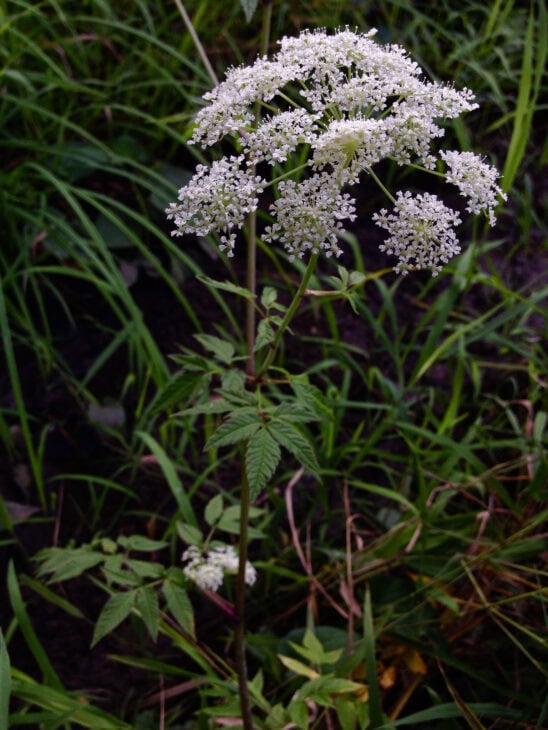
Water hemlock is considered the most toxic plant in North America. A single bite of the root can kill an adult, causing violent seizures within an hour. It grows in wet meadows, ditches, marshes and along streams, 3 to 7 feet tall, with a smooth, hollow stem often streaked with purple and rounded, domed umbels of white flowers in summer. Its leaves are divided into narrow, toothed leaflets, and the leaf veins run to the notches between the teeth, not to their tips. Its thick roots have chambers inside that ooze yellowish, poisonous liquid when cut.
Giant Hogweed (Heracleum mantegazzianum)

Giant hogweed looks like Queen Anne’s lace grown to monstrous size: 8 to 15 feet tall, with umbrella-shaped flower heads up to 2½ feet across, deeply cut leaves up to 5 feet wide and thick, hollow stems with purple blotches and coarse white hairs. Its sap makes skin extremely sensitive to sunlight and can cause severe, painful blisters and scars that last for years. It is a federal noxious weed from the Caucasus, found mainly in the Northeast, the Great Lakes and the Pacific Northwest. Don’t touch it; report it to your state’s department of agriculture.
Cow Parsnip (Heracleum maximum)

Cow parsnip is a native relative of giant hogweed that grows across most of North America in moist meadows, stream banks and forest edges. It grows 5 to 8 feet tall, with a thick, hairy, ridged stem, very large leaves divided into three big, maple-like leaflets and flat umbels of white flowers up to a foot across in early summer. Its sap can also cause blisters in sunlight, though usually less severe than giant hogweed’s.
Wild Parsnip (Pastinaca sativa)
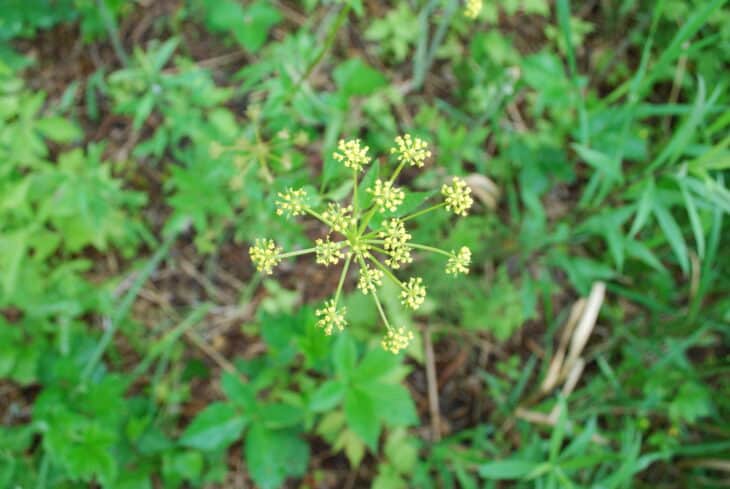
Wild parsnip is the wild form of the garden parsnip. It has flat umbels like Queen Anne’s lace, but its flowers are yellow. It grows 2 to 5 feet tall, with a smooth, grooved stem and leaves divided into broad, toothed leaflets, and it flowers from June to July, often in the same fields and roadsides as Queen Anne’s lace. Its sap causes phytophotodermatitis: burns and blisters wherever skin that touched it is exposed to sunlight, often in streaks, and dark marks that can last for months. Wear gloves, long sleeves and pants when mowing or pulling it.
Fool’s Parsley (Aethusa cynapium)

Fool’s parsley is a poisonous annual weed from Europe, related to poison hemlock, that grows in gardens, fields and waste ground in the northern U.S. and Canada. It is 1 to 3 feet tall, with glossy, parsley-like leaves that smell unpleasant when crushed and small umbels of white flowers in summer. The easiest way to recognize it is the three long, narrow bracts that hang down from under each small cluster of flowers like a beard. See our list of plants that look like parsley.
Less Dangerous Lookalikes
Bishop’s Flower (False Queen Anne’s Lace) (Ammi majus)
Read our guide to Bishop’s Flower (False Queen Anne’s Lace)
Bishop’s flower is a garden annual, sold as false Queen Anne’s lace, that is grown for cut flowers and cottage gardens. It has airy, white, lacy umbels 3 to 6 inches across on smooth stems 2 to 3 feet tall, and it lasts well in a vase. It comes from the Mediterranean and rarely spreads beyond the garden. Its sap and seeds contain the chemical used in some treatments for skin conditions, which can make sensitive skin burn in sunlight, and it is toxic to livestock and pets if eaten.
Cow Parsley (Anthriscus sylvestris)

Cow parsley, or wild chervil, is a European plant that has become an invasive weed in parts of the Northeast and the Pacific Northwest. It grows 3 to 5 feet tall, with fern-like leaves and loose, airy umbels of small white flowers in May and June, a month or more before Queen Anne’s lace. Its stems are hollow and grooved, with hairs only near the base. It spreads quickly in fields and along roads and shades out other plants.
Hedge Parsley (Torilis arvensis and T. japonica)

Hedge parsleys are weedy annuals from Europe and Asia that grow in fields, roadsides and woodland edges. They are 1 to 3 feet tall, with small, sparse umbels of tiny white flowers in summer and finely divided leaves. After flowering they make small, bristly seeds that stick to clothing and fur like burrs. Spreading hedge parsley can take over pastures and prairies in the Midwest.
Yarrow (Achillea millefolium)

Yarrow has flat-topped clusters of small white flowers that look like Queen Anne’s lace from a distance. Up close, each tiny flower is a little daisy, with five short, white petals around a creamy center, and the clusters are branched, not spoked like an umbel. Its leaves are very finely divided and feathery, and they have a strong, spicy smell when crushed. Yarrow is a perennial native across the Northern Hemisphere, 1 to 3 feet tall, that flowers all summer and is a good plant for pollinators.
Elderberry (Sambucus canadensis)

American elderberry has large, flat clusters of tiny, creamy white flowers in early summer that can look very like Queen Anne’s lace. But it is a woody shrub, 5 to 12 feet tall, with leaves of 5 to 11 toothed leaflets, and the flower clusters are branched, not spoked. The dark purple berries that follow are edible only when fully ripe and cooked. The leaves, stems, roots and unripe berries are poisonous.
Golden Alexanders (Zizia aurea)

Golden Alexanders is a native perennial of prairies, meadows and open woods in eastern North America, 1 to 3 feet tall. It has flat umbels of small, bright yellow flowers in late spring, well before Queen Anne’s lace, and shiny leaves divided into toothed leaflets in groups of three. It is a host plant for black swallowtail caterpillars and a good native garden plant for sun or part shade. Don’t eat it: it can easily be confused with its poisonous relatives, and some sources consider it toxic.
How to Identify Queen Anne’s Lace
- Hairy stem: the stem of Queen Anne’s lace is solid green, with no purple spots, and covered in short, stiff hairs. A smooth stem with purple blotches means poison hemlock. Remember “the Queen has hairy legs”.
- Lacy bracts: under each flower head is a ring of stiff, green bracts divided into three-forked, thread-like segments.
- Dark center floret: many flower heads have one tiny, dark purple or red flower in the center, though not all do.
- Bird’s nest: after flowering, the head curls inward into a cup of bristly seeds.
- Carrot smell: the thin, white root smells like a carrot. Poison hemlock smells musty.
- Height: Queen Anne’s lace is 1 to 4 feet tall. Anything over 6 feet is more likely poison hemlock, cow parsnip or giant hogweed.
Safety Tips
- Never eat any wild plant in the carrot family unless an expert has confirmed what it is. Even foragers have died after mistaking poison or water hemlock for wild carrot.
- Wear gloves, long sleeves and pants when pulling or mowing wild parsnip, cow parsnip, giant hogweed or poison hemlock, and wash your skin with soap and water right after contact.
- If someone may have eaten poison hemlock or water hemlock, call Poison Control at 1-800-222-1222 right away, or 911 if they have seizures or trouble breathing.
For more, see our guides to the poison hemlock plant and poisonous plants in Tennessee.