Most plants that look like parsley are its relatives in the carrot family (Apiaceae), and several of them are among the most poisonous plants in North America and Europe. Chervil and cilantro are edible herbs you can grow in its place. Poison hemlock, fool’s parsley and water hemlock can kill, and all three grow wild in gardens, ditches and field edges. The safe rule is simple: only eat parsley you planted or bought, and never pick “wild parsley”.
Contents
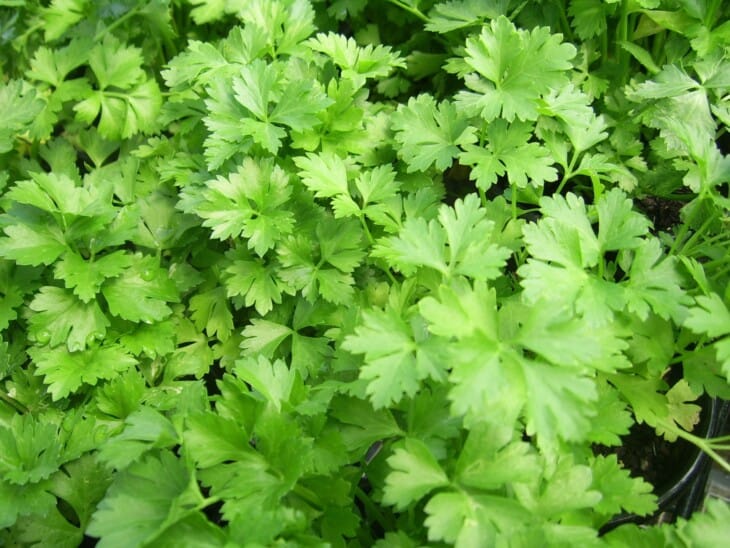
Garden parsley (Petroselinum crispum) comes from the Mediterranean. It is a biennial grown as an annual. In its first year it forms a low clump of bright green, divided leaves, 8 to 12 inches tall, from a single taproot. If you leave it in the ground, it sends up a 2 to 3 foot flower stalk the second spring, with flat clusters (umbels) of tiny yellow-green flowers, and then dies. There are three kinds: curly parsley, flat-leaf (Italian) parsley and root parsley, grown for its parsnip-like root. Crushed parsley leaves have a clean, fresh smell. That smell, and knowing where the plant came from, are the best checks.
- Edible Herbs That Look Like Parsley
- Harmless Weeds That Look Like Parsley
- Poisonous Plants That Look Like Parsley
- How to Tell Parsley From Its Lookalikes
| Plant | Botanical name | Safe to eat? | How to tell it from parsley |
|---|---|---|---|
| Chervil (French Parsley) | Anthriscus cerefolium | Yes | Paler, lacier leaves; mild anise flavor |
| Cilantro (Coriander) | Coriandrum sativum | Yes | Rounder, lobed lower leaves; strong citrusy or “soapy” smell |
| Hedge Parsley | Torilis arvensis | Not eaten | Hairy stems and leaves; bur-like seeds that stick to clothing |
| Cow Parsley | Anthriscus sylvestris | Don’t risk it | 2–5 ft; hollow, grooved stems; blooms in spring along roadsides |
| Wild Carrot (Queen Anne’s Lace) | Daucus carota | Don’t risk it | Hairy stems; carrot smell; single dark flower in the middle of the umbel |
| Parsley Piert | Aphanes arvensis | Not eaten | Tiny, fan-shaped leaves; hugs the ground in lawns |
| Poison Hemlock | Conium maculatum | No, deadly | 5–10 ft; smooth stems with purple blotches; musty smell |
| Fool’s Parsley | Aethusa cynapium | No, poisonous | Unpleasant smell; long, drooping bracts under each small umbel |
| Water Hemlock | Cicuta maculata | No, deadly | Wet ground; leaf veins end in the notches between teeth; chambered root |
Edible Herbs That Look Like Parsley
Chervil (French Parsley) (Anthriscus cerefolium)

Chervil is a delicate annual herb from the Caucasus and southern Russia, common in French cooking, where it is one of the “fines herbes”. Its leaves are finely divided like parsley’s but paler, softer and lacier, and they taste mildly of parsley with a hint of anise. It grows 12 to 24 inches tall and prefers cool weather and light shade. In warm weather it quickly bolts, sending up small white flower umbels, and the leaves turn bitter. Sow it every few weeks in spring and fall for a steady supply.
Cilantro (Coriander) (Coriandrum sativum)

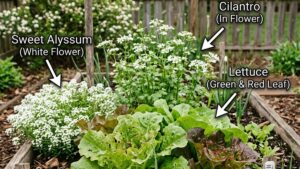
Cilantro, also called coriander or Chinese parsley, looks most like flat-leaf parsley, and grocery stores often shelve them side by side. The lower leaves are broader and more rounded, with shallow lobes. The leaves higher up the stem are thin and feathery. The easiest test is smell: cilantro has a strong, citrusy scent that some people find soapy because of a common variation in a smell-receptor gene. It is an annual, 1 to 2 feet tall, that bolts quickly in heat. The seeds are the spice coriander.
Harmless Weeds That Look Like Parsley
Hedge Parsley (Torilis arvensis)
Read our guide to Hedge Parsley

Spreading hedge parsley is a European annual weed that has spread across much of the U.S., especially in the South and Midwest. It grows 1 to 3 feet tall with finely divided, fern-like leaves and small white umbels. Unlike parsley, its stems and leaves are rough with short white hairs. In summer it makes small, bristly seeds that cling to socks, pants and pet fur, which is how it spreads. It is not known to be poisonous, but it has no food value, and pulling it before it seeds is the best control.
Cow Parsley (Anthriscus sylvestris)

Cow parsley is a tall European biennial that lines roadsides and hedges in spring with clouds of white umbels. In Britain it is called Queen Anne’s lace, a name Americans use for wild carrot. It grows 2 to 5 feet tall, with fern-like leaves and hollow, grooved stems that are green or purplish but not spotted. It is edible, but foragers are warned away from it because it looks so much like poison hemlock and fool’s parsley. It has escaped in parts of the northeastern U.S., Canada and the Pacific Northwest, where it is treated as an invasive weed.
Wild Carrot (Queen Anne’s Lace) (Daucus carota)

Wild carrot is the wild form of the garden carrot and grows in sunny fields and roadsides across North America. Its first-year rosette of finely cut leaves looks a lot like parsley. In its second summer it sends up 2 to 4 foot stems with lacy, flat white umbels, often with a single dark purple floret in the center. The stems are hairy, and the root and leaves smell like carrot. Those two traits separate it from poison hemlock, whose stems are smooth. See plants that look like Queen Anne’s lace for more.
Parsley Piert (Aphanes arvensis)

Parsley piert shares only its name with parsley. It is a tiny annual in the rose family, native to Europe, and now a lawn weed in parts of North America. It grows 1 to 4 inches tall and spreads into low mats in thin lawns and bare soil. Its small leaves are fan-shaped and cut into three lobes, a bit like a miniature parsley leaf, and its tiny green flowers sit where the leaves join the stem.
Poisonous Plants That Look Like Parsley
These three are the reason you should never eat wild “parsley”. All are in the carrot family, all have white umbels, and all can kill.
Poison Hemlock (Conium maculatum)
Read our guide to Poison Hemlock

Poison hemlock is a European biennial that now grows along roadsides, ditches, streams and field edges in nearly every U.S. state. Its first-year rosette of glossy, finely divided leaves is easy to mistake for flat-leaf parsley. The second year it shoots up 5 to 10 feet, with smooth, hollow stems covered in purple blotches and many small white umbels. Crushed leaves smell unpleasant and musty. Every part contains coniine and related alkaloids, which paralyze the muscles, including the ones used for breathing. The plant stays toxic after it dries. Wear gloves and long sleeves when you pull it, and never compost or burn it. This is the hemlock that killed Socrates.
Fool’s Parsley (Aethusa cynapium)
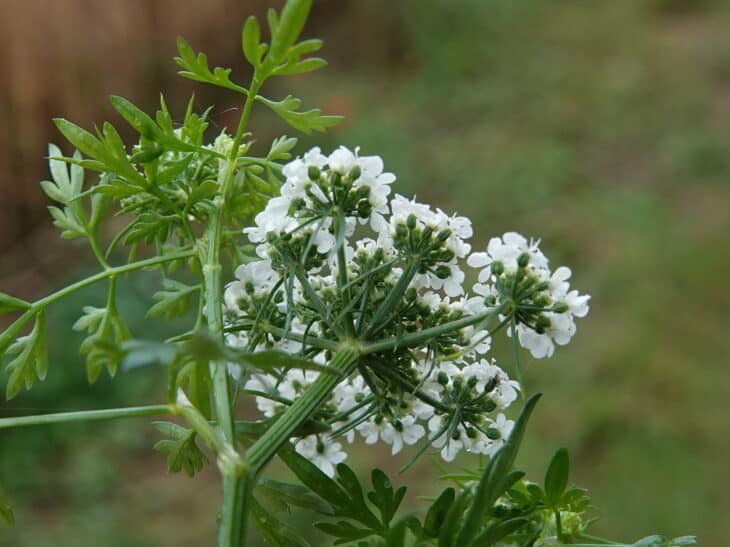
Fool’s parsley is the plant most likely to be mistaken for flat-leaf parsley in a vegetable garden. It is an annual weed from Europe, naturalized in the northeastern U.S. and Canada, and grows 1 to 3 feet tall with glossy, dark green, finely divided leaves. Look under the small white umbels: each has three long, narrow bracts hanging down on one side, like a little beard. The leaves smell unpleasant when crushed, not fresh like parsley. It contains toxins similar to poison hemlock’s.
Water Hemlock (Cicuta maculata)
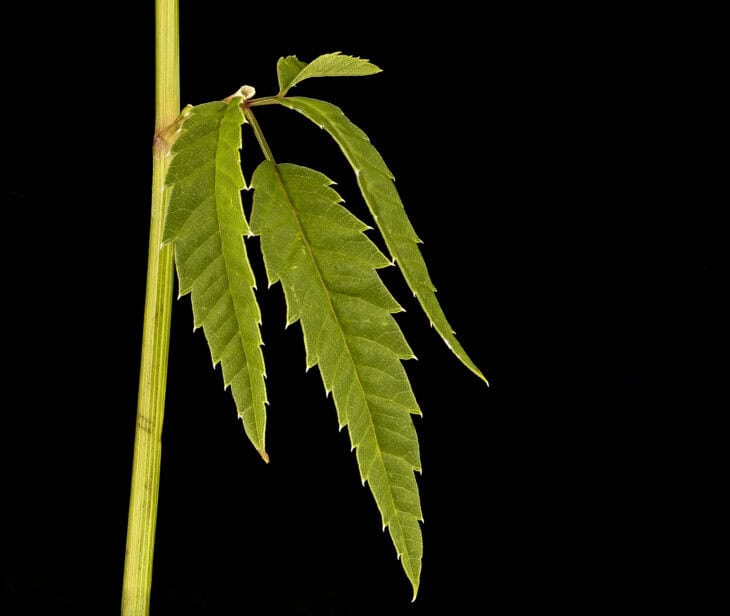
Spotted water hemlock is a native North American plant of wet meadows, marshes and stream banks, and it is often called the most toxic plant in North America. A single bite of the root can cause seizures and death within hours. It grows 3 to 6 feet tall, with purple-streaked stems and white umbels. The leaves are divided into narrow, toothed leaflets, and the leaf veins run to the notches between the teeth, not to the tips. Its thick root base, when cut lengthwise, has hollow chambers and oozes a yellowish, oily liquid.
How to Tell Parsley From Its Lookalikes
- Where it grows. Parsley doesn’t escape into the wild in most of North America. A “parsley” growing in a ditch, a damp meadow or a field edge is almost certainly something else.
- Smell. Crushed parsley smells clean and fresh. Poison hemlock and fool’s parsley smell unpleasant or musty.
- Stems. Parsley stems are smooth and green. Purple blotches or streaks point to poison hemlock or water hemlock.
- Height. A parsley clump stays under a foot tall in its first year. A plant heading for 5 feet or more is not parsley.
- Flowers. Parsley flowers are yellow-green and only appear in the second year. White umbels mean a lookalike.
- If someone eats a wild lookalike, call Poison Control at 1-800-222-1222 (U.S.) or emergency services right away. Symptoms of hemlock poisoning can start within 30 minutes.
For more on poisonous plants, see our guide to common poisonous plants.