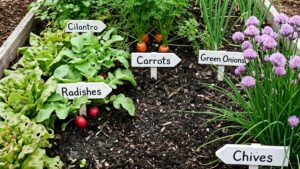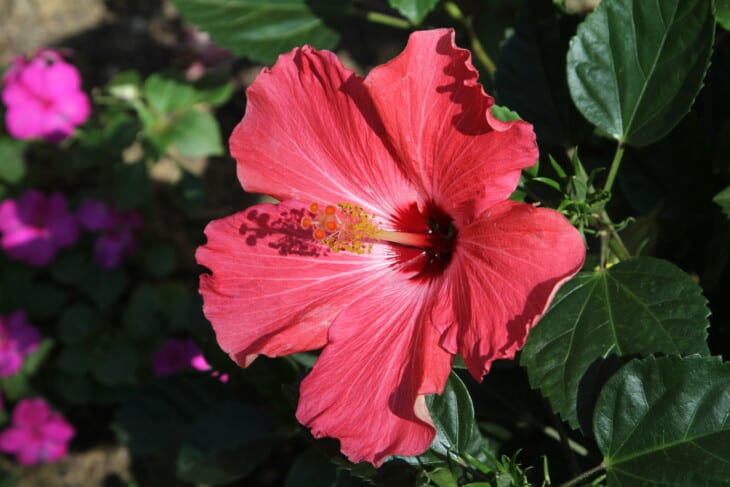
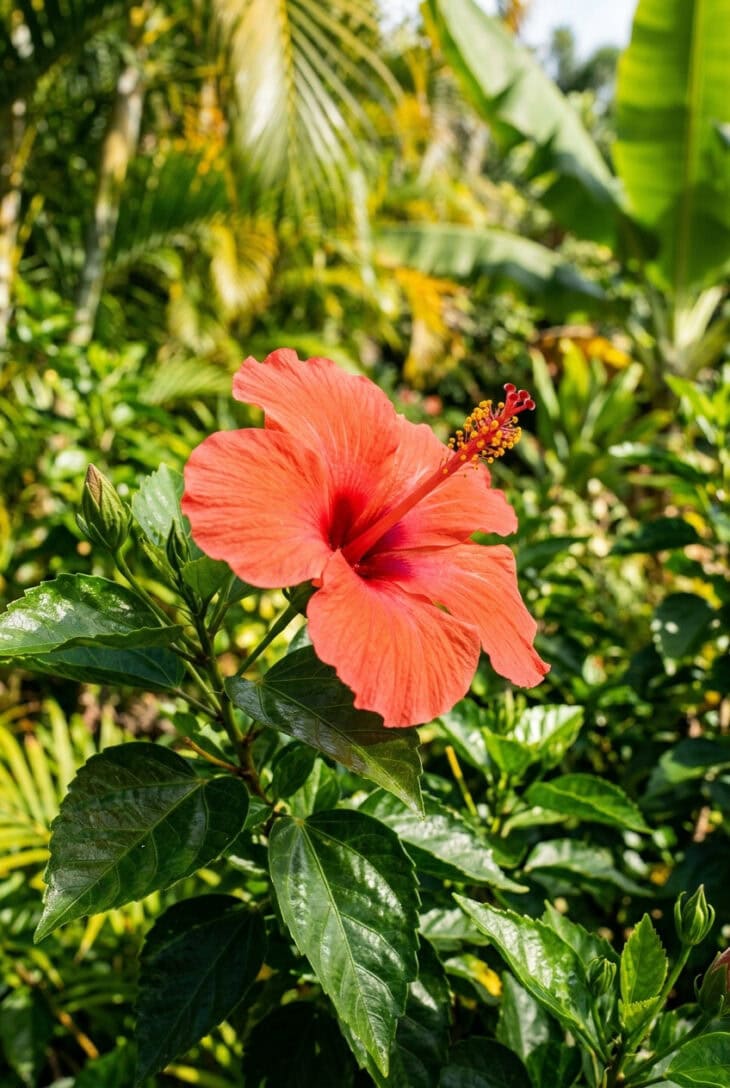
The plants that look most like hibiscus are its relatives in the mallow family: rose of Sharon (which is a hibiscus), hollyhock, okra, annual mallow, flowering maple, Turk’s cap, chaparral bush mallow and Norfolk Island hibiscus. They share the hibiscus’s broad, five-petaled flowers and, in most, the long column of stamens in the center. Unrelated plants with hibiscus-like flowers include silky camellia, Franklin tree, mandevilla, canna and belladonna lily. The surest check is the center of the flower: only hibiscus and its mallow relatives have a single column with the stamens along its sides and five fuzzy stigma pads at the tip.
Contents
- Hibiscus Relatives in the Mallow Family
- Rose of Sharon (Hibiscus syriacus)
- Hollyhock (Alcea rosea)
- Okra (Abelmoschus esculentus)
- Annual Mallow (Lavatera) (Malva trimestris (Lavatera trimestris))
- Flowering Maple (Abutilon × hybridum)
- Turk’s Cap (Malvaviscus arboreus var. drummondii)
- Chaparral Bush Mallow (Malacothamnus fasciculatus)
- Norfolk Island Hibiscus (Lagunaria patersonia)
- Unrelated Plants With Hibiscus-Like Flowers
- How to Tell a Hibiscus From a Lookalike
Gardeners grow three main kinds of hibiscus. Tropical hibiscus (Hibiscus rosa-sinensis) is an evergreen shrub with glossy leaves and red, pink, orange, yellow or bicolored flowers 4 to 8 inches across, hardy outdoors only in zones 9 or 10 to 11 and grown elsewhere in pots. Hardy hibiscus, or rose mallow (H. moscheutos and its hybrids), is a perennial that dies to the ground in winter and has huge, dinner-plate flowers up to 12 inches across in zones 4 or 5 to 9. Rose of Sharon is a hardy shrub. Each hibiscus flower usually lasts only a day, but new ones open all summer.

- Hibiscus Relatives in the Mallow Family
- Unrelated Plants With Hibiscus-Like Flowers
- How to Tell a Hibiscus From a Lookalike
| Plant | Botanical name | Looks like hibiscus because | How to tell it apart |
|---|---|---|---|
| Rose of Sharon | Hibiscus syriacus | It is a hibiscus: same flower shape and column | Hardy, deciduous shrub; smaller flowers, 2 to 4 inches; blooms late summer |
| Hollyhock | Alcea rosea | Round, papery flowers with a mallow column in the center | Flowers stacked along tall spikes 5 to 8 feet high; rounded, rough leaves |
| Okra | Abelmoschus esculentus | Pale yellow flowers with a dark red center, just like a hibiscus | A vegetable; each flower is followed by a long, green, ridged pod |
| Annual Mallow (Lavatera) | Malva trimestris (Lavatera trimestris) | Satiny, trumpet-shaped pink or white flowers with dark veins | An annual, 3 to 4 feet tall; flowers smaller, about 3 inches |
| Flowering Maple | Abutilon × hybridum | Mallow flowers with a protruding column | Bell- or lantern-shaped flowers that hang down; maple-shaped leaves |
| Turk’s Cap | Malvaviscus arboreus var. drummondii | Red hibiscus-like flowers with a long protruding column | Flowers never open fully; petals stay twisted around the column |
| Chaparral Bush Mallow | Malacothamnus fasciculatus | Pale pink, cup-shaped mallow flowers | Flowers only about an inch across; gray, fuzzy leaves; a dry-country shrub |
| Norfolk Island Hibiscus | Lagunaria patersonia | Pink, five-petaled mallow flowers with a central column | A tree 30 to 50 feet tall; petals curl back; leathery, gray-green leaves |
| Silky Camellia | Stewartia malacodendron | Large, white, five-petaled flowers with a showy center | Purple stamens with blue-gray anthers; a small tree in the tea family |
| Franklin Tree | Franklinia alatamaha | Large white flowers with a bright center of yellow stamens | Flowers in late summer and fall; long, glossy leaves that turn red in fall |
| Mandevilla | Mandevilla hybrids | Big, trumpet-shaped flowers in pink, red or white on tropical patio plants | A twining vine with milky sap; petals twisted like a pinwheel; no central column |
| Canna | Canna × generalis | Large, bright red, orange or yellow tropical flowers | Huge, paddle-shaped leaves on tall stems; flowers in clusters at the top; no column |
| Belladonna Lily | Amaryllis belladonna | Large, pink, trumpet-shaped flowers with prominent stamens | Six petals; flowers on bare, leafless stems from a bulb in late summer |
Hibiscus Relatives in the Mallow Family
Rose of Sharon (Hibiscus syriacus)
Read our guide to Rose of Sharon
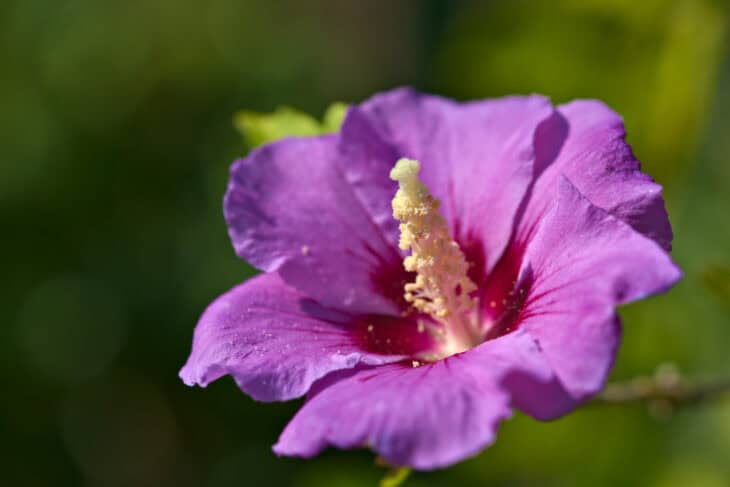
Rose of Sharon isn’t just a lookalike: it is a hibiscus. It is a hardy, upright, deciduous shrub, 8 to 12 feet tall, from China and India, not Syria as its name suggests, and it is the national flower of South Korea. Its flowers are 2 to 4 inches across, in white, pink, lavender, purple or blue, often with a dark red eye, and single or double. It blooms from mid-summer into fall, when little else is flowering, and grows in zones 5 to 9. Its leaves are small and often three-lobed. Most older varieties drop masses of seeds that sprout all over the garden, so choose sterile varieties.
Hollyhock (Alcea rosea)

Hollyhocks are old-fashioned cottage garden plants in the mallow family, with open, cup-shaped flowers 3 to 5 inches across in pink, red, white, yellow and near-black. Up close, a single flower looks very like a hibiscus. The difference is the plant: the flowers open one after another up a single, tall spike 5 to 8 feet high, above large, rounded, rough leaves. Hollyhocks are short-lived perennials or biennials, hardy in zones 3 to 8, and often suffer from rust. See our list of plants that look like hollyhocks.
Okra (Abelmoschus esculentus)
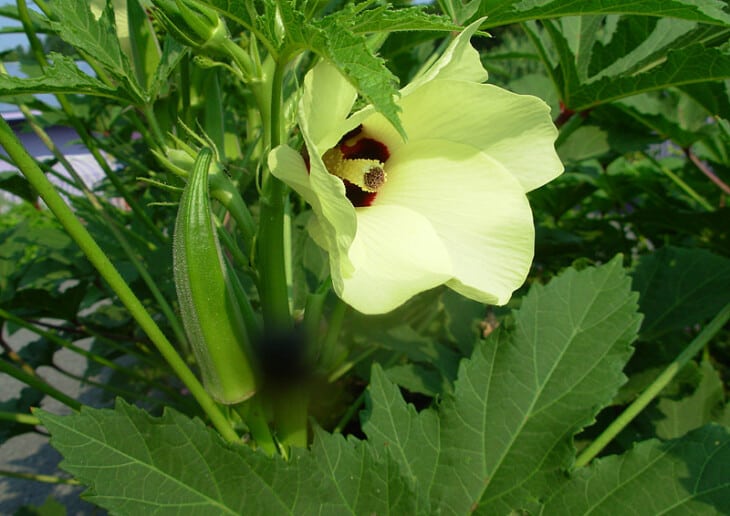
Okra is so closely related to hibiscus that it used to be classified as one. Its flowers are 2 to 3 inches across, pale yellow or cream with a dark maroon center, and last only a day, like a hibiscus’s. Each one is followed by the edible pod, which must be picked young and tender. Okra is an annual that grows 3 to 6 feet tall in hot summers, with large, lobed leaves. Some varieties, such as ‘Red Burgundy’, are grown as ornamentals.
Annual Mallow (Lavatera) (Malva trimestris (Lavatera trimestris))

Annual mallow is a fast-growing annual from the Mediterranean, 3 to 4 feet tall, covered all summer in satiny, trumpet-shaped flowers about 3 inches across, in pink, rose or white with darker veins. It looks like a small hibiscus bush in flower. It grows easily from seed sown in spring and does best in cool summers. Its shrubby relative, tree mallow, grows 6 to 8 feet tall.
Flowering Maple (Abutilon × hybridum)
Flowering maple, or abutilon, is a tropical shrub in the mallow family, named for its maple-shaped leaves, which are often variegated. Its flowers are bell-shaped or like small lanterns, 1 to 3 inches long, in orange, yellow, red, pink or white, and they hang down, with the stamen column sticking out of the mouth. It is hardy only in zones 9 to 11 and is grown elsewhere as a houseplant or patio plant. It flowers most of the year in bright light.
Turk’s Cap (Malvaviscus arboreus var. drummondii)
Turk’s cap is called the “sleeping hibiscus” because its bright red flowers never open: the petals stay wrapped around each other like a turban, with the stamen column sticking out of the top. It is a shrub, 2 to 5 feet tall, native to Texas, the Gulf Coast and Mexico, and hardy in zones 7 to 10. It grows in shade or sun, flowers from summer to frost and is one of the best plants for hummingbirds. Its small red fruits are edible.
Chaparral Bush Mallow (Malacothamnus fasciculatus)

Chaparral bush mallow is a shrub from the chaparral of Southern California and Baja California, 5 to 15 feet tall, with long, wand-like stems and gray-green leaves covered in soft, star-shaped hairs. In spring and summer it has many small, pale pink to lavender, cup-shaped flowers, about an inch across, that look like tiny hibiscus flowers. It is very drought tolerant and is one of the first shrubs to return after wildfires.
Norfolk Island Hibiscus (Lagunaria patersonia)

Norfolk Island hibiscus, or pyramid tree, is a tree in the mallow family from Norfolk Island, Lord Howe Island and Queensland in Australia. It grows 30 to 50 feet tall, with a neat, pyramid shape and leathery, gray-green leaves, and in summer it has pink flowers about 2 inches across whose petals curl back and fade to white. It tolerates wind and salt, so it is planted in coastal California. Its seed pods are full of stiff, irritating hairs, which give it the name “cow itch tree”, so wear gloves when handling them.
Silky Camellia (Stewartia malacodendron)

Silky camellia is a rare shrub or small tree, 10 to 20 feet tall, native to the Southeast from Virginia to Louisiana. In late spring it has white, five-petaled flowers 3 to 4 inches across, with slightly crinkled petals and a bold center of purple stamens tipped with blue-gray anthers. It belongs to the tea family, like camellias, not the mallow family, and its stamens form a ring, not a column. It needs moist, acid soil and part shade and is difficult to grow, but it is one of the most beautiful native shrubs.
Franklin Tree (Franklinia alatamaha)

Franklin tree was discovered by the botanists John and William Bartram along the Altamaha River in Georgia in 1765, and it hasn’t been seen in the wild since the early 1800s. Every Franklin tree today descends from seeds William Bartram collected. It grows 10 to 25 feet tall and has white, cup-shaped flowers about 3 inches across with a round cluster of yellow stamens in late summer and fall. Its long, glossy leaves turn brilliant red in fall. It is in the tea family and is hardy in zones 5 to 8, but it is hard to grow and often dies from root rot.
Mandevilla (Mandevilla hybrids)
Mandevilla is sold next to tropical hibiscus in garden centers every spring and has the same big, bright, tropical look. Its flowers are trumpet-shaped, 3 to 4 inches across, in pink, red or white, with five petals that overlap like a pinwheel and a yellow throat, with no stamen column. It is a twining vine with glossy leaves and milky, irritating sap, grown on trellises and in hanging baskets. It is hardy only in zones 10 and 11.
Canna (Canna × generalis)

Cannas have large, ruffled flowers in red, orange, yellow, pink and bicolors that give the same tropical look as hibiscus. The showy “petals” are actually modified stamens, and there is no central column. Cannas grow 3 to 6 feet tall from rhizomes, with huge, paddle-shaped leaves, sometimes striped or bronze, and flowers in clusters at the top of the stems. They are hardy in zones 8 to 11. In colder areas, dig the rhizomes in fall.
Belladonna Lily (Amaryllis belladonna)

Belladonna lily, or naked lady, is a bulb from South Africa. In late summer it sends up bare, purple-red stems 2 to 3 feet tall, each topped with a cluster of fragrant, pink, trumpet-shaped flowers with long, curved stamens. Its strap-shaped leaves appear only in winter and spring, separately from the flowers. All parts, especially the bulb, are poisonous. It grows outdoors in zones 7 to 10 and thrives in dry-summer climates such as California’s.
How to Tell a Hibiscus From a Lookalike
- The column: a hibiscus flower has a single, long column in the center, with stamens along its sides and five fuzzy stigma pads at the tip. Mallow relatives have a similar but usually shorter column. Camellias, Franklin tree, mandevilla, canna and lilies don’t.
- Petals: hibiscus has five petals, often with a dark eye at the base. Canna and belladonna lily have six or more petal-like parts.
- Flowers last a day: most hibiscus flowers open in the morning and wilt by the next day, then fall off whole.
- Leaves: tropical hibiscus has glossy, oval, toothed leaves. Rose of Sharon has smaller, often three-lobed leaves, and hardy hibiscus has large, soft, heart-shaped leaves.
- The plant: hibiscus is a shrub or a bushy perennial. A tall spike of flowers means hollyhock, a vine means mandevilla, and paddle-shaped leaves mean canna.