
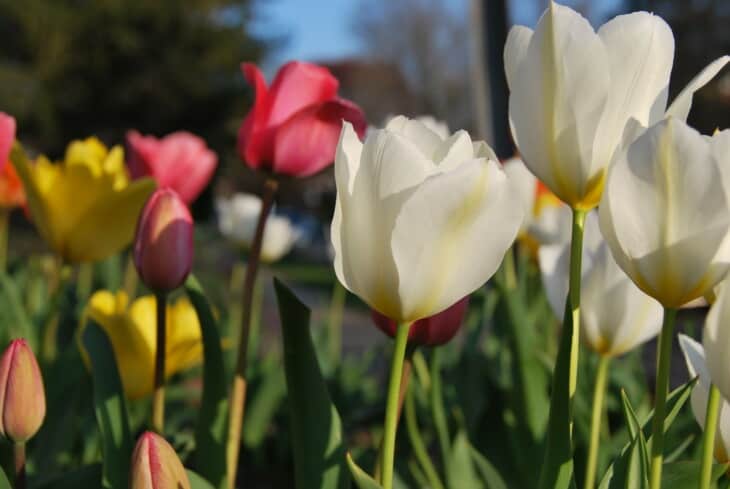
Tulips are beloved for their elegant, cup-shaped blooms and vibrant spring color, but they aren’t always the easiest plants to grow successfully year after year. If you love the look of tulips but want alternatives that may be hardier, longer-blooming, or better suited to your climate, there are several excellent options.
Contents
- 1. Lisianthus (Eustoma grandiflorum)
- 2. Dutch crocus (Crocus vernus)
- 3. California Poppy (Eschscholzia californica)
- 4. Daffodil (Narcissus spp.)
- 5. Crown Imperial (Fritillaria imperialis)
- 6. Canterbury Bells (Campanula medium)
- 7. Tulip Tree (Liriodendron tulipifera)
- 8. Little Volunteer Tulip Tree (Liriodendron tulipifera ‘Little Volunteer’)
- 9. Saucer / Chinese Magnolia (Magnolia × soulangeana)
- Choosing the Right Tulip Lookalike for Your Garden
This guide covers plants that share the tulip’s signature upright form, bold colors, or graceful silhouette, from perennial bulbs and drought-tolerant annuals to stately flowering trees. Whether you’re looking for cut flowers, companion plants, or landscape focal points, these tulip lookalikes offer beauty and versatility.
1. Lisianthus (Eustoma grandiflorum)

Lisianthus produces elegant, rose-like blooms with a tulip-like silhouette, especially in single-petal varieties. The flowers come in shades of pink, white, purple, and lavender, and are prized for their long vase life—often lasting two weeks or more as cut flowers.
Native to warm regions of the southern United States, Mexico, and the Caribbean, lisianthus is typically grown as an annual in most climates, though it can be perennial in frost-free areas. It reaches 12 to 24 inches tall and blooms in late spring through summer.
Growing conditions: Lisianthus thrives in full sun and well-drained soil. It prefers consistent moisture but is sensitive to overwatering. According to the University of Florida IFAS Extension, lisianthus performs well across USDA zones when grown as an annual and benefits from regular feeding during the growing season.
Best for: Cut flower gardens, container plantings, and mixed borders where you want a sophisticated, tulip-inspired look with excellent longevity indoors.
2. Dutch crocus (Crocus vernus)
Read our guide to Dutch crocus

Crocuses are among the earliest spring bloomers and closely resemble miniature tulips. Their cup-shaped flowers come in shades of purple, yellow, white, and striped bicolors. Most varieties grow just 3 to 6 inches tall, making them perfect for rock gardens, lawn naturalizing, and front-of-border plantings.
Like tulips, crocuses grow from corms (often mistaken for bulbs) and prefer cool winters. The Dutch crocus (Crocus vernus) is the largest and most popular variety, blooming in early to mid-spring depending on the region.
Growing conditions: Crocuses are hardy in USDA zones 3 through 8 and need full sun to partial shade. They prefer well-drained soil and will naturalize over time if left undisturbed. Plant corms in fall for spring blooms. For more details, see the NC State Extension plant profile.
Best for: Early season color, naturalizing in lawns or under deciduous trees, and pairing with other spring bulbs like tulips and daffodils.
3. California Poppy (Eschscholzia californica)
Read our guide to California Poppy

The California poppy is the state flower of California and offers a cheerful, tulip-like bloom on slender stems. Flowers are typically golden orange, but cultivars are available in yellow, red, pink, and white. Blooms open in full sun and close at night or in cloudy weather.
This hardy annual or short-lived perennial grows 6 to 12 inches tall and blooms from spring through fall in many regions. It thrives in hot, dry conditions and is highly drought-tolerant once established.
Growing conditions: California poppies prefer full sun and well-drained, even sandy or poor soil. They resent transplanting, so direct sow seeds in fall or early spring. Hardy in USDA zones 6 through 10, they self-sow readily and are ideal for low-water gardens.
Best for: Xeriscaping, wildflower meadows, cottage gardens, and areas with Mediterranean or dry-summer climates.
Related: Are Poppies Poisonous?
4. Daffodil (Narcissus spp.)

Daffodils are classic spring bulbs often planted alongside tulips for complementary color and bloom timing. While their trumpet-shaped flowers are distinct, their upright form, bright colors, and spring bloom period make them excellent tulip companions. They come in shades of yellow, white, orange, and bicolors.
Daffodils are more reliable perennials than tulips in many climates, returning year after year with minimal care. They’re also deer- and rodent-resistant, unlike tulips, which are often eaten by wildlife.
Growing conditions: Daffodils are hardy in USDA zones 3 through 9, depending on the variety. They prefer full sun to partial shade and well-drained soil. Plant bulbs in fall, about 6 inches deep. Most varieties naturalize well and make excellent cut flowers.
Best for: Spring borders, naturalizing in lawns or woodland edges, and combining with tulips for extended color.
Related: Are Daffodils Poisonous?
5. Crown Imperial (Fritillaria imperialis)
Read our guide to Crown Imperial

Crown imperial is a striking spring bulb with clusters of downward-facing, bell-shaped flowers in shades of orange, yellow, or red, topped by a crown of green leaves. Individual blooms have a tulip-like form and the plant reaches 2 to 3 feet tall, making it a dramatic focal point.
Native to the mountainous regions of Turkey, Iran, and Afghanistan, this bulbous perennial blooms in mid to late spring. The flowers have a musky, skunk-like scent that some find unpleasant, though it’s said to deter rodents and deer.
Growing conditions: Crown imperials are hardy in USDA zones 5 through 8. They need full sun and very well-drained soil to prevent bulb rot. Plant bulbs in fall, tilted slightly on their side to prevent water from collecting in the hollow crown. They are drought-tolerant once established. More information is available from Washington State University Extension.
Best for: Statement plantings, cottage gardens, and borders where their height and bold color can shine.
6. Canterbury Bells (Campanula medium)
Read our guide to Canterbury Bells

Canterbury bells are biennial flowers with large, bell-shaped blooms in shades of blue, purple, pink, and white. The cup-like flowers grow along tall spikes that can reach 2 to 3 feet, offering a vertical accent similar to tulips but with a cottage garden charm.
Native to southern Europe, Canterbury bells bloom in late spring to early summer in their second year. They are often grown as biennials, producing foliage the first year and flowers the next.
Growing conditions: Hardy in USDA zones 5 through 9, Canterbury bells prefer full sun in cooler climates and afternoon shade in hot regions. They need moist, well-drained soil enriched with organic matter. Staking may be necessary to support tall flower spikes. Protect first-year plants with mulch over winter. See the NC State Extension guide for more care details.
Best for: Cottage gardens, cutting gardens, and mixed borders where their height and color range add variety.
7. Tulip Tree (Liriodendron tulipifera)

The tulip tree is a large deciduous tree native to eastern North America, named for its tulip-shaped flowers and distinctively lobed leaves. The flowers are greenish-yellow with orange markings and bloom in late spring, though they often appear high in the canopy and can be hard to see up close.
Mature trees can reach 60 to 90 feet tall (sometimes over 100 feet) with a straight trunk and pyramidal to oval crown. In fall, the foliage turns a clear golden yellow.
Growing conditions: Tulip trees are hardy in USDA zones 4 through 9. They prefer full sun and deep, moist, well-drained soil. They grow quickly when young and need ample space—not suitable for small yards. Best planted in large landscapes or parks. More details are available from the NC State Extension.
Best for: Large properties, shade trees, naturalized areas, and specimens where fall color and spring flowers are desired.
8. Little Volunteer Tulip Tree (Liriodendron tulipifera ‘Little Volunteer’)
‘Little Volunteer’ is a compact cultivar of the tulip tree, reaching just 15 to 25 feet tall and wide—far smaller than the species. It retains the distinctive tulip-shaped flowers and lobed leaves but in a form suitable for smaller landscapes and residential gardens.
This cultivar blooms in late spring with the same greenish-yellow, tulip-like flowers and offers good golden-yellow fall color. It’s also relatively low-maintenance and adaptable to a range of soil types.
Growing conditions: Hardy in USDA zones 5 through 9, ‘Little Volunteer’ prefers full sun and moist, well-drained soil but tolerates some drought once established. It’s a good option for urban or suburban yards where space is limited.
Best for: Small to medium gardens, specimen plantings, and landscapes where a tulip tree aesthetic is desired without the massive size.
9. Saucer / Chinese Magnolia (Magnolia × soulangeana)
Read our guide to Chinese Magnolia

Saucer magnolia is a popular ornamental tree or large shrub known for its spectacular early spring display of large, tulip-shaped flowers in shades of pink, purple, and white. Blooms appear before the leaves, creating a striking effect on bare branches.
This hybrid magnolia was bred in France in the early 1820s and has become one of the most widely planted flowering trees in temperate climates. It typically grows 20 to 30 feet tall with a rounded, spreading form.
Growing conditions: Saucer magnolias are hardy in USDA zones 4 through 9. They prefer full sun to partial shade and moist, well-drained, slightly acidic soil enriched with organic matter. Because they bloom early, flowers can be damaged by late frosts—plant in a protected location if possible. Avoid planting in exposed, windy sites. Refer to the NC State Extension for detailed care guidelines.
Best for: Specimen trees, foundation plantings, and early spring focal points in borders or mixed shrub beds.
Related: 6 Trees Similar To Magnolia
Choosing the Right Tulip Lookalike for Your Garden
When selecting plants that resemble tulips, consider your climate, available space, and what role you want the plant to play. Bulbs like crocus and crown imperial offer early spring interest and pair well with tulips. Annuals like lisianthus and California poppy provide long-lasting color and are ideal for cutting gardens or containers. Trees like saucer magnolia and tulip tree make bold landscape statements but require more space and long-term planning.
Many of these tulip alternatives are more reliable perennials or easier to maintain than tulips themselves, offering similar beauty with less replanting or pest pressure. Whether you’re looking to extend your spring bulb season, add height and structure, or explore drought-tolerant options, these plants bring tulip-inspired elegance to a wide range of garden styles.



.jpg)