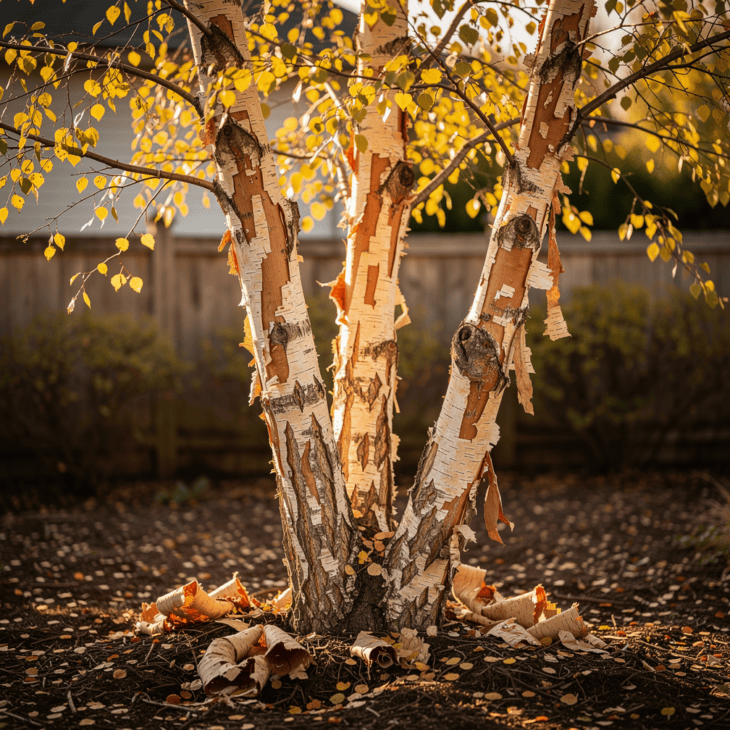
Birch trees (Betula spp.) are deciduous trees grown primarily for their ornamental bark, which peels in papery layers to reveal striking underlayers of cinnamon, salmon, cream, or chalk-white depending on the species.
The most commonly planted species in the US are River birch (Betula nigra), Paper birch (Betula papyrifera), and European white birch (Betula pendula).
At maturity, most reach 40 to 70 feet (12 to 21m) tall with a spread of 25 to 45 feet (7.5 to 14m), though compact cultivars like ‘Fox Valley’ top out closer to 8 to 10 feet (2.4 to 3m).
Native birches are ecologically valuable, supporting over 400 species of native Lepidoptera caterpillars according to entomologist Doug Tallamy’s research.
Whether birch is right for your garden depends heavily on which species you choose and where you garden. River birch is a broadly adaptable native that handles wet soils and summer heat in Zones 4 to 9.
Paper birch and European white birch are a different story: beautiful in cool northern climates, but prone to decline and serious pest problems in Zone 6 and warmer.
The same white-barked look that makes birch so appealing in garden centers is often the thing that disappoints gardeners who plant the wrong species in the wrong climate.
This article covers the four main advantages and four main drawbacks of birch trees, with honest zone-by-zone guidance so you can make an informed decision before you plant.
Pros Of Birch Trees
The Ornamental Bark Delivers Four-Season Interest Unlike Most Trees
Birches are grown primarily for their bark, and for good reason: it is ornamentally exceptional in a way few other landscape trees match. River birch ‘Heritage’ (Betula nigra ‘Heritage’) peels in cinnamon-pink to salmon layers throughout the year, including in winter when the rest of the garden has little to offer.
Paper birch (B. papyrifera) produces bright white bark that reflects light in winter and stands out dramatically against dark evergreens or a gray sky. The bark display is present in every season, making birch one of the strongest candidates when you want a four-season specimen tree.
‘Heritage’ is the top-selling birch in the US nursery trade precisely because it combines that ornamental bark with better heat tolerance than Paper birch. Planting a multi-stem clump with three or five trunks dramatically amplifies the bark display across the full height of the tree. This benefit is most valuable for gardeners who want a prominent winter focal point or a year-round specimen in a lawn or mixed border position where the tree is viewed from multiple angles.

Fast Growth Puts Canopy and Structure in Place Within a Decade
Birches are among the faster-growing ornamental trees available in temperate landscapes, typically adding 1.5 to 2 feet (45 to 60cm) per year under good conditions. This growth rate gives a landscape presence within five to eight years that slower alternatives simply cannot match at the same starting size. For new homeowners establishing a bare site or gardeners filling in a gap after removing a dead tree, that pace is a genuine practical advantage over slower ornamentals.
By comparison, dogwood grows 13 to 25 inches (33 to 64cm) per year and Japanese maple grows 12 to 24 inches (30 to 60cm) per year under comparable conditions. Birch reaches tree-like presence more quickly than either. This makes birch a realistic choice for gardeners who want a significant canopy established within ten years without committing to the much longer wait of oaks or lindens.
River Birch Handles Wet, Clay, and Flood-Prone Sites That Defeat Most Trees
River birch (Betula nigra) is one of the very few ornamental trees that tolerates both seasonally flooded soils and summer heat in Zones 4 to 9. This is a natural adaptation: River birch is native to river floodplains throughout the eastern and central US, so its tolerance of wet conditions is built in, not marginal. Low-lying areas, rain gardens, wet clay sites, and spots near streams or ponds are all situations where River birch succeeds while oaks, maples, dogwoods, and most other ornamental trees fail to establish.
The cultivar ‘Heritage’ has improved heat and drought resistance compared to the straight species, making it the preferred choice for most landscape situations. In Zones 7 and 8, River birch is the most reliable birch species available: Paper birch and European white birch decline rapidly in southern summer heat, while River birch continues to perform. For anyone with a persistently soggy area that has defeated previous planting attempts, River birch is one of the few trees worth trying.

Native Birches Are Among the Most Ecologically Valuable Trees You Can Plant
Native North American birch species, particularly River birch (Betula nigra) and Paper birch (B. papyrifera), are ecologically productive trees. Research by entomologist Doug Tallamy places Betula species among the top ten most ecologically valuable tree genera for native caterpillars in eastern North America, supporting over 400 species of native moths and butterflies. The small winged seeds produced in catkins also provide a reliable food source for songbirds including chickadees, redpolls, and pine siskins through fall and winter.
This ecological value applies specifically to the native species: European white birch (B. pendula), which is non-native, hosts far fewer native insects. For gardeners building a wildlife-supporting landscape or replacing purely ornamental trees with ecologically functional alternatives, a native birch planted in the right site delivers value well beyond its visual appeal.
Cons Of Birch Trees
Birch Trees Live Significantly Shorter Lives Than Most Landscape Trees
Birches are short-lived compared to oaks, maples, and most other landscape trees. Most birch species in cultivated landscapes live 30 to 50 years before declining noticeably, compared to oaks (200 or more years), maples (100 or more years), or even dogwoods (around 80 years). Paper birch (B. papyrifera) is particularly short-lived in landscape settings outside its cool native range: in Zones 6 and 7, many specimens are visibly declining by 20 to 25 years. This is the most consistent surprise for buyers who plant birch without fully understanding what they are committing to.
River birch lives somewhat longer, especially the cultivar ‘Heritage,’ which can reach 40 to 50 years or more when sited correctly. Planting multi-stem clumps helps: if one stem fails, the others persist, extending the visual life of the planting. But there is no workaround for the fundamentally shorter lifespan. Gardeners who plant birch expecting a forever tree are likely to be disappointed; those who treat it as a 25 to 40 year feature and plan accordingly will get more satisfaction from it.
Bronze Birch Borer Can Kill the Tree From the Top Down
The bronze birch borer (Agrilus anxius) is the most serious pest threat to birch in cultivation. The borer larvae tunnel under the bark, disrupting the tree’s vascular system and killing branches from the crown downward. This pattern of top-down dieback is the most recognizable symptom. Stressed trees are far more vulnerable than healthy, vigorous specimens: drought, heat, poor soil, and compacted roots all weaken a birch to the point where borer damage becomes lethal rather than manageable. In Zones 6 to 9, Paper birch and European white birch are highly susceptible because they are growing outside their preferred cool, moist climate, keeping them in a state of chronic stress the borer readily exploits.
The most reliable mitigation is choosing the right species for your climate. River birch (‘Heritage’) is substantially more borer-resistant than Paper or European white birch and is the recommended choice for Zones 5 to 9. Keeping trees well-watered during drought periods and removing dead branches promptly also reduce risk. Preventive systemic insecticide applications (imidacloprid soil drench) are used in some situations but are controversial for gardens where pollinators are a priority.
Paper Birch and European White Birch Are Poor Choices for Zones 6 and Warmer
Paper birch (B. papyrifera) and European white birch (B. pendula) are genuinely poor choices for Zones 6 to 9, and yet both remain widely sold in garden centers throughout the South, Midwest, and Mid-Atlantic. Both species evolved in cool, moist climates and decline rapidly when subjected to hot summers, warm nights, and the drought stress that comes with them. Paper birch in Zone 6 to 7 often shows serious crown dieback within 10 to 15 years of planting. The white-barked look that attracts most buyers is the very thing that fails first in a warm climate.
The straightforward workaround is a species swap: do not plant Paper birch or European white birch in Zones 6 to 9. River birch (‘Heritage’) provides exfoliating bark and genuine ornamental appeal across Zones 4 to 9. For gardeners who specifically want a compact tree, ‘Fox Valley’ is a River birch cultivar that tops out at 8 to 10 feet (2.4 to 3m), suitable for smaller yards where a full-size River birch would be out of scale.
Catkins and Leaf Litter Create Ongoing Cleanup Near Paved Areas
Birches produce substantial quantities of small, winged seeds in drooping clusters called catkins in spring, and then drop masses of small leaves in fall. The catkins are fine-textured and sticky, collecting on lawns, mulch beds, and hardscape in a way that takes several passes to clean up. In a large garden or a naturalistic site where some litter is acceptable, this is a minor inconvenience. On a small paved patio, pool surround, or formal garden where litter is highly visible, it becomes a recurring maintenance task.
Siting the tree away from paved areas reduces the problem significantly. A mulched bed around and beneath the tree absorbs much of the falling litter and makes it less visible. Compact cultivars like ‘Little King’ and ‘Fox Valley’ produce proportionally less litter than full-size trees and are worth considering for sites where cleanup is a real concern.
Is Birch Right For You?
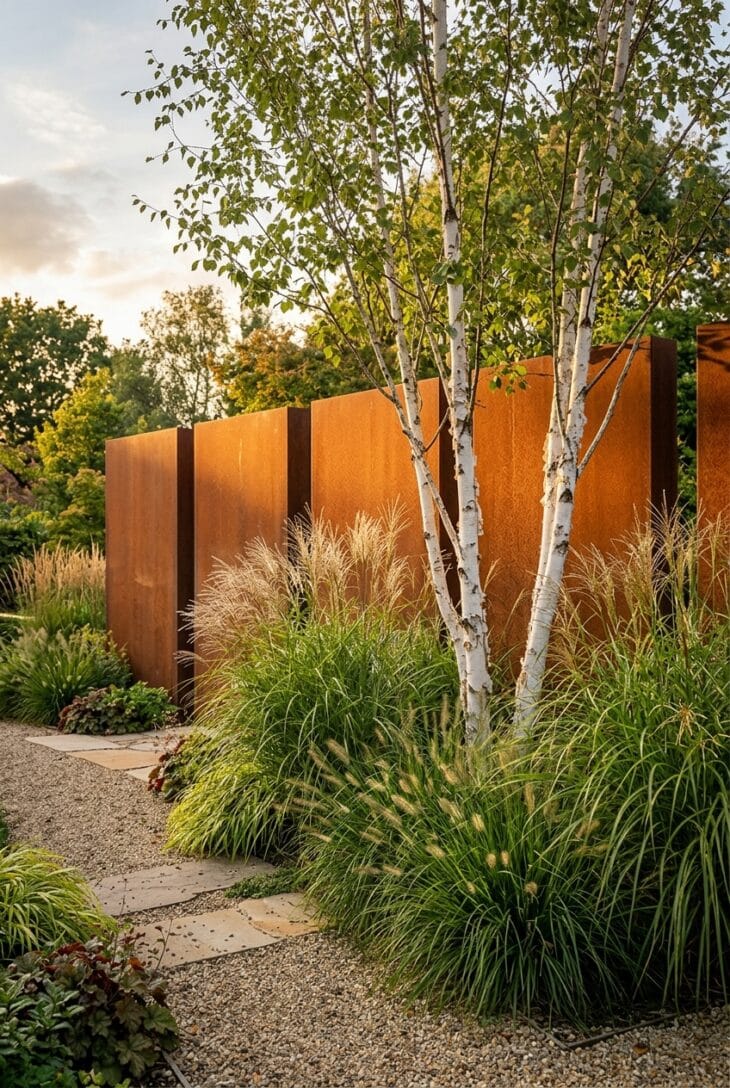
Birch trees are an excellent fit for gardeners in Zones 4 to 7 who have a moist, slightly acidic, well-drained site in full sun and want a fast-growing specimen with genuine four-season ornamental value. River birch (Betula nigra ‘Heritage’) is the most broadly suitable species for most US gardeners, working well across Zones 4 to 9 as long as consistent moisture is available. The ideal setting is a lawn specimen, the edge of a rain garden, or a position alongside a stream or pond where natural moisture is reliable. A multi-stem clump planted in a prominent position, where the peeling bark can be appreciated at close range in winter, makes the most of what birch does best.
Birch is a poor fit if you are in Zones 6 to 9 and want the white-barked look of Paper or European white birch: both species decline in warm climates, and the disappointment is predictable. It is also a poor fit if you are looking for a long-lived tree, if you have hot, dry, or compacted soil without the ability to irrigate in summer, or if you want a low-maintenance tree near paved areas. Gardeners who plant birch expecting a 100-year specimen are better served by an oak, linden, or hornbeam.
If birch is not quite the right fit, consider serviceberry (Amelanchier × grandiflora), a four-season native tree with spring bloom, fall color, and wildlife value that is longer-lived and lower-maintenance than birch across Zones 3 to 8. American hornbeam (Carpinus caroliniana) is a small native understory tree with distinctive muscled bark, excellent fall color, shade tolerance, and a lifespan measured in centuries rather than decades, covering Zones 3 to 9. For gardeners who specifically want birch character in a smaller footprint, River birch ‘Fox Valley’ delivers the cinnamon-peeling bark in a tree that tops out at 8 to 10 feet (2.4 to 3m).
Frequently Asked Questions
How long do birch trees live?
Most birch trees in cultivated landscapes live 30 to 50 years, which is significantly shorter than oaks, maples, or lindens. Paper birch and European white birch decline faster, often showing serious crown dieback by 20 to 25 years when planted in Zone 6 and warmer. River birch (Betula nigra) is the longest-lived species in landscape conditions, especially the cultivar ‘Heritage.’ Heat stress, drought, and bronze birch borer all accelerate decline regardless of species.
Why is my birch tree dying from the top down?
Top-down dieback is the classic symptom of bronze birch borer (Agrilus anxius), a wood-boring insect that tunnels under the bark and cuts off the flow of water and nutrients. Trees weakened by drought, heat, poor soil, or compacted roots are far more vulnerable than healthy, vigorous specimens. Remove and dispose of dead branches promptly. River birch is substantially more resistant than Paper or European white birch. If you are in Zone 6 or warmer, the underlying cause is likely a species mismatch rather than a care problem.
What is the best birch tree to plant in my yard?
For most US gardeners in Zones 4 to 9, River birch (Betula nigra ‘Heritage’) is the best choice. It combines ornamental cinnamon-peeling bark with better heat tolerance, borer resistance, and adaptability to wet or clay soils compared to Paper birch or European white birch. ‘Fox Valley’ is a compact cultivar reaching 8 to 10 feet (2.4 to 3m) for smaller yards. Paper birch is appropriate only for Zones 2 to 6 in cool, moist sites where summers are reliably mild.
Do birch trees make a mess?
Yes. Birch trees produce substantial quantities of small winged seeds in drooping catkins in spring and drop masses of small leaves in fall. The catkins are fine and sticky, accumulating on lawns, mulch, and hardscape and requiring repeated cleanup. This is a manageable task for most gardens but worth thinking through if you have a small paved patio or pool area directly under the canopy. Compact cultivars like ‘Little King’ and ‘Fox Valley’ produce proportionally less litter than full-size trees.