Most plants that look like onions are other alliums: chives, garlic, leeks, shallots, Egyptian walking onions, ramps and the wild onions and wild garlic that grow in lawns. All of them are edible. The dangerous lookalikes are onion-like bulbs and grassy leaves from other plants, such as death camas, star-of-Bethlehem, daffodils and lily of the valley, which are poisonous. The test that separates them is smell. Every true onion relative smells of onion or garlic when you crush a leaf, and none of the poisonous lookalikes do.
Contents
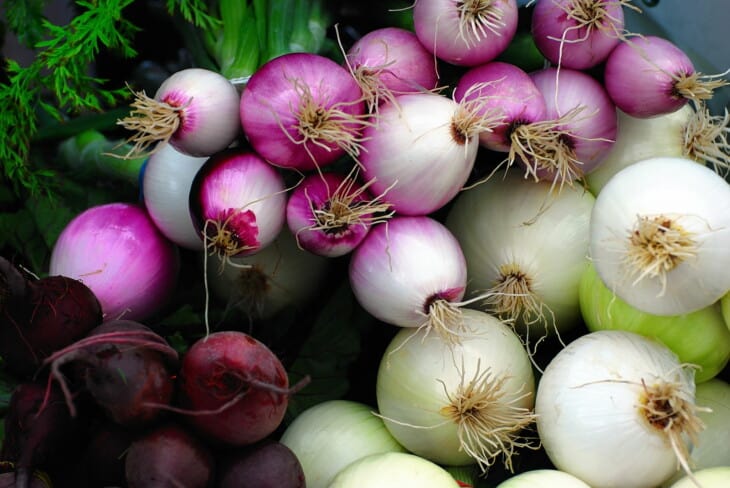
The common onion (Allium cepa) has hollow, tubular, blue-green leaves, 1 to 2 feet long, that grow from a single bulb. It is usually harvested in its first year. If left in the ground it flowers the next summer, sending up a hollow stalk 2 to 4 feet tall topped with a round ball of small white or greenish-white flowers.

- Edible Garden Alliums
- Wild Onions and Garlic
- Poisonous Plants That Look Like Onions
- How to Tell a Real Onion From a Poisonous Lookalike
| Plant | Botanical name | Edible? | How to tell it from an onion |
|---|---|---|---|
| Egyptian Walking Onion | Allium × proliferum | Yes | Clusters of small bulbs on top of the stalk instead of flowers |
| Chives | Allium schoenoprasum | Yes | Grass-thin hollow leaves in dense clumps; pink-purple flowers |
| Garlic | Allium sativum | Yes | Flat, solid leaves; bulb split into cloves; curly flower stalk on hardneck types |
| Leek | Allium ampeloprasum | Yes | Flat, folded leaves in a fan; thick stem; no real bulb |
| Shallots and Potato Onions | Allium cepa Aggregatum Group | Yes | Several small bulbs in a clump instead of one big bulb |
| Ramps (Wild Leeks) | Allium tricoccum | Yes | Broad, flat leaves 1–2.5 in wide; spring woodlands |
| Wild Onion (Meadow Garlic) | Allium canadense | Yes | Flat, solid, grass-like leaves; small bulbs and pink-white flowers on top |
| Wild Garlic (Field Garlic) | Allium vineale | Yes | Hollow, thin leaves in lawns; garlic smell when mowed |
| Death Camas | Toxicoscordion venenosum | No, deadly | V-shaped grass-like leaves; no onion smell; cream flowers in a spike |
| Star-of-Bethlehem | Ornithogalum umbellatum | No, poisonous | Grass-like leaves with a white stripe down the middle; no onion smell |
| Daffodil | Narcissus spp. | No, poisonous | Flat, strap-shaped leaves; papery brown bulb; no onion smell |
| Lily of the Valley | Convallaria majalis | No, deadly | Leaves in pairs from creeping roots, no bulb; no onion smell |
Edible Garden Alliums
Egyptian Walking Onion (Allium × proliferum)

Egyptian walking onions are a hybrid between the common onion and the Welsh onion. The leaves are hollow and tubular like an onion’s. The difference shows in summer: instead of a ball of flowers, the top of each stalk grows a cluster of small, reddish bulbs, sometimes with a few flowers mixed in. The bulbs can sprout while still on the stalk. Their weight bends the stalk to the ground, where they root a short distance away, so the clump slowly “walks” across the bed. The leaves, the small underground bulbs and the top bulbs are all edible.
Chives (Allium schoenoprasum)

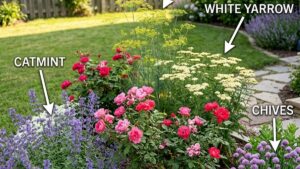
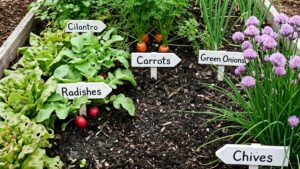
Chives form dense clumps of very thin, hollow leaves 10 to 18 inches tall, much finer than onion leaves. They don’t form a real bulb, just small, narrow ones packed together at the base. In late spring they bloom with round heads of pink to purple flowers, which are edible too. Chives are a perennial and come back every year, while onions are grown as annuals.
Garlic (Allium sativum)

Young garlic looks like an onion from a distance, but the leaves are flat and solid, not hollow tubes. The bulb divides into cloves wrapped in papery skin. Hardneck garlic sends up a stiff stalk in early summer called a scape, which curls into a loop and ends in a cluster of tiny bulbs and a few pale flowers. Growers cut the scapes off to get bigger bulbs, and the scapes are edible. Softneck garlic rarely makes a stalk. The plant smells of garlic, not onion.
Leek (Allium ampeloprasum)

Leeks are bigger and stockier than onions, 2 to 3 feet tall. Their leaves are flat and folded lengthwise, and they grow in a fan shape from a thick white stem. Leeks don’t form a real bulb. The part you eat is the stem made of tightly wrapped leaf bases, which gardeners blanch by piling soil around it. If a leek overwinters, it flowers the next summer with a big round head of pink or white flowers on a tall stalk.
Shallots and Potato Onions (Allium cepa Aggregatum Group)

Shallots and potato onions are varieties of the common onion, and above ground they look nearly identical to it, with the same hollow leaves. The difference is underground: each planted bulb divides into a cluster of 4 to 12 smaller bulbs instead of growing into one large one. Shallot bulbs are often elongated with copper, gray or pinkish skins and have a milder, sweeter flavor. Potato onions are rounder and slightly larger. Both are usually grown from bulbs, not seed.
Wild Onions and Garlic
These grow wild in woods, lawns and fields. They are edible, but use the smell test on every plant before you eat it, because their leaves grow among poisonous lookalikes.
Ramps (Wild Leeks) (Allium tricoccum)

Ramps grow in rich, moist hardwood forests of eastern North America and come up in early spring. They don’t look like onions at all above ground: each plant has 2 or 3 broad, smooth, flat leaves, often with a reddish stem, and the leaves die back by early summer, before the plant flowers. Below ground is a small, white, onion-like bulb. The strong garlicky-onion smell is the giveaway. Ramps grow slowly, and over-harvesting has depleted many wild patches, so pick only a leaf per plant and leave the bulbs in the ground.
Wild Onion (Meadow Garlic) (Allium canadense)

Wild onion is a native perennial of lawns, meadows and open woods across the eastern and central U.S. Its leaves are narrow, flat and solid, like thick grass blades. In late spring it sends up a stalk topped with a cluster of small bulbs, often mixed with pink or white star-shaped flowers. The whole plant smells strongly of onion, and it is edible, though the fibrous bulbs are small.
Wild Garlic (Field Garlic) (Allium vineale)

Wild garlic, or field garlic, is a European plant that is now a common lawn weed in the eastern U.S. It has thin, hollow leaves, much like chives, that grow taller and faster than the grass in early spring. You often smell it before you see it, when the lawn is mowed. In early summer it makes a head of small bulbs, sometimes with a few flowers. It is edible, but strongly flavored.
Poisonous Plants That Look Like Onions
None of these smell like onion or garlic. If a bulb or leaf looks like an onion but smells of nothing, don’t eat it.
Death Camas (Toxicoscordion venenosum)

Death camas is a group of related plants native to meadows, grasslands and open woods of western North America, with a few species in the Midwest and East. Its bulb and its narrow, grass-like leaves look very much like a wild onion’s. But the leaves are V-shaped in cross-section, not hollow or round, and the plant has no onion smell at all. It flowers from spring to early summer with a spike of small, cream-white, star-shaped flowers, not a round ball. All parts are poisonous, especially the bulb. It is a common cause of livestock poisoning, especially in sheep, and people have died after mistaking it for wild onion or edible camas.
Star-of-Bethlehem (Ornithogalum umbellatum)

Star-of-Bethlehem is a European bulb that has spread into many lawns and gardens in the eastern U.S. Its narrow, grass-like leaves have a white stripe down the center and grow from small, white, onion-like bulbs that spread quickly. In spring it opens clusters of white, star-shaped flowers with green stripes on the back. There’s no onion smell. All parts, and especially the bulbs, contain heart toxins that are dangerous to people, pets and grazing animals.
Daffodil (Narcissus spp.)
Daffodil bulbs are the most common poisonous onion lookalike in the kitchen. Dormant bulbs stored in a garage or cellar have brown, papery skins and look a lot like onions or shallots, and people have cooked them by mistake. The leaves are flat, strap-shaped and gray-green, not hollow. Neither the bulb nor the leaves smell of onion. Eating the bulbs causes vomiting, diarrhea and abdominal pain, and they are toxic to dogs and cats as well. Store and label bulbs away from food. See our daffodil entry for details.
Lily of the Valley (Convallaria majalis)
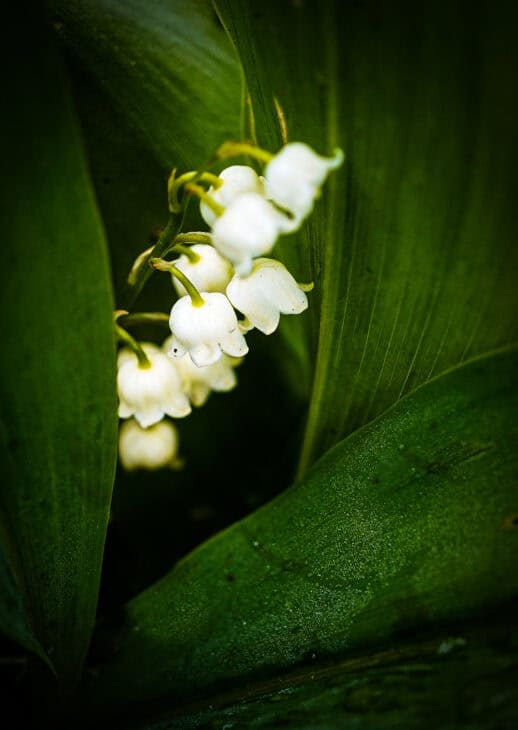
Lily of the valley is the dangerous lookalike for ramps, not onions. Its broad, smooth, pointed leaves come up in shady spots in spring, often in pairs, and look very much like ramp leaves. Crush a leaf: lily of the valley has no onion smell. It also has no bulb, only thin creeping roots, and in late spring it has sprays of small, white, fragrant bells. All parts contain heart glycosides and can cause dangerous heart rhythm problems.
How to Tell a Real Onion From a Poisonous Lookalike
- Smell every plant. Crush a leaf or bulb. A true onion, garlic, chive, leek or ramp smells of onion or garlic. No smell means don’t eat it. Wash your hands between plants, so the smell from one doesn’t carry over to the next.
- Look at the leaves. Onions, chives and wild garlic have hollow, tubular leaves. Garlic, leeks and wild onion have flat but solid leaves. A white stripe down the middle points to star-of-Bethlehem.
- Look at the flowers. Alliums have a round or domed cluster of flowers all starting from one point at the top of a bare stalk. Death camas has its flowers along a spike.
- Know your bulbs. Keep daffodil, tulip and other flower bulbs out of the kitchen, and label stored bulbs.
- If someone eats a lookalike, call Poison Control at 1-800-222-1222 (U.S.) or emergency services right away. For a pet, call your vet.
Onions and other alliums are also toxic to dogs and cats, even though they are safe for people. For more, see our guide to common poisonous plants.