Cucumber beetles are one of the most destructive forces in the vegetable garden — and they don’t just eat foliage. They transmit bacterial wilt, a disease that can collapse an otherwise healthy cucumber vine in days with no cure available. The right companion plants disrupt this cycle before it starts.
Companion planting is the practice of growing different plants in proximity so that each benefits the other — through pest deterrence, improved soil fertility, pollinator attraction, or simply by acting as a decoy. For cucumbers, the stakes are particularly high. They face pressure from multiple chewing and sucking insects, two serious fungal diseases, and bacterial wilt spread by cucumber beetles. A thoughtfully planted bed can reduce all of these threats simultaneously rather than relying on a single intervention.
The benefits companions provide for cucumbers fall into several categories represented in the research: pest repellents and trap crops that intercept insects before they reach your cucumbers, beneficial insect attractors that bring in predatory and parasitic insects to police the pest population, soil enrichers that fix atmospheric nitrogen to support steady plant growth, and pollinator attractors that ensure strong fruit set. Many companions deliver more than one of these benefits.
When choosing companions, match their basic needs to those of cucumbers: full sun (at least 6–8 hours daily), a soil pH of 6.0–6.8, and warm growing temperatures in the range of 65–85°F (18–29°C). Plants that thrive in similar conditions will be easier to manage in the same bed and won’t compete for fundamentally different resources.
Best companion plants for cucumber
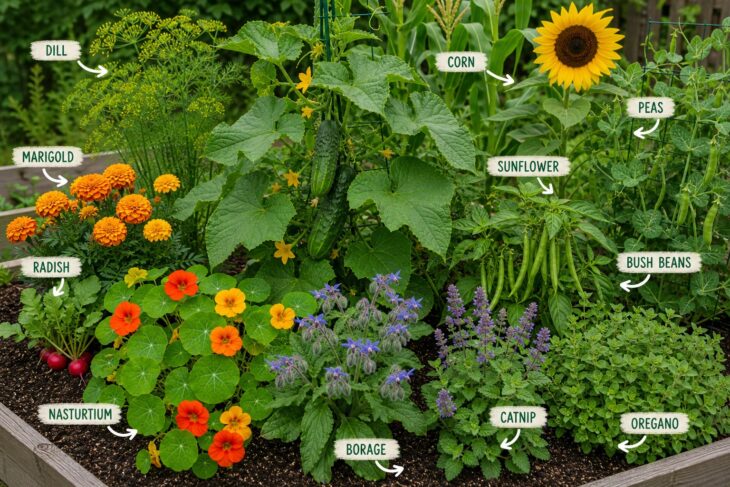
Nasturtium (Tropaeolum majus)
What it helps with
Nasturtiums draw aphids and cucumber beetles away from cucumbers while simultaneously attracting the predatory insects that will hunt those pests.
Why it works with cucumber
Nasturtiums release volatile compounds — particularly glucosinolates — that many pest insects find highly attractive, making them effective trap crops that pull aphids off cucumbers and concentrate them in one spot. They also attract hoverflies and lacewings, both of which prey on aphids. Some gardeners widely report that densely planted nasturtiums repel cucumber beetles as well, though this repellent effect is less supported by controlled research than the trap crop mechanism.
Planting notes
Direct-sow nasturtiums after the last frost at the same time you plant cucumbers — they share the same warm-season window. Plant them at the bed perimeter or interspersed within 12–18 inches (30–45 cm) of your cucumber plants. Both trailing and bush varieties work well; trailing types make effective ground-level lures along bed edges.
Possible drawback or limit
Nasturtiums can become heavily infested with aphids — which is partly the point. If aphid populations on nasturtiums grow too large, you’ll need to decide whether to remove the infested plants or let predatory insects work through the colony.
Dill (Anethum graveolens)
What it helps with
Young dill attracts parasitic wasps and predatory insects that keep aphid, cucumber beetle, and spider mite populations in check.
Why it works with cucumber
Dill belongs to the umbellifer family, and its flat-topped flowers are a major nectar source for braconid wasps (Aphidius spp.) that parasitize aphids, as well as predatory beetles and hoverflies. This is well documented in horticultural literature on insectary plants. The aromatic foliage may also help mask cucumbers from pest insects navigating by scent, though this effect is less clearly established.
Planting notes
Plant dill 18–24 inches (45–60 cm) from cucumber plants and succession-sow every 3–4 weeks through the season to maintain young, actively flowering plants. Keep dill in the vegetative stage while it’s near cucumbers — once it goes to seed, allelopathic compounds in the mature plant can inhibit cucumber growth and should be harvested or removed before seed set occurs.
Possible drawback or limit
This is a nuanced companion: mature dill going to seed near cucumbers can inhibit their growth. Many gardening sources list dill as either a companion or an enemy of cucumbers without distinguishing between plant age — keep plants young and the relationship stays beneficial.
Marigold (Tagetes spp.)
What it helps with
Marigolds deter aphids, whiteflies, and soil nematodes while attracting hoverflies and parasitic wasps that prey on cucumber pests.
Why it works with cucumber
Marigolds produce thiophenes and sulfur compounds from their roots and foliage with demonstrated repellent effects on whiteflies and aphids — this is supported by controlled studies. French marigold (Tagetes patula) root exudates have been shown in peer-reviewed research to suppress root-knot nematodes (Meloidogyne spp.), a soil pest that damages cucumber roots. The bright flowers attract hoverflies and parasitic wasps that target the insect pests cucumbers face above ground.
Planting notes
Plant marigolds along bed edges or interspersed every 18–24 inches (45–60 cm) among cucumbers. Both French marigolds (T. patula) and African marigolds (T. erecta) are effective; French types offer stronger nematode suppression through their roots, while African types produce more flower mass for pollinator attraction. Sow at the same time as cucumbers after the last frost.
Possible drawback or limit
The nematode suppression benefit is cumulative over a season — it won’t resolve an existing severe infestation immediately. For best results, plant marigolds early and allow them to grow alongside cucumbers throughout the season.
Radish (Raphanus sativus)
What it helps with
Radishes act as a trap crop for flea beetles and may help deter cucumber beetles from moving into the bed.
Why it works with cucumber
Flea beetles strongly prefer radish foliage over cucumbers, making radishes an effective decoy that draws these pests away from the main crop — this trap crop behavior is well established in vegetable crop research. Daikon radish (Raphanus sativus var. longipinnatus) in particular emits isothiocyanates that may repel certain soil pests and cucumber beetles, though the cucumber beetle deterrence is primarily based on gardener reports with limited controlled studies.
Planting notes
Plant radishes as a border around the cucumber bed, 6–12 inches (15–30 cm) from cucumber plants. They’re a cool-season crop, so they work best when sown in early spring at the same time as or slightly before cucumbers are started. In hot climates, radishes bolt and die back in midsummer, which reduces their effectiveness as the cucumber season peaks.
Possible drawback or limit
The effectiveness window is largely limited to spring. Once temperatures consistently exceed 80°F (27°C), radishes bolt and provide minimal trap crop benefit for the remainder of the cucumber season.
Borage (Borago officinalis)
What it helps with
Borage increases pollinator density at the cucumber patch, directly improving fruit set and yield on a crop that relies entirely on bee pollination.
Why it works with cucumber
Borage produces star-shaped blue flowers with exceptionally high nectar concentrations, making them highly attractive to bumblebees and honeybees — the primary pollinators of cucumber flowers. Since cucumbers set fruit only when female flowers are pollinated, more pollinators mean more cucumbers. Borage is also traditionally claimed to deter aphids and tomato hornworm near crops, though these effects are rooted in folk gardening practice rather than controlled research, and the pollinator benefit is the primary evidence-backed mechanism.
Planting notes
Plant borage 12–18 inches (30–45 cm) from cucumbers — it spreads generously and needs room. It may need to be started 4–6 weeks before the last frost date indoors so it’s already flowering when cucumbers come into production. Once established, it self-seeds readily; allow a few plants to go to seed for an effortless supply the following season.
Possible drawback or limit
Borage grows large — up to 24–36 inches (60–90 cm) tall and wide — and can shade smaller cucumber seedlings if placed carelessly. Position it where it won’t block sun from reaching the cucumber bed.
Bush beans (Phaseolus vulgaris)
What it helps with
Bush beans fix atmospheric nitrogen in the soil, steadily enriching fertility that supports cucumber growth throughout the season.
Why it works with cucumber
Bush beans form a symbiotic relationship with Rhizobium soil bacteria that colonize their root nodules and convert atmospheric nitrogen (N₂) into plant-available ammonium. This fixed nitrogen is partially released into the surrounding soil as roots are disturbed or die back, benefiting neighboring cucumbers. This mechanism is thoroughly documented in agricultural science, and the direct soil fertility benefit for companion plants in mixed-cropping systems is well established.
Planting notes
Plant bush beans 12–18 inches (30–45 cm) from cucumber plants in the same warm-season window after the last frost. Avoid positioning beans on the south side where they might shade cucumbers; low-growing bush types are easier to manage alongside sprawling cucumber vines than pole varieties. The nitrogen benefit builds over the growing season rather than providing an immediate boost.
Possible drawback or limit
Bush beans and cucumbers share some pest vulnerabilities, particularly aphids. Monitor both crops together — a heavy aphid infestation on beans can spread to cucumbers if left unaddressed.
Sunflower (Helianthus annuus)
What it helps with
Sunflowers attract a high diversity of pollinators and beneficial predatory insects while also functioning as a living trellis for vining cucumber varieties.
Why it works with cucumber
Sunflower pollen and nectar attract a broad range of native bees and honeybees, increasing pollinator activity across the entire garden bed — a direct benefit for a crop as pollinator-dependent as cucumber. The sturdy stalk provides a natural climbing structure for lightweight vining cucumbers without requiring additional hardware. Sunflowers also attract ambush bugs and spiders that help keep pest populations suppressed, though these predator benefits are primarily based on garden observation rather than controlled research.
Planting notes
Give sunflowers a 2–3 week head start before cucumbers so they’re established and tall enough to trellis by the time cucumber vines need support. Plant them on the north or west side of cucumber rows — 18–24 inches (45–60 cm) away — to ensure they provide afternoon windbreak without blocking morning sun from reaching the cucumbers. Train vining cucumber stems gently toward sunflower stalks as they grow.
Possible drawback or limit
Large sunflower varieties can cast substantial shade. Choose varieties in the 5–8 foot (1.5–2.4 m) range rather than giant types, and position them carefully to avoid shading the cucumber bed during peak morning sun hours.
Catnip (Nepeta cataria)

Catnip
Catnip is a fragrant perennial herb grown for its aromatic foliage and small pale flowers. It is easy to grow and commonly used in herb and pollinator gardens and as a cat attractant.
Read our guide to CatnipWhat it helps with
Catnip’s volatile aromatic compounds repel aphids and may deter squash bugs and cucumber beetles from entering the bed.
Why it works with cucumber
Catnip contains nepetalactone, a volatile iridoid compound that has been shown in laboratory studies to repel aphids and certain beetle species — a 2011 study specifically documented its effectiveness as an aphid repellent. Gardeners widely report that catnip also deters squash bugs and cucumber beetles in field conditions, though controlled field studies specifically targeting these pests are limited. Crushing catnip leaves activates and releases nepetalactone more strongly, so occasional bruising of foliage can increase the repellent effect.
Planting notes
Plant catnip at the perimeter of the cucumber bed, 12–18 inches (30–45 cm) from plants. As a perennial in USDA zones 3–9, it will return each season and be in place when cucumbers are planted. Alternatively, grow it in pots nearby and crush a few stems occasionally during the peak pest season. Catnip can spread aggressively — growing it in containers helps keep it from overtaking the bed.
Possible drawback or limit
Laboratory evidence for nepetalactone as a repellent is solid, but field-scale results specifically for cucumber pests are not yet well documented. Treat it as a promising addition to a multi-strategy pest management approach rather than a standalone solution.
Oregano (Origanum vulgare)
What it helps with
Oregano’s aromatic foliage may deter pest insects navigating by scent, while its flowers attract small parasitic wasps and hoverflies beneficial to the cucumber bed.
Why it works with cucumber
Oregano produces carvacrol and thymol — volatile terpenoids with documented insect-deterrent properties in laboratory studies. These compounds may mask the scent profile of cucumber plants from pests that locate host crops by smell. Oregano flowers attract a range of small beneficial insects including parasitic wasps and hoverflies. The aromatic deterrent mechanism is less clearly established in field conditions than laboratory results imply, and gardener observation forms much of the field evidence for this companion relationship.
Planting notes
Grow oregano as a low-growing border at bed edges, 12 inches (30 cm) from cucumber plants. As a perennial herb (USDA zones 5–10), it will be established and ready each season. Allow it to flower rather than harvesting it back heavily during the cucumber season — the flowers are what attract beneficial insects. It tolerates the same full sun and soil pH range as cucumbers.
Possible drawback or limit
The pest deterrence effect of oregano in field settings is primarily based on gardener reports and small-scale observation. It is best treated as a supportive companion rather than a primary pest management tool, paired with more evidence-backed companions like marigolds or nasturtiums.
Corn (Zea mays)
What it helps with
Tall corn moderates heat and soil moisture for cucumbers in hot climates and provides a living trellis structure for vining varieties.
Why it works with cucumber
In hot, arid conditions, corn stalks provide afternoon shade that reduces soil temperature and moisture loss — conditions cucumbers benefit from during heat peaks. Corn stalks also support lightweight vining cucumbers, eliminating the need for additional trellis infrastructure. This intercropping approach adapts traditional Three Sisters planting (which traditionally uses squash) and is widely reported in agronomic practice; there is no well-documented biochemical mechanism, and the benefit is primarily structural and microclimate-based.
Planting notes
Start corn 3–4 weeks ahead of cucumbers so stalks are established before cucumber vines need support. Plant corn 12–18 inches (30–45 cm) from cucumbers on the south or west side of the bed so that afternoon shade falls across cucumbers during the hottest part of the day without blocking morning sun. This pairing is most valuable in climates where summer temperatures regularly exceed 90°F (32°C).
Possible drawback or limit
In cooler climates or cloudy summers, the shade corn provides may reduce cucumber yield rather than improve it. This companion relationship is most beneficial in genuinely hot conditions — in temperate gardens, it offers less advantage and may not be worth the bed space.
Peas (Pisum sativum)
What it helps with
Peas fix atmospheric nitrogen in spring as a predecessor crop, leaving enriched, organic-matter-rich soil ready for the cucumbers that follow.
Why it works with cucumber
Peas form a symbiotic relationship with Rhizobium leguminosarum bacteria in root nodules, fixing atmospheric nitrogen that becomes plant-available when roots break down. As a cool-season crop grown and removed before cucumbers go in, peas function as a relay companion — improving soil fertility for the following crop rather than growing alongside it. This predecessor planting approach is a well-established practice in organic vegetable production and is thoroughly documented in agronomic literature.
Planting notes
Sow peas in the same bed where cucumbers will grow as soon as soil can be worked in early spring — they can tolerate light frost and thrive in 45–65°F (7–18°C) conditions that would kill cucumbers. When pea plants begin to yellow in early summer and soil temperatures climb above 70°F (21°C), cut them at the base, turn the roots and remaining plant material into the soil, and transplant cucumber seedlings into the same spot. The nitrogen and organic matter will be available as cucumbers establish.
Possible drawback or limit
Peas and cucumbers don’t share growing time — this is a sequential companion relationship rather than a simultaneous one. If you’re looking for companions that grow alongside cucumbers in summer, combine peas as a spring predecessor with a warm-season companion like bush beans.
Plants to avoid with cucumber
Fennel (Foeniculum vulgare) is broadly allelopathic and should be kept entirely away from cucumber beds. Its roots release compounds that inhibit the growth of most nearby vegetables — cucumbers included — and this effect is well documented in horticultural literature. Give fennel its own isolated bed, well away from any vegetable crops.
Melons (Cucumis melo) should not be grown adjacent to cucumbers, and this is confirmed by their shared biology. Both belong to the Cucurbitaceae family and share the same pest pressures — cucumber beetles, aphids, powdery mildew — and the same disease vulnerabilities. Planting them side by side concentrates these problems in a single area and sharply increases the risk of disease moving between plants.
Sage (Salvia officinalis) is widely reported by gardeners to inhibit cucumber growth when planted in close proximity. The mechanism is not well characterized scientifically — possible allelopathic root compounds or volatile interference have been suggested — but the incompatibility is consistently noted across a broad range of gardening sources. Given the uncertainty, it’s prudent to keep sage out of the cucumber bed and note that this is a pattern of gardener-reported experience rather than confirmed research.
Potatoes (Solanum tuberosum) share fungal disease vulnerabilities with cucumbers, particularly late blight, and growing them in close proximity increases the risk of disease moving between plants. Both crops also attract aphid populations, and a combined planting concentrates aphid pressure that affects both. Keep a reasonable distance between potato rows and cucumber beds, particularly in humid climates where fungal disease spreads readily.