Four trees make up about 70% of Germany’s forests: Scots pine, Norway spruce, European beech and oak. Forest covers about a third of the country, about 11.5 million hectares (28 million acres). According to Germany’s latest national forest inventory (2022), pine and spruce each cover about a fifth of the forest area, beech about a sixth and oak about a tenth. The rest is a mix of birch, larch, Douglas fir, fir, maple, ash, alder, lime and hornbeam.
Left alone, most of Germany would be beech forest. The spruce and pine plantations are the result of centuries of forestry. Since the drought years of 2018 to 2020 and the bark beetle outbreaks that followed, spruce has been dying on a huge scale, and foresters are replanting with beech, oak, fir and other mixed species.
| Tree | Botanical name | Type | Where you’ll see it |
|---|---|---|---|
| Scots Pine | Pinus sylvestris | Native conifer | Sandy lowlands of the north and east, especially Brandenburg |
| Norway Spruce | Picea abies | Native conifer (mountains) | Harz, Black Forest, Bavaria, the uplands |
| European Larch | Larix decidua | Native conifer (Alps) | Mixed forests, the Alps |
| Douglas Fir | Pseudotsuga menziesii | Introduced (North America) | Plantations, especially in the southwest |
| Silver Fir | Abies alba | Native conifer | Black Forest, Bavarian Forest, the Alps |
| European Beech | Fagus sylvatica | Native broadleaf | Forests nationwide |
| Pedunculate Oak | Quercus robur | Native broadleaf | Forests, river floodplains, parks and fields |
| Silver Birch | Betula pendula | Native broadleaf | Heaths, forest edges, abandoned land, towns |
| Sycamore Maple | Acer pseudoplatanus | Native broadleaf | Mountain forests, parks and streets |
| Norway Maple | Acer platanoides | Native broadleaf | Streets, parks, mixed forests |
| Small-Leaved Lime (Linden) | Tilia cordata | Native broadleaf | Village squares, avenues, mixed forests |
| European Ash | Fraxinus excelsior | Native broadleaf | Floodplains, moist forests |
| Horse Chestnut | Aesculus hippocastanum | Introduced (Balkans) | Beer gardens, parks, avenues |
Conifers
Scots Pine (Pinus sylvestris)

Scots pine is Germany’s most common tree by area. It dominates the sandy, dry soils of the northern and eastern lowlands, where Brandenburg’s forests are mostly pine. It grows 65 to 115 feet (20 to 35 m) tall. Its paired blue-green needles are 1 1/2 to 3 inches long, and the upper trunk has distinctive orange, flaky bark. Pure pine plantations burn easily, which is why most of Germany’s forest fires happen in Brandenburg.
Norway Spruce (Picea abies)

Norway spruce is native only to the Alps and Germany’s higher mountains, but it was planted almost everywhere for timber from the 1800s on, because it grows fast and straight. It reaches 100 to 165 feet (30 to 50 m), with drooping side branches and long, hanging cones. Planted on warm, dry lowland soils, spruce is the tree most damaged by drought and bark beetles. Whole hillsides in the Harz and the Sauerland have died since 2018.
European Larch (Larix decidua)

European larch is the only native German conifer that loses its needles in winter. The soft, bright green needles grow in tufts, turn golden yellow in fall and drop, leaving bare, knobby twigs. It grows 100 to 130 feet (30 to 40 m) tall. It needs full sun and is native to the Alps, but it was planted widely in mixed forests for its durable, rot-resistant wood.
Douglas Fir (Pseudotsuga menziesii)

Douglas fir comes from western North America and was first planted in Germany in the 1800s. It is now the country’s most important non-native forest tree, covering about 2% of the forest area. It copes with drought better than spruce and grows very fast, so foresters are planting more of it as a spruce replacement. Its cones have three-pointed bracts that stick out between the scales, like the back legs and tail of a mouse hiding inside.
Silver Fir (Abies alba)
Silver fir is the “Tanne” of the Black Forest (Schwarzwald) and the tree that most Germans picture as a native evergreen. It grows 100 to 165 feet (30 to 50 m) tall, with flat needles that have two white stripes underneath and upright cones that fall apart on the tree. Air pollution and heavy deer browsing made it scarce in the 20th century, but its deep roots make it more drought-resistant than spruce, and foresters are now planting it again.
Broadleaf Trees
European Beech (Fagus sylvatica)

The European beech (Rotbuche) is the natural master tree of central Europe, and Germany is at the heart of its range. It grows 100 to 130 feet (30 to 40 m) tall, with smooth, silver-gray bark and glossy, oval leaves that cast such deep shade that few plants grow underneath. Five German beech forests, including Jasmund on the island of Rügen and the Hainich in Thuringia, are part of a UNESCO World Heritage Site for Europe’s ancient beech forests.
Pedunculate Oak (Quercus robur)

Two native oaks together make up about a tenth of Germany’s forest: the pedunculate oak (Stieleiche), whose acorns hang on long stalks, and the sessile oak (Traubeneiche, Quercus petraea), whose acorns sit directly on the twig. Both grow 80 to 130 feet (25 to 40 m) tall and can live for many centuries. The oak is a national symbol of Germany and appears on the German 1, 2 and 5 euro-cent coins. Oak forests support more insect species than any other German tree.
Silver Birch (Betula pendula)

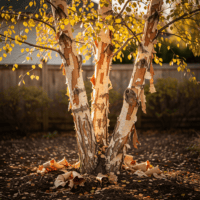
Silver birch is a pioneer tree: it is one of the first trees to grow on bare land, clearings, heaths and old industrial sites. It grows 50 to 80 feet (15 to 25 m) tall, with white bark that develops black, diamond-shaped cracks with age and slender, drooping twigs. Birch pollen is one of the main causes of hay fever in Germany in April.
Sycamore Maple (Acer pseudoplatanus)
Sycamore maple (Bergahorn) is the most common of Germany’s three native maples, alongside Norway maple and field maple. It grows 80 to 100 feet (25 to 30 m) tall, with large, five-lobed leaves and paired, winged seeds that spin like helicopters. It is common in mountain forests and is also planted along streets and in parks.
Norway Maple (Acer platanoides)
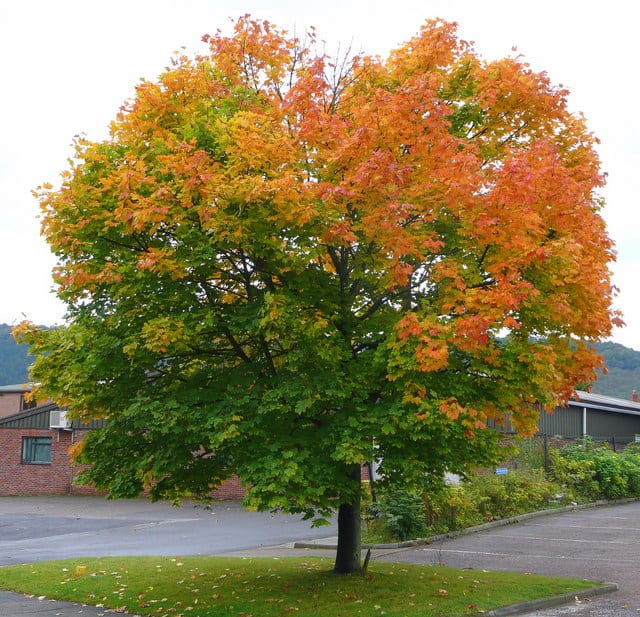
Norway maple (Spitzahorn) has sharp-pointed leaf lobes and flowers in bright yellow-green clusters in April, before the leaves open. It grows 65 to 100 feet (20 to 30 m) tall and handles city conditions well, so it is one of the most common street trees in Germany. Break a leaf stalk and a milky sap appears. That is the quickest way to tell it from sycamore maple.
Small-Leaved Lime (Linden) (Tilia cordata)

The linden, or lime tree (Linde), has a special place in German culture: many villages have a linden in the square where people once met and held court, and Berlin’s grand avenue Unter den Linden is named after it. Germany has two native species, the small-leaved lime and the large-leaved lime (Tilia platyphyllos). Both grow 65 to 100 feet (20 to 30 m) tall, have heart-shaped leaves and fragrant, cream-colored flowers in early summer that bees love. Lime-blossom tea is a traditional cold remedy.
European Ash (Fraxinus excelsior)
European ash grows 65 to 130 feet (20 to 40 m) tall on moist, rich soil, with leaves divided into 9 to 13 leaflets and black buds in winter. Since the early 2000s, ash dieback, a fungal disease from East Asia, has been killing ash trees across Germany. Only a small percentage of trees show some resistance, and researchers are trying to breed from them.
Horse Chestnut (Aesculus hippocastanum)

The horse chestnut (Rosskastanie) is not native to Germany, but it has been planted in parks, avenues and especially Bavarian beer gardens for centuries. Brewers planted it to shade their beer cellars, and it still shades the tables today. It grows 65 to 100 feet (20 to 30 m) tall, with large hand-shaped leaves of 5 to 7 leaflets and upright white “candles” of flowers in May. Its shiny brown conkers are poisonous; they are not the edible sweet chestnut (Esskastanie).
Growing German Trees in North America
Most of these trees are also sold in North America. European beech, littleleaf linden, Scots pine, Norway spruce and European larch all do well in zones 4 to 7. Two of them are best avoided: Norway maple is invasive in the forests of the Northeast and Midwest, and Scots pine often suffers from pine wilt in the Midwest.
Related: Most Common Trees in Canada · Trees of New York State