
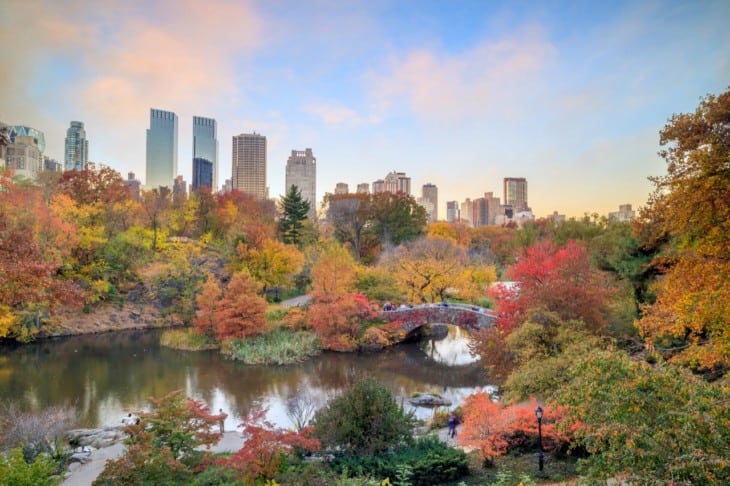
About 60% of New York State is forest, and most of it is northern hardwood forest of sugar maple, red maple, American beech and yellow birch, mixed with eastern white pine and hemlock. Spruce and fir take over in the high Adirondacks, and oak and hickory in the lower Hudson Valley and on Long Island. City streets are a different world: the most common street tree in New York City is the London plane, a hybrid that doesn’t grow wild anywhere.
Contents
- Native Forest Trees
- Sugar Maple (Acer saccharum)
- Red Maple (Acer rubrum)
- American Beech (Fagus grandifolia)
- Eastern White Pine (Pinus strobus)
- Eastern Hemlock (Tsuga canadensis)
- Northern Red Oak (Quercus rubra)
- Black Cherry (Prunus serotina)
- Paper Birch (Betula papyrifera)
- Red Spruce (Picea rubens)
- Balsam Fir (Abies balsamea)
- Tulip Tree (Liriodendron tulipifera)
- American Hornbeam (Carpinus caroliniana)
- Street and Yard Trees
- Two Trees Not to Plant
- Choosing a Tree for a New York Yard
This guide covers the trees you are most likely to see in New York: first the native forest trees, then the street and yard trees planted in cities and suburbs, including two you should not plant.
- Native Forest Trees
- Street and Yard Trees
- Two Trees Not to Plant
- Choosing a Tree for a New York Yard
| Tree | Botanical name | Native to NY | Where you’ll see it |
|---|---|---|---|
| Sugar Maple | Acer saccharum | Yes | Forests statewide; the state tree |
| Red Maple | Acer rubrum | Yes | Everywhere, from swamps to dry ridges |
| American Beech | Fagus grandifolia | Yes | Northern hardwood forests statewide |
| Eastern White Pine | Pinus strobus | Yes | Forests and old fields statewide |
| Eastern Hemlock | Tsuga canadensis | Yes | Cool ravines and stream banks |
| Northern Red Oak | Quercus rubra | Yes | Hudson Valley, southern NY, Long Island |
| Black Cherry | Prunus serotina | Yes | Forest edges, fencerows, woods |
| Paper Birch | Betula papyrifera | Yes | Adirondacks, Catskills, the north |
| Red Spruce | Picea rubens | Yes | Adirondacks and Catskills, high elevations |
| Balsam Fir | Abies balsamea | Yes | Adirondacks, high mountains |
| Tulip Tree | Liriodendron tulipifera | Yes | Southern NY, the lower Hudson Valley, Long Island |
| American Hornbeam | Carpinus caroliniana | Yes | Understory of moist woods and stream banks |
| London Plane | Platanus × acerifolia | No (hybrid) | NYC streets and parks |
| Honeylocust | Gleditsia triacanthos | No (central US) | City streets, parking lots, suburbs |
| Pin Oak | Quercus palustris | Yes | Streets, yards; wild in southern NY |
| Littleleaf Linden | Tilia cordata | No (Europe) | Streets and parks |
| Ginkgo | Ginkgo biloba | No (China) | NYC streets and parks |
| Silver Maple | Acer saccharinum | Yes | Riverbanks; older yards and streets |
| Saucer Magnolia | Magnolia × soulangeana | No (garden hybrid) | Front yards in spring |
| Callery Pear | Pyrus calleryana | No (invasive) | Streets, suburbs, highway edges |
| Green Ash | Fraxinus pennsylvanica | Yes | Riverbanks; formerly streets |
Native Forest Trees
Sugar Maple (Acer saccharum)

The sugar maple has been New York’s state tree since 1956. It grows 60 to 80 feet tall and can live 300 to 400 years. Its leaves have five lobes with smooth, U-shaped gaps between them, and in fall they turn yellow, orange and scarlet. New York is the second-largest maple syrup producer in the US, after Vermont. Sugar maples are sensitive to road salt and compacted soil, so they do better in yards and parks than along busy streets.
Red Maple (Acer rubrum)

Red maple is one of the most abundant trees in New York’s forests because it tolerates almost any site, from wet swamps to dry, rocky hilltops. It grows 40 to 70 feet tall. Something on it is red in every season: the flowers in early spring, the leaf stalks and seeds in summer, the leaves in fall and the buds in winter. Its leaves have three main lobes with V-shaped gaps and toothed edges, which set it apart from sugar maple.
American Beech (Fagus grandifolia)

American beech is easy to recognize by its smooth, pale gray bark, which stays smooth even on old trees. It grows 50 to 80 feet tall, and young trees keep their papery, tan leaves through winter. Beech nuts feed bears, deer and turkeys. Beech leaf disease, caused by a microscopic worm and first found in Ohio in 2012, is now spreading across New York. It makes the leaves stripy and thick and can kill young trees within a few years.
Eastern White Pine (Pinus strobus)

Eastern white pine is the tallest tree in the Northeast. It usually reaches 80 to 100 feet, and old trees can top 150 feet. It is the only native eastern pine with needles in bundles of five. They are soft, flexible and 3 to 5 inches long. The branches grow in regular whorls, one tier per year, and the long cones are often sticky with resin. White pine quickly takes over abandoned farmland, so much of New York’s white pine grows on old fields.
Eastern Hemlock (Tsuga canadensis)

Eastern hemlock grows in cool, shady ravines and along streams, where its dense evergreen shade keeps the water cold enough for trout. It reaches 60 to 70 feet and can live more than 500 years. The flat needles are only half an inch long, with two white stripes underneath, and the cones are tiny, under an inch. The hemlock woolly adelgid, a sap-sucking insect that shows up as white woolly tufts at the base of the needles, has been killing hemlocks as it spreads north across the state.
Northern Red Oak (Quercus rubra)

Northern red oak is the most common oak in New York. It grows 60 to 75 feet tall, fast for an oak, and has leaves with 7 to 11 pointed, bristle-tipped lobes. The bark of mature trees has long, flat-topped ridges that look like ski tracks. Its acorns take two years to ripen and are a key food for wildlife. It is also a good, tough street and yard tree.
Black Cherry (Prunus serotina)

Black cherry grows 50 to 80 feet tall in forests and pops up along fencerows, where birds drop its seeds. Its bark is the best identification feature: young bark is smooth with horizontal lines, and older bark breaks into dark, curled scales that look like burnt potato chips. It has hanging clusters of white flowers in spring and small dark cherries in late summer. The fruit is eaten by birds, but the wilted leaves, twigs and seeds contain cyanide compounds that are toxic to livestock.
Paper Birch (Betula papyrifera)

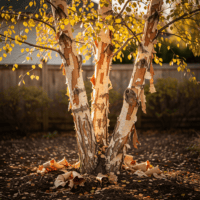
Paper birch, also called white birch, is the tree with the chalky white bark that peels in thin, papery strips. It grows 50 to 70 feet tall in the cooler north and at higher elevations, and it is one of the first trees to return after fire or logging. It doesn’t like heat, so it struggles in yards in the warmer parts of the state.
Red Spruce (Picea rubens)

Red spruce is the spruce of New York’s mountains. It grows 60 to 80 feet tall with a narrow, conical crown. Its needles are yellow-green, sharp, about half an inch long, and grow from all sides of the twig. Acid rain killed many red spruces in the Adirondacks in the 1970s and 1980s. Since air pollution controls took effect, the species has been recovering strongly.
Balsam Fir (Abies balsamea)

Balsam fir grows with red spruce in the Adirondacks and is the classic fragrant Christmas tree. It stays 40 to 60 feet tall, with a narrow, spire-like crown. Its flat, blunt needles have two white stripes underneath, and its upright cones fall apart on the tree. Young bark is smooth with resin blisters.
Tulip Tree (Liriodendron tulipifera)

The tulip tree (also called tulip poplar, though it is a magnolia relative) grows only in the southern part of the state, where it is one of the tallest hardwoods. It usually reaches 70 to 90 feet and can pass 150 feet. Its leaves have a flat, notched tip, and its tulip-shaped green-and-orange flowers appear in late spring. The Queens Giant, in Alley Pond Park, is a tulip tree about 130 feet tall and several hundred years old, often called the oldest living thing in New York City.
American Hornbeam (Carpinus caroliniana)

American hornbeam is a small understory tree, 20 to 35 feet tall, that grows in the shade of larger trees in moist woods. Its smooth, blue-gray bark has long ridges that look like flexed muscles, which is why it is also called musclewood and ironwood. It is a good, tough choice for a shady yard.
Street and Yard Trees
London Plane (Platanus × acerifolia)

The London plane is the most common street tree in New York City, and its leaf is the NYC Parks logo. It is a hybrid of the native American sycamore and the Oriental plane, and it tolerates pollution, compacted soil and heavy pruning. It grows 70 to 100 feet tall. The patchy bark peels to show cream, olive and gray, and its seed balls hang on through winter.
Honeylocust (Gleditsia triacanthos)

Honeylocust is native to the central US, not New York, but thornless, seedless cultivars are among the most planted street trees in the state. It grows 30 to 70 feet tall. The fine, fern-like leaves cast a light, dappled shade that lets grass grow underneath, and the tiny leaflets fall into lawns and gutters with no raking needed. Wild honeylocusts have long, branched thorns on the trunk.
Pin Oak (Quercus palustris)

Pin oak grows wild on poorly drained ground in southern New York and is also a common street tree in the city and suburbs. It reaches 50 to 70 feet, with a pyramid shape: upper branches angle up, middle branches stick straight out and lower branches droop. Its leaves have deep, narrow cuts between the lobes. In alkaline soil its leaves turn yellow (iron chlorosis).
Littleleaf Linden (Tilia cordata)

Littleleaf linden is a European tree that is widely planted along streets for its neat, pyramid-shaped crown and its tolerance of city conditions. It grows 50 to 70 feet tall, with small, heart-shaped leaves. In early summer it has clusters of pale yellow, very fragrant flowers that attract bees. New York’s own linden is the American basswood (Tilia americana), which has much larger leaves.
Ginkgo (Ginkgo biloba)

The ginkgo is an ancient tree from China, a living fossil whose relatives grew alongside dinosaurs. It grows 50 to 80 feet tall, with fan-shaped leaves that turn bright gold in fall and often drop all at once. It shrugs off pollution, salt and pests, which is why it is so common along New York City streets. Only plant male trees. The fleshy seeds that fall from female trees in autumn smell like rancid butter.
Silver Maple (Acer saccharinum)

Silver maple grows wild along rivers and lake shores and was widely planted in yards in the past because it grows very fast. It reaches 50 to 80 feet tall. Its leaves are deeply cut into five lobes, with silvery-white undersides that flash in the wind. The downsides: its wood is weak and breaks in ice storms, and its shallow roots lift sidewalks and invade sewer pipes. It is best left to riversides and large properties.
Saucer Magnolia (Magnolia × soulangeana)

Saucer magnolia is the small tree covered in big, goblet-shaped pink and white flowers in April, before its leaves come out. It grows 20 to 30 feet tall and is one of the most popular flowering trees in New York yards. A late frost can turn the flowers brown overnight. New York does have a native magnolia, the cucumber tree (Magnolia acuminata), but in the wild it is rare and grows only in western New York.
Two Trees Not to Plant
Callery Pear (Pyrus calleryana)

Callery pear, sold as ‘Bradford’ and other cultivars, was planted widely for its white spring flowers, which smell unpleasant. Different cultivars cross-pollinate, and birds spread the fruit, so it now forms dense, thorny thickets along highways and field edges across the Northeast. The trees are also weak: their tight branch angles make them split apart in storms after about 20 years. Plant serviceberry or a native dogwood instead.
Green Ash (Fraxinus pennsylvanica)

Green ash is a native tree of riverbanks and wet ground that was planted along thousands of streets because it grew anywhere. It grows 50 to 70 feet tall, with leaves divided into 5 to 9 leaflets. The emerald ash borer, first found in New York in 2009, kills nearly every untreated ash within a few years of arriving. New ash trees shouldn’t be planted, and large ash trees near homes need to be treated or removed before they become brittle.
Choosing a Tree for a New York Yard
- Check your zone: New York ranges from zone 4 in the Adirondacks to zone 7 in New York City and on Long Island. Tulip tree and sweetgum like the warm south, and paper birch and balsam fir the cold north.
- Go native when you can: red maple, northern red oak, American hornbeam, serviceberry and black gum are tough, native choices that support far more wildlife than imported trees.
- Near roads and sidewalks: choose salt- and drought-tolerant trees such as honeylocust, London plane, ginkgo or pin oak (in acidic soil) rather than sugar maple.
Related: Trees of Pennsylvania · Most Common Trees in New England



.jpg)