
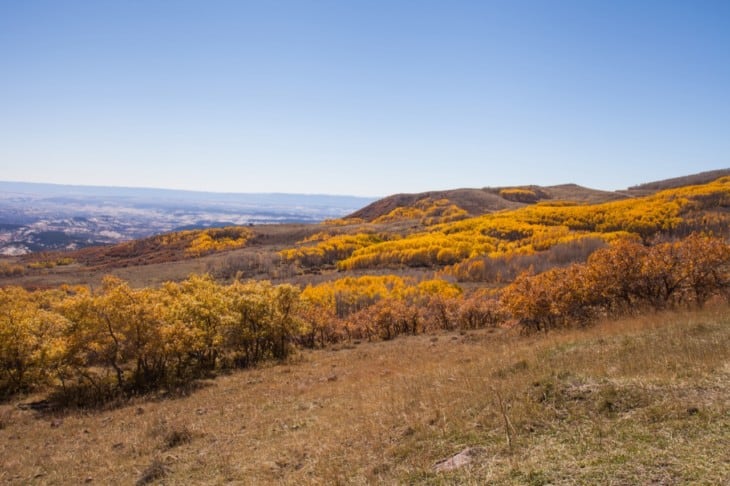
Utah’s most common trees change with elevation. Utah juniper and pinyon pine cover more of the state than any other forest type, on the dry foothills and plateaus. Gambel oak and bigtooth maple fill the canyons of the Wasatch Front. Douglas fir, white fir and ponderosa pine grow higher up. Quaking aspen, Engelmann spruce and subalpine fir grow near the top of the mountains. Along streams you’ll see Fremont and narrowleaf cottonwoods, boxelder and willows. Quaking aspen has been Utah’s state tree since 2014, when it replaced the blue spruce.
Contents
- High Mountains
- Mountain Slopes and Canyons
- Foothills and Deserts
- Utah Juniper (Juniperus osteosperma)
- Rocky Mountain Juniper (Juniperus scopulorum)
- Two-Needle Pinyon (Colorado Pinyon) (Pinus edulis)
- Singleleaf Pinyon (Pinus monophylla)
- Curl-Leaf Mountain Mahogany (Cercocarpus ledifolius)
- Utah Serviceberry (Amelanchier utahensis)
- Netleaf Hackberry (Celtis reticulata)
- Joshua Tree (Yucca brevifolia (Y. jaegeriana))
- Desert Willow (Chilopsis linearis)
- Streams and Canyon Bottoms
- Fremont Cottonwood (Populus fremontii)
- Narrowleaf Cottonwood (Populus angustifolia)
- Boxelder (Acer negundo)
- Peachleaf Willow (Salix amygdaloides)
- Water Birch (Betula occidentalis)
- Black Chokecherry (Prunus virginiana var. melanocarpa)
- Black Hawthorn and River Hawthorn (Crataegus douglasii and C. rivularis)
- Don’t Plant These Invasive Trees
- How to Identify Utah’s Common Conifers
- Trees Planted in Utah Towns
This guide covers 29 native trees you are likely to see in Utah, grouped by where they grow, and 4 invasive trees that you shouldn’t plant.

- High Mountains
- Mountain Slopes and Canyons
- Foothills and Deserts
- Streams and Canyon Bottoms
- Don’t Plant These Invasive Trees
- How to Identify Utah’s Common Conifers
- Trees Planted in Utah Towns
| Tree | Botanical name | Where you’ll see it in Utah |
|---|---|---|
| Quaking Aspen | Populus tremuloides | Mountains statewide, about 6,000 to 10,500 ft; the state tree |
| Engelmann Spruce | Picea engelmannii | Subalpine forests, about 8,000 to 11,000 ft |
| Subalpine Fir | Abies lasiocarpa | High mountains and near timberline, with Engelmann spruce |
| Blue Spruce | Picea pungens | Mountain streams and canyon bottoms, about 6,000 to 9,000 ft |
| Limber Pine | Pinus flexilis | Rocky ridges and high, windy slopes |
| Lodgepole Pine | Pinus contorta var. latifolia | Uinta Mountains and northern Utah, about 7,500 to 10,500 ft |
| Great Basin Bristlecone Pine | Pinus longaeva | High, rocky plateaus of southern and western Utah, such as Cedar Breaks and Bryce Canyon |
| Douglas Fir | Pseudotsuga menziesii var. glauca | North-facing slopes and canyons, about 5,500 to 9,500 ft |
| White Fir (Concolor Fir) | Abies concolor | Mountain slopes, mainly in central and southern Utah |
| Ponderosa Pine | Pinus ponderosa var. scopulorum | Plateaus and slopes of southern and eastern Utah, such as Bryce Canyon |
| Gambel Oak (Scrub Oak) | Quercus gambelii | Foothills and canyons along the Wasatch Front and throughout the state |
| Bigtooth Maple | Acer grandidentatum | Canyons of the Wasatch and other ranges, often mixed with Gambel oak |
| Rocky Mountain Maple | Acer glabrum | Moist canyons and slopes, mixed with aspen and conifers |
| Utah Juniper | Juniperus osteosperma | Dry foothills, mesas and valleys statewide, about 3,000 to 8,000 ft |
| Rocky Mountain Juniper | Juniperus scopulorum | Rocky slopes and canyons, usually higher and moister than Utah juniper |
| Two-Needle Pinyon (Colorado Pinyon) | Pinus edulis | Pinyon-juniper woodland of eastern and southern Utah |
| Singleleaf Pinyon | Pinus monophylla | Pinyon-juniper woodland of western Utah and the Great Basin |
| Curl-Leaf Mountain Mahogany | Cercocarpus ledifolius | Dry, rocky slopes and ridges, about 4,000 to 9,000 ft |
| Utah Serviceberry | Amelanchier utahensis | Dry slopes and canyons throughout Utah |
| Netleaf Hackberry | Celtis reticulata | Canyons, washes and rocky slopes, especially in southern Utah |
| Joshua Tree | Yucca brevifolia (Y. jaegeriana) | Only the far southwest corner, around Beaver Dam Wash west of St. George |
| Desert Willow | Chilopsis linearis | Washes of the far southwest; planted in St. George |
| Fremont Cottonwood | Populus fremontii | Rivers and washes of southern and western Utah and lower valleys |
| Narrowleaf Cottonwood | Populus angustifolia | Mountain streams and canyon bottoms, about 5,000 to 8,000 ft |
| Boxelder | Acer negundo | Streams and floodplains statewide; also common in towns |
| Peachleaf Willow | Salix amygdaloides | Stream banks and wet ground at lower elevations |
| Water Birch | Betula occidentalis | Along mountain streams, usually in dense clumps |
| Black Chokecherry | Prunus virginiana var. melanocarpa | Streams, canyons and moist slopes statewide |
| Black Hawthorn and River Hawthorn | Crataegus douglasii and C. rivularis | Stream banks, meadows and canyon bottoms |
| Russian Olive | Elaeagnus angustifolia | No, invasive: rivers, ditches and wetlands statewide |
| Tamarisk (Saltcedar) | Tamarix ramosissima and T. chinensis | No, invasive: banks of the Colorado, Green, Virgin and other rivers |
| Siberian Elm | Ulmus pumila | No, invasive: towns, farms, fence lines and vacant lots |
| Tree of Heaven | Ailanthus altissima | No, invasive: roadsides, railways and vacant lots, especially in Salt Lake City and St. George |
High Mountains
Quaking Aspen (Populus tremuloides)
Read our guide to Quaking Aspen
Quaking aspen is Utah’s state tree and the most widespread tree in North America. It has smooth, chalky white bark with black scars and knots, and round leaves on flattened stalks that make them tremble in the slightest breeze. In fall whole mountainsides turn gold. Aspens spread mainly by root suckers, so a grove is often a single plant. Pando, a grove in Fishlake National Forest in central Utah, covers about 106 acres with some 47,000 trunks from one root system, and it is one of the largest living organisms known. Aspens usually grow 20 to 60 feet tall.
Engelmann Spruce (Picea engelmannii)

Engelmann spruce is the main tree of Utah’s high, cold forests, usually with subalpine fir. It grows 80 to 120 feet tall, with a narrow, pointed crown and short, four-sided needles that are sharp but more flexible than blue spruce needles. The small cones, 1 to 2.5 inches long, have thin, papery scales. Outbreaks of spruce beetle have killed large areas of mature spruce on the Wasatch, Fishlake and Dixie plateaus.
Subalpine Fir (Abies lasiocarpa)
Subalpine fir is easy to spot by its very narrow, spire-like shape, which sheds heavy snow. Its flat, soft needles curve upward along the twig, and its dark purple cones stand upright on the top branches and fall apart there, so you rarely find one whole on the ground. It grows 50 to 100 feet tall in sheltered forest, and near timberline it can be a low, sprawling shrub.
Blue Spruce (Picea pungens)

Blue spruce was Utah’s state tree from 1933 to 2014. In the wild it grows along streams at middle elevations, usually 50 to 75 feet tall. Its needles are stiff and very sharp, and range from green to silvery blue. The cones are 2 to 4 inches long, with papery, crinkled scale tips. Blue spruce is also one of the most planted yard trees in Utah, and it is the state tree of Colorado.
Limber Pine (Pinus flexilis)
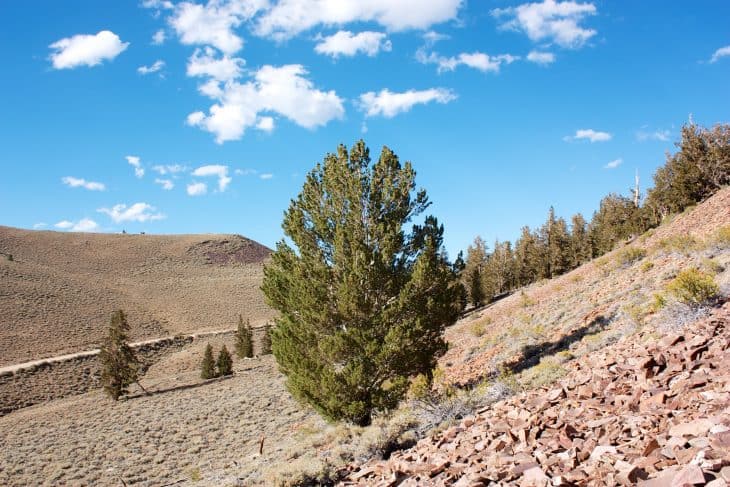
Limber pine grows on exposed, rocky ridges where few other trees survive. Its needles grow in bundles of five, and its young twigs are so flexible that you can tie them in a knot, which gives the tree its name. It is usually 30 to 50 feet tall and often twisted by the wind. The cones are 3 to 6 inches long with thick, smooth scales, and its large seeds feed Clark’s nutcrackers, which bury them and plant new trees.
Lodgepole Pine (Pinus contorta var. latifolia)

Lodgepole pine forms dense, even stands of straight, slender trunks, especially in the Uinta Mountains. Its needles are short, often twisted and grow in pairs. Many of its small, hard cones stay closed on the tree for years until the heat of a fire opens them, so lodgepole forests often grow back as a single age after a fire. It grows 50 to 80 feet tall. Its straight trunks were used by Plains tribes for lodge poles.
Great Basin Bristlecone Pine (Pinus longaeva)

Great Basin bristlecone pines are among the oldest living things on Earth. Some in Utah are several thousand years old, and the oldest known, in California’s White Mountains, is more than 4,800 years old. They grow slowly, rarely more than 30 to 50 feet tall, often with twisted, partly dead trunks polished by wind and ice. The needles grow in bundles of five and stay on the tree for 30 years or more, so each branch looks like a bottlebrush. The cones have a sharp bristle on each scale.
Mountain Slopes and Canyons
Douglas Fir (Pseudotsuga menziesii var. glauca)

Douglas fir grows on cool, shaded slopes in all of Utah’s mountain ranges. The Rocky Mountain variety is smaller than the Pacific coast tree, usually 60 to 100 feet tall. Its soft, flat needles grow singly all around the twig. The best ID feature is the cone: three-pointed bracts stick out from under each scale, like the back legs and tail of a mouse. Despite the name, it is not a true fir.
White Fir (Concolor Fir) (Abies concolor)

White fir has the longest needles of any fir in Utah, 2 to 3 inches long, soft, flat and silvery blue-green, and they smell of citrus when crushed. The bark is smooth and gray on young trees and becomes deeply furrowed with age. It grows 60 to 100 feet tall in the forest. Sold as concolor fir, it is one of the best evergreens for Utah yards, because it tolerates heat and dry soil better than most firs and spruces.
Ponderosa Pine (Pinus ponderosa var. scopulorum)

Ponderosa pine grows in open, park-like stands on the plateaus of southern Utah. Its long needles, usually 4 to 7 inches, grow in bundles of two or three, and old trees have thick, orange-brown bark in large plates. On a warm day the bark smells of vanilla or butterscotch. It usually grows 60 to 100 feet tall. Thick bark and high branches protect it from the frequent, low ground fires that once burned through these forests.
Gambel Oak (Scrub Oak) (Quercus gambelii)

Gambel oak is the only common oak in Utah and forms the dense thickets of “scrub oak” that cover the foothills above the cities. It spreads by underground stems, so a thicket is often one plant, and it sprouts back quickly after fire or cutting. Its glossy leaves have deep, rounded lobes, and its acorns are small with a scaly cap. On the best sites it grows into a tree 20 to 30 feet tall. In fall the thickets turn orange, red and brown.
Bigtooth Maple (Acer grandidentatum)

Bigtooth maple gives the Wasatch canyons their bright red and orange fall color, famous on the Alpine Loop and in Big Cottonwood Canyon. It is a close relative of sugar maple, with small leaves that have three main lobes and a few large, blunt teeth. It grows 20 to 40 feet tall, often as a clump of several trunks. It is a good native maple for Utah yards, because it handles alkaline soil and dry spells better than most maples.
Rocky Mountain Maple (Acer glabrum)

Rocky Mountain maple is a shrub or small tree, 10 to 30 feet tall, usually with several thin trunks. Its leaves are small, with three lobes and sharp, double teeth, on red leaf stalks, and the young twigs are red too. The fall color ranges from yellow to red. It grows in moister, shadier spots than bigtooth maple and is an important food for deer and elk.
Foothills and Deserts
Utah Juniper (Juniperus osteosperma)

Utah juniper is the most common tree in Utah. With pinyon pine, it forms the pinyon-juniper woodland, the most widespread forest type in the state. It is a short, bushy, often many-stemmed tree, 15 to 30 feet tall, with shreddy, gray-brown bark and tiny, scale-like leaves. Its berry-like cones are bluish-brown with a waxy bloom and usually hold one hard seed. Early settlers called junipers “cedars”, which is how Cedar City got its name. Many birds and mammals eat the berries.
Rocky Mountain Juniper (Juniperus scopulorum)

Rocky Mountain juniper is taller and more tree-like than Utah juniper, 20 to 40 feet, often with a single trunk and slightly drooping branch tips. Its scale leaves are finer and its berries are bright blue with a waxy bloom, usually with two seeds. It grows in canyons and on rocky slopes, often with Douglas fir and pinyon, and it is sold in many upright, blue-gray varieties for windbreaks and hedges.
Two-Needle Pinyon (Colorado Pinyon) (Pinus edulis)

Two-needle pinyon is a small, round-headed pine, usually 15 to 35 feet tall, with short, stiff needles in pairs. Its small, round cones hold large, wingless seeds, the pine nuts that people have gathered for thousands of years and that pinyon jays, squirrels and bears depend on. It grows very slowly and can live for centuries. It is the state tree of New Mexico.
Singleleaf Pinyon (Pinus monophylla)

Singleleaf pinyon is the only pine in the world with just one needle in each bundle. The needles are stout, curved and gray-green. Otherwise it looks much like two-needle pinyon, a small, rounded tree, 15 to 35 feet tall, and it also bears edible pine nuts. It replaces two-needle pinyon in the ranges of western Utah and is one of Nevada’s two state trees.
Curl-Leaf Mountain Mahogany (Cercocarpus ledifolius)

Curl-leaf mountain mahogany is an evergreen shrub or small tree, 10 to 25 feet tall, with small, narrow, leathery leaves whose edges roll under. It isn’t a real mahogany; it is in the rose family. It has no berries. Instead, each seed has a long, feathery, twisted tail, 2 to 3 inches long, that glistens in the sun in late summer. Its wood is so dense that it sinks in water. It is an important winter food for deer and elk.
Utah Serviceberry (Amelanchier utahensis)

Utah serviceberry is a shrub or small tree, usually 6 to 15 feet tall, covered in white, five-petaled flowers in spring. Its small, rounded leaves are grayish-green and toothed only near the tip. The small, purple-black fruit is edible but dry and seedy. Saskatoon serviceberry (A. alnifolia), which grows in moister spots at higher elevations, has larger, juicier berries that are good for pies and jam.
Netleaf Hackberry (Celtis reticulata)

Netleaf hackberry is a tough, drought-tolerant small tree, 20 to 30 feet tall, often with a crooked trunk. Its thick leaves are rough like sandpaper on top, with a raised network of veins underneath, which gives the tree its name. Its small, orange-red to purple fruits are sweet and eaten by many birds. Its tolerance of heat, drought and alkaline soil makes it a good native shade tree for southern Utah.
Joshua Tree (Yucca brevifolia (Y. jaegeriana))

Joshua trees reach the northeastern edge of their range in Utah, on the slopes of the Beaver Dam Mountains in the southwest corner of the state. They are tree-sized yuccas, 15 to 30 feet tall, with branching arms tipped with clusters of stiff, sharp leaves and creamy white flowers in spring. The Joshua trees of Utah and eastern Mojave are sometimes treated as a separate, shorter species, the eastern Joshua tree (Y. jaegeriana).
Desert Willow (Chilopsis linearis)

Desert willow isn’t a willow at all but a relative of the catalpa. It gets its name from its long, narrow, willow-like leaves. It grows 15 to 25 feet tall, often with several trunks, and from late spring to late summer it has pink, lavender or white trumpet-shaped flowers that bring hummingbirds, followed by long, thin seed pods. It grows wild in Utah only in the washes of Washington County, but it is widely planted in St. George as a drought-tolerant flowering tree.
Streams and Canyon Bottoms
Fremont Cottonwood (Populus fremontii)

Fremont cottonwood is the big shade tree of the desert rivers, such as the Virgin and the lower Green and Colorado. It grows 40 to 80 feet tall with a broad, spreading crown and thick, deeply furrowed gray bark. Its triangular, coarsely toothed leaves flutter on flattened stalks and turn bright yellow in fall. In spring female trees release cottony seeds. Wherever you see a line of cottonwoods in the desert, there is water close to the surface.
Narrowleaf Cottonwood (Populus angustifolia)

Narrowleaf cottonwood grows along streams in the mountains and canyons. Its narrow, lance-shaped leaves look more like willow leaves than the triangular leaves of other cottonwoods. It grows 30 to 60 feet tall, with a narrower crown than Fremont cottonwood and smooth, pale bark on young trunks. Where the two grow together, at the mouths of canyons, they often form hybrids with in-between leaves.
Boxelder (Acer negundo)

Boxelder is a maple, although it doesn’t look like one. Its leaves are divided into three to five leaflets, like an ash, and its young twigs are often green or purplish with a waxy bloom. It has typical maple seeds, winged pairs that hang in clusters on female trees through winter. It grows quickly to 30 to 50 feet, has weak wood and often has several leaning trunks. The red and black boxelder bugs that gather on sunny walls in fall feed on the seeds of female trees.
Peachleaf Willow (Salix amygdaloides)

Peachleaf willow is one of the few willows in Utah that grows into a real tree, 20 to 40 feet tall, often with several trunks. Its long, lance-shaped leaves are shiny green on top and pale, whitish underneath, and they droop on long, slender stalks. Its bark is brown and becomes rough and furrowed with age. Like other willows, it has fuzzy catkins in spring and roots easily from cut branches, so it is used to stabilize stream banks.
Water Birch (Betula occidentalis)

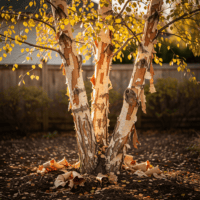
Water birch is Utah’s only native tree birch. Unlike paper birch, its bark is not white: it is shiny, reddish-brown to bronze, with pale horizontal marks called lenticels. It grows in dense clumps of many thin trunks, 15 to 25 feet tall, right along the edges of mountain streams. Its small, rounded, toothed leaves turn yellow in fall. It is a good choice for a clump tree in a wet spot in a Utah yard.
Black Chokecherry (Prunus virginiana var. melanocarpa)

Chokecherry is a shrub or small tree, 10 to 25 feet tall, that spreads into thickets. In spring it has dense, cylindrical clusters of small white flowers, and in late summer the clusters ripen into shiny, dark red to black cherries. The fruit is sour and astringent when raw and makes good jelly and syrup. The leaves, bark and pits contain compounds that release cyanide, and wilted leaves can poison livestock, so don’t eat the pits.
Black Hawthorn and River Hawthorn (Crataegus douglasii and C. rivularis)

Black hawthorn and the closely related river hawthorn are shrubs or small trees, 10 to 25 feet tall, often in thickets along streams. They have sharp thorns up to an inch long, toothed, slightly lobed leaves and flat clusters of white flowers in late spring. Unlike most hawthorns, the fruit is not red but dark purple to black when ripe. Birds eat the fruit, and the thorny thickets give them shelter.
Don’t Plant These Invasive Trees
These four trees are widely established in Utah and crowd out native plants, especially along rivers and streams. If you have one, removing it is better than letting it spread.
Russian Olive (Elaeagnus angustifolia)

Russian olive was planted across Utah for windbreaks and shade. It has narrow, silvery leaves, thorny twigs, small, very fragrant yellow flowers in late spring and dry, olive-like fruit that birds spread along waterways. It now forms dense thickets along many of Utah’s rivers and wetlands, where it crowds out cottonwoods and willows and uses a lot of water. Plant a native such as netleaf hackberry or boxelder instead.
Tamarisk (Saltcedar) (Tamarix ramosissima and T. chinensis)

Tamarisk is a shrubby tree, 10 to 25 feet tall, with tiny, scale-like leaves on feathery branches and plumes of pink flowers in summer. It came from Asia as an ornamental and for erosion control and now lines the rivers of southern and eastern Utah. It uses large amounts of water, and its leaves give off salt that builds up in the soil beneath it, so native plants struggle to grow there. It is on Utah’s noxious weed list. A small leaf beetle released to control it has defoliated large areas along the Colorado Plateau rivers.
Siberian Elm (Ulmus pumila)
Siberian elm is one of the most common trees in Utah towns, planted because it grows fast and survives drought and cold. It has small, toothed leaves and, in early spring, millions of round, papery seeds that blow into gutters and flower beds and sprout everywhere. Its wood is brittle and breaks in storms, and it is often attacked by elm leaf beetles. It is invasive in open land and along roads and ditches. Don’t plant it.
Tree of Heaven (Ailanthus altissima)

Tree of heaven is a fast-growing Chinese tree with long compound leaves, similar to sumac, and a strong, rank smell when its leaves or twigs are crushed. It spreads by seed and by root suckers and is very hard to kill: cutting it just causes dozens of new shoots. It is also the preferred host of the spotted lanternfly, an invasive pest spreading in the eastern U.S. Control needs herbicide on the stem or cut stump, followed by repeat treatments.
How to Identify Utah’s Common Conifers
| If the needles or leaves… | It’s probably |
|---|---|
| Come in bundles of 5 and stay on the branch for decades, like a bottlebrush | Bristlecone pine |
| Come in bundles of 5 on twigs you can tie in a knot | Limber pine |
| Come in bundles of 2 or 3, 4 to 7 in. long, on a tree with orange bark | Ponderosa pine |
| Come in pairs, short and twisted, on a tall, straight trunk | Lodgepole pine |
| Come in pairs, short and stiff, on a small, round tree | Two-needle pinyon |
| Grow one per bundle, stout and curved | Singleleaf pinyon |
| Are flat and soft, and the cones have three-pointed bracts | Douglas fir |
| Are flat and 2 to 3 in. long, silvery blue-green | White fir |
| Are flat, short and curve upward, on a narrow, spire-shaped tree | Subalpine fir |
| Are square and very sharp, often blue | Blue spruce |
| Are square, sharp but flexible, high in the mountains | Engelmann spruce |
| Are tiny scales, with bluish-brown berries holding 1 seed | Utah juniper |
| Are tiny scales, with bright blue berries holding 2 seeds | Rocky Mountain juniper |
Trees Planted in Utah Towns
Many trees you’ll see in Salt Lake City, Provo, Ogden and St. George are planted, not native. The most common are honey locust, London plane, green ash, Norway maple, linden, crabapple, flowering pear and blue spruce, with Kentucky coffeetree, Japanese tree lilac, hackberry and bur oak becoming popular because they handle Utah’s alkaline soil, hot summers and dry air. Fruitless mulberry, Arizona ash, Mondell pine and Italian cypress are common in the warm southwest around St. George.
For Utah’s neighbors, see our guides to trees in Arizona and trees in Oregon, which share many of the same mountain conifers.



_in_Churchill_County,_Nevada.jpg)