
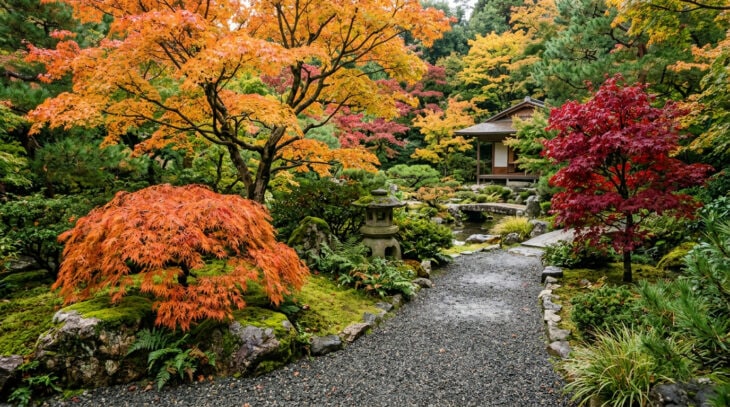
Japanese maple leaves come in five basic shapes, and the difference is how deep the cuts between the lobes go. From broadest to finest: Amoenum (wide lobes, shallow cuts), Palmatum (the classic “hand”), Matsumurae (long, narrow lobes cut almost to the stalk), Dissectum (laceleaf, cut to the stalk and then cut again) and Linearilobum (thin straps).
Contents
- How We Sorted These Types
- The Five Japanese Maple Leaf Shapes
- 1. Palmatum Group: The Classic Hand-Shaped Leaf (‘Bloodgood’)
- 2. Amoenum Group: Broad, Shallow Lobes (‘Osakazuki’)
- 3. Matsumurae Group: Long, Narrow Lobes Cut Almost to the Stalk (‘Trompenburg’)
- 4. Dissectum Group: Laceleaf Japanese Maples (‘Crimson Queen’)
- 5. Linearilobum Group: Strap-Leaf Japanese Maples (‘Koto-no-ito’)
- Leaf Traits That Cross the Groups
- Related Maples That Look Like Japanese Maples
- Which Type Should You Choose?
- Red Japanese Maples Don’t All Stay Red All Summer
- Frequently Asked Questions
- Sources
On top of shape, a leaf can be variegated, flush bright red in spring, stay tiny on a dwarf plant, or crinkle into tight tufts. Three related maples, fullmoon, golden fullmoon and Korean maple, look similar but have rounder leaves with more lobes.
If you just want to know which type you have, look at a mature summer leaf and ask one question: how far do the cuts reach toward the leaf stalk? That sorts most trees into the right group in seconds.
How We Sorted These Types
The five shape groups come from J.D. Vertrees, whose 1978 book Japanese Maples defined the groups that specialist growers still list, and from the group codes the Royal Horticultural Society prints on its Japanese maple profiles.
Each type below is shown through one widely sold cultivar, with alternates, and the facts come from extension services, botanic gardens, the RHS and specialist growers, named where they appear.
Treat the groups as a guide, not a law. Sources disagree on where some cultivars belong: ‘Bloodgood’ is Palmatum group to japanesemaple.org and Amoenum group to the RHS. Bark-first types such as coral bark ‘Sango-kaku’ are covered under the leaf group they belong to, not as a leaf type of their own.
| Type | Example | Zones | Size | Best for |
|---|---|---|---|---|
| Palmatum (classic) | Acer palmatum ‘Bloodgood’ | 5–8 | 15–20 ft (4.5–6 m) | A small shade or specimen tree |
| Amoenum (broad lobes) | A. palmatum ‘Osakazuki’ | 5–8 | 8–25 ft (2.5–7.5 m) | Fall color, sunnier sites |
| Matsumurae (deep, narrow lobes) | A. palmatum ‘Trompenburg’ | 5–8 | 8–25 ft (2.5–7.5 m) | An upright tree with finer texture |
| Dissectum (laceleaf) | A. palmatum ‘Crimson Queen’ | 5–8 | 8–10 ft (2.5–3 m) | A weeping mound by rocks or water |
| Linearilobum (strap-leaf) | A. palmatum ‘Koto-no-ito’ | 5–8* | 6–15 ft (1.8–4.5 m) | Fine texture in a small space |
| Variegated | A. palmatum ‘Butterfly’ | 5–8 | 7–12 ft (2–3.5 m) | Lighting up part shade |
| Spring-red | A. palmatum ‘Shindeshojo’ | 6–9 | 5–10 ft (1.5–3 m) | The brightest spring show |
| Dwarf (yatsubusa) | A. palmatum ‘Mikawa-yatsubusa’ | 5–9 | 3–6 ft (1–1.8 m) | Containers, bonsai, heat |
| Crinkled (lion’s head) | A. palmatum ‘Shishigashira’ | 5–8 | 7–15 ft (2–4.5 m) | Unusual texture, late fall color |
| Fullmoon maple | Acer japonicum | 5–7 | 20–30 ft (6–9 m) | Cool-summer gardens |
| Golden fullmoon maple | A. shirasawanum ‘Aureum’ | 5–7 | 16–20 ft (5–6 m) | Gold leaves in part shade |
| Korean maple | A. pseudosieboldianum | 4–8 | 15–25 ft (4.5–7.5 m) | Zone 4 gardens |
*Zones 5–8 is the Missouri Botanical Garden rating for the strap-leaf cultivar ‘Villa Taranto’. No extension source rates ‘Koto-no-ito’ itself; nurseries list it for Zones 5–9.
The Five Japanese Maple Leaf Shapes
All five are forms of one species, the Japanese maple (Acer palmatum). Its leaves are 2 to 5 inches (5 to 13 cm) long, sit in opposite pairs on the twig, and carry five to nine toothed lobes, according to NC State Extension.
1. Palmatum Group: The Classic Hand-Shaped Leaf (‘Bloodgood’)
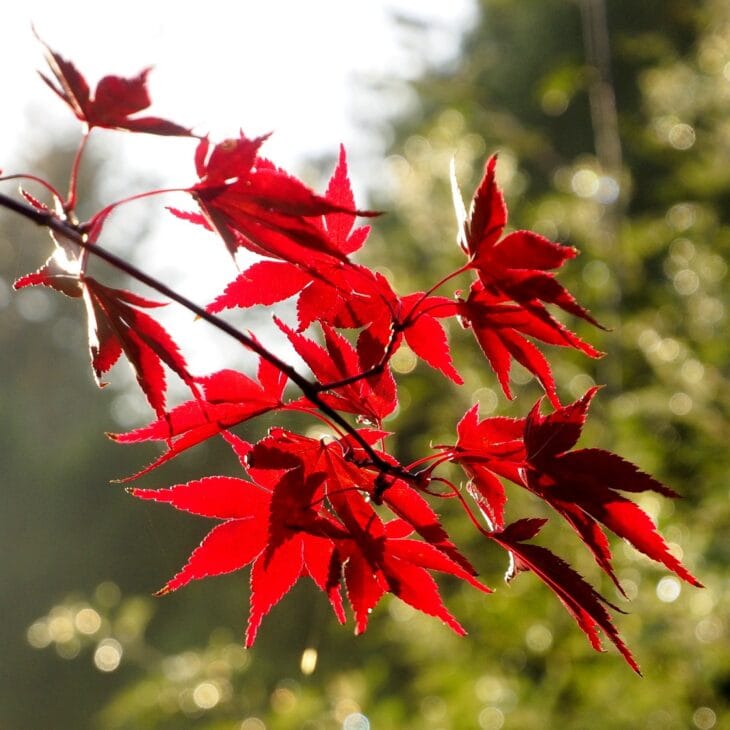
Zones: 5–8 · Size: 15 to 20 feet (4.5 to 6 m) tall and wide · Light: full sun in the North, afternoon shade in the South · Soil: moist, well-drained, acidic to neutral, rich in organic matter
The leaf: the shape most people picture, a small “hand” with pointed, toothed lobes cut two-thirds to three-quarters of the way to the stalk. On ‘Bloodgood’, NC State describes a 2 to 4 inch (5 to 10 cm) leaf with five main lobes plus two small ones near the base.
‘Bloodgood’ is the benchmark red Japanese maple: deep reddish-purple through summer, then crimson in fall. Oregon State notes that the color may “bronze out” before fall, and NC State says leaves can turn greenish red or scorch in hot southern summers without shade or irrigation.
Watch for: it leafs out early, so late spring frosts can damage new growth, and NC State warns it is prone to verticillium wilt in poorly drained soil. Oregon State also notes that more than one clone is sold under the ‘Bloodgood’ name, so two trees with the same label may not be identical.
Other picks: ‘Wolff’ (sold as Emperor I) has similar dark red leaves but leafs out about two weeks later, which lowers the frost risk; it grows 10 to 15 feet (3 to 4.5 m). ‘Sango-kaku’ has green leaves that turn yellow-gold in fall and coral-red young stems in winter, though Oregon State rates it highly susceptible to bacterial blight.
2. Amoenum Group: Broad, Shallow Lobes (‘Osakazuki’)
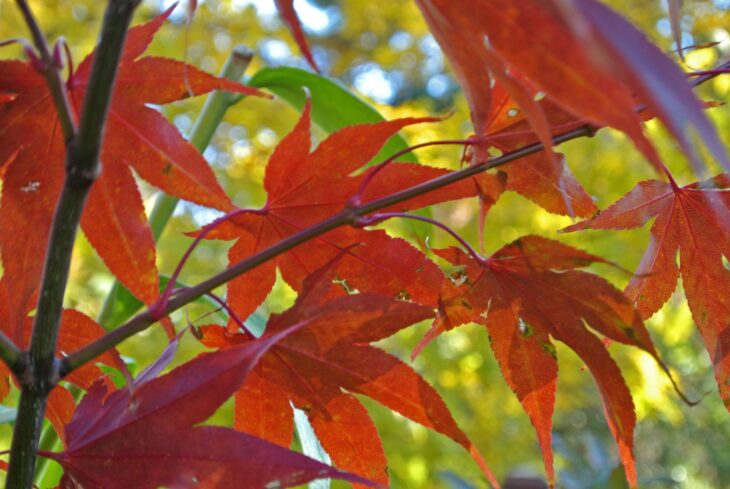
Zones: 5–8 · Size: 8 to 25 feet (2.5 to 7.5 m) tall; sources disagree widely · Light: full sun to part shade · Soil: rich, moist, acidic; adapts to clay and sand
The leaf: the fullest leaf of the five, with seven to nine wide lobes cut no more than two-thirds of the way to the stalk. On ‘Osakazuki’ the cuts go just past halfway, and the Missouri Botanical Garden notes the leaf base is cupped, which is where the name (“wine cup”) comes from.
The leaves stay plain green all summer, then turn crimson to orange-scarlet in fall. UW Botanic Gardens calls its fall color the most intense crimson of any maple, and it is the one to plant if fall is the point.
Watch for: size estimates run from 15 to 25 feet (4.5 to 7.5 m) at Missouri and NC State down to about 8 feet (2.5 m) at the UW arboretum, so give it room. NC State rates it resistant to leaf scorch, wind and drought, but says color is best in part shade.
Other picks: ‘Hogyoku’ (“jewel”) has large, leathery green leaves that turn an unusual pumpkin orange in fall, on a compact 15 to 18 foot (4.5 to 5.5 m) tree.
3. Matsumurae Group: Long, Narrow Lobes Cut Almost to the Stalk (‘Trompenburg’)
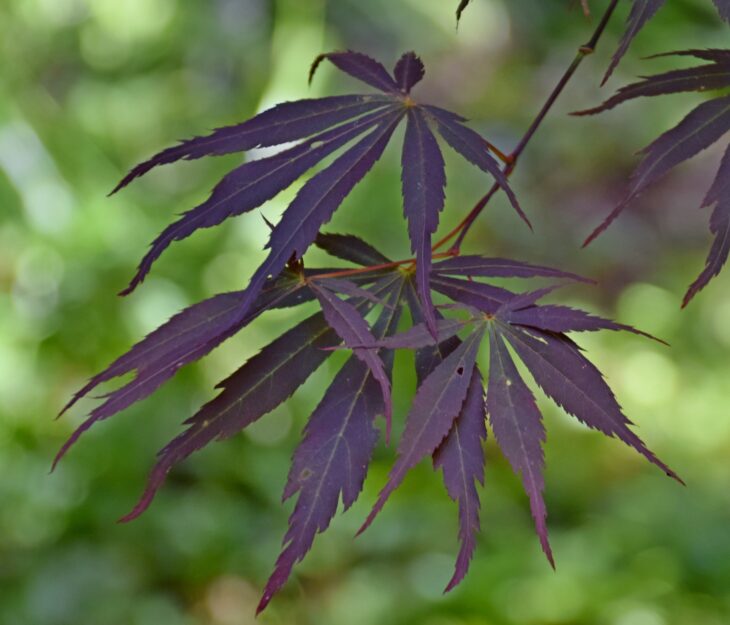
Zones: 5–8 · Size: 15 to 18 feet (4.5 to 5.5 m) in 10 years, up to 25 feet (7.5 m) eventually (Missouri); the RHS says 8 to 13 feet (2.5 to 4 m) · Light: full sun to part shade · Soil: moist, well-drained
The leaf: seven to nine long, narrow, sharply toothed lobes cut more than three-quarters of the way to the stalk. It looks almost as fine as a laceleaf, but the lobes aren’t cut a second time and the tree grows upright rather than weeping.
‘Trompenburg’ is easy to recognize: the edges of each lobe roll under, so the lobes look like narrow tubes or fingers. The leaves emerge dark reddish-purple, fade toward reddish-green and bronze in late summer, and turn crimson in fall.
Watch for: the RHS says leaf color is best in part shade. Japanesemaple.org warns that another Matsumurae cultivar, ‘Burgundy Lace’, “will burn severely in full sun”.
Other picks: ‘Sumi-nagashi’ (shown above) has deep red to maroon summer leaves and crimson fall color, to about 20 feet (6 m). ‘Beni-kagami’ is a vigorous one the RHS rates to 26 feet (8 m).
4. Dissectum Group: Laceleaf Japanese Maples (‘Crimson Queen’)
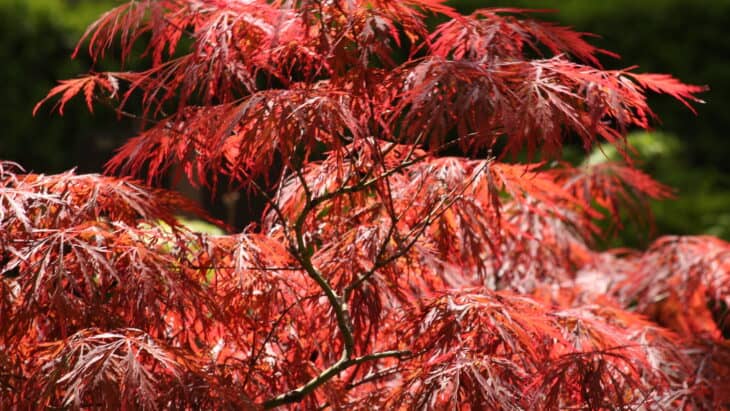
Zones: 5–8 · Size: 8 to 10 feet (2.5 to 3 m) tall and 10 to 12 feet (3 to 3.5 m) wide (Missouri); estimates run from 5 to 15 feet (1.5 to 4.5 m) · Light: sun to part shade; red types need some sun for color · Soil: moist, well-drained, rich in organic matter
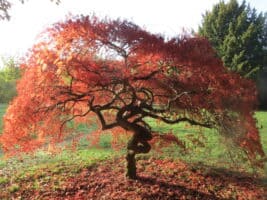
The leaf: 7 to 11 lobes cut all the way to the stalk, and then each lobe is cut again into fine, toothed segments. Oregon State calls it “feathery”. These are the laceleaf, cutleaf or threadleaf maples, and most of them grow into a weeping mound wider than tall.
Japanesemaple.org calls ‘Crimson Queen’ arguably the most widely planted Japanese maple in the US. Missouri and Oregon State say it holds its deep red well into summer before turning scarlet in fall, though Clemson and japanesemaple.org say it can go bronze-green in the hottest weeks.
Watch for: the RHS says Japanese maples with fine-cut leaves are especially prone to leaf scorch in windy or very sunny spots. Site laceleafs out of drying wind, and keep the soil evenly moist in summer.
Other picks:
- ‘Tamukeyama’: purple-red, a mound 6 to 8 feet (1.8 to 2.5 m) tall and about 12 feet (3.5 m) wide.
- ‘Inaba-shidare’: larger leaves, to 6 inches (15 cm).
- ‘Viridis’ and ‘Waterfall’: green laceleafs that turn gold, orange and red in fall.
- ‘Seiryu’ (“green dragon”): Missouri and NC State call it the only dissected cultivar that grows upright, 10 to 15 feet (3 to 4.5 m) tall.
5. Linearilobum Group: Strap-Leaf Japanese Maples (‘Koto-no-ito’)
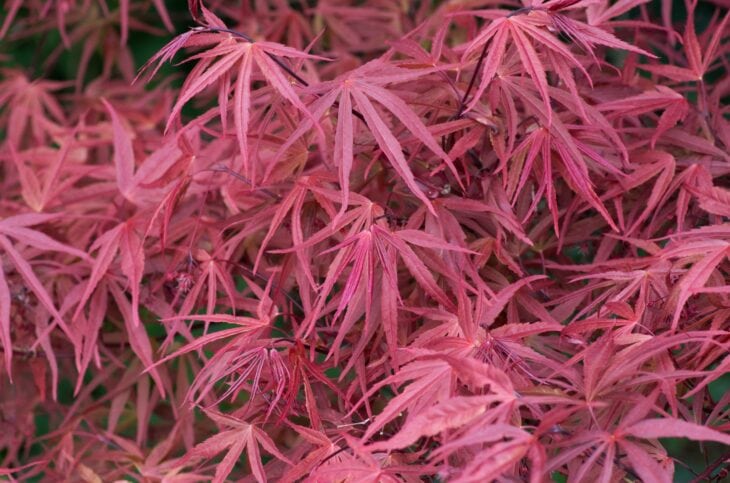
Zones: 5–8 for ‘Villa Taranto’ (Missouri); nurseries list ‘Koto-no-ito’ for 5–9 · Size: about 6 feet (1.8 m) tall in 10 years, 10 to 15 feet (3 to 4.5 m) at maturity · Light: sun to part shade; color is best in part shade · Soil: reliably moist, well-drained
The leaf: five or seven lobes cut all the way to the stalk, but unlike a laceleaf, each lobe is a long, narrow strap with smooth or lightly toothed edges. The effect is closer to bamboo than to a typical maple.
‘Koto-no-ito’ means “harp strings”, according to the Seattle Japanese Garden. Its green leaves turn golden yellow in fall on a dense, upright, vase-shaped plant.
Watch for: leaf width changes through the season, which confuses people. On ‘Koto-no-ito’, the Seattle garden notes that the spring leaves are almost string-like and later leaves on new growth are broader. The RHS warns of scorch if the soil dries out or the plant is too exposed.
Other picks: ‘Red Pygmy’ (shown above) has red-purple straps on a slow mound the RHS puts at 3 to 5 feet (1 to 1.5 m). ‘Villa Taranto’ has reddish-purple spring leaves that turn green and then golden orange, on a compact 6 to 10 foot (1.8 to 3 m) plant.
Leaf Traits That Cross the Groups
These four types describe color, size or texture, not how deep the cuts go. A variegated or dwarf maple still has one of the five leaf shapes underneath.
6. Variegated Japanese Maples (‘Butterfly’)
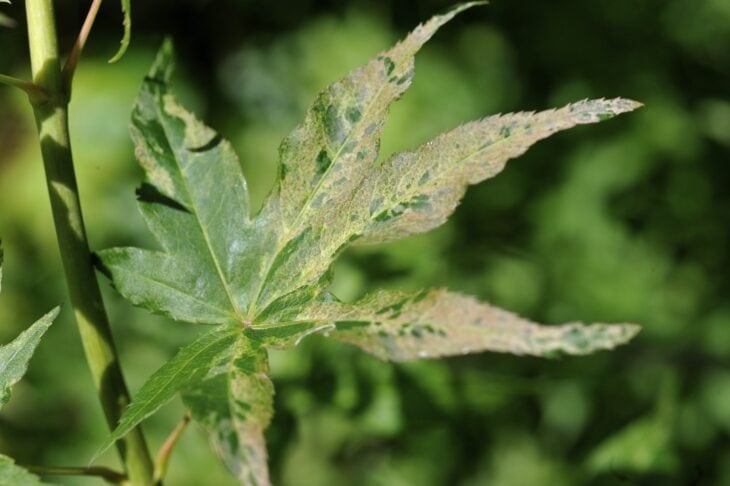
Zones: 5–8 · Size: 7 to 12 feet (2 to 3.5 m) tall, 4 to 8 feet (1.2 to 2.5 m) wide · Light: part shade, out of afternoon sun · Soil: moist, well-drained
The leaf: green splashed, edged or speckled with white, cream or pink. On ‘Butterfly’, Missouri describes small, deeply divided, gray-green leaves with creamy white edges, often pink-tinged in spring, that sometimes twist. The white parts turn scarlet to magenta in fall.
Variegation comes in several patterns. ‘Ukigumo’ (shown above) emerges mostly white with pink tips, then matures to green heavily mottled with white. ‘Shigitatsu-sawa’ is reticulated: pale yellow-green leaves with dark green veins, which the Seattle Japanese Garden compares to stained glass.
Watch for: the RHS says variegated Japanese maples need part shade to keep afternoon sun from scorching the leaves. The reticulated pattern also fades once the leaves darken in midsummer.
7. Spring-Red Japanese Maples (‘Shindeshojo’)
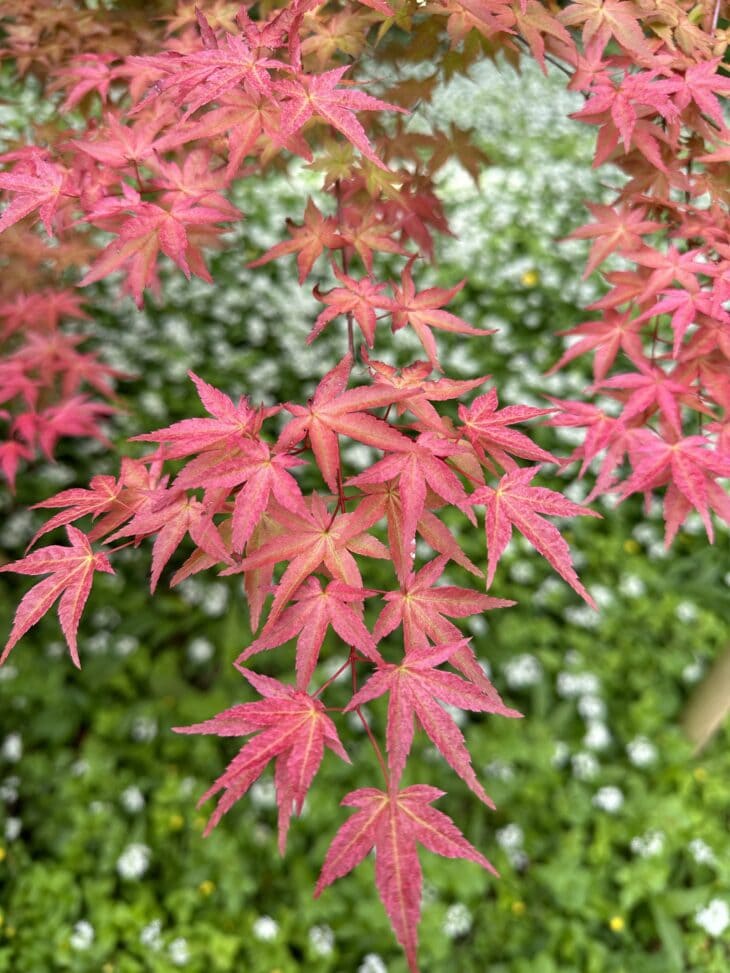
Zones: 6–9 (Missouri lists 5; Oregon State rates it hardy to Zone 6) · Size: 5 to 7 feet (1.5 to 2 m) tall and wide, eventually up to 10 feet (3 m) · Light: sun to part shade · Soil: moist, well-drained
The leaf: an ordinary small palmate leaf, up to 2 inches (5 cm) long with seven lobes. What sets this type apart is timing: the new leaves open a brilliant red or pink, then fade to green for summer.
The Missouri Botanical Garden says ‘Shindeshojo’ reportedly has the best red spring color of any Japanese maple. Oregon State says the color lasts about a month before turning reddish green, then dull green by midsummer, with red and orange fall color.
Watch for: don’t buy one in May expecting a red tree all year. Summer leaves may also show small cream or white specks, which the RHS and japanesemaple.org both describe as normal for this cultivar.
Other picks: ‘Deshojo’ is its parent, with brilliant red spring leaves that turn bright green. For orange or gold spring leaves instead of red, try ‘Katsura’, whose leaves open chartreuse with orange edges, or ‘Orange Dream’, whose golden-yellow spring leaves are edged orange-red.
8. Dwarf Japanese Maples: Yatsubusa Types (‘Mikawa-yatsubusa’)
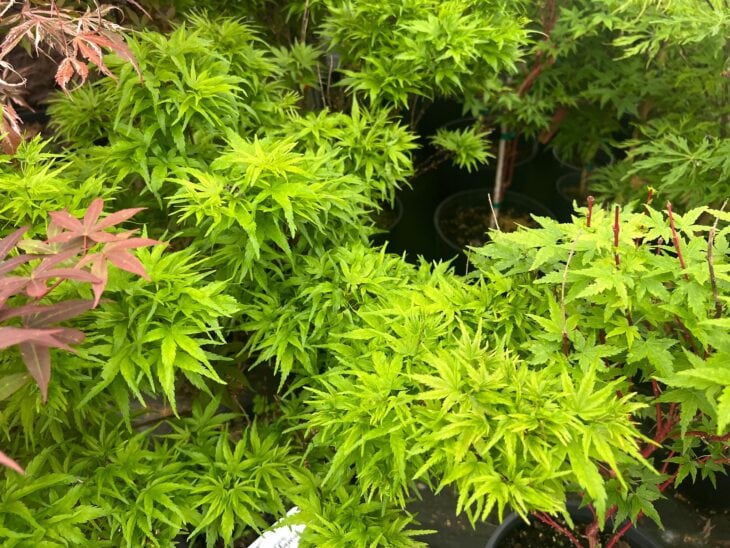
Zones: 5–9 · Size: 4 to 6 feet (1.2 to 1.8 m) tall and about 4 feet (1.2 m) wide (NC State); the RHS says 3 to 4 feet (about 1 m) · Light: part shade to full sun · Soil: moist, well-drained
The leaf: the dwarf group is defined by size, not shape: cultivars that usually stay under 6 feet (1.8 m). “Yatsubusa” means small or dwarf, per the Seattle Japanese Garden. On ‘Mikawa-yatsubusa’, small five- or seven-lobed leaves overlap densely, which the RHS describes as “a bunched, layered effect”.
The leaves open yellow-green, turn medium green for summer, and go gold, orange and red in fall. NC State calls it more heat tolerant than most Japanese maples, which makes it one of the better choices for the Southeast.
Watch for: NC State warns that temperature swings in late winter and spring can seriously damage the foliage and even young branches. Wind, drought or underwatering cause leaf scorch.
Other picks: ‘Sharp’s Pygmy’ (shown above) has small five-lobed leaves that turn orange-red in fall, and usually stays 2 to 4 feet (60 cm to 1.2 m) tall. ‘Kiyohime’ spreads wider than tall; NC State puts it at 2 to 3 feet (60 to 90 cm) tall and calls it very tolerant of hot summers.
9. Crinkled Leaves: Lion’s Head Maple (‘Shishigashira’)
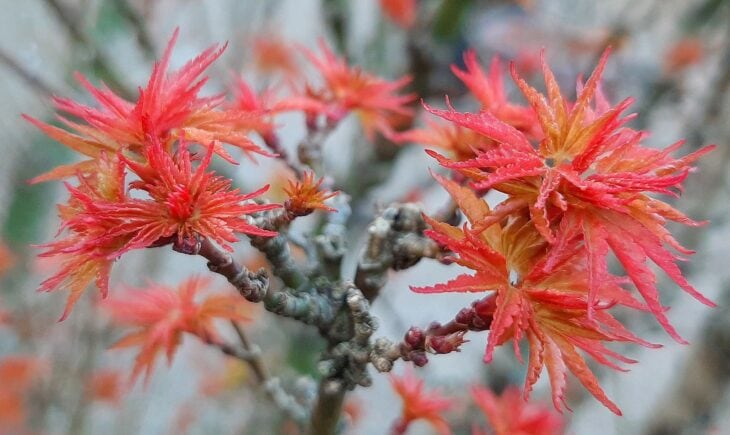
Zones: 5–8 · Size: 7 to 15 feet (2 to 4.5 m) tall, 5 to 12 feet (1.5 to 3.5 m) wide · Light: sun to part shade · Soil: moist, well-drained
The leaf: small, bright green, five- to seven-lobed leaves about 2 inches (5 cm) long that are crinkled and curled rather than flat. They grow in dense tufts along the stems, which is where the name comes from: ‘Shishigashira’ means lion’s head.
It is a slow, upright, compact tree, and the Seattle Japanese Garden says it is one of the last maples to color in fall, turning scarlet or gold burnished with red. It is also sold as ‘Ribesifolium’.
Watch for: Missouri notes the foliage on young trees can look sparse. The tufted look fills in with age.
These are separate species, not forms of Acer palmatum. The quick tell is the leaf: rounder, with more lobes (7 to 13) than a typical Japanese maple’s five to nine.
10. Fullmoon Maple (Acer japonicum)

Zones: 5–7 · Size: 20 to 30 feet (6 to 9 m) tall and wide for the species; popular cultivars stay smaller · Light: lightly dappled shade · Soil: medium moisture, well-drained
The leaf: round, 3 to 6 inches (7.5 to 15 cm) across, with 7 to 11 toothed lobes cut a third to halfway toward the center. The fullmoon maple gets its name because each leaf is said to resemble a full moon, and Clemson Extension notes the leaves are wider and larger than a Japanese maple’s.
Leaves turn yellow and red in fall, and small purplish-red flowers hang in clusters before the leaves open in spring. The Missouri Botanical Garden says the species itself is rarely sold. You will usually meet it as a cultivar.
Watch for: Missouri and NC State both say fullmoon maples perform poorly south of Zone 7 and prefer cool summers. Leaves can scorch in full sun in hot summers, and early leaf-out makes new growth vulnerable to late frost.
Cultivar picks: ‘Aconitifolium’ (fernleaf fullmoon maple) grows slowly to 8 to 10 feet (2.5 to 3 m), with 9 to 11 lobes cut nearly to the stalk and cut again, turning crimson in fall. ‘Vitifolium’ has large, shallowly lobed leaves up to 6 inches (15 cm) across that look like grape leaves.
11. Golden Fullmoon Maple (Acer shirasawanum ‘Aureum’)
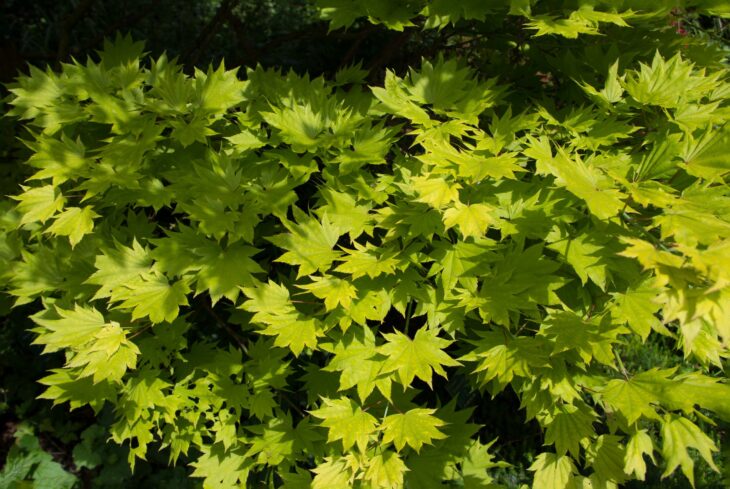
Zones: 5–7 (Oregon State rates it hardy to Zone 6, possibly 5) · Size: slowly to 16 to 20 feet (5 to 6 m) tall and wide · Light: part shade, especially in the afternoon · Soil: moist, well-drained
The leaf: small and nearly round, 2 to 3 inches (5 to 7.5 cm), with 9 to 13 shallow, toothed lobes. It opens bright yellow in spring, sometimes edged red, darkens to yellow-green by summer and turns orange-red in fall.
Another useful ID feature: its red seeds (samaras) are held upright in clusters above the leaves. It was sold as Acer japonicum ‘Aureum’ until botanists moved it to Acer shirasawanum in 1984, which is why the “fullmoon” name stuck.
Watch for: Missouri, Oregon State and NC State all warn the gold leaves can scorch in full sun, and it prefers cool summers. Protect it from wind and late spring frost.
12. Korean Maple (Acer pseudosieboldianum)
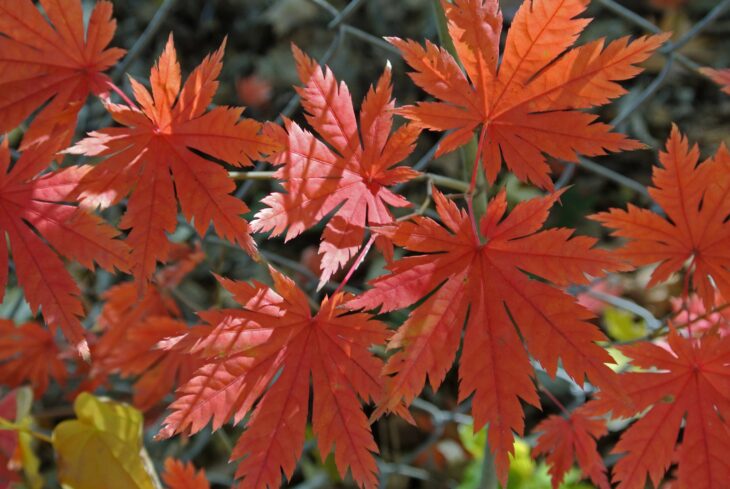
Zones: 4–8 (3–8 for ‘KorDak’) · Size: 15 to 25 feet (4.5 to 7.5 m) tall and wide · Light: full sun to part shade · Soil: moist, organically rich, well-drained
The leaf: up to 5 inches (13 cm) long with 9 to 11 double-toothed lobes, so it looks like something between a Japanese maple and a fullmoon maple. Fall color runs yellow, orange and red.
This is the answer for cold gardens. The Missouri Botanical Garden rates it one zone colder than most Japanese maples, and a Minnesota Ask Extension answer calls it an ideal substitute for Japanese maple there. ‘KorDak’ (sold as Northern Spotlight), released by North Dakota State University, is rated to Zone 3.
Watch for: avoid hot, dry sites. Missouri lists no serious problems, but notes stem canker, leaf spots, tar spot, anthracnose and verticillium wilt can occur.
Also for Zone 4: Iseli Nursery’s Jack Frost series crosses Korean maple with Japanese maple; the nursery rates hybrids such as North Wind to Zone 4. ‘Velvet Viking’ is a laceleaf Japanese maple selected in Minnesota, about 3 feet (90 cm) tall, that Anoka County Extension Master Gardeners describe as Zone 4 hardy.
Which Type Should You Choose?
- A pot, a small yard or bonsai: a dwarf such as ‘Mikawa-yatsubusa’, ‘Sharp’s Pygmy’ or ‘Kiyohime’, or the small ‘Shindeshojo’ and ‘Red Pygmy’.
- A weeping mound over rocks or water: a Dissectum laceleaf. It is the classic choice for Japanese garden ideas.
- A small tree to sit under: Palmatum or Amoenum types such as ‘Bloodgood’ or ‘Osakazuki’. For lace on an upright tree, ‘Seiryu’.
- The hot South (Zones 7b–8): UF/IFAS says leaves often scorch there without shade or irrigation. Pick heat-tolerant ‘Mikawa-yatsubusa’ or ‘Kiyohime’, or scorch-resistant ‘Osakazuki’, give them afternoon shade, and skip fullmoon types.
- Zone 4 or colder: Korean maple, ‘KorDak’ or a Korean hybrid.
- Late spring frosts: ‘Emperor I’, which leafs out about two weeks later than other cultivars.
- Brightening shade: golden fullmoon maple or a variegated type, both of which want afternoon shade anyway. They suit most shade garden ideas.
- The best fall color: ‘Osakazuki’. For winter interest, coral bark ‘Sango-kaku’.
Red Japanese Maples Don’t All Stay Red All Summer
A red Japanese maple bought in spring often looks bronze or green by July, and owners assume something is wrong. Usually nothing is. Clemson Extension says many red varieties change to green in summer heat and turn red again in fall, and the non-dissected red types fade to bronze-green in summer.
Light matters in both directions. Oregon State says red laceleafs need strong sun for at least part of the day to color up, and Clemson says too much shade turns purple leaves greener. The New York Botanical Garden adds very hot summers, drought and too much nitrogen fertilizer as causes of fading.
If summer color matters most, pick a cultivar known to hold it. Oregon State names ‘Crimson Queen’ and ‘Ever Red’, and Clemson names ‘Bloodgood’ and ‘Inaba-shidare’. Give them morning sun and afternoon shade in hot climates, and go easy on fertilizer.
Frequently Asked Questions
How do I identify which Japanese maple I have?
Start with a mature summer leaf and match its cuts to one of the five groups above. Then note the spring, summer and fall color, whether the tree weeps or grows upright, and its size. That narrows it to a handful of cultivars.
Naming the exact cultivar is often impossible from looks alone. There are hundreds of cultivars, and japanesemaple.org notes that alternate names and misapplied labels mean nobody knows the exact number. Your best leads are the original nursery tag or receipt, or a comparison with labeled trees at an arboretum with a named collection.
How can I tell a Japanese maple leaf from other maple leaves?
A Japanese maple leaf is small, 2 to 5 inches (5 to 13 cm), with five to nine pointed, toothed lobes that spread from one point like an open hand, and most are deeply cut. Fullmoon, golden fullmoon and Korean maples have rounder leaves with 7 to 13 lobes.
What every maple shares, according to NC State, is leaves in opposite pairs and winged seeds (samaras). Don’t confuse “red maple” with a red-leaved Japanese maple. Red maple is a different species, Acer rubrum, whose leaves are green in summer.
Why does my Japanese maple have two different leaves?
Most often it is the rootstock. Most cultivars are grafted onto a plain green Japanese maple, and Ohio State Extension explains that shoots from below the graft grow more vigorously and can outgrow the cultivar on top. Cut those shoots off below the graft union while they are small, and keep removing them when they return.
Some differences are normal. Many red cultivars open red and turn green for summer, shaded leaves are greener than sunny ones, and strap-leaf types such as ‘Koto-no-ito’ grow narrower leaves in spring than later in the season.
Are Japanese maples toxic to dogs, cats or horses?
Japanese maple is not listed on the ASPCA’s toxic plant lists for dogs, cats or horses. That means no listed toxicity, not a guarantee of safety.
Red maple (Acer rubrum) is a different story: the ASPCA lists it as toxic to horses, with wilted leaves the most toxic. Penn State Extension says related maples may carry the same toxins, so if you keep horses, keep them away from wilted maple leaves you can’t identify.
Are Japanese maples invasive?
In parts of the East, yes, it is starting to be. The Invasive Plant Atlas reports it has escaped and naturalized in the eastern US, and NC State notes it self-seeds and can become weedy.
As of 2026, it is on the Delaware Invasive Species Council list, a Pennsylvania DCNR watch list and New Jersey’s Do Not Plant list as an emerging invader. It is reported invasive in Rock Creek Park in Washington, DC, and on local lists in Arlington and Alexandria, Virginia, though not on Virginia’s state list.
Pull seedlings where they come up, especially near woodland. It is one of the real drawbacks of Japanese maples in the Mid-Atlantic.
Sources
- Japanesemaple.org (Boyd Nursery): the Vertrees leaf groups
- Royal Horticultural Society: Japanese maples growing guide
- Missouri Botanical Garden Plant Finder: Acer palmatum
- NC State Extension: Acer palmatum
- Oregon State University Landscape Plants: Acer palmatum
- UF/IFAS Extension: Acer palmatum, Japanese maple
- Clemson Cooperative Extension: Maple
- Seattle Japanese Garden: Maples
- Trees and Shrubs Online: Acer palmatum




.JPG)