
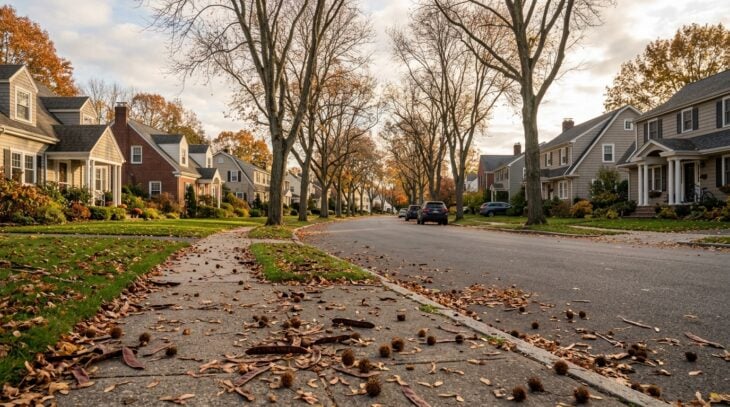
To identify seed pods from trees, sort the fruit into one of four shapes first: long flat pods, spiky or round balls, winged seeds, or cone-like clusters. Then check the size, the season and the leaves of the tree it came from.
Contents
This guide covers 19 trees common in US yards, streets and parks, and most of their fruit is harmless. A few are not. Golden chain tree, black locust, Kentucky coffeetree and horse chestnut all have poisonous pods or seeds, and black walnut hulls are a risk to dogs and horses.
The real trap is the lookalikes. Black locust (poisonous) and redbud pods are nearly the same size and shape, for example, so a comparison table follows the summary and every entry names the feature that sets it apart.
Warning: never eat a pod, seed or nut because of a photo, an article or an app. Identification from a web page is not safe identification.
If a child eats one, call Poison Control at 1-800-222-1222. If a pet does, call ASPCA Poison Control at (888) 426-4435 or your vet. The ASPCA says a consultation fee may apply.
How We Chose These 19 Trees
A pod here means any fruit a tree holds or drops that gets mistaken for something else: bean-like pods, hard capsules, fuzzy balls, winged seeds and cone-like clusters. We picked broadleaf trees that are common in US yards and streets, plus the ones most often confused with another entry.
Left out: pine, spruce and fir cones, palms, tropical trees, and nuts and acorns. For oaks, see our oak identification guide, and for round balls hanging from an oak, see the balls on oak trees.
Sizes and ripening times are typical ranges from NC State Extension. They shift with the tree and the year, so use them to sort lookalikes, not to rule a tree in or out.
| Tree | Botanical name | Key difference | Toxic? |
|---|---|---|---|
| Golden chain tree | Laburnum anagyroides | Long, flat pods that split open; leaves with exactly 3 leaflets | Yes, all parts |
| Black locust | Robinia pseudoacacia | Short flat pods, 2 to 4 in; long compound leaves, paired spines | Yes (bark, leaves, seeds) |
| Kentucky coffeetree | Gymnocladus dioicus | Wide, thick pods up to 10 in; huge twice-divided leaves | Yes (leaves, seeds, pulp) |
| Honeylocust | Gleditsia triacanthos | Very long (12 to 18 in), narrow, twisted pods | Not listed |
| Eastern redbud | Cercis canadensis | Flat pods, 2 to 4 in; simple heart-shaped leaves | Not listed |
| Catalpa | Catalpa speciosa, C. bignonioides | Thin, cigar-like pods, up to 22 in | Not listed |
| Mimosa | Albizia julibrissin | Flat pods, 4 to 8 in, in tight bunches; fern-like leaves | Dogs (NC State) |
| Horse chestnut | Aesculus hippocastanum | Prickly husk around a big glossy seed with a pale scar | Yes (seeds) |
| Black walnut | Juglans nigra | Smooth, round green husk that stains; pointed tip | Dogs, horses |
| Sweetgum | Liquidambar styraciflua | Hard, spiky gumball, 1 to 3 in | Not listed |
| American sycamore | Platanus occidentalis | Fuzzy ball on a long stalk, usually one per stalk | Not listed |
| Osage orange | Maclura pomifera | Wrinkled, brain-like fruit, 4 to 6 in | Not listed |
| White ash | Fraxinus americana | Single paddle-shaped wings in drooping clusters | Not listed |
| Tree of heaven | Ailanthus altissima | Twisted single wings in big clusters; notched leaflets, foul smell | Not listed |
| Red maple | Acer rubrum | Paired V-shaped wings, about 3/4 in | Horses (wilted leaves) |
| American elm | Ulmus americana | Flat, round papery wafer with the seed in the center | Not listed |
| Tulip tree | Liriodendron tulipifera | Upright cone-like cluster of winged seeds | Not listed |
| Southern magnolia | Magnolia grandiflora | Cone-like fruit with red seeds on thin threads | Not listed |
| Princess tree | Paulownia tomentosa | Woody oval capsule, 1 to 1.5 in, in clusters | Not listed |
“Not listed” means the NC State and ASPCA pages checked for this guide do not list the tree as toxic. It is not a safety guarantee, and it does not make a pod fit to eat.
How to Tell the Lookalikes Apart
These are the pairs and trios that cause the most mistakes. Each row starts from what you are holding.
| If you found | It could be | The tell |
|---|---|---|
| A flat brown pod, 2 to 4 in (5 to 10 cm) | Black locust (poisonous) or eastern redbud | Look at the leaves. Black locust has long compound leaves and paired spines at the leaf scars. Redbud has simple, heart-shaped leaves. |
| A big flat pod, 10 in (25 cm) or longer | Honeylocust or Kentucky coffeetree (poisonous) | Honeylocust pods are 12 to 18 in (30 to 45 cm), narrow and twisted. Coffeetree pods are shorter, up to 10 in, and 1 to 3 in (2.5 to 7.5 cm) wide. |
| A very long, thin pod | Catalpa or honeylocust | Catalpa pods are slender and cigar-like. Honeylocust pods are flat and twisted. |
| A spiky ball | Sweetgum or horse chestnut (poisonous) | Sweetgum is a hard, bristly capsule on a stalk. Horse chestnut is a leathery, prickly husk that opens to a big glossy seed with a pale scar. |
| A fuzzy ball on a stalk | American sycamore or London planetree | American sycamore usually has one ball per stalk. London planetree usually has two, and they are a little larger. |
| A single-winged seed in a cluster | White ash or tree of heaven (invasive) | Count the leaflets. Ash usually has 7. Tree of heaven has 10 to 41, each with a glandular notch at the base, and the crushed leaves smell foul. |
| A paired, V-shaped wing | Red maple, silver maple or boxelder | Red maple wings are about 3/4 in (2 cm). Silver maple wings spread at 80 to 90 degrees. Boxelder wings are 1 to 1.5 in (2.5 to 4 cm), almost twice as long as other maples. |
| A cone-like cluster on a branch | Tulip tree or southern magnolia | Tulip tree fruit breaks apart into papery winged seeds. Magnolia fruit opens to show red seeds on thin threads. |
Long, Flat and Bean-Like Pods
Seven trees drop pods that look like oversized pea or bean pods. The first three are poisonous, so they come first.
Japanese pagoda tree (Styphnolobium japonicum) has no entry here, but it belongs on the watch list. Its 3 to 8 inch (7.5 to 20 cm) pods pinch between the seeds like beads on a string, and NC State says the seeds are poisonous.
1. Golden Chain Tree (Laburnum anagyroides)
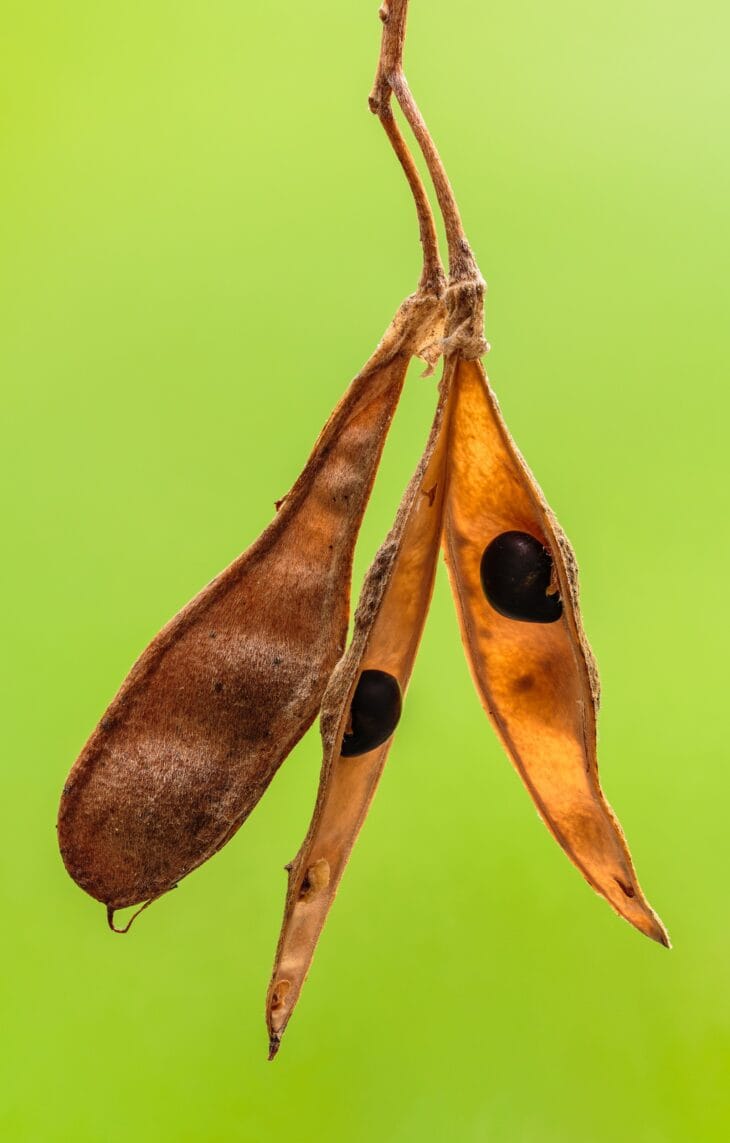
Pod: long, flattened, splits open when ripe · Tree: 15 to 30 feet (4.5 to 9 m) tall · Zones: 5–7 · Toxic: yes, all parts
Golden chain tree is in the bean family, so its pods look like pea pods hanging from a drooping branch. The seeds are black, and the yellow flower chains, 4 to 10 inches (10 to 25 cm) long, bloom in spring.
Every part of the tree is poisonous, and the seeds contain cytisine. NC State rates the poison severity high for people, goats and horses. A few seeds often cause no symptoms, but nausea and vomiting are the usual ones, and higher doses can bring sleepiness, convulsions and coma.
How to tell it apart: the leaves have exactly three leaflets, while black locust and honeylocust leaves have many.
2. Black Locust (Robinia pseudoacacia)
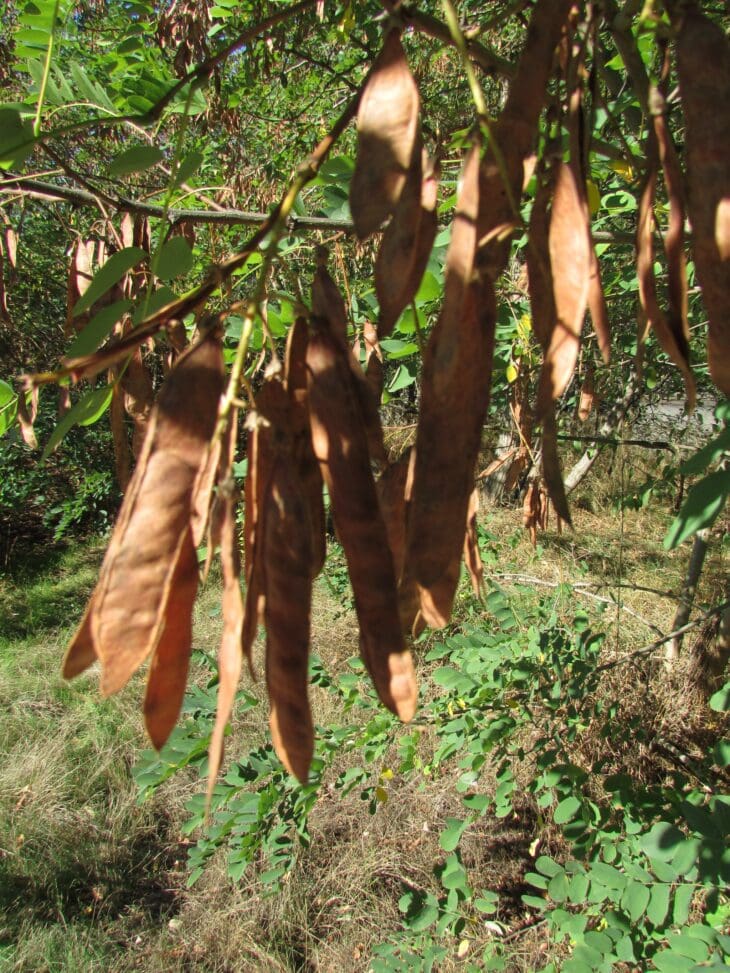
Pod: flat, purple-brown, 2 to 4 inches (5 to 10 cm) long, with 4 to 8 kidney-shaped seeds · Tree: 30 to 50 feet (9 to 15 m) tall · Zones: 3–8 · Toxic: yes
The pods show from July to November and often stay on the tree through winter, so you can find them in any season. The bark, leaves and seeds are all poisonous.
The ASPCA lists locust as toxic to dogs, cats and horses, with vomiting, weakness, bloody diarrhea and death among the signs.
How to tell it apart: black locust has long compound leaves with up to 23 leaflets and short paired spines beside each leaf scar. Redbud pods are about the same size, but redbud leaves are simple and heart-shaped.
3. Kentucky Coffeetree (Gymnocladus dioicus)
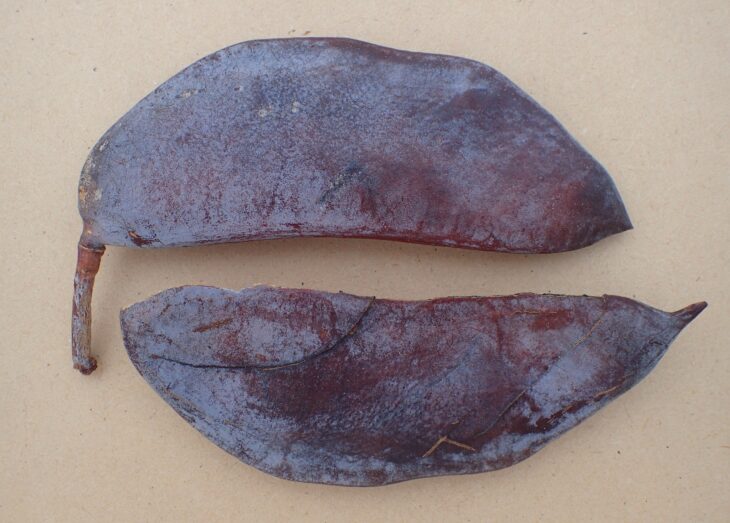
Pod: reddish-brown, up to 10 inches (25 cm) long and 1 to 3 inches (2.5 to 7.5 cm) wide · Tree: 60 to 80 feet (18 to 24 m) tall · Zones: 3–8 · Toxic: yes
Only female trees set fruit. The pods ripen in fall and stay on through winter, each holding 4 to 7 hard seeds in sticky pulp. The leaves are huge, up to 3 feet (90 cm) long and divided twice.
Early settlers used the seeds as a coffee substitute, but the USDA plant guide says the leaves, seeds and pulp are poisonous to livestock, people and pets.
How to tell it apart: next to honeylocust, coffeetree pods are shorter and much wider.
4. Honeylocust (Gleditsia triacanthos)
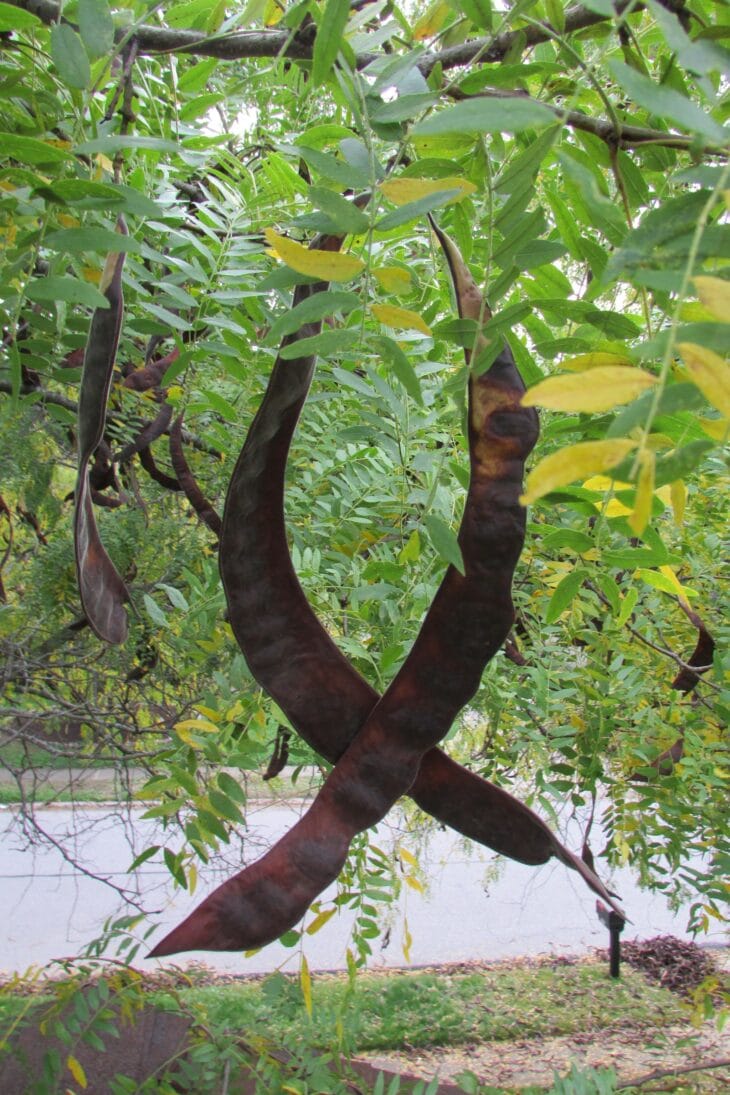
Pod: flat, twisted, 12 to 18 inches (30 to 45 cm) long, reddish-brown to black · Tree: 60 to 80 feet (18 to 24 m) tall and wide · Zones: 3–8 · Toxic: not listed
Honeylocust has the longest flat pods in this group. They twist into corkscrews, turn black when ripe, and hold a sweet, sticky substance that gave the tree its name. Our honey locust profile covers the tree itself.
The ASPCA lists honey locust as non-toxic to dogs, cats and horses, but that does not make the pods good to eat. They are messy when they fall, and the tree is often thorny, so wear gloves when you rake.
How to tell it apart: black locust is the poisonous lookalike, and its pods are a fraction of the length. Honeylocust leaves are feathery.
5. Eastern Redbud (Cercis canadensis)
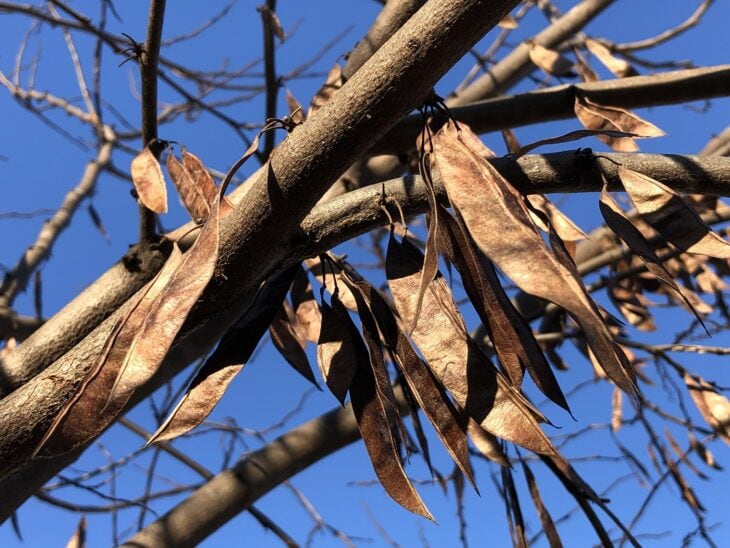
Pod: flat, oblong, 2 to 4 inches (5 to 10 cm) long, about 9 seeds · Tree: 20 to 30 feet (6 to 9 m) tall · Zones: 4–9
Redbud pods form after the flowers fade, turn from green to brown, and can hang on through fall and even winter. They look untidy on a bare branch.
How to tell it apart: redbud is the easy one to mistake for black locust. Check the leaves: redbud leaves are simple, heart-shaped and 3 to 5 inches (7.5 to 12.5 cm) wide, with smooth edges.
6. Catalpa (Catalpa speciosa and C. bignonioides)
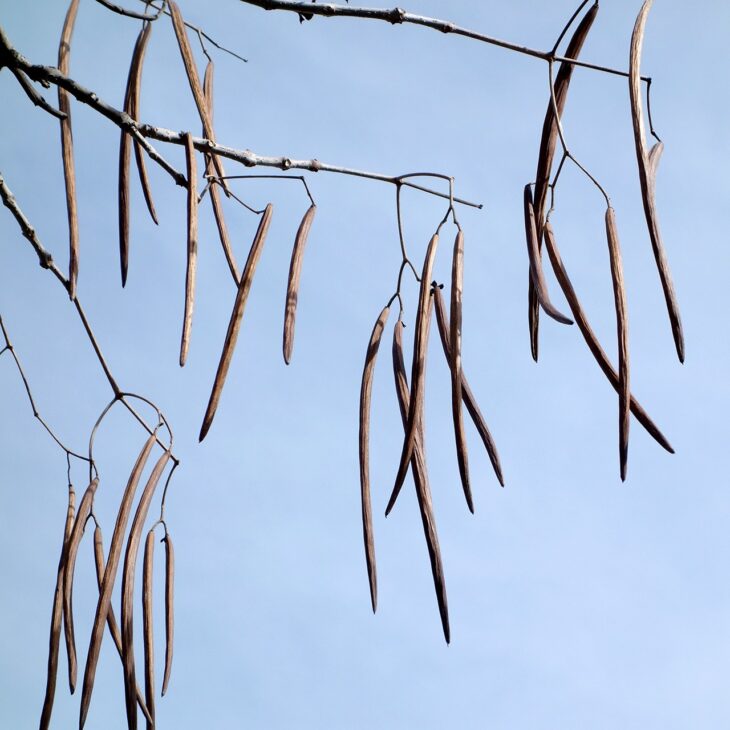
Pod: long, thin, cigar-like, up to 22 inches (55 cm) on northern catalpa and up to 15 inches (38 cm) on southern catalpa · Tree: northern catalpa 40 to 70 feet (12 to 21 m) tall · Zones: 4–8 (northern), 5–9 (southern)
The pods ripen to dark brown in fall, then split lengthwise to release their seeds on the wind. The shape earned both species the nickname cigar tree. Our northern catalpa profile covers the tree.
How to tell it apart: among the trees in this guide, only catalpa has pods this long and thin. The big heart-shaped leaves, 6 to 12 inches (15 to 30 cm) long, help confirm it.
Crush a leaf to separate the species: NC State says northern catalpa lacks the unpleasant smell of southern catalpa.
7. Mimosa (Albizia julibrissin)
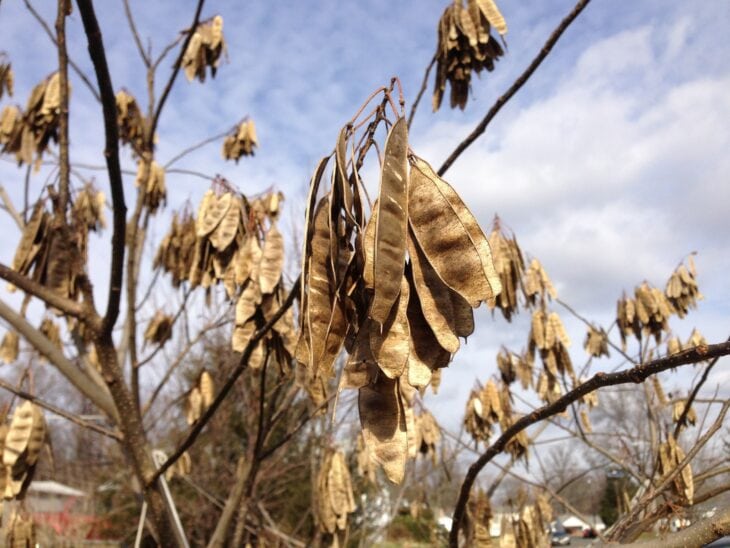
Pod: flat, brown, 4 to 8 inches (10 to 20 cm) long and about 1 inch (2.5 cm) wide, with 5 to 10 seeds · Tree: 20 to 40 feet (6 to 12 m) tall · Zones: 6–9 · Invasive in the Southeast
Mimosa pods hang in tight bunches, ripen between August and November, and often stay on the bare tree through winter. The fern-like leaves are a quick check.
Virginia Tech Extension notes that mimosa is considered invasive and has serious impacts on biodiversity in parts of the southeastern US. It adds that cultivars sold as disease resistant still set seed and can be considered potentially invasive.
NC State also lists mimosa as a problem for dogs. See our guide to types of mimosa trees for which ones to avoid.
Spiky, Fuzzy and Ball-Shaped Fruit
Five trees drop round or spiky fruit. Horse chestnut and black walnut can harm dogs and horses, so they come first.
8. Horse Chestnut (Aesculus hippocastanum)
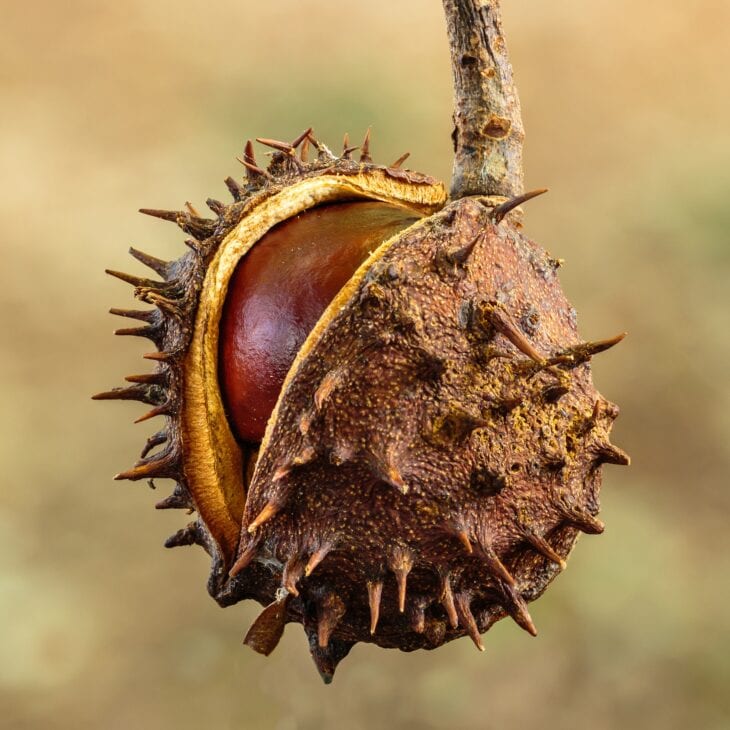
Fruit: prickly, leathery capsule, 1 to 2 inches (2.5 to 5 cm), holding large glossy brown seeds with a pale scar · Tree: 50 to 75 feet (15 to 23 m) tall · Zones: 4–7 · Toxic: yes
NC State rates the seeds as poisonous to people, dogs, cats and horses, at high severity. The ASPCA lists buckeye and horse chestnut as toxic to dogs, cats and horses, with severe vomiting and diarrhea, weakness and seizures among the signs.
Buckeyes are close relatives. Ohio buckeye (Aesculus glabra) has a warty or prickly capsule with one to three shiny seeds, and our red buckeye profile covers another species.
How to tell it apart: Chinese chestnut (Castanea mollissima) grows its nuts in a spiny bur 2 to 3 inches (5 to 7.5 cm) across, usually two or three to a bur. Chestnuts are sold as food, but never decide which one you have from a photo.
9. Black Walnut (Juglans nigra)
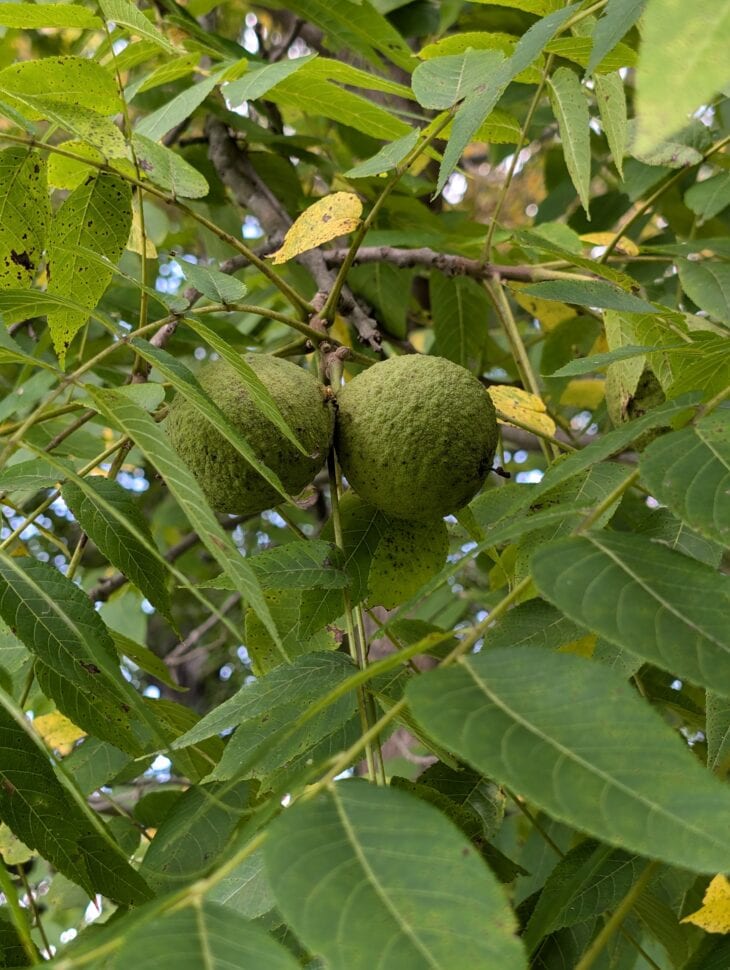
Fruit: round, yellow-green husk around a hard nut, ripe in October · Tree: 50 to 75 feet (15 to 23 m) tall and wide · Zones: 4–9 · Toxic: dogs and horses
Black walnuts hang singly or in pairs, in a fleshy husk that does not split open. The husk stains skin and clothing heavily, so wear gloves to pick them up.
The ASPCA lists black walnut as toxic to dogs and horses and non-toxic to cats. Moldy nuts and hulls can cause tremors and seizures in dogs, and horses can develop laminitis and colic.
The tree is also allelopathic, which means it releases chemicals that can stunt plants growing nearby.
How to tell it apart: the husk is globular with a pointed tip, and the compound leaves carry 15 to 23 leaflets. The only other big green ball here, osage orange, has a wrinkled, brain-like surface.
10. Sweetgum (Liquidambar styraciflua)
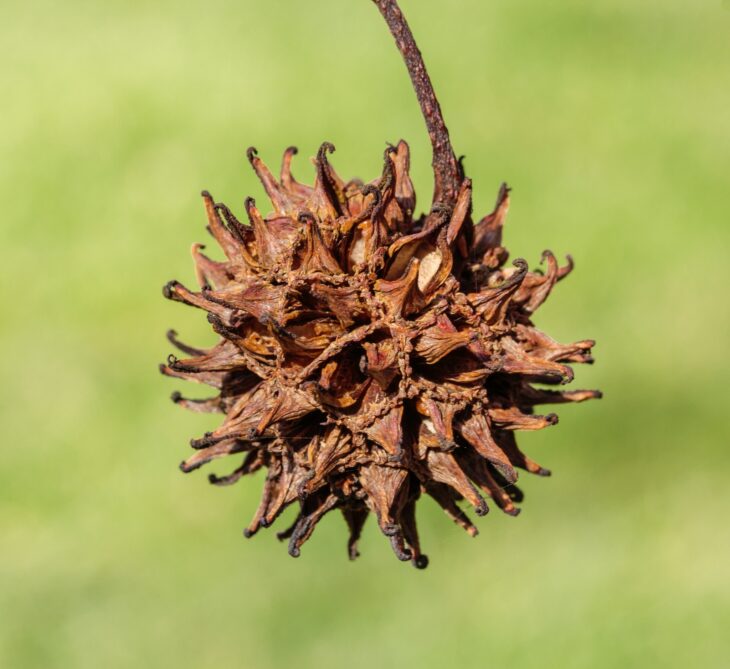
Fruit: hard, bristly, beak-shaped capsules in a ball 1 to 3 inches (2.5 to 7.5 cm) across · Tree: 60 to 100 feet (18 to 30 m) tall · Zones: 5–9
These are the gumballs. They appear in August and September, turn dark brown, and usually stay on the tree through winter. The clusters fall between December and April, and each capsule holds two tiny seeds.
NC State calls the fruit a litter problem on lawns and patios, so sweetgum is a poor choice beside a walkway.
How to tell it apart: the ball is hard and spiky and hangs on a stalk. The star-shaped leaves have 5 to 7 pointed lobes and are fragrant when bruised.
11. American Sycamore (Platanus occidentalis)
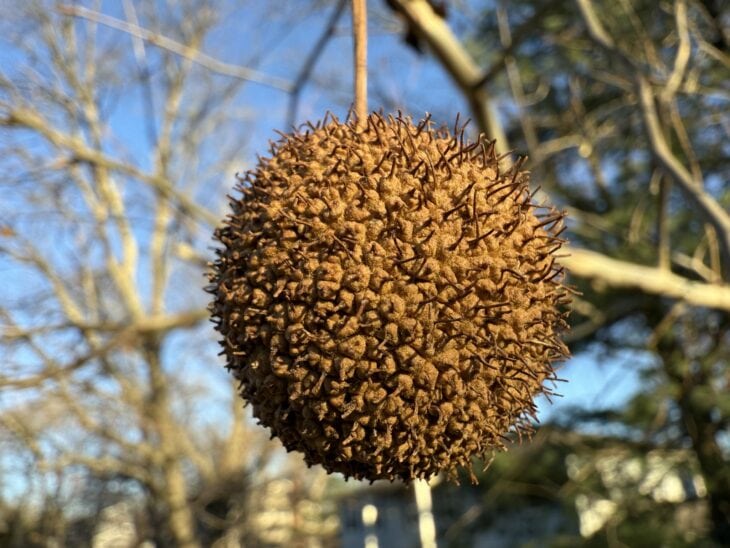
Fruit: fuzzy ball 0.5 to 1 inch (1.3 to 2.5 cm) across, usually one per stalk, on a stalk 3 to 6 inches (7.5 to 15 cm) long · Tree: 75 to 100 feet (23 to 30 m) tall and wide · Zones: 4–9
The balls ripen to brown in fall and hang on into early winter. They then fall apart, and the seeds drift off in downy tufts.
How to tell it apart: a sycamore ball is fibrous, not hard and spiky, and it disintegrates. London planetree usually carries two balls on each stalk, and they are a little larger at 1 to 1.5 inches (2.5 to 4 cm).
The leaves are broad, with 3 to 5 lobes, 4 to 9 inches (10 to 23 cm) wide, and usually wider than long.
12. Osage Orange (Maclura pomifera)
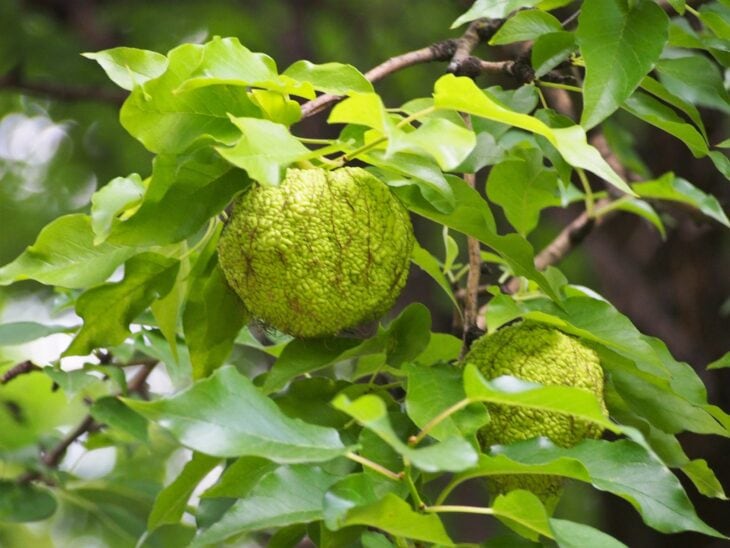
Fruit: wrinkled, yellow-green, 4 to 6 inches (10 to 15 cm) across, like a large orange or grapefruit · Tree: 25 to 70 feet (7.5 to 21 m) tall · Zones: 4–9
Nothing else in this guide looks like it. The fruit is a wrinkled, brain-like ball made of many small fruits fused together, and it oozes latex sap when cut. NC State calls it inedible.
The tree is native from southeast Oklahoma to Texas and Arkansas. Our osage orange profile has more on the tree.
Winged Seeds (Samaras)
Winged seeds glide or spin away from the tree. Check whether the wing is single or paired, and count the leaflets on the leaf.
13. White Ash (Fraxinus americana)
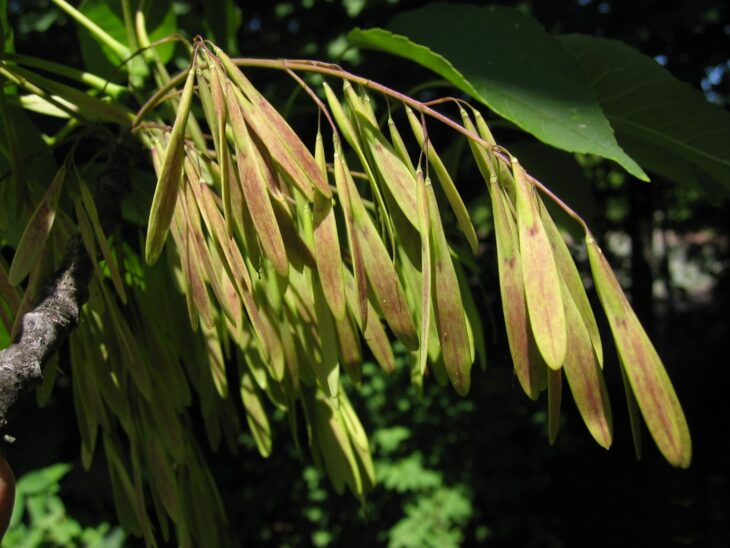
Fruit: single-winged flat samaras up to 2 inches (5 cm) long, in drooping clusters 6 to 8 inches (15 to 20 cm) long · Tree: 60 to 120 feet (18 to 36 m) tall · Zones: 3–9
Each ash seed has one narrow wing, like a paddle. The clusters ripen in fall and may stay on through winter.
How to tell it apart: ash leaves are compound, with usually seven leaflets (sometimes five or nine) and smooth edges. Tree of heaven leaves carry many more leaflets, each with a glandular notch at the base.
Ash trees also face a pest. Emerald ash borer, first found in southeastern Michigan in 2002, makes ash lose most of their canopy within two years and die within three to four, according to the invasivespeciesinfo.gov page. A thinning crown is worth a call to an arborist.
14. Tree of Heaven (Ailanthus altissima)
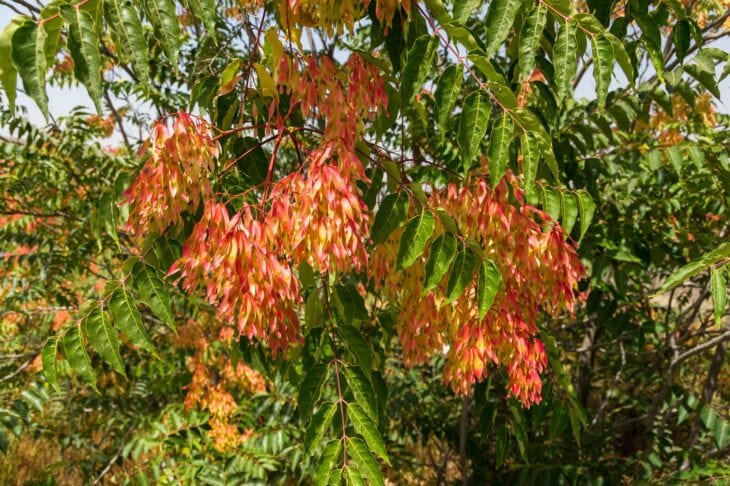
Fruit: flat, twisted, reddish-brown winged seeds in large drooping clusters, each samara 1 to 2 inches (2.5 to 5 cm) long · Tree: 40 to 60 feet (12 to 18 m) tall · Zones: 4–8 · Invasive
NC State lists tree of heaven as invasive, allelopathic and weedy. Cornell says one female tree can make more than 300,000 seeds in a year, and it spreads by root sprouts, which are a problem when a tree is damaged, so ask your extension office before cutting one down.
It is also the preferred host of the spotted lanternfly, according to MDInvasives.
How to tell it apart: the leaves have 10 to 41 leaflets, each with one or two glandular teeth at the base, and they smell foul when crushed. Cornell points to those glands as a key feature for telling it from lookalikes such as ash.
15. Red Maple (Acer rubrum)
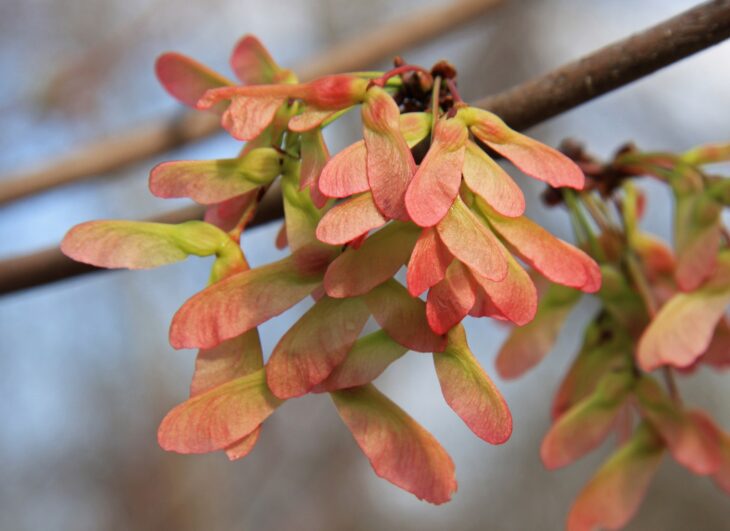
Fruit: paired, V-shaped samaras about 3/4 inch (2 cm) long, red, pink or yellow, on drooping stems · Tree: 40 to 120 feet (12 to 36 m) tall · Zones: 2–9
The pairs of “helicopters” turn tan or brown and drop. NC State lists the samaras as available from April to July in North Carolina, so these are the pods of spring and early summer, not fall. Our red maple profile covers the tree.
How to tell it apart: red maple wings are short, about 3/4 inch (2 cm). Silver maple wings spread at an 80 to 90 degree angle, and boxelder (Acer negundo) samaras are 1 to 1.5 inches (2.5 to 4 cm) long, almost twice as long as other maples.
The ASPCA lists red maple as toxic to horses, with wilted leaves the most dangerous, and non-toxic to dogs and cats.
16. American Elm (Ulmus americana)
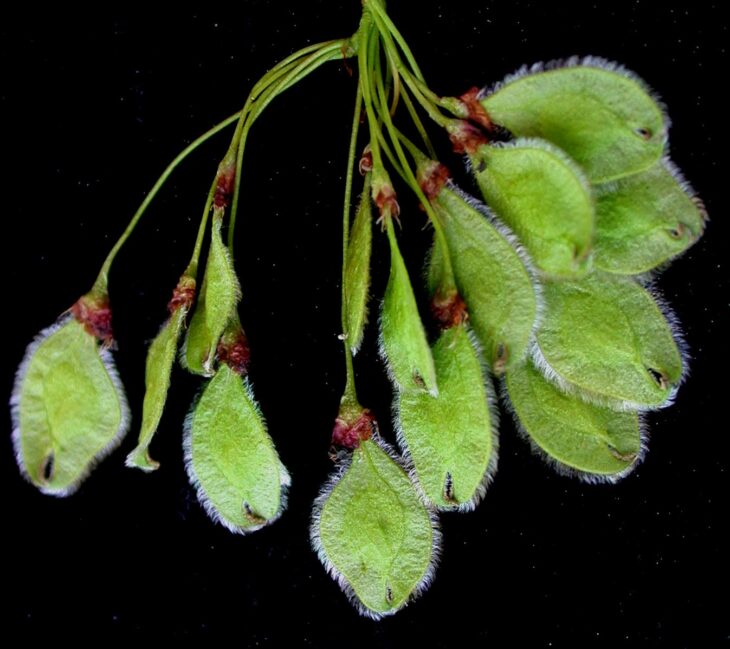
Fruit: flat, round, papery wafer with one seed in the center, in clusters on long stems · Ripe: spring · Tree: 60 to 80 feet (18 to 24 m) tall · Zones: 3–9
Elm seeds are the earliest on this list. They mature in April and May, just as the leaves reach full size, and in North Carolina they are available from March.
How to tell it apart: the wing is round and flat and surrounds the seed, which sits in the middle. An ash seed sits at the end of a long wing.
Dutch elm disease, a fatal fungal disease spread by bark beetles, has no known cure, although resistant cultivars such as ‘Princeton’ are available.
Cone-Like Clusters and Capsules
In these three trees the fruit sits in a tight cluster or capsule on the branch instead of hanging loose. Two are native and one is invasive.
17. Tulip Tree (Liriodendron tulipifera)
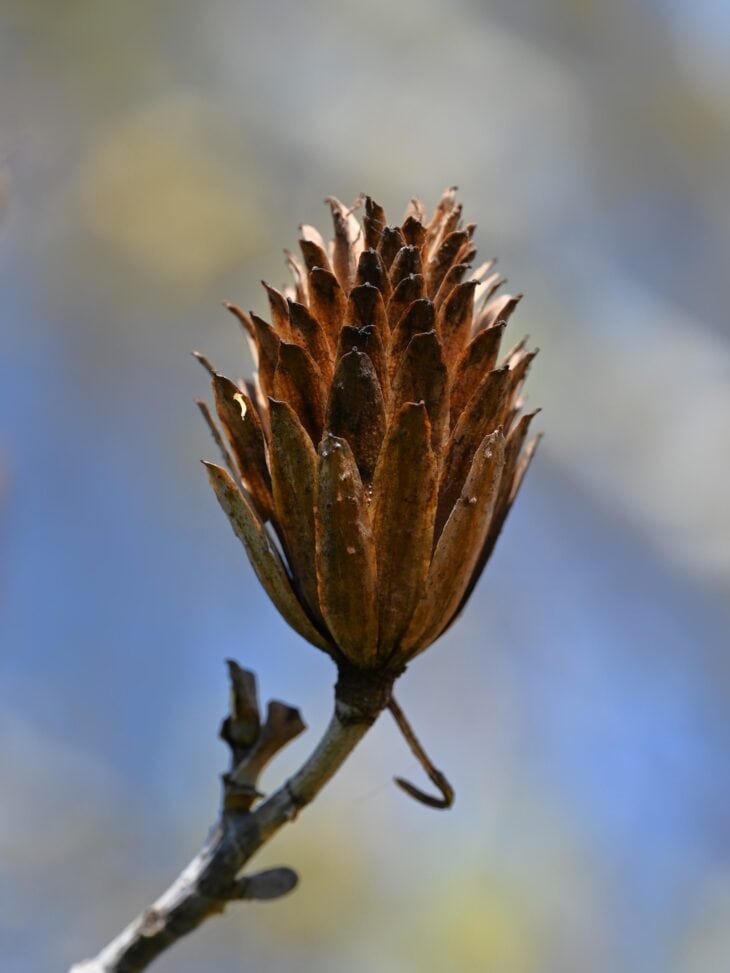
Fruit: upright, cone-like cluster of samaras, 2 to 3 inches (5 to 7.5 cm) long and about 3/4 inch (2 cm) wide · Ripe: September to October · Tree: 80 to 120 feet (24 to 36 m) tall · Zones: 4–9
The cluster looks like a small brown cone standing on the branch. Over winter it breaks apart into single winged seeds.
How to tell it apart: the cluster is made of papery winged seeds that fall away one by one. The leaf has four main lobes, with a broad, flat-ended top lobe.
NC State lists the tree as messy, with weak wood and frequent insect and disease problems.
18. Southern Magnolia (Magnolia grandiflora)
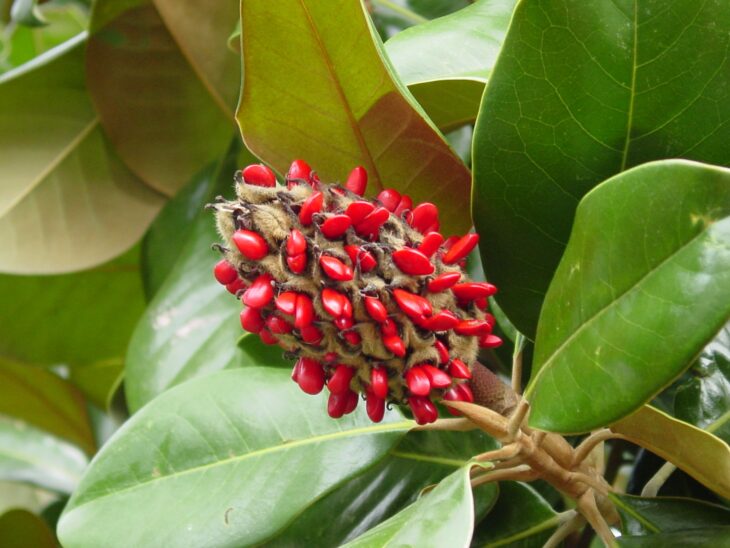
Fruit: cone-like cluster of follicles 3 to 5 inches (7.5 to 12.5 cm) long · Ripe: September to October · Tree: 60 to 80 feet (18 to 24 m) tall · Zones: 6–10
When the fruit ripens it opens, and the seeds hang out on thin red threads, each coated in rose-red. Our magnolia profile covers the tree, and the pros and cons of magnolia trees weighs it up.
How to tell it apart: the evergreen leaves are leathery and glossy, 5 to 10 inches (12.5 to 25 cm) long, with rusty-brown fuzz underneath, so you rarely need the fruit to know it.
19. Princess Tree (Paulownia tomentosa)
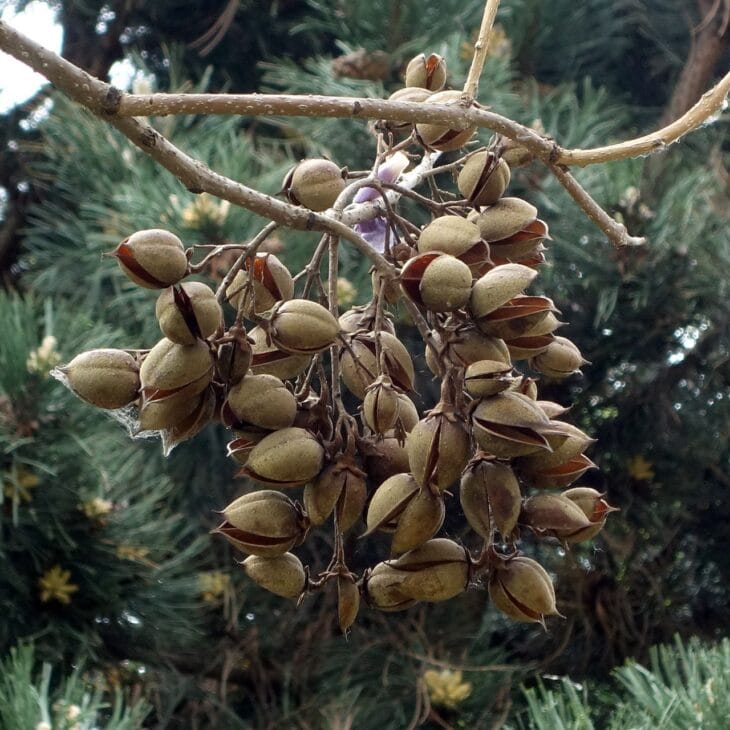
Fruit: woody, oval capsule 1 to 1.5 inches (2.5 to 4 cm) long, in clusters · Tree: 30 to 50 feet (9 to 15 m) tall · Zones: 5–9 · Invasive
Each capsule splits open and releases thousands of small winged seeds. The capsules are sticky and green at first, then brown in fall.
NC State lists princess tree as invasive and weedy, with weak wood. Our royal empress tree profile advises checking regional invasive lists and local rules before planting.
How to tell it apart: the velvety, heart-shaped leaves, 5 to 12 inches (12.5 to 30 cm) long, grow in opposite pairs and look like catalpa leaves. Catalpa has long thin pods, and princess tree has short oval capsules.
A Pod That Looks Like a Bean Is Not Safe to Eat
It is easy to assume that anything shaped like a pea pod, a chestnut or a nut is food. This guide shows why that fails.
Golden chain tree is in the bean family and its pods look like pea pods, yet NC State rates it high for poison. Kentucky coffeetree seeds were once used as a coffee substitute, yet the USDA plant guide calls the seeds poisonous. Japanese pagoda tree pods look like strings of beads, and the seeds are poisonous.
A horse chestnut seed looks like a chestnut but is toxic. Even within one family, honeylocust pods are not listed as toxic while black locust seeds, bark and leaves are poisonous, and the two pods look alike on the ground.
Never eat a pod, seed or nut because of a photo, an article or an app. If you want to forage, learn from a local expert in person.
How to Identify an Unknown Seed Pod, Step by Step
- Sort by shape. Long pod, ball, winged seed or cone-like cluster, as in the four groups above.
- Measure and count. Pod length, seeds per pod, and single or paired wings separate most lookalikes. Black locust pods are 2 to 4 inches (5 to 10 cm), and honeylocust pods are 12 to 18 inches (30 to 45 cm).
- Check the tree. Pods blow and roll away, so find the nearest tree that matches. Look at whether the leaves are simple or compound, how many leaflets there are, and whether the twigs carry thorns.
- Use the calendar. Elm and red maple seeds ripen in spring. Most of the others ripen from late summer to fall, and black locust, honeylocust, Kentucky coffeetree, redbud, mimosa, sweetgum, ash and tulip tree fruit can still hang on the bare tree in winter.
- Photograph and confirm. Take pictures of the pod, a leaf and the whole tree, then check them against an app and your state extension office. An app suggests, and an expert confirms.
Frequently Asked Questions
How do I identify a seed pod from a tree?
Start with the shape: long pod, ball, winged seed or cone-like cluster. Then measure it, look at the leaves of the nearest matching tree, and note the season. The tables above match each shape to 19 common trees.
Which trees have long, bean-like pods?
Golden chain tree, black locust, Kentucky coffeetree, honeylocust, eastern redbud, catalpa and mimosa all drop long pods. The first three are poisonous. Japanese pagoda tree also has bean-like pods, and its seeds are poisonous too.
What tree drops spiky balls?
Sweetgum drops hard, bristly gumballs. Horse chestnut and buckeye have prickly husks that open to a glossy seed, and the seeds are toxic. American sycamore balls are fuzzy and fall apart rather than staying spiky.
Is there a free app to identify seeds?
Seek by iNaturalist is a free app that identifies plants from the camera and does not require registration. Pl@ntNet lets you upload up to four photos of one plant. Both rely on community observations, so treat the answer as a suggestion.
Is there an app to take a picture of a tree and identify it?
Yes, the same apps work for trees. Photograph a leaf, the pods and the bark rather than only the whole tree, and compare the result with the entries above before you trust it.
Are tree seed pods poisonous to dogs?
Some are. The ASPCA lists black locust, buckeye and horse chestnut as toxic to dogs, and moldy black walnut hulls can cause tremors and seizures, while NC State lists mimosa as a problem for dogs. Call ASPCA Poison Control at (888) 426-4435 or your vet if your dog eats one.


,_31-08-2024._(d.j.b).jpg)


_Catalpa_bignonioides_7.jpg)

_20-09-2020_(d.j.b.)_01.jpg)

._Detail._31-03-2020_(d.j.b.).jpg_06.jpg)


_Paulownia_tomentosa_11.jpg)