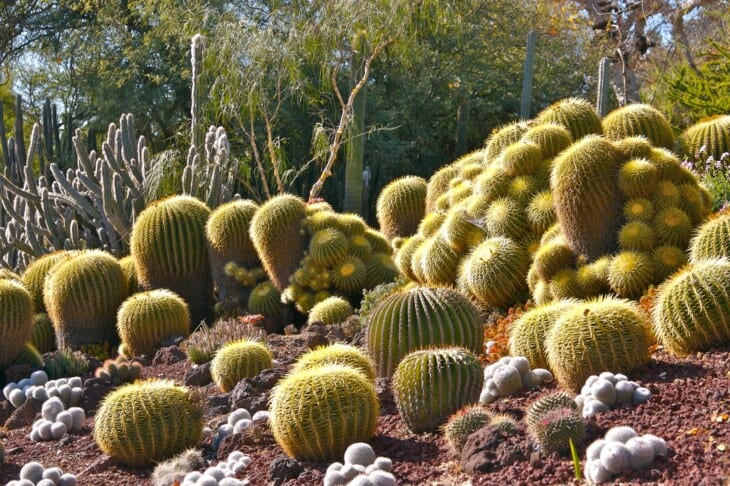
Cacti are remarkable plants with diverse practical and ornamental uses. Many species produce edible fruits and pads, while their spines have historically been used for needles and tools. Cacti display an incredible range of forms, from compact globes to towering columns. Their exceptional drought tolerance allows some species to survive over a year without water, storing moisture in their thick, fleshy stems.
Contents
The cactus family (Cactaceae) contains nearly two thousand species. They are native primarily to North and South America, ranging from Canada to Patagonia. Only one genus, Rhipsalis, occurs naturally outside the Americas—in Sri Lanka, East Africa, and Madagascar. While most cacti inhabit arid deserts and scrublands, many species thrive in tropical forests and humid mountain regions.
Cacti are herbaceous perennials characterized by thick, succulent stems covered in spines and sometimes hair. Small cushion-like structures called areoles are unique to cacti and give rise to spines, hair, and flowers. Areoles replace the side branches found in most plants. Most cacti develop shallow, fibrous root systems that spread widely to capture moisture, though some species produce deep taproots.
Cactus spines are modified leaves that do not perform photosynthesis. Instead, the green stem contains chlorophyll and carries out the plant’s photosynthetic work. The spines provide shade, reduce water loss, and protect against herbivores. With over eighteen hundred species, cacti range dramatically in size—from miniature varieties under an inch tall to giants like the saguaro, which can reach sixty feet.
Cacti are pollinated by a variety of animals, including bees, moths, hummingbirds, and bats, depending on the species. They make excellent indoor and outdoor plants in dry climates where few other plants survive. Cacti grow well in most well-drained soils but are highly sensitive to waterlogging. Overwatering or poorly drained soil quickly leads to root rot and plant death.
1. Spineless Yucca (Yucca elephantipes)
Read our guide to Spineless Yucca

Spineless yucca (Yucca elephantipes) is a popular succulent often mistaken for a cactus. Also known as stick yucca or giant yucca, it develops thick trunks that widen and wrinkle with age, resembling an elephant’s foot—the origin of its species name. Native to Mexico and Guatemala, it thrives in USDA zones 9–11 and is widely grown indoors throughout cooler climates.
Spineless yucca can reach thirty feet tall and twenty-five feet wide outdoors in warm climates. Indoors, it typically grows six to ten feet. The plant features narrow, sword-shaped, blue-green leaves arranged in rosettes atop a woody trunk. The evergreen foliage is smooth, leathery, and pointed but lacks the sharp terminal spine found in many other yucca species.
Mature plants produce impressive flower stalks up to three feet long, covered with clusters of creamy white, bell-shaped blooms in late spring or summer. The flowers are edible and provide potassium and calcium. Spineless yucca is toxic to dogs, cats, and horses due to saponins that cause vomiting, drooling, and digestive upset if ingested.
Spineless yucca thrives in full sun and tolerates partial shade, though growth may slow. Indoors, place it near a bright south- or west-facing window. Water thoroughly during the growing season, allowing soil to dry between waterings. Reduce watering significantly in winter. The plant is sensitive to frost and should be protected below 30°F. It resists most pests but may occasionally attract aphids or develop fungal leaf spots in humid conditions.
2. Century Plant (Agave americana)
Read our guide to Century Plant

Century plant (Agave americana) is also known as American aloe, maguey, and sap plant. Native to Texas and Mexico, it has naturalized widely across warm climates worldwide, including the Mediterranean, Australia, and South Africa. Despite its common name, century plant belongs to the Asparagaceae family, not the aloe family.
Century plant is a large, architectural succulent growing six feet tall and up to ten feet wide. This evergreen perennial forms a rosette of thick, fleshy leaves that may be blue-green, gray-green with pale central stripes, or green with yellow marginal stripes depending on the cultivar. Each leaf ends in a sharp, rigid spine capable of puncturing skin and tires, and the margins are lined with smaller hooked teeth.
Agave americana is monocarpic, flowering only once at the end of its life. The plant typically lives ten to thirty years before sending up a massive flower spike, sometimes reaching twenty-five feet tall. The branched inflorescence bears clusters of yellow-green flowers attractive to bees, birds, and bats. After flowering and setting seed, the main plant dies, but it usually leaves behind numerous offsets or pups that continue the colony.
Like cacti, century plants are extremely drought-tolerant due to their water-storing leaves and CAM photosynthesis. They perform best in full sun and tolerate extreme heat and poor soils. Century plant adapts to rocky, sandy, or loamy soils as long as drainage is excellent. It is hardy in USDA zones 8–11 and withstands brief light frosts once established.
3. Splurge (Euphorbia Canariensis)

Euphorbia canariensis is native to the Canary Islands and commonly called Canary Island spurge or Hercules club. It is frequently mistaken for a cactus due to its columnar, spiny stems. All Euphorbia species produce a milky white latex sap that is highly irritating to skin and mucous membranes and toxic if ingested, earning them the nickname “milk bush.”
Euphorbia canariensis is leafless, with multiple upright, succulent stems that are four- to six-sided. The ridges are lined with pairs of short, sharp spines. Stems are typically bright green with reddish or brownish tints, especially along the margins. Small, inconspicuous reddish-brown to purple flowers appear in late spring and early summer near the stem tips.
Mature clumps can grow six to eight feet tall and equally wide, forming dense, columnar clusters that create dramatic focal points in xeriscapes and succulent gardens. Euphorbia canariensis is a popular choice for rock gardens and pairs well visually with true cacti and other drought-tolerant succulents, though it requires similar care.
Euphorbia canariensis is hardy and resistant to most pests and diseases. It grows in nearly any well-drained soil, including sandy, rocky, or gravelly substrates, but struggles in heavy clay or waterlogged conditions. Water needs are minimal—occasional deep watering during prolonged drought is sufficient. Plant in full sun for best growth and compact form. It is hardy to USDA zone 9 and tolerates light frost.
4. Gasteria (Gasteria spp.)

Gasterias are small succulents native to South Africa and Namibia, often confused with cacti due to their thick leaves and compact growth. They grow naturally in coastal scrub, open forests, and semi-arid regions. Gasteria belongs to the Asphodelaceae family and includes about twenty species. Gasteria carinata and Gasteria batesiana are among the most commonly cultivated, prized for their sculptural, tongue-like leaves.
The genus name Gasteria refers to the stomach-shaped flowers. The thick, leathery leaves are arranged in two opposite rows or rosettes and are often marked with white spots, bands, or tubercles. Individual plants show considerable variation in leaf shape, color, and texture depending on age, light exposure, and growing conditions, making each specimen unique.
Gasterias hybridize easily with each other and with related genera like Aloe and Haworthia, resulting in a wide array of forms and colors. Flowers are tubular and slightly curved, borne on slender, arching stems. They are typically coral-pink to orange-red with green tips and appear in late winter through spring, attracting hummingbirds and sunbirds in their native range.
These plants prefer bright, indirect light or partial shade, especially in hot climates. In cooler regions, they tolerate more sun. Gasterias handle irregular watering well but perform best with moderate moisture during the growing season and drier conditions in winter. They are not frost-tolerant and should be protected below 40°F. Like all succulents, they require well-drained soil to prevent root rot.
5. Aloe Vera (Aloe vera)

Aloes belong to the Asphodelaceae family and comprise over six hundred species. Native primarily to Africa, they are found in South Africa, Madagascar, the Arabian Peninsula, and various Indian Ocean islands. Aloe vera, also called true aloe or medicinal aloe, is the most widely recognized species due to its extensive use in skincare and herbal medicine.
Aloes feature thick, water-storing leaves arranged in rosettes. Leaf color varies widely—gray-green, blue-green, bright green, reddish, or variegated with white spots or stripes. The leaves contain a clear to yellowish gel rich in polysaccharides, enzymes, and vitamins. This gel has been used for centuries to treat burns, wounds, and digestive issues and remains a staple in modern cosmetics and supplements.
Aloe flowers are tubular and clustered on tall spikes that rise above the foliage, resembling colorful candles. Blooms are typically red, orange, yellow, or pink and appear in winter or spring. Many aloe species are adapted to survive wildfires common in southern African ecosystems. Their fleshy leaves and underground rhizomes allow regrowth after fire, and seeds germinate readily in ash-enriched soil.
Aloe flowers attract sunbirds, bees, and other pollinators with their vibrant colors and abundant nectar. Some species produce fleshy berries eaten by birds, aiding seed dispersal. Aloes are long-lived—large tree aloes such as Aloe marlothii and Aloe ferox can live one hundred to two hundred years. Size varies dramatically, from miniature species under six inches tall to tree forms exceeding thirty feet.