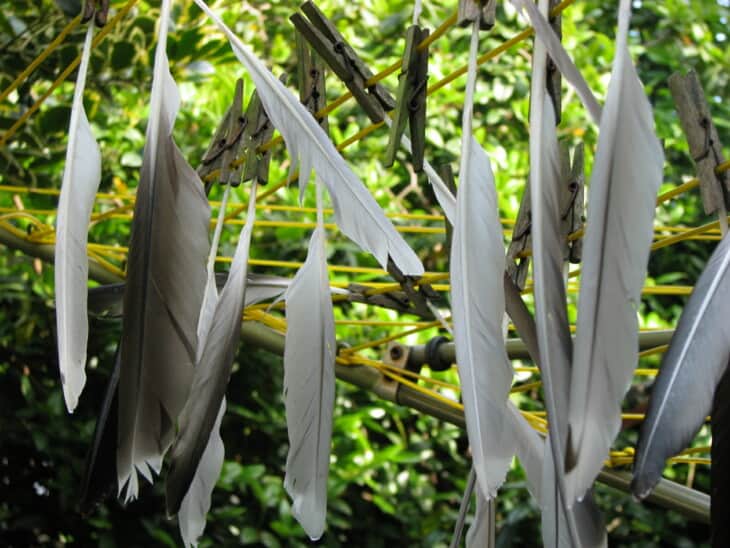
The plants that look most like feathers are ornamental grasses with soft, plume-like flower heads, such as feather reed grass, maiden grass, fountain grass, pink muhly and pampas grass. Some flowers look feathery too: plumed celosia, astilbe, goat’s beard and Russian sage. Other plants have feathery leaves, such as asparagus fern, partridge feather and the mimosa tree. A few of the most popular feathery plants are invasive in parts of the U.S., including pampas grass, Mexican feather grass, maiden grass, mimosa and tamarisk. Each entry below says where that is a problem, and the native pink muhly and the sterile feather reed grass are safe choices almost anywhere.
Contents
- Grasses With Feathery Plumes
- Flowers That Look Like Feathers
- Plants With Feathery Leaves
- Tips for Growing Feathery Plants
| Plant | Botanical name | Feathery part | Height | Zones |
|---|---|---|---|---|
| Feather Reed Grass ‘Karl Foerster’ | Calamagrostis × acutiflora ‘Karl Foerster’ | Flower plumes | 4–5 ft in bloom | 4–9 |
| Maiden Grass | Miscanthus sinensis | Flower plumes | 5–8 ft | 5–9 |
| Purple Fountain Grass | Cenchrus setaceus ‘Rubrum’ | Flower plumes | 3–5 ft | 9–11 (annual elsewhere) |
| Pink Muhly Grass | Muhlenbergia capillaris | Flower clouds | 2–3 ft | 6–10 |
| Mexican Feather Grass | Nassella tenuissima | Whole plant | 1–2 ft | 6–10 |
| Pampas Grass | Cortaderia selloana | Flower plumes | 8–10 ft | 7–11 |
| Plumed Celosia | Celosia argentea Plumosa Group | Flower plumes | 1–3 ft | Annual |
| Astilbe | Astilbe spp. | Flower plumes | 1–4 ft | 4–8 |
| Goat’s Beard | Aruncus dioicus | Flower plumes | 4–6 ft | 3–7 |
| Russian Sage | Salvia yangii | Flower spikes and leaves | 3–5 ft | 4–9 |
| Bottlebrush | Callistemon spp. | Flower spikes | 3–15 ft | 8–11 |
| Partridge Feather | Tanacetum densum subsp. amani | Leaves | 3–6 in | 4–9 |
| Asparagus Fern | Asparagus setaceus | Leaves | 1–3 ft; climbs to 10 ft | 9–11; houseplant elsewhere |
| Peacock Plant | Goeppertia makoyana | Leaf pattern | 1–2 ft | Houseplant |
| Mimosa Tree | Albizia julibrissin | Leaves and flowers | 20–35 ft | 6–9 |
| Tamarisk | Tamarix spp. | Leaves and flowers | 10–20 ft | 4–10 |
Grasses With Feathery Plumes
Feather Reed Grass ‘Karl Foerster’ (Calamagrostis × acutiflora ‘Karl Foerster’)

‘Karl Foerster’ is the most widely planted feather reed grass and one of the most reliable ornamental grasses. It forms a clump of green leaves 2 to 3 feet tall, and in early summer it sends up stiff, upright stems topped with narrow, feathery plumes. The plumes open pinkish purple and fade to wheat-gold. They stand straight up through winter, so the plant stays tidy. It is a sterile hybrid of two European reed grasses, so it doesn’t seed around. It takes wet or dry soil in full sun to light shade.
Maiden Grass (Miscanthus sinensis)

Maiden grass, or Chinese silver grass, forms large, arching clumps of narrow leaves 5 to 8 feet tall. In late summer it sends up feathery, fan-shaped plumes in silver, pink or copper, which turn fluffy and white in fall and last through winter. It comes from East Asia and is easy to grow in sun and almost any soil. But it self-seeds and is invasive in much of the eastern U.S., especially the Mid-Atlantic and the Appalachians. Check your state’s invasive list before planting it.
Purple Fountain Grass (Cenchrus setaceus ‘Rubrum’)
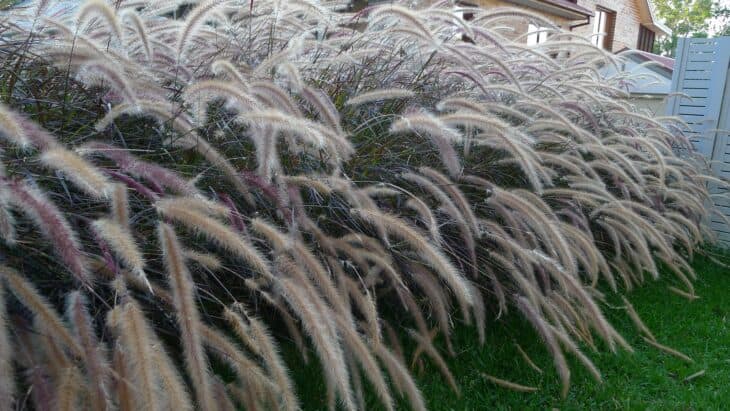
Purple fountain grass has arching burgundy leaves and soft, fuzzy, purple-red plumes that nod like foxtails from summer to frost. It grows 3 to 5 feet tall. It is hardy only in zones 9 to 11, so most gardeners grow it as an annual in pots and borders. ‘Rubrum’ rarely sets seed. The green-leaved species (also listed as Pennisetum setaceum) is invasive in Hawaii, Arizona and California.
Pink Muhly Grass (Muhlenbergia capillaris)
Pink muhly is a native grass of the eastern and southern U.S. In fall, its fine, wiry flower heads open into a cloud of pink-purple haze above the clump, 2 to 3 feet tall, and look especially feathery when backlit by the sun. It is very drought tolerant once established and does best in full sun and well-drained soil. It is the best feathery grass to plant if you want a native.
Mexican Feather Grass (Nassella tenuissima)
Read our guide to Mexican Feather Grass

Mexican feather grass forms soft, fine, hair-like clumps 1 to 2 feet tall that ripple in the slightest breeze. In summer the clumps are topped with silky, feathery flower heads that fade from green to blond. It is native to Texas, New Mexico, Mexico and Argentina, and it thrives in dry, sunny spots. It seeds heavily, though, and it is invasive in California, Australia and South Africa. It is also sold as Stipa tenuissima.
Pampas Grass (Cortaderia selloana)

Pampas grass is the biggest feathery grass: a huge clump of arching leaves with tall stems of silky white, cream or pink plumes 8 to 10 feet tall in late summer and fall. The leaf edges are razor sharp, so wear gloves and long sleeves when you cut it back. It comes from South America and seeds prolifically. It is invasive in California, Hawaii and many other mild-winter regions, where it crowds out native plants and becomes a fire hazard. The dwarf form ‘Pumila’ grows 4 to 6 feet tall.
Flowers That Look Like Feathers
Plumed Celosia (Celosia argentea Plumosa Group)
Read our guide to Plumed Celosia

Plumed celosia has upright, flame-shaped flower heads made of hundreds of tiny, soft flowers, in red, orange, yellow, pink and magenta. It is grown as a summer annual and blooms from midsummer until frost. It needs full sun, heat and regular water, and it is killed by the first frost. The flowers dry well and keep their color.
Astilbe (Astilbe spp.)

Astilbe is one of the few shade plants with showy flowers. In early to midsummer it sends up feathery plumes of tiny flowers in white, pink, red or lavender above clumps of fern-like leaves. It needs moist soil and partial shade, and its leaves scorch in dry soil or hot afternoon sun. Deer and rabbits usually leave it alone.
Goat’s Beard (Aruncus dioicus)

Goat’s beard looks like a giant astilbe, 4 to 6 feet tall, with big, branched plumes of tiny creamy-white flowers in early summer. It is native to moist woods in both eastern and western North America, as well as in Europe and Asia. It grows best in partial shade and moist, rich soil. Male and female flowers grow on separate plants, and the male plumes are fuller and showier.
Russian Sage (Salvia yangii)

Russian sage makes a haze of tiny lavender-blue flowers on tall, branching, silvery stems from midsummer into fall. The finely cut, gray leaves smell like sage when crushed. It comes from the dry steppes of Central Asia and loves heat, full sun and poor, well-drained soil. Deer avoid it. It was known as Perovskia atriplicifolia until botanists moved it into Salvia in 2017.
Bottlebrush (Callistemon spp.)

Bottlebrush is an Australian shrub or small tree whose flower spikes are made of long, bristly red stamens, like a brush or a fluffy red plume. It blooms mainly in spring and summer, and hummingbirds visit the flowers. It needs full sun and mild winters. Most kinds are hardy only in zone 8 or 9 and warmer. Dwarf varieties such as ‘Little John’ stay about 3 feet tall. Botanists now include most bottlebrushes in the genus Melaleuca.
Plants With Feathery Leaves
Partridge Feather (Tanacetum densum subsp. amani)
Partridge feather is a low, spreading groundcover from Turkey with small, silvery-white leaves that are cut like tiny feathers and very soft to the touch. It grows only 3 to 6 inches tall but spreads 1 to 2 feet wide. In summer it has small, yellow button flowers, but it is grown for its leaves. It needs full sun and sharp drainage and suits rock gardens and dry slopes. Wet soil in winter kills it.
Asparagus Fern (Asparagus setaceus)

Asparagus fern, or lace fern, is not a fern at all but a relative of garden asparagus. Its tiny, needle-like leaves grow in flat, feathery sprays. It is grown as a houseplant or in hanging baskets, and outdoors in frost-free areas, where it can climb 10 feet or more. It comes from southern Africa. It is invasive in Florida and Hawaii, where birds spread its berries. The berries are toxic to cats and dogs.
Peacock Plant (Goeppertia makoyana)

The peacock plant’s leaves don’t feel like feathers, but they are marked like a peacock’s tail feathers: pale green with dark green, feather-shaped patches along the veins and purple undersides. It is a houseplant from Brazil, formerly Calathea makoyana, in the same family as the prayer plant, and its leaves also fold up at night. It needs bright, indirect light, steady moisture and high humidity.
Mimosa Tree (Albizia julibrissin)

The mimosa, or silk tree, has fern-like, feathery leaves made of hundreds of tiny leaflets that fold together at night, and fluffy, pink, powder-puff flowers in summer. It is a fast-growing tree, 20 to 35 feet tall, from Asia. It spreads by seed and is invasive in much of the southeastern U.S. See types of mimosa trees for its purple and weeping varieties.
Tamarisk (Tamarix spp.)

Tamarisk, or saltcedar, is a shrub or small tree with feathery, scale-like leaves and airy plumes of tiny pink flowers in spring and summer. It is also one of the worst invasive plants in the western U.S. It has taken over thousands of miles of riverbanks, where it uses large amounts of water and makes the soil saltier. Don’t plant it. If you like the look, Russian sage or pink muhly give a similar soft, pink-and-purple haze.
Tips for Growing Feathery Plants
- Plant them where light hits. Plumes and fine leaves look best with the sun behind them, in the morning or evening. Put them on the east or west side of a bed.
- Contrast the textures. Feathery plants stand out next to bold, broad-leaved plants such as hostas, sedums, coneflowers or cannas.
- Leave grasses standing in winter. Most grass plumes last into winter. Cut the clumps back to a few inches in late winter, before new growth starts.
- Check the invasive list. Before you buy pampas grass, maiden grass, Mexican feather grass or fountain grass, check your state’s invasive plant list. Sterile or native choices such as ‘Karl Foerster’ and pink muhly give the same look without the risk.