The best alternatives to arborvitae for a privacy screen depend on why arborvitae doesn’t suit you. If deer eat yours, try ‘Green Giant’ thuja, Taylor or Spartan juniper, or Nellie R. Stevens holly, which deer mostly leave alone. For hot, dry summers in the South and West, choose junipers, Italian cypress or Leyland cypress. For shade, try Hicks yew, Nellie R. Stevens holly, skip laurel or Japanese cedar. For a very narrow space, choose Sky Pencil holly, Blue Arrow juniper or Taylor juniper.
Contents
- Narrow Conifers
- ‘Green Giant’ Thuja and Western Red Cedar (Thuja ‘Green Giant’ and Thuja plicata)
- Taylor Juniper (Juniperus virginiana ‘Taylor’)
- Spartan Juniper (Juniperus chinensis ‘Spartan’)
- Blue Arrow Juniper (Juniperus scopulorum ‘Blue Arrow’)
- Eastern Red Cedar (Juniperus virginiana)
- Leyland Cypress (Cupressus × leylandii)
- Japanese Cedar (Cryptomeria japonica)
- Hinoki Cypress (Chamaecyparis obtusa)
- Italian Cypress (Cupressus sempervirens)
- Broadleaf Evergreens
- Better Arborvitae Varieties
- Tips for a Privacy Screen
American arborvitae (Thuja occidentalis) is native from eastern Canada south through the Great Lakes, including northern Illinois, and along the Appalachians. It is hardy in zones 2 to 7, and the popular ‘Emerald Green’ grows 10 to 15 feet tall and only 3 to 4 feet wide. Its weak points are deer, which browse it heavily in winter, heavy snow, which splays the branches open, bagworms and spider mites, and the long, hot, humid summers of zones 8 and warmer. It also needs at least half a day of sun and well-drained soil.

| Tree | Botanical name | Height | Zones | Why choose it |
|---|---|---|---|---|
| ‘Green Giant’ Thuja and Western Red Cedar | Thuja ‘Green Giant’ and Thuja plicata | 40–60 ft | 5–8 | Fastest thuja; less browsed by deer |
| Taylor Juniper | Juniperus virginiana ‘Taylor’ | 20–30 ft | 3–9 | Very narrow; drought tolerant |
| Spartan Juniper | Juniperus chinensis ‘Spartan’ | 15–20 ft | 4–9 | Dense, dark green; takes heat |
| Blue Arrow Juniper | Juniperus scopulorum ‘Blue Arrow’ | 12–15 ft | 4–9 | Only 2 ft wide; silver-blue |
| Eastern Red Cedar | Juniperus virginiana | 30–50 ft | 3–9 | Native; tough and deer resistant |
| Leyland Cypress | Cupressus × leylandii | 60–70 ft | 6–10 | Fastest screen of all, but short-lived |
| Japanese Cedar | Cryptomeria japonica | 25–60 ft | 6–9 | Soft texture; takes some shade |
| Hinoki Cypress | Chamaecyparis obtusa | 10–20 ft (garden varieties) | 5–8 | Graceful; good for small spaces |
| Italian Cypress | Cupressus sempervirens | 40–60 ft | 7–10 | Very narrow; for hot, dry climates |
| Nellie R. Stevens Holly | Ilex ‘Nellie R. Stevens’ | 15–25 ft | 6–9 | Shade tolerant; red berries; deer mostly avoid it |
| Sky Pencil Holly | Ilex crenata ‘Sky Pencil’ | 4–10 ft | 6–9 | Only 1–2 ft wide; takes shade |
| Hicks Yew | Taxus × media ‘Hicksii’ | 10–20 ft | 4–7 | The best choice for shade |
| Skip Laurel | Prunus laurocerasus ‘Schipkaensis’ | 10–18 ft | 6–8 | Fast; shade tolerant; flowers |
| Little Gem Magnolia | Magnolia grandiflora ‘Little Gem’ | 20–25 ft | 7–9 | Glossy leaves and big white flowers |
| Clumping Bamboo | Fargesia robusta and other Fargesia | 10–15 ft | 6–9 | Fast screen; doesn’t run |
Narrow Conifers
‘Green Giant’ Thuja and Western Red Cedar (Thuja ‘Green Giant’ and Thuja plicata)

‘Green Giant’ is a hybrid of western red cedar and Japanese thuja, and it is the most popular replacement for American arborvitae. It grows 3 to 5 feet a year when young and reaches 40 to 60 feet tall and 12 to 20 feet wide, so it needs more room than ‘Emerald Green’. It keeps its rich green color in winter, handles heat and clay better than American arborvitae and is browsed much less by deer, though hungry deer will still eat it. Western red cedar, one of its parents, is a native tree of the Pacific Northwest, where it makes a large, soft-textured screen. Plant both 6 to 10 feet apart for a screen.
Taylor Juniper (Juniperus virginiana ‘Taylor’)

‘Taylor’ is a very narrow form of eastern red cedar, 20 to 30 feet tall and only 3 to 4 feet wide. It has dense, blue-green foliage, tolerates heat, drought, wind, poor soil and cold, and deer rarely browse it. It was selected in Nebraska and is a good choice for the Plains and Midwest. Like other junipers, it needs full sun and good drainage, and it can host cedar-apple rust, which damages nearby apple and crabapple trees.
Spartan Juniper (Juniperus chinensis ‘Spartan’)

‘Spartan’ is a fast-growing Chinese juniper with a dense, narrow pyramid shape, 15 to 20 feet tall and 3 to 5 feet wide. Its rich, dark green color is close to ‘Emerald Green’ arborvitae, but it takes heat, drought and salt much better, so it is popular in the South and in the dry West. It can be sheared into a formal hedge. It needs full sun and good drainage.
Blue Arrow Juniper (Juniperus scopulorum ‘Blue Arrow’)
‘Blue Arrow’ is a selection of the Rocky Mountain juniper with bright silver-blue foliage and an extremely narrow shape, 12 to 15 feet tall and just 2 feet wide. It fits beside a door, between windows or in a narrow side yard, and a row of them planted 2 to 3 feet apart makes a slim screen. It thrives in dry climates and full sun but suffers in wet soil and humid heat.
Eastern Red Cedar (Juniperus virginiana)

Eastern red cedar is the most widespread native conifer in the eastern U.S. and grows almost anywhere: dry, rocky, alkaline or clay soil, heat, cold and wind. Wild trees are pyramid-shaped, 30 to 50 feet tall and 8 to 20 feet wide, and female trees bear blue, berry-like cones that feed many birds. It makes a tough, informal windbreak or screen. Named varieties such as ‘Taylor’ and ‘Brodie’ give a narrower, more even shape.
Leyland Cypress (Cupressus × leylandii)

Leyland cypress is a hybrid that grows 3 to 4 feet a year, faster than any other evergreen screen. It has soft, feathery, gray-green foliage and grows 60 to 70 feet tall and 15 to 25 feet wide, so it quickly outgrows small yards unless it is trimmed every year. In the humid Southeast it is often short-lived, because it is prone to Seiridium canker, Botryosphaeria dieback and bagworms, and many plantings decline after 15 to 20 years. Space trees at least 8 to 10 feet apart, and don’t plant it where you can’t keep up with trimming.
Japanese Cedar (Cryptomeria japonica)

Japanese cedar has soft, awl-shaped needles on drooping branches and red-brown, peeling bark. The species grows 50 to 60 feet tall, but screening varieties such as ‘Radicans’ and ‘Yoshino’ are usually 25 to 40 feet tall and 10 to 20 feet wide. It tolerates part shade and clay soil better than most conifers and is rarely eaten by deer. It needs steady moisture and shelter from drying winter winds, which can bronze the foliage.
Hinoki Cypress (Chamaecyparis obtusa)
Read our guide to Hinoki Cypress

Hinoki cypress is a Japanese tree whose rich green foliage grows in flat, fan-like sprays. The wild tree grows over 50 feet, but garden varieties such as ‘Gracilis’ reach only 10 to 20 feet tall and 4 to 6 feet wide, slowly, and dwarf varieties stay far smaller. It makes a softer, more graceful screen than arborvitae in a small garden. It needs moist, well-drained soil and protection from hot afternoon sun in the South.
Italian Cypress (Cupressus sempervirens)

Italian cypress is the classic narrow column of Mediterranean gardens, 40 to 60 feet tall and only 3 to 6 feet wide. It grows fast and thrives in the hot, dry summers of California, Arizona and Texas, where arborvitae struggles. It dislikes humid heat, heavy clay and snow, and it is prone to canker in the wrong climate. See the pros and cons of Italian cypress and our list of trees similar to Italian cypress.
Broadleaf Evergreens
Broadleaf evergreens make a screen that looks less formal than a row of conifers, and several tolerate much more shade than arborvitae.
Nellie R. Stevens Holly (Ilex ‘Nellie R. Stevens’)

Nellie R. Stevens is a hybrid holly, a vigorous, pyramid-shaped shrub or small tree 15 to 25 feet tall and 8 to 12 feet wide. It has glossy, dark green, spiny leaves and bright red berries in winter, which it usually sets even without a male holly nearby. It grows fast for a holly, about 2 to 3 feet a year when young, takes heavy pruning and tolerates part shade, heat and clay. Deer usually leave it alone because of the spines.
Sky Pencil Holly (Ilex crenata ‘Sky Pencil’)

‘Sky Pencil’ is a Japanese holly with small, dark green leaves on stiff, upright stems. It grows only 1 to 2 feet wide and 4 to 10 feet tall, so it fits spaces far too narrow for any tree, such as between a path and a wall or in a large container on a patio. It tolerates part shade. Snow can bend the stems apart, so tie them loosely in winter in snowy areas.
Hicks Yew (Taxus × media ‘Hicksii’)
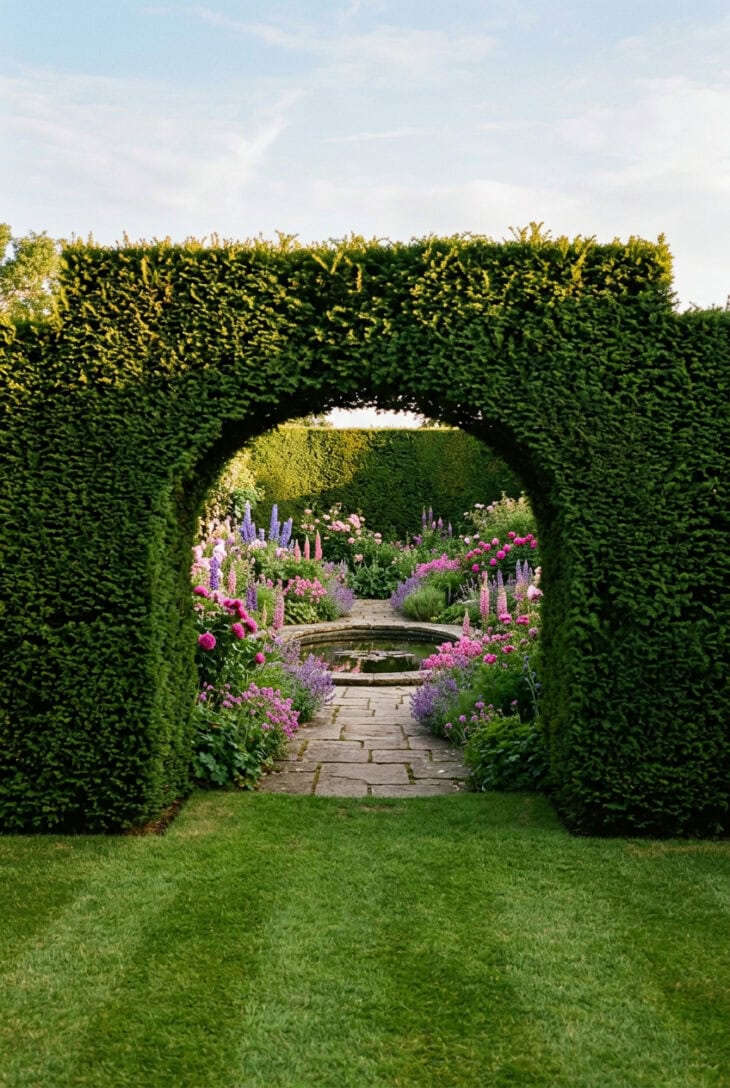
Hicks yew is an upright yew with dark green needles and red berry-like fruit on female plants. It is one of the few evergreens that grows well in full shade, and it takes shearing better than almost any other, so it makes a dense, formal hedge that can be kept at any height. Left unclipped, it grows 10 to 20 feet tall. Its drawbacks: deer love it, it needs good drainage, and all parts except the red flesh are very poisonous to people, pets and livestock.
Skip Laurel (Prunus laurocerasus ‘Schipkaensis’)

Skip laurel is a hardy form of cherry laurel with glossy, leathery, bright green leaves. It grows 2 feet or more a year to 10 to 18 feet tall and 5 to 10 feet wide, takes shade and pruning, and has spikes of fragrant white flowers in spring, followed by black berries that birds love. Its leaves and seeds are poisonous. Cherry laurel is invasive in the Pacific Northwest and parts of the Southeast, so plant it only where it isn’t a problem, and don’t plant it at all in Washington and Oregon.
Little Gem Magnolia (Magnolia grandiflora ‘Little Gem’)
Read our guide to Little Gem Magnolia

‘Little Gem’ is a compact form of southern magnolia, 20 to 25 feet tall and 10 to 15 feet wide, with glossy, dark green leaves that are rusty brown underneath. It flowers from late spring through summer, with fragrant, creamy white flowers 4 to 6 inches across, smaller than the species’ but much more numerous. Planted 8 to 10 feet apart, it makes a handsome, flowering screen in the South. It drops leaves all year, so keep it away from pools.
Clumping Bamboo (Fargesia robusta and other Fargesia)

Fargesia bamboos form tight clumps instead of sending out runners, so they don’t take over the yard like running bamboos. Fargesia robusta grows 10 to 15 feet tall and makes a dense, upright screen of evergreen leaves within a few years. It is best in cool or mild climates. In hot, humid summers and full sun its leaves curl and burn, so give it afternoon shade in the South. Never plant running bamboo (Phyllostachys) as a screen without a deep root barrier.
Better Arborvitae Varieties

If you like arborvitae and your climate suits it, choosing the right variety solves many problems:
- ‘Emerald Green’ (‘Smaragd’): 10 to 15 feet tall and 3 to 4 feet wide. The most popular, but slow and a favorite of deer.
- ‘Techny’ (sold as Mission): 15 to 20 feet tall and 6 to 10 feet wide, very hardy and dark green in winter. Because it is wider, you need fewer plants for a screen.
- ‘North Pole’: 10 to 15 feet tall and only 3 to 5 feet wide, with good winter color and cold hardiness.
- ‘Green Giant’: much faster and larger, and less browsed by deer (see above).
Tips for a Privacy Screen
- Space for the mature width: plant trees about two-thirds of their mature width apart for a solid wall within a few years. Planting closer makes a quick screen that becomes crowded and thin at the base.
- Mix it up: a screen of two or three different species is less likely to be wiped out by one pest or disease than a single row of one plant.
- Stagger the row: two staggered rows fill in faster and look more natural than one straight line.
- Water the first two summers: even drought-tolerant evergreens need deep watering once a week until they are established.
- For instant privacy: a trellis with a fast-growing vine, such as clematis, climbing hydrangea or, in warm climates, star jasmine, gives cover in a season or two while trees grow.