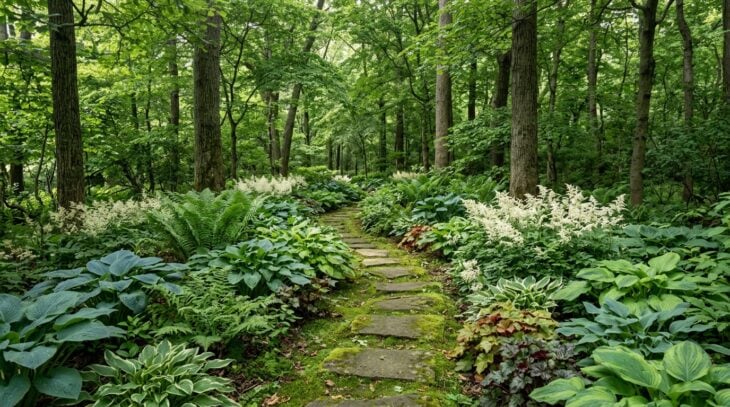
Shade is not a problem to be solved. The cool, dim spot under a tree or against a north-facing wall is where some of the most beautiful gardens happen, full of texture, layered greens, and the kind of quiet calm that a sun-baked border never quite manages. Once you stop fighting the conditions and start planting for them, a shady garden becomes the easiest place to grow.
Contents
- 01. Layered Woodland Border with Ferns and Hostas
- 02. Dry Shade Bed Beneath a Mature Tree
- 03. A White Moon Garden for a Shady Corner
- 04. Japanese-Inspired Shade Garden with Acers
- 05. A Fern Grotto for Deep Shade
- 06. A Hosta Collection Bed
- 07. Shade Container Display for a Sunless Patio
- 08. A Spring Bulb Carpet Under Deciduous Trees
- 09. A Hellebore Border for Winter Interest
- 10. A Moss Garden or Moss Lawn
- 11. A Shaded Gravel Path with Edge Planting
- 12. A Hydrangea Border for Light Shade
- 13. A Shade Pollinator Garden
- 14. A Dappled Shade Seating Nook
- 15. A North-Facing Wall Clothed in Climbers
- 16. A Damp Shade Bog-Edge Bed
- 17. A Heuchera Foliage Tapestry
- 18. A Bright Courtyard with Reflective Surfaces
- 19. A Stumpery for Character and Wildlife
- 20. A Weed-Smothering Ground-Cover Carpet
- 21. A Foxglove Woodland Edge
- 22. An Evergreen Shade Structure Planting
- 23. A Variegated Foliage Brightening Scheme
- 24. A Shaded Water Feature
- 25. Epimedium Edging for Dry Shade
- 26. A Shade Garden for Cutting and Foliage
- 27. A Lush Tropical-Look Shade Garden
- 28. A Woodland Path with Stepping Stones
- 29. A North-Facing Window Box or Balcony
- 30. A Four-Season Shade Garden Plan
These 30 ideas cover every kind of shade, from the dry rooty ground beneath a mature beech to the damp gloom beside a wall, and from light dappled shade to deep, all-day darkness. There are woodland borders, fern groves, hosta collections, container schemes for a sunless balcony, and four-season planting plans. Whether you have a tiny courtyard or a long shaded boundary, there is something here that fits.
Work out what kind of shade you actually have first, then scroll through and pick the two or three ideas that match it. Dry shade and damp shade want very different plants, so knowing your conditions is half the battle. The rest is just choosing what you like.
01. Layered Woodland Border with Ferns and Hostas
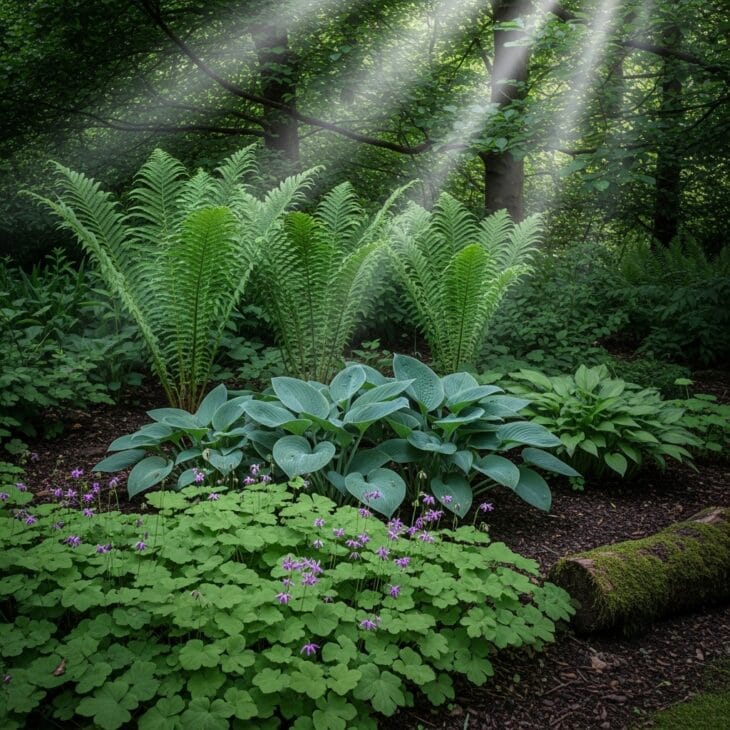
What you see This is the classic shade border, and for good reason. Tall ostrich ferns (Matteuccia struthiopteris) arch at the back, big-leaved hostas like ‘Halcyon’ form a blue-green middle layer, and a low skirt of epimedium and wood sorrel knits the ground together. Everything is green, but in a dozen shades and shapes, so the eye never gets bored.
Why it works It works because shade planting is all about foliage, not flowers. When you have no bright blooms to lean on, contrast in leaf size, texture, and tone does the heavy lifting. The fine lace of a fern against the broad paddle of a hosta is a more lasting pleasure than any flower, and it looks good from spring right through to the first frosts.
How to get it Build the soil before you plant. Fork in a thick layer of leaf mould or garden compost, because woodland plants want moisture-retentive, humus-rich ground. Space hostas about 18 to 24in (45 to 60cm) apart and ferns a similar distance, planting in autumn or early spring. Mulch every spring with more leaf mould to mimic the natural leaf fall they evolved with. Avoid planting too close to greedy tree roots, or water and feed generously if you must.
02. Dry Shade Bed Beneath a Mature Tree
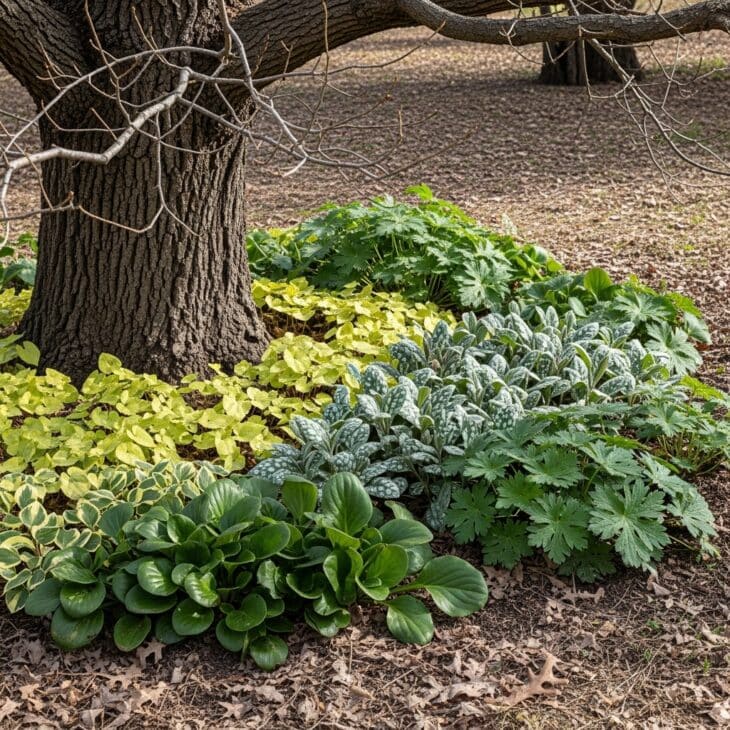
What you see The hardest spot in any garden is the dry, dark ground under a big tree, where roots take all the water and the canopy blocks the rain. Yet a small group of tough plants positively thrives there: leathery bergenia, spreading hardy geranium (Geranium macrorrhizum), silver-spotted lungwort (Pulmonaria), and the indestructible epimedium. Together they make a furnished, settled-looking carpet where most people see only bare earth.
Why it works These plants succeed because they are evolved survivors with either deep tap roots, waxy drought-proof leaves, or a creeping habit that lets them colonize slowly. They ask for almost nothing once established, which is exactly what you want in a position you can barely reach a watering can into.
How to get it Plant small and plant in autumn, when the soil is at its most moist, so roots can establish before the dry season. Dig individual planting pockets between the tree roots rather than disturbing the whole area, and never cut major roots. Water deeply once a week for the first year, then leave them be. A 2in (5cm) mulch of bark or leaf mould, kept clear of stems, holds in what little moisture there is.
03. A White Moon Garden for a Shady Corner
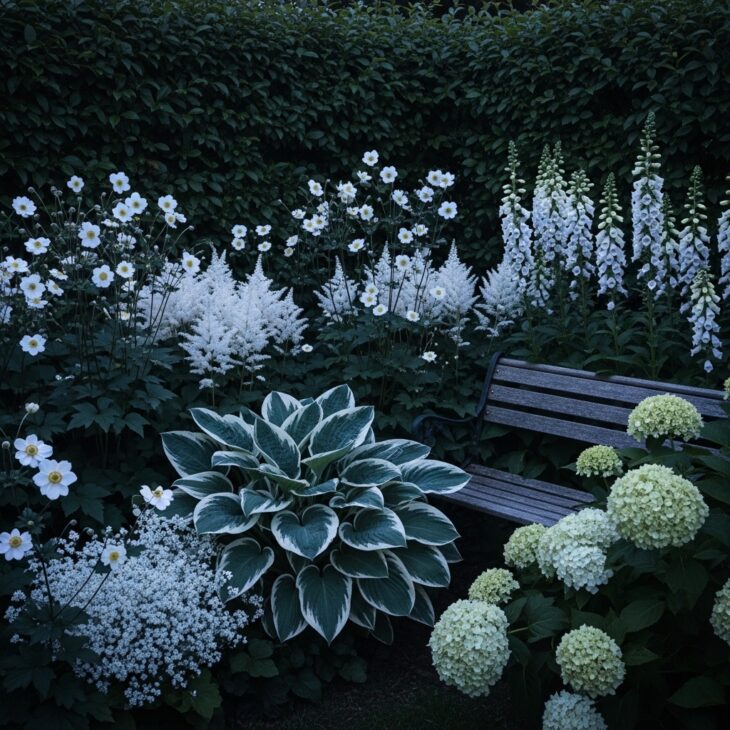
What you see White flowers were made for shade. In a dim corner, pale petals catch and hold what little light there is, almost glowing at dusk while every other color fades to grey. This scheme combines white Japanese anemones, the feathery white plumes of astilbe, silver-edged hostas, and a pale lacecap hydrangea for a corner that comes alive in the evening.
Why it works A single-color palette imposes calm and makes a small space feel larger and more considered. White also reads as light, so it visibly brightens a gloomy spot in a way no amount of clever foliage quite manages. Place it where you sit on summer evenings and it earns its keep after dark, when the garden is otherwise invisible.
How to get it Choose reliably shade-tolerant whites: Anemone x hybrida ‘Honorine Jobert’, Astilbe ‘Deutschland’, and Hydrangea macrophylla ‘Lanarth White’. The damp-loving astilbe in particular needs soil that never dries out, so improve the ground with compost and mulch well. Underplant with white-flowered hardy cyclamen for autumn and white wood anemones for spring, so the corner is never fully dark. Avoid mixing in even one stray pink, which will break the spell.
04. Japanese-Inspired Shade Garden with Acers
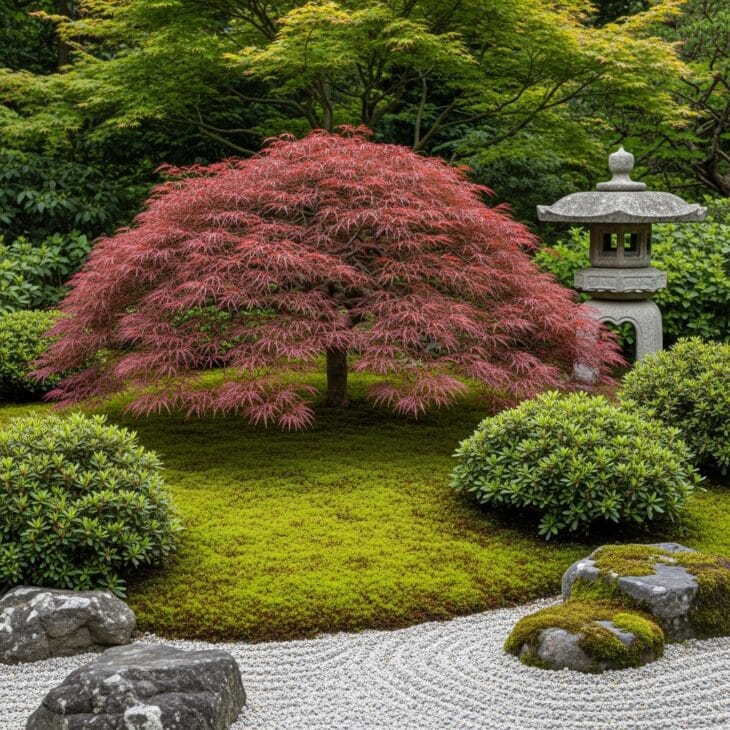
What you see Few plants love light shade as much as the Japanese maple, and few make a more elegant focal point. Picture a finely cut red-leaved acer rising over a ground of emerald moss, a weathered stone lantern, and a couple of moss-furred rocks. The whole scene is restrained, green, and deeply calming, the opposite of a busy flower border.
Why it works Dappled shade is actually the maple’s preferred home. The delicate leaves of the cut-leaf forms scorch and brown in full afternoon sun, so a position sheltered from harsh light and drying wind keeps the foliage perfect all season. The Japanese aesthetic of restraint also suits shade, where simplicity and texture read far better than a riot of color.
How to get it Choose a reliable variety such as the Japanese maple ‘Bloodgood’ for deep red, or the lacy green ‘Dissectum’ for a mounded shape. Plant in spring or autumn in moist, well-drained, slightly acidic soil, sheltered from wind. Keep pruning to a minimum, removing only crossing or dead branches in late summer or winter. Mulch with leaf mould and never let a young tree dry out in its first two years.
05. A Fern Grotto for Deep Shade
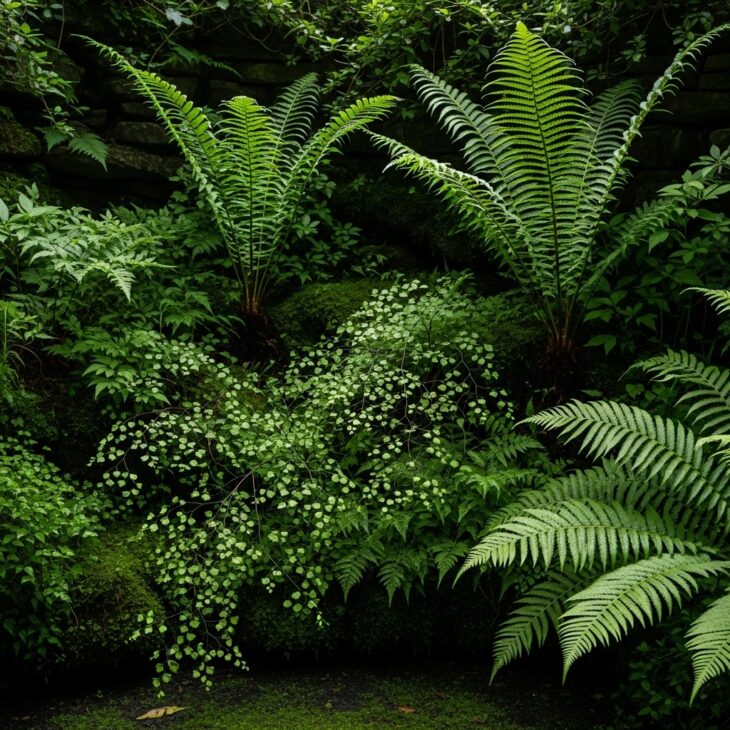
What you see For the deepest, dampest shade where almost nothing flowers, plant a fernery. Layered against a cool stone wall, shuttlecock ferns rise like green fountains, glossy hart’s tongue (Asplenium scolopendrium) provides strappy contrast, and delicate maidenhair threads between mossy rocks. It feels like a secret green hollow, the kind of place you discover rather than design.
Why it works Ferns are the ultimate shade plant because they evolved on the forest floor, in exactly the low light and high humidity most plants hate. Massing several different kinds together turns their one shared quality, leafiness, into a study in texture: feathery, leathery, lacy, and strap-like fronds all playing off one another. There is more variety in a fern collection than people expect.
How to get it Mix evergreen ferns like soft shield fern (Polystichum setiferum) and hart’s tongue with deciduous ones such as the lady fern (Athyrium filix-femina) for year-round structure. They demand moisture above all, so dig in plenty of leaf mould and choose a spot that stays damp. Plant in spring, set the crowns at soil level, and mulch around but not over them. If your shade is dry, this is one of the few ideas that will not work without irrigation.
06. A Hosta Collection Bed
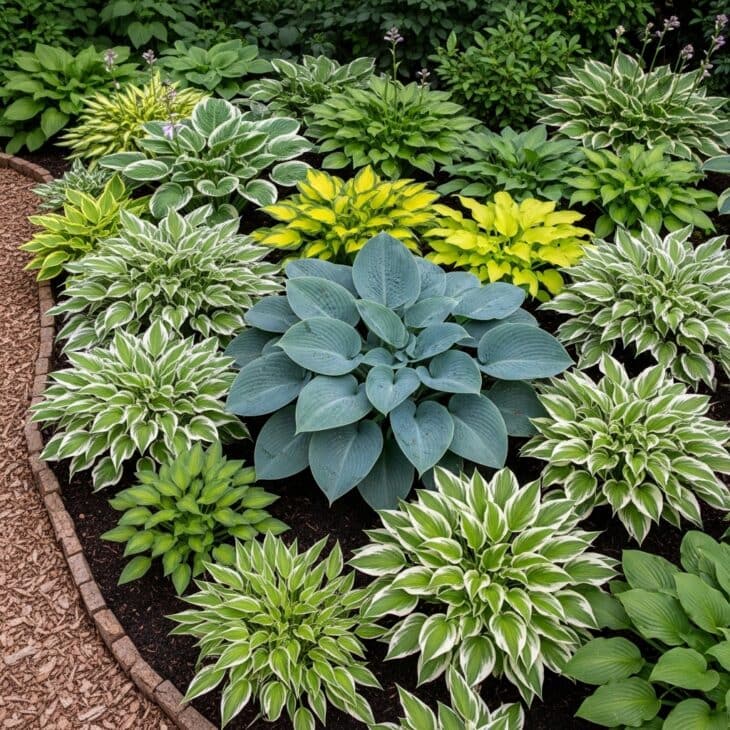
What you see If one plant could be the face of shade gardening, it would be the hosta. A bed devoted to them shows just how varied they are: vast blue-grey ‘Sum and Substance’, crisp white-margined ‘Patriot’, glowing gold ‘Sun Power’, and dainty lance-leaved miniatures, all mounding into a quilt of overlapping leaves. The range of size, color, and texture from a single genus is remarkable.
Why it works Grouping hostas together lets their differences sing while keeping their care identical, which makes the bed genuinely low-effort. Their bold, weed-smothering leaves cover ground quickly and read as lush and generous even in a sunless spot. The summer flower spikes are a bonus, but it is the foliage you plant them for.
How to get it Plant in moist, rich soil in spring, spacing them according to eventual size, from 12in (30cm) for minis to 3ft (90cm) for the giants. Slugs and snails are the one real enemy, so use wildlife-safe wool pellets or crushed grit around the crowns and clear hiding places nearby. Lift and divide congested clumps every few years in early spring. For gentle gradations beyond hostas, several hosta look-alikes like bergenia and brunnera extend the same bold-leaf effect.
07. Shade Container Display for a Sunless Patio
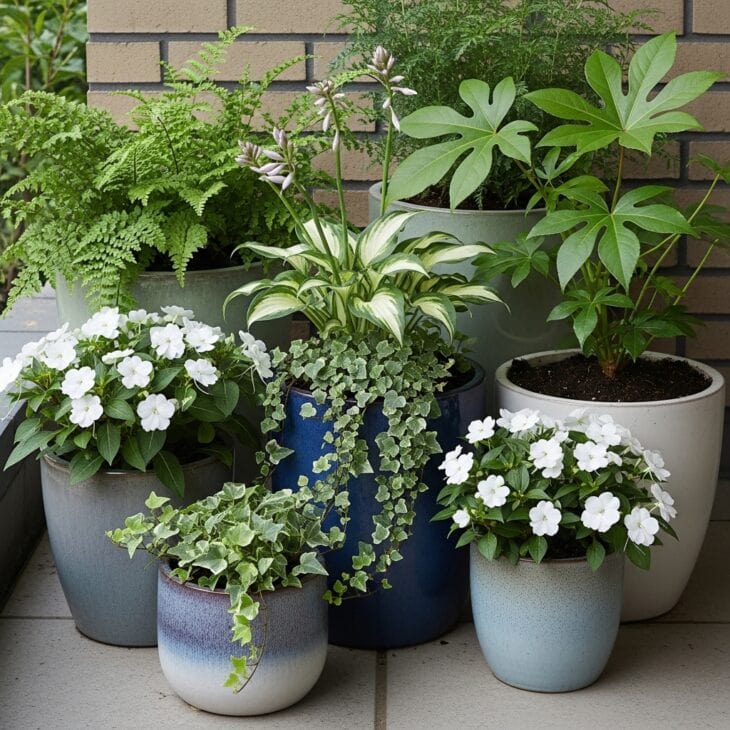
What you see A sunless patio or balcony does not rule out pots; it just changes the cast. Group glazed containers planted with ferns, a variegated hosta, trailing ivy, glossy-leaved fatsia, and a froth of white busy lizzies (Impatiens) for a corner that feels furnished and full. Varying the pot heights and using a cool green-and-white scheme keeps it from looking flat.
Why it works Containers give you total control over the soil and moisture that shade plants crave, which is a real advantage where the ground is dry, paved, or root-filled. They also let you move plants to follow the best light or swap in seasonal color, turning a dead corner into the most flexible part of the garden. This idea suits renters and small spaces especially well.
How to get it Use a loam-based compost with added leaf mould, and choose generously sized pots that hold moisture longer than small ones. Shade pots still dry out, particularly under a balcony overhang that blocks rain, so check them twice a week in summer. Feed monthly through the growing season and refresh the top inch of compost each spring.
08. A Spring Bulb Carpet Under Deciduous Trees
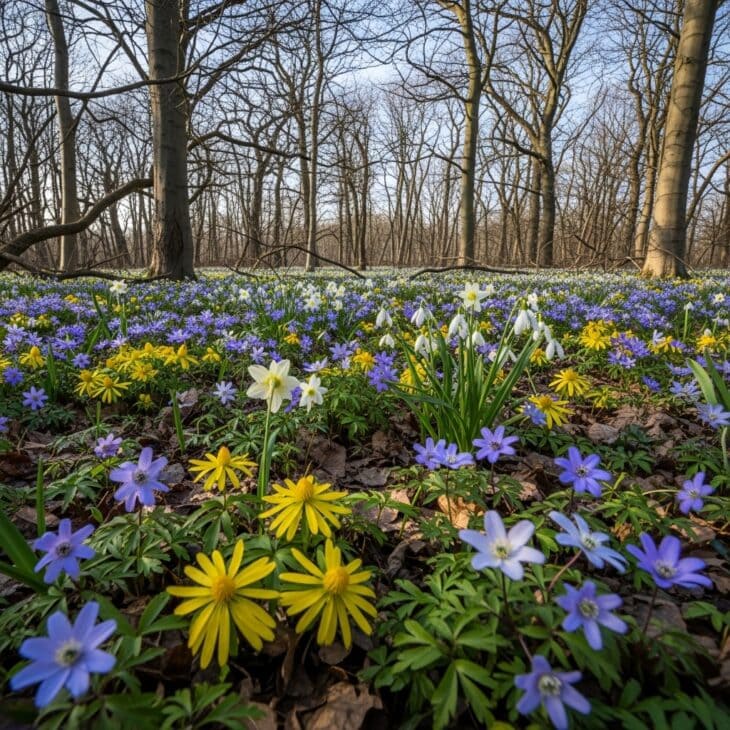
What you see The ground under deciduous trees has a secret window of light in early spring, before the canopy leafs out, and woodland bulbs have evolved to seize it. Carpet that ground with snowdrops, golden winter aconites, blue wood anemones, and pale narcissus and you get a sheet of flower exactly when the garden most needs cheering. By the time the trees cast deep shade, the bulbs have done their work and faded back.
Why it works This is shade gardening that works with the seasons rather than against them. These bulbs are dormant through the dark months and use the bright, leafless spring weeks to feed and flower, so the canopy overhead never bothers them. Once established, many self-seed and spread into ever-wider drifts for free.
How to get it Plant snowdrops and wood anemones “in the green” just after flowering for the best establishment, and plant winter aconites and narcissus as bulbs in autumn. Scatter them in natural-looking drifts rather than rows, and leave the foliage to die down completely so the bulbs build strength for next year. Resist mowing or tidying the area until early summer. Add hardy cyclamen for an autumn echo of the same effect.
09. A Hellebore Border for Winter Interest
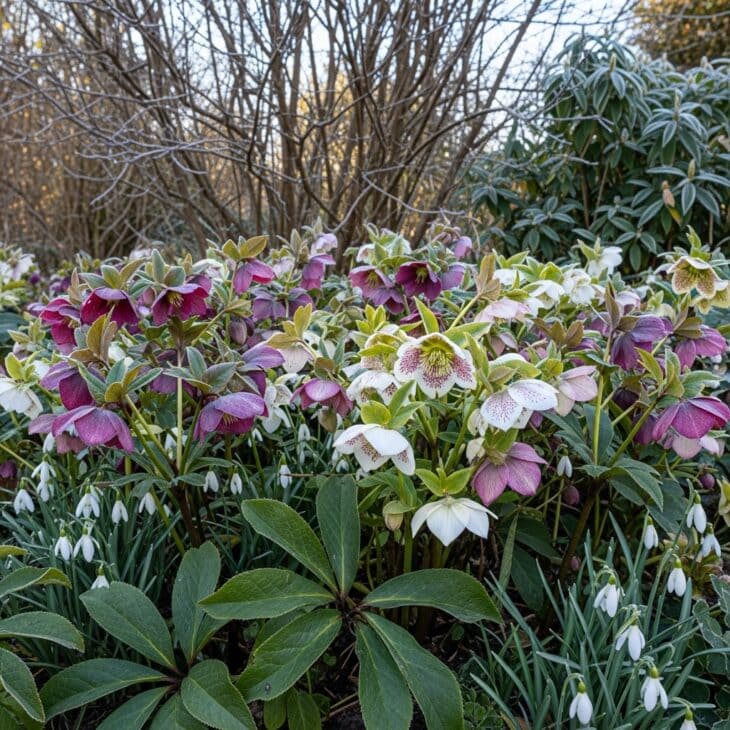
What you see When the rest of the garden is asleep, a hellebore border is in full flower. The nodding blooms come in plum, soft pink, pure white, and freckled cream above leathery evergreen leaves, often opening in the dead of winter and lasting for weeks. Tuck a few snowdrops between them and you have a shaded bed that peaks precisely when nothing else does.
Why it works Hellebores are perfect for shade under deciduous trees and shrubs because they relish the bright winter light and tolerate the summer shade once they have finished flowering. Their long season, evergreen foliage, and quiet self-seeding make them one of the most rewarding plants you can grow in a difficult spot. A mature clump is a thing of real beauty.
How to get it Plant Lenten roses (Helleborus x hybridus) in autumn in rich, moist soil that drains freely, spacing them about 18in (45cm) apart. Cut away the old, tattered leaves in midwinter so the emerging flowers show clearly and to reduce hellebore leaf-spot disease. Mulch with compost each autumn and leave the plants undisturbed, as they dislike being moved. Self-sown seedlings will appear around the parents and can be lifted and replanted.
10. A Moss Garden or Moss Lawn
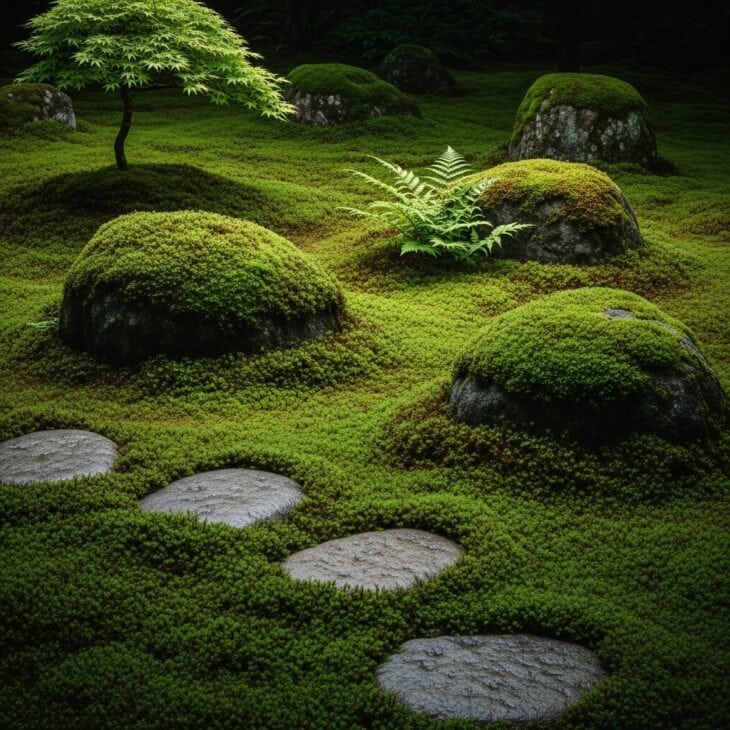
What you see Where grass struggles and sulks in shade, moss flourishes. A moss garden turns that frustration into an asset: a soft, undulating carpet of intense green covering the ground and flowing over boulders, with a few ferns and stepping stones for movement. It is the greenest, most peaceful surface a garden can have, and it needs no mowing, ever.
Why it works Moss thrives in exactly the damp, shaded, compacted, acidic conditions that defeat a lawn, so you are working with the site instead of forcing it. The result feels ancient and serene, which is why moss is so central to Japanese garden design. It also stays green right through winter, when a lawn would be brown and muddy.
How to get it Start by clearing weeds and grass and gently compacting the soil, which should be damp and on the acidic side. Encourage existing moss by keeping the area moist and shaded, or transplant patches of moss pressed firmly onto bare soil and misted daily until established. Keep fallen leaves swept off so the moss is not smothered, and never use lawn fertilizer nearby. Patience is the main requirement; a moss garden settles over a year or two.
11. A Shaded Gravel Path with Edge Planting
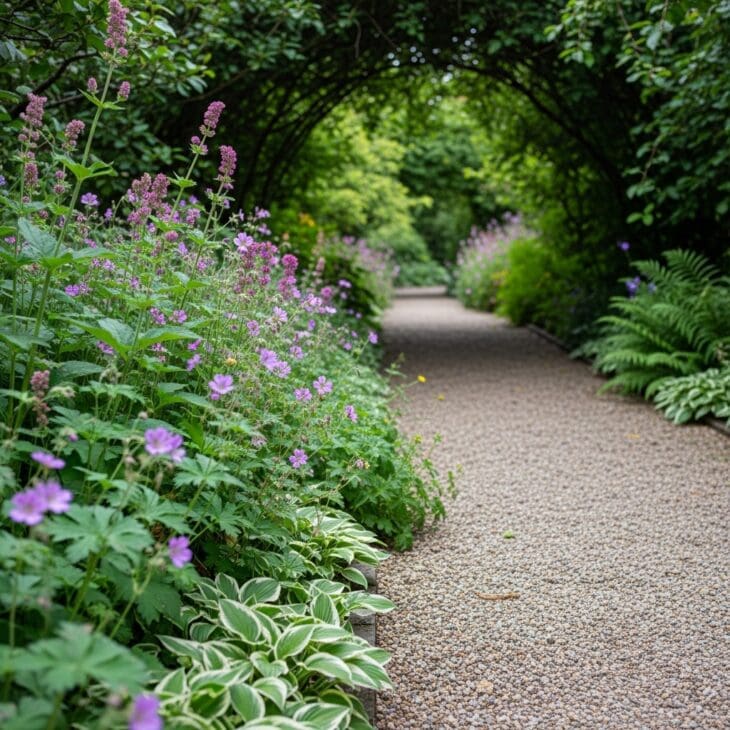
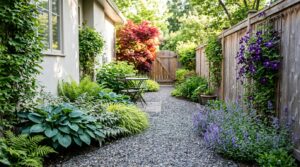
What you see A pale gravel path does two jobs in a shady garden: it reflects light into a dim area and it draws you through the space. Edge it with soft, spilling planting, lady’s mantle (Alchemilla mollis), low hostas, ferns, and hardy geraniums, so the plants tumble onto the gravel and blur the line between path and border. The effect is a relaxed green tunnel that invites a stroll.
Why it works Gravel is the ideal shade surface because it is cheap, permeable, and bright, bouncing light around in a way that dark paving never could. The loose, self-seeding edge planting suits a woodland feel and softens the hard line of a path so the whole thing looks established rather than laid. It is also far easier to maintain than a shaded lawn.
How to get it Lay a permeable membrane and 2in (5cm) of angular gravel, which knits together better underfoot than rounded pea shingle. Plant the edges in pockets cut through the membrane, choosing self-seeders like Alchemilla and aquilegia that will colonize the gravel margins naturally. Keep the gravel topped up and rake it occasionally to keep it fresh. Hoe out any unwanted seedlings in spring before they take hold.
12. A Hydrangea Border for Light Shade
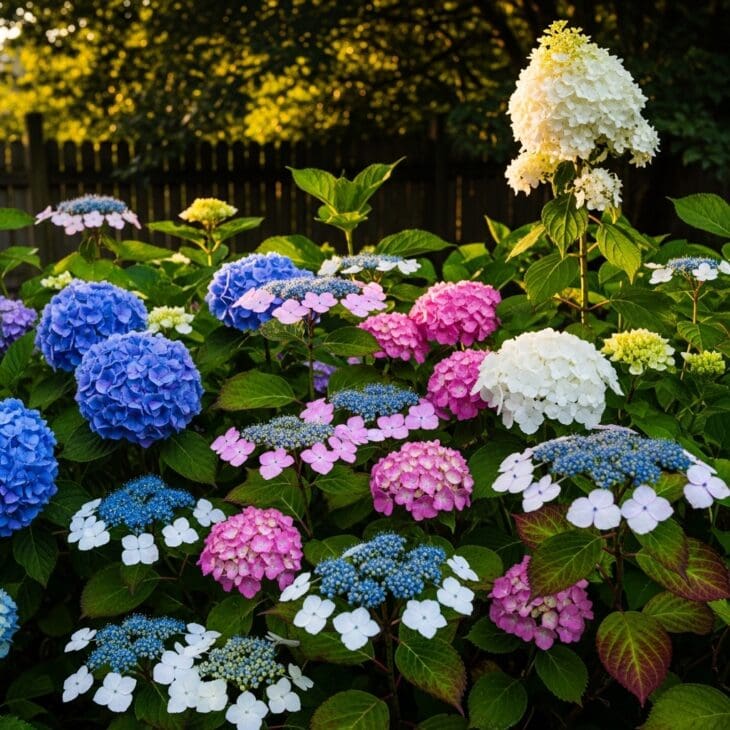
What you see For real flower power in shade, nothing beats hydrangeas. A border combining blue and pink mopheads, delicate lacecaps, and a tall white panicle hydrangea gives months of generous bloom from midsummer into autumn, the flower heads gradually fading to antique tones that last into winter. It is the most abundant, romantic look you can achieve in a position that gets little direct sun.
Why it works Most hydrangeas actually prefer light or dappled shade, especially in hotter regions, where full sun scorches the flowers and wilts the leaves. Their large, long-lasting blooms bring the kind of color and scale to a shady spot that you usually only get in sun. Even after flowering, the dried heads add structure through the cold months.
How to get it Plant in moist, fertile soil in spring or autumn, spacing shrubs 3 to 5ft (90 to 150cm) apart depending on variety. With mophead and lacecap types (Hydrangea macrophylla), acidic soil turns flowers blue and alkaline soil turns them pink, so test your soil if color matters. Prune macrophyllas lightly in spring, removing only spent heads and dead wood, while panicle types (H. paniculata) can be cut back harder for bigger blooms. Never let them dry out, as the name “hydra” suggests.
13. A Shade Pollinator Garden
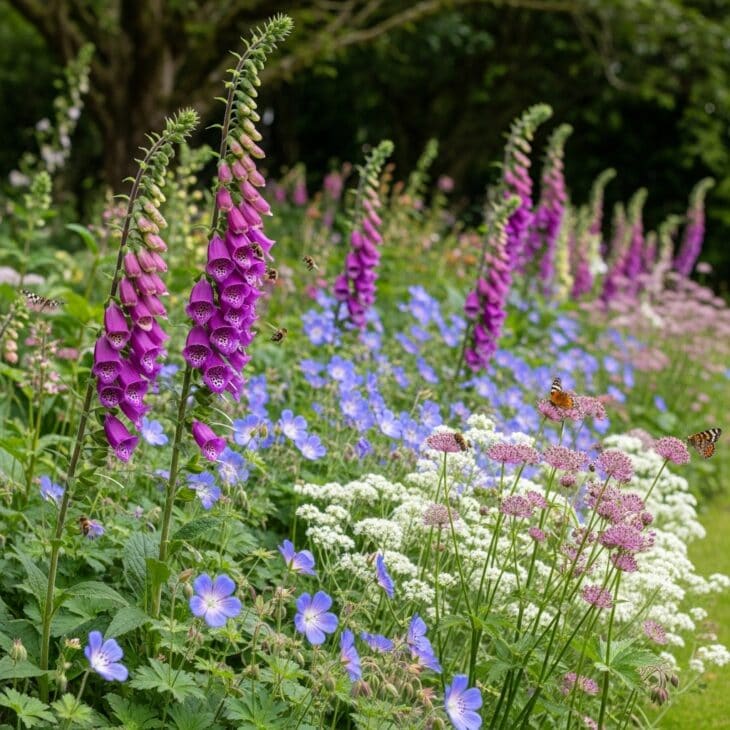
What you see Pollinators do not only forage in sunny meadows; plenty of shade plants are valuable nectar sources, and a well-chosen shady border can hum with bees. Foxgloves send up spires that bumblebees climb right inside, sweet woodruff and astrantia offer landing-pad flowers, and the long-blooming Geranium ‘Rozanne’ keeps the buffet open for months. It proves a shaded plot can pull its weight for wildlife.
Why it works This idea matters because gardens are increasingly important habitat, and the shady ones are too often written off as dead zones. Woodland-edge flowers evolved alongside pollinators in exactly these light levels, so they are perfectly adapted to feed them. A succession of blooms from spring to autumn gives insects a reliable food source where they might otherwise find none.
How to get it Plant a sequence for continuous nectar: pulmonaria and wood anemone in spring, foxgloves and astrantia in early summer, then hardy geraniums and Japanese anemones into autumn. Choose single-flowered varieties, as double forms often lack accessible nectar. Let some foxgloves self-seed for next year and avoid pesticides entirely. A shallow water dish and a log pile nearby complete the habitat.
14. A Dappled Shade Seating Nook
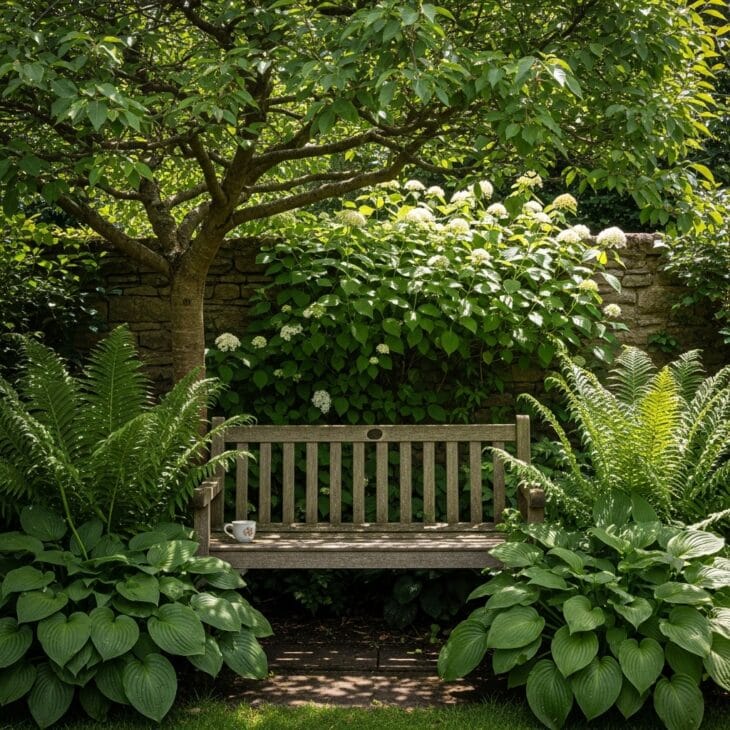
What you see On a hot summer afternoon, the coolest, most comfortable seat in the garden is in the shade. Set a simple wooden bench beneath a small tree, surround it with ferns and hostas, and let a climbing hydrangea clothe the wall behind, and you create a genuine retreat. The dappled light moving over the ground is part of the pleasure.
Why it works Designing a destination into a shady corner gives it purpose and draws you to a part of the garden you might otherwise ignore. Shade is an asset for a seating area, offering relief from glare and heat, so the very quality that makes the spot hard to plant makes it the best place to relax. Enclosing the seat with foliage adds a sense of sanctuary.
How to get it Position the bench to look back at the garden or at a small focal point, and give it a firm, level base of gravel or paving. Surround it with low-maintenance, good-looking foliage plants so the setting needs little fuss, and add a scented shade plant like sweet box (Sarcococca) nearby for winter fragrance. A solar lantern extends its use into the evening. Keep the planting back from the seat itself so it stays usable.
15. A North-Facing Wall Clothed in Climbers
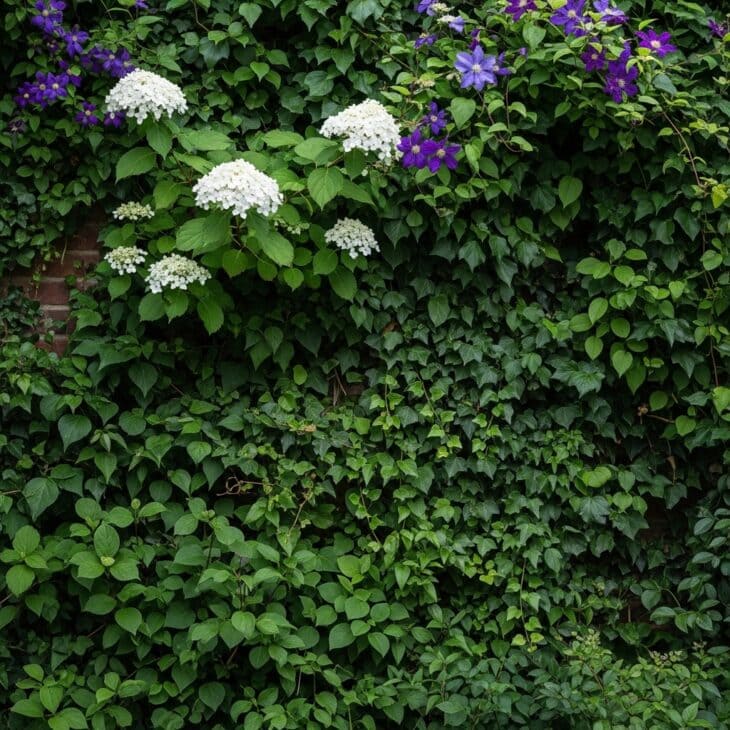
What you see A cold, shaded north-facing wall is one of the most underused surfaces in any garden, and the answer is to grow up it. A self-clinging climbing hydrangea smothers brick in lacecap white flowers, evergreen ivy holds the wall green all winter, and a shade-tolerant clematis threads through with spring blooms. A bare wall becomes a vertical garden in its own right.
Why it works Growing vertically is the smartest way to add planting where there is no ground to spare, and several excellent climbers genuinely prefer a cool, shaded aspect. They soften hard architecture, provide nesting cover for birds, and turn a problem wall into a feature. The climbing hydrangea in particular is one of the few showy flowering climbers that flowers well in full shade.
How to get it For self-clingers like climbing hydrangea (Hydrangea anomala subsp. petiolaris) and ivy, no support is needed, though they are slow to start, so be patient for the first two or three years. Twining climbers such as the clematis ‘Nelly Moser’, which keeps its color better out of strong sun, need wires or trellis. Plant 18in (45cm) out from the wall base where soil is moister, angle the roots toward the wall, and water well until established, as the ground at the foot of a wall is notoriously dry.
16. A Damp Shade Bog-Edge Bed
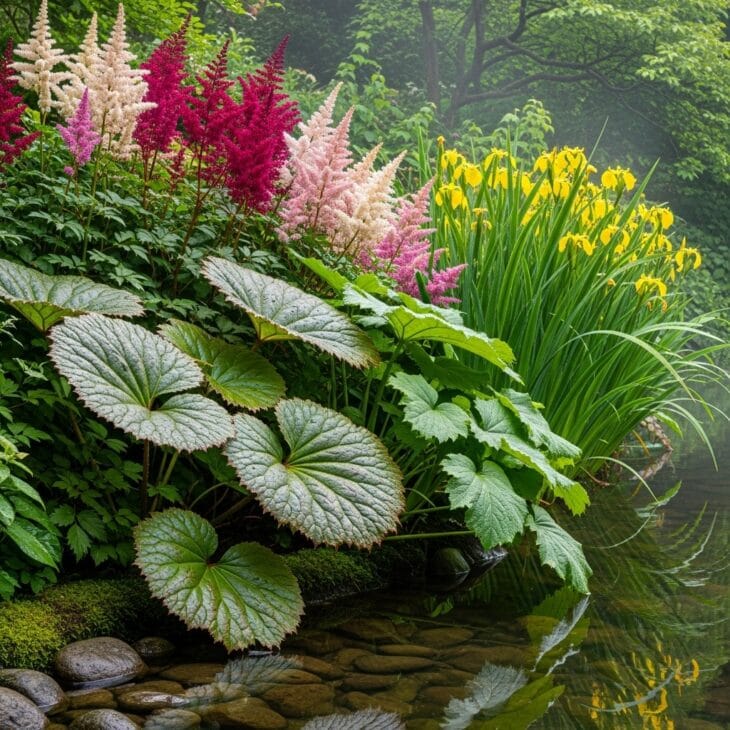
What you see A shady spot that stays reliably moist, the low corner that never quite drains or the margin of a pond, is a gift, because it suits a group of dramatic, large-leaved plants. Feathery astilbe plumes in pink and red rise above the ribbed leaves of Rodgersia, yellow flag iris, and the bold paddles of Ligularia. It is the lushest, most jungle-like planting that shade can offer.
Why it works These plants are moisture-lovers that sulk and scorch in dry ground but grow lavishly where their roots stay damp. Matching them to a naturally wet, shaded site means they need almost no extra care, and their scale brings a sense of abundance you rarely get in shade. The big leaves also read beautifully reflected in still water.
How to get it Combine astilbe, Rodgersia, hosta, and Ligularia ‘The Rocket’ in soil enriched with organic matter to hold even more moisture. Plant in spring, spacing the bigger plants 2 to 3ft (60 to 90cm) apart to allow for their spread. If your damp spot dries in high summer, mulch heavily and be ready to water, as these plants collapse dramatically when thirsty. Ligularia leaves wilt in afternoon sun even when the soil is wet, so deep shade suits them best.
17. A Heuchera Foliage Tapestry
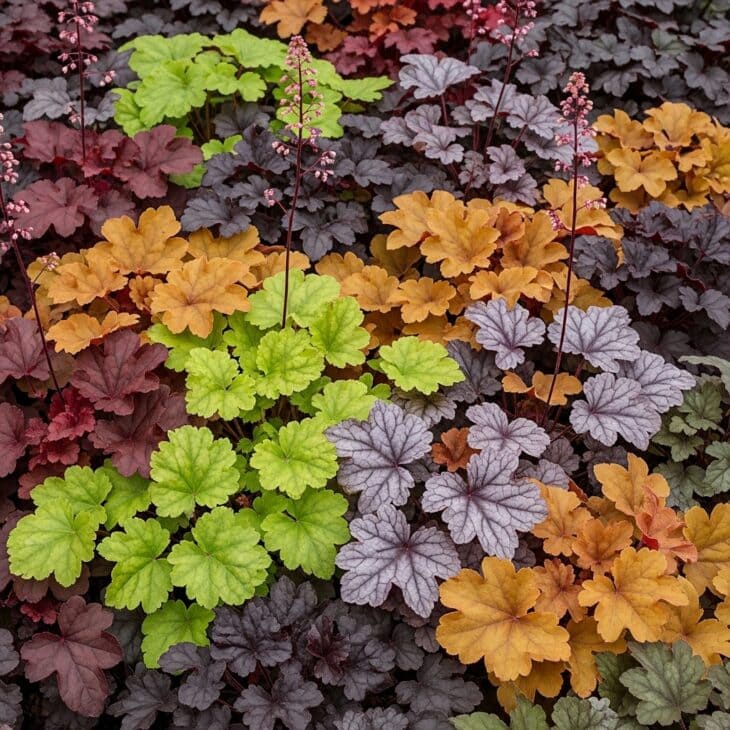
What you see For color in shade without relying on flowers, weave a tapestry of heucheras. Their ruffled, rounded leaves come in an astonishing range, deep burgundy, lime green, caramel-orange, silver-veined purple, and almost black, and massed together they make a low, dense quilt of color that holds all season. Slender wands of tiny flowers rise above in early summer as a bonus.
Why it works Foliage color is the key to a long-lasting shade scheme, and few plants offer as much of it as heuchera, which keeps its tones from spring well into winter. Planting several varieties together turns a flat, dim area into a glowing patchwork that needs no deadheading to look good. The mounded, evergreen-to-semi-evergreen habit also makes neat, weed-suppressing edging.
How to get it Plant coral bells (Heuchera) in moist, well-drained soil in light or part shade, spacing them about 12in (30cm) apart. The darker-leaved varieties hold their color best with a little light, while lime-greens prefer deeper shade to avoid scorch. Lift and divide clumps every three years to keep them vigorous, and re-firm any that lift out of the ground over winter. Avoid heavy, waterlogged soil, which causes the crowns to rot.
18. A Bright Courtyard with Reflective Surfaces
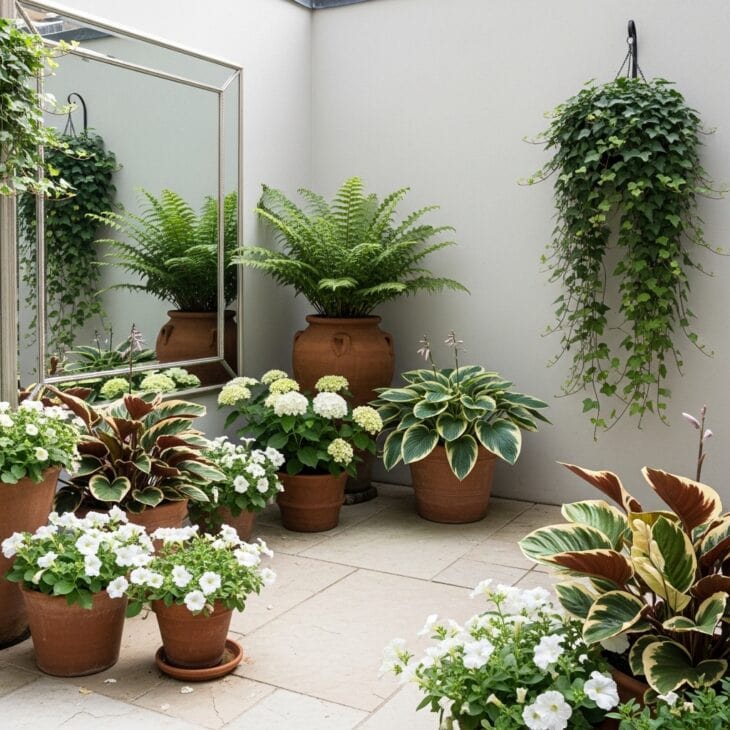
What you see A shaded courtyard does not have to feel gloomy. Paint the walls a pale off-white, lay light-colored paving, hang a mirror to bounce greenery and light around, and plant white flowers and variegated foliage in generous pots. The whole space lifts and brightens, feeling airy and fresh rather than dark and closed-in.
Why it works Light management, not just plant choice, is half of successful shade design. Pale, reflective surfaces multiply the available light, while mirrors create an illusion of depth and double the apparent planting. In a small enclosed space these tricks make a dramatic difference, turning a dim well into a calm, light-filled room outdoors.
How to get it Use a good-quality exterior masonry paint in a warm white or pale grey, which reads brighter than a cold brilliant white. Position a weatherproof acrylic or glass mirror to reflect the best view or a plant, angled so it does not simply mirror a blank wall, and frame it so it reads as a window. Choose variegated and white-flowered plants that stand out against the pale backdrop. Keep the scheme uncluttered, as too many objects undo the sense of space.
19. A Stumpery for Character and Wildlife
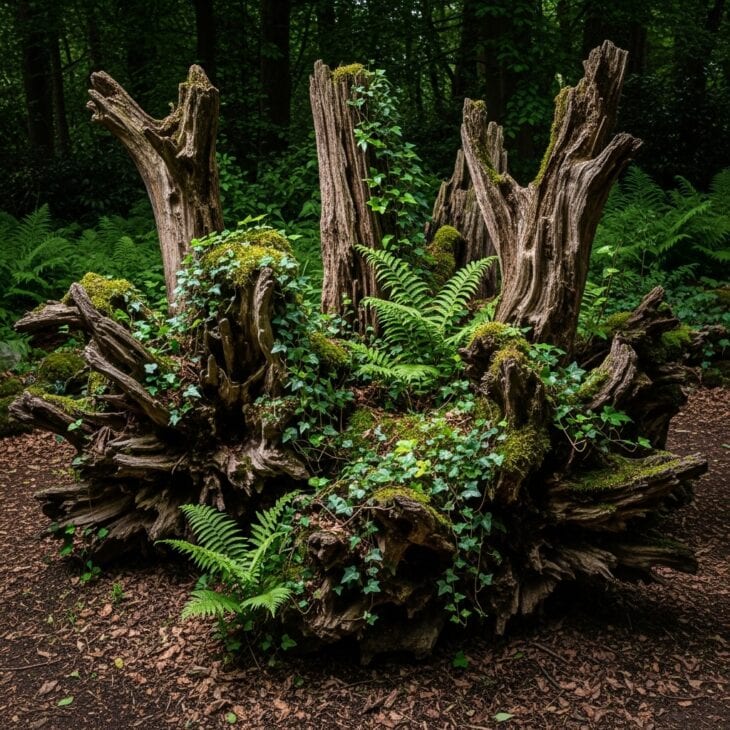
What you see A stumpery is a Victorian idea that has come back into fashion: old tree stumps and gnarled roots arranged as sculpture, then planted with ferns, ivy, and moss that colonize the weathered wood. In deep shade it looks utterly at home, all texture and character, like a fragment of ancient forest tucked into the garden. It is the most atmospheric way to use a difficult dark corner.
Why it works Beyond the looks, a stumpery is superb for wildlife, as the decaying wood feeds beetles, fungi, and the food chain that depends on them. It also recycles material most people would pay to remove, making it a genuinely sustainable feature. The shade and humidity that suit a stumpery are exactly the conditions that ferns and mosses need, so the planting more or less looks after itself.
How to get it Source stumps, logs, and root balls, ideally of slow-rotting hardwoods like oak, and arrange them in a pleasing, naturalistic group, partly buried for stability. Plant ferns such as hart’s tongue and soft shield fern into the gaps and pockets, with ivy and moss to clothe the wood over time. Keep the area moist and let leaves and debris accumulate to feed the system. The whole thing improves with age as the wood weathers and the plants spread.
20. A Weed-Smothering Ground-Cover Carpet
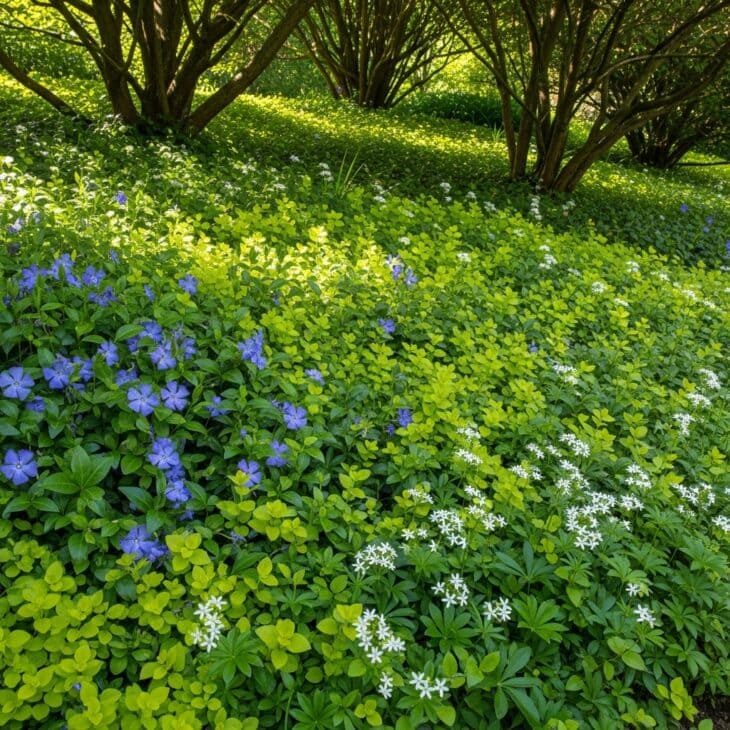
What you see For a low-effort solution to bare, weed-prone shade, plant a living carpet of ground cover. Glossy periwinkle (Vinca) studded with blue flowers, golden creeping Jenny, and starry white sweet woodruff knit together into a dense mat that covers the soil completely. Once it closes over, weeds simply cannot find the light to germinate.
Why it works Ground cover is the lazy gardener’s best friend in shade, because it does the weeding for you while looking far better than bare earth or mulch. A spreading carpet also holds moisture in the soil and protects the roots of larger plants. Under shrubs and trees, where little else thrives, it furnishes the ground and ties the planting together.
How to get it Match the vigor of the plant to the space: use enthusiastic spreaders like periwinkle for large rough areas, and gentler ones like sweet woodruff or wild ginger (Asarum) for smaller, more cultivated beds. Plant in autumn or spring, spacing 12 to 18in (30 to 45cm) apart, and mulch between young plants until they meet. Keep more thuggish species away from delicate neighbours they could swamp. A single annual trim keeps the carpet dense and tidy.
21. A Foxglove Woodland Edge
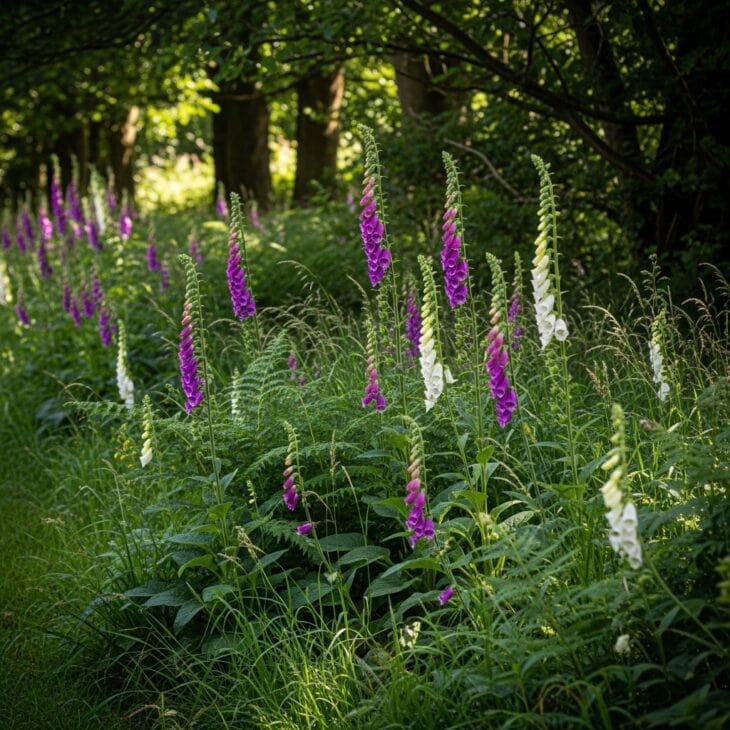
What you see Tall foxglove spires rising through the dappled light at the edge of woodland is one of the most romantic sights in early summer. In purple, pink, and white, they self-seed into loose, ever-changing drifts among ferns and grasses, giving height and movement to a part of the garden that can otherwise feel low and flat. Bees work their way up each spire all day long.
Why it works Foxgloves are happiest in exactly this transitional light between sun and shade, which is why they colonize woodland clearings in the wild. As biennials they flower in their second year and then seed themselves around, so a single planting becomes a self-renewing population that drifts naturally through the border. Few plants give so much vertical drama for so little effort.
How to get it Sow or plant foxglove (Digitalis purpurea) in autumn or spring for flowers the following summer, in moist, humus-rich soil. Let the best plants set and scatter seed, only deadheading spent spikes you do not want to reproduce, and thin the seedlings the following spring. Note that all parts are toxic if eaten, so site them with care around children and pets. After a couple of seasons the colony self-sustains, and you simply edit which seedlings to keep.
22. An Evergreen Shade Structure Planting
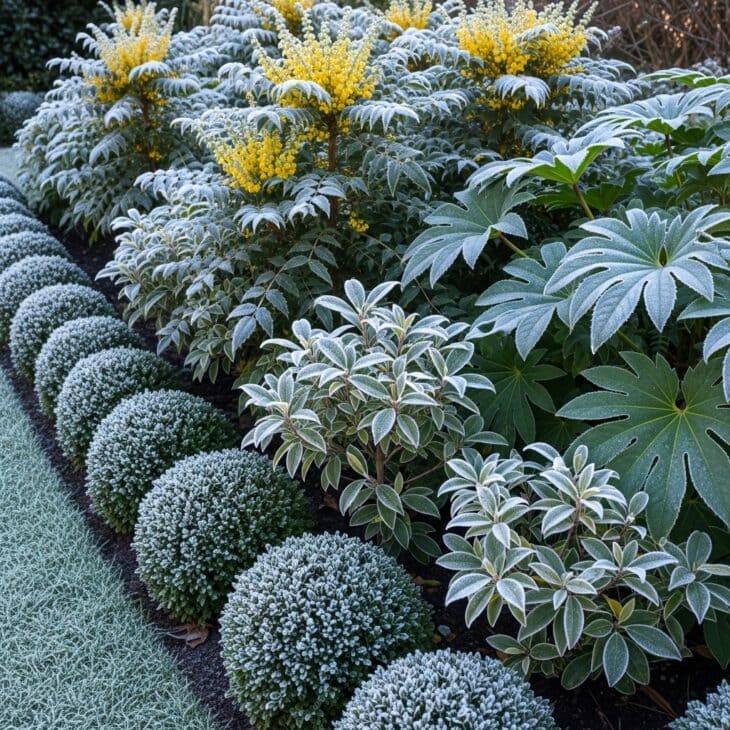
What you see To keep a shady border looking furnished in winter, build it around evergreens. Glossy sweet box (Sarcococca) brings powerful winter scent, architectural Mahonia adds spiny leaves and yellow winter flowers, clipped box gives neat form, and fatsia contributes bold, hand-shaped leaves. Together they hold the structure of the border when the deciduous plants have died back.
Why it works Evergreens are the bones of a good shade garden, providing color, form, and substance through the bleakest months when foliage perennials disappear underground. Many of the best evergreen shrubs are shade-tolerant by nature, having evolved as forest understory plants. Anchoring a border with them means it never looks empty, and the seasonal perennials simply add and subtract layers around a permanent frame.
How to get it Plant evergreens in autumn or spring, allowing room for their mature spread, and position scented ones like Sarcococca confusa near a path or door where you will catch the fragrance in winter. Mahonia ‘Charity’ makes a fine architectural specimen, while box (Buxus sempervirens) gives clipped contrast, though watch for box blight and consider alternatives like Ilex crenata if it is a problem locally. Underplant with spring bulbs and shade perennials to layer the seasons. A yearly mulch keeps them all in good health.
23. A Variegated Foliage Brightening Scheme
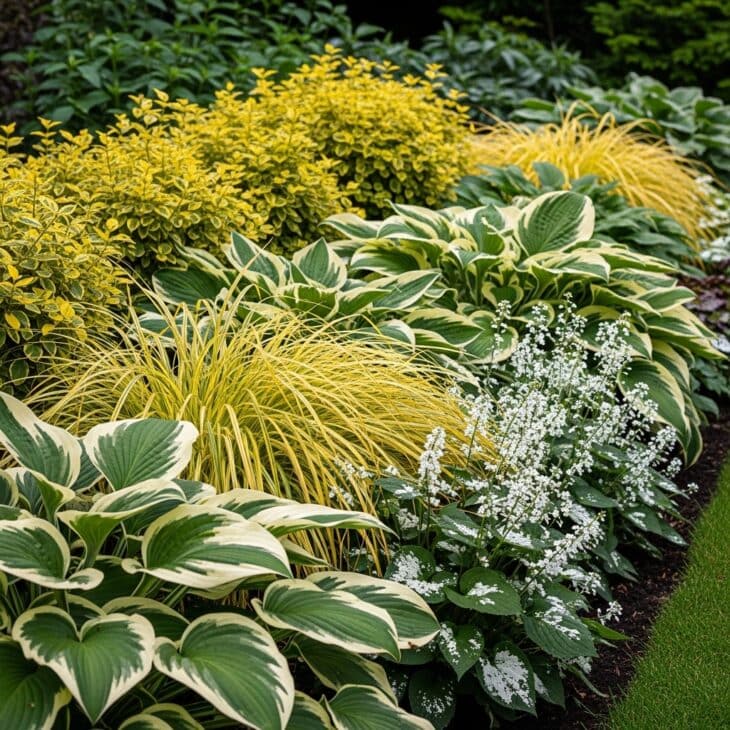
What you see Variegated and golden foliage can make a shady corner look as though sunlight is falling on it even when none is. Cream-splashed hostas, the flowing gold of Hakonechloa grass, white-speckled brunnera, and gold-edged euonymus all seem to glow against darker greens, lifting the whole area. It is a clever optical trick that brings warmth to the dimmest spot.
Why it works Pale variegation reflects more light than plain green leaves, so these plants genuinely brighten their surroundings as well as appearing to. Used in moderation, they act as highlights that draw the eye and create the impression of dappled sun. The contrast between bright variegation and deep shadow gives a shade border the depth and sparkle it can otherwise lack.
How to get it Choose shade-reliable performers such as Hosta ‘Francee’, Brunnera ‘Jack Frost’, and Hakonechloa macra ‘Aureola’, and place them where their glow will be most welcome, near a seat or at the end of a view. Use variegation as an accent rather than everywhere, or the effect becomes busy and loses its impact. Note that some gold-leaved plants scorch in direct sun, so they are ideally suited to shade. Remove any all-green shoots that revert on variegated plants to keep the bright leaves dominant.
24. A Shaded Water Feature
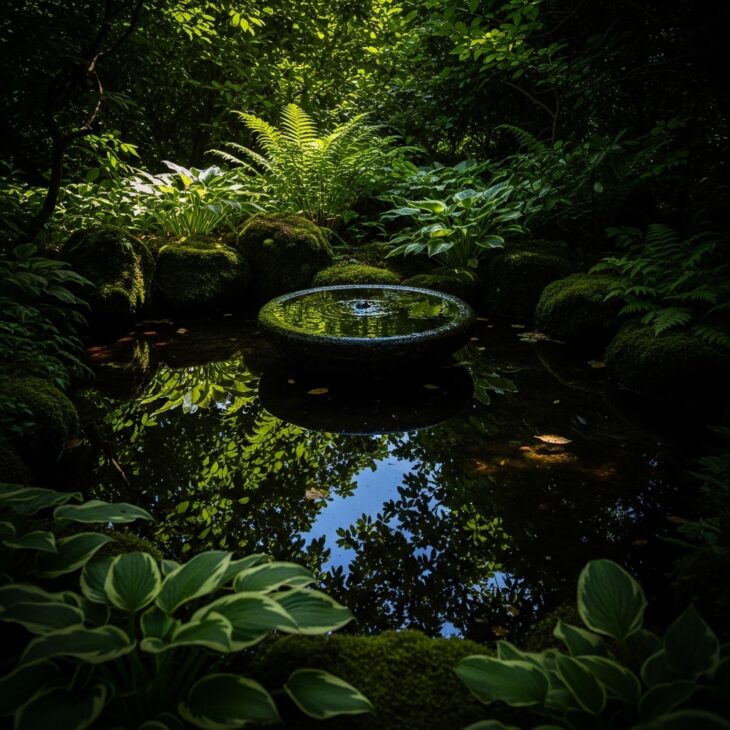
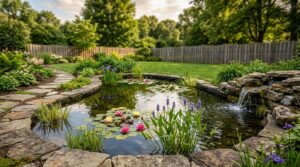
What you see Water and shade are natural companions. A still, dark reflective pool or a simple stone water bowl set among ferns, hostas, and mossy rocks mirrors the green canopy overhead and brings light, movement, and sound into a quiet corner. The reflective surface doubles the foliage and catches what little light reaches the spot.
Why it works A shaded position is actually ideal for water, because less direct sun means far less algae and a clearer pool with less maintenance. The cool, humid microclimate around water also suits the moisture-loving ferns and foliage plants you would want to grow there anyway. The sound of a trickle or the stillness of a reflective surface adds a sensory dimension that planting alone cannot.
How to get it Even a half-barrel or a drilled stone bowl with a small recirculating pump makes an effective feature in a small space, with no digging required. Surround it with lush damp-shade planting like astilbe, ferns, and hostas to settle it into the garden. Keep fallen leaves out with a net in autumn to stop the water fouling, and top up in summer as it evaporates. If you want wildlife, include a shallow sloping edge or a ramp so creatures can get in and out safely.
25. Epimedium Edging for Dry Shade
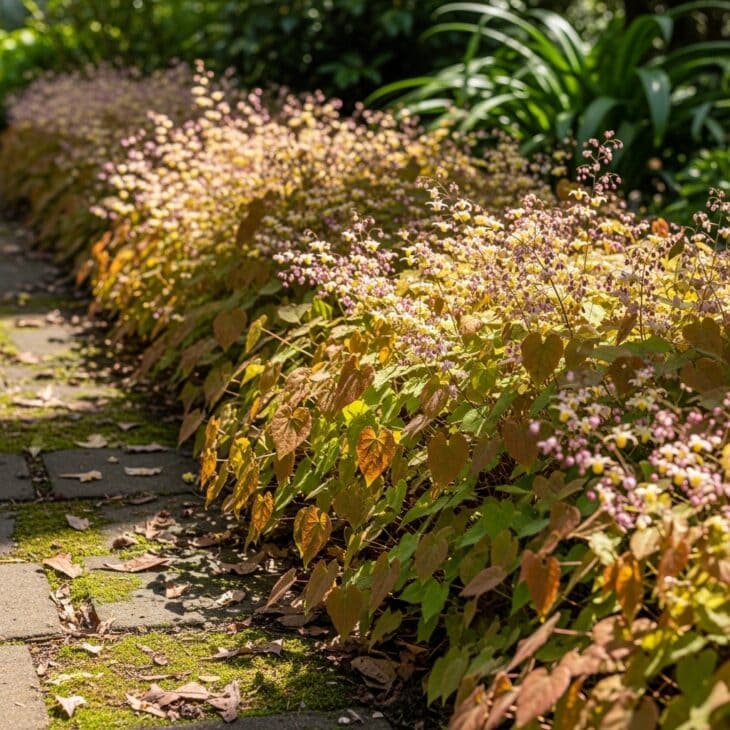
What you see Epimedium, sometimes called barrenwort or bishop’s hat, is the unsung hero of dry shade. Its heart-shaped leaves emerge tinted bronze-red in spring, settle to fresh green, and often color again in autumn, while delicate sprays of tiny spurred flowers in yellow, pink, or white hover above the foliage. As a path edging it makes a tidy, weed-proof line where little else would even survive.
Why it works What makes epimedium so valuable is its tolerance of the toughest spot in the garden, dry shade under trees, combined with genuine refinement. Most plants that survive there look coarse; epimedium looks delicate. It spreads slowly into a dense, low clump that suppresses weeds and stays attractive across three seasons, asking almost nothing in return.
How to get it Plant epimedium in autumn or spring, working leaf mould into the planting hole to give it a good start in poor soil, and space clumps about 12in (30cm) apart. Cut back the old leaves in late winter, just before the flowers appear, so the blooms and fresh foliage show clearly. Water through the first year to establish it, after which it tolerates considerable drought. Choose evergreen types like Epimedium x perralchicum ‘Frohnleiten’ for year-round cover.
26. A Shade Garden for Cutting and Foliage
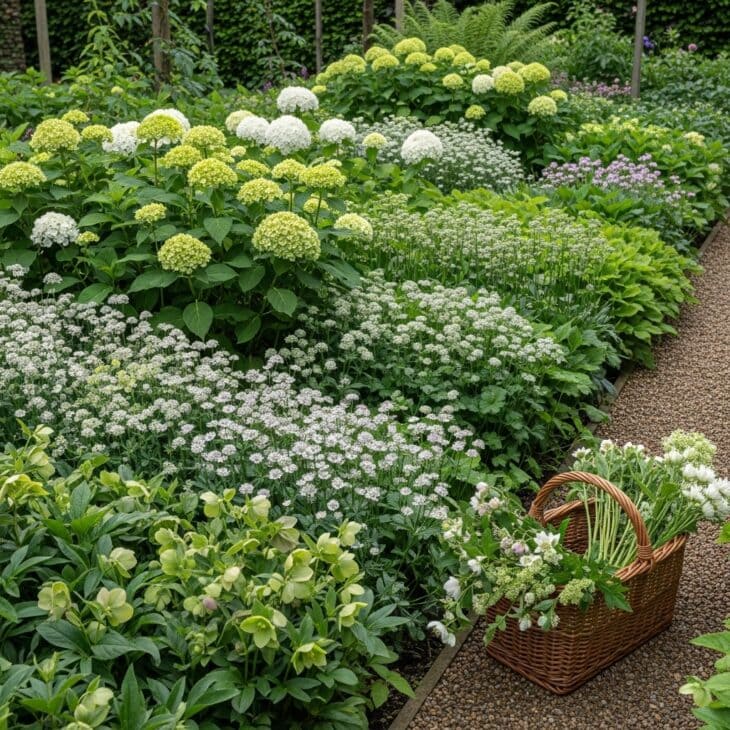
What you see A shady patch can be surprisingly productive if you grow it for cutting. Hydrangeas, astrantia, lady’s mantle, ferns, and hellebores all make excellent vase material, and the lush greens and cool whites of shade plants are exactly the foliage that florists pay a premium for. A trug of cut stems from a dim corner is a genuine harvest.
Why it works Cutting gardens are usually imagined in full sun, but shade offers the leafy fillers and elegant, long-lasting blooms that arrangements need to look professional rather than blowsy. Growing them in a quiet, out-of-the-way spot means you can cut freely without spoiling a display border. The cool conditions also keep cut flowers fresher for longer once they are in the vase.
How to get it Grow generous clumps of foliage plants like alchemilla, ferns, and hosta leaves alongside flowering hydrangea, astrantia, and Japanese anemone, so you always have both structure and bloom to cut. Harvest in the cool of early morning and plunge stems straight into water. Cut hydrangeas only when the flowers feel papery and mature, or they wilt instantly. Keep plants well watered and fed, as regular cutting takes energy and encourages more growth.
27. A Lush Tropical-Look Shade Garden
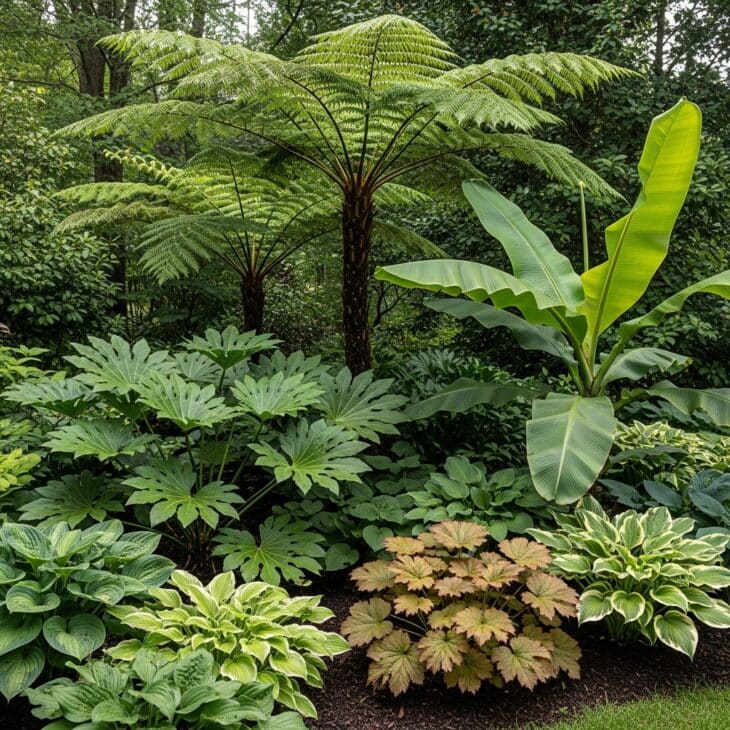
What you see You can conjure a jungle in temperate shade using hardy plants with big, bold leaves. A tree fern’s spreading crown overhead, the giant glossy hands of fatsia, the architectural foliage of Rodgersia, and the broad paddles of large hostas layer into a dense, exotic green that feels nothing like a typical garden. In shade, the lush humidity reads as genuinely tropical.
Why it works The trick is that shade is the natural home of the big-leaved look, since plants grow large, thin leaves to capture light in low conditions. Massing several of these architectural foliage plants together creates the dramatic, layered canopy that gives the tropical effect, all without needing heat or constant watering. It is the most exciting thing you can do with a damp, sheltered shady spot.
How to get it Choose hardy exotics suited to your climate: tree fern (Dicksonia antarctica) where winters are mild or with winter protection, plus Fatsia japonica, hardy banana (Musa basjoo), and Rodgersia for reliable structure. Plant in rich, moisture-retentive soil in a sheltered position out of cold wind, which shreds large leaves. Protect tender crowns over winter with straw or fleece in colder areas. Layer the planting in height tiers, from canopy to ground cover, to build the jungle effect.
28. A Woodland Path with Stepping Stones

What you see A path of flat stepping stones curving through shade turns a planted area into a place to explore. Set into moss and leaf litter with ferns and bluebells crowding the edges, the path disappears around a bend into the green, inviting you to follow. The curve and the partial concealment do most of the work, making even a small shaded plot feel like a journey.
Why it works A meandering path is the heart of woodland-style design, because it slows you down and lets you experience the planting at close range. Stepping stones tread lightly on the ground, allowing moss and low plants to grow right up to and between them rather than being cut off by a hard edge. Hiding the far end around a curve creates anticipation and makes the space feel larger and more layered than it is.
How to get it Set natural stone slabs or log rounds at a comfortable stride, roughly 24in (60cm) centre to centre, bedded firmly so they do not rock underfoot. Curve the route so the destination is not visible all at once, and let shade-loving plants soften the edges. Choose a non-slip surface, as stone in shade grows slippery with algae, and scrub it occasionally. Plant tough, tread-tolerant creepers like mind-your-own-business (Soleirolia) in the gaps if you want a green-jointed look.
29. A North-Facing Window Box or Balcony
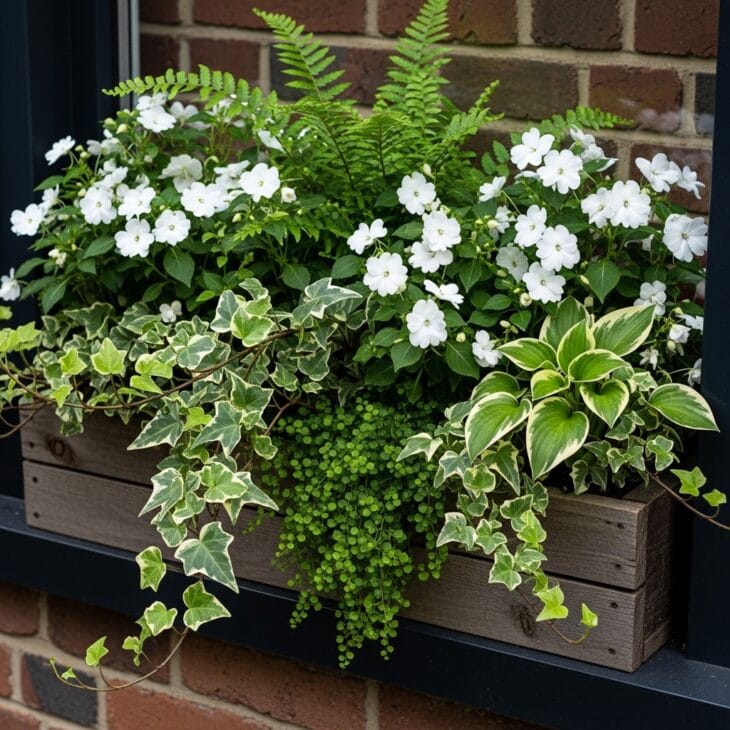
What you see Even a sunless windowsill or north-facing balcony can carry a full, green display. A window box of trailing ivy, a compact fern, white busy lizzies, and a small variegated hosta spilling over the edges looks fresh and abundant against the brick, proving that no light does not mean no plants. It softens a hard frontage and gives you something living to look at from indoors.
Why it works Shade-tolerant container plants make small-scale gardening possible for flat-dwellers and renters who have only a shaded sill or ledge to work with. The compact, foliage-led palette suits the confined space, and many of these plants are happy to stay put for years with minimal fuss. It is the smallest possible shade garden, and one of the most cheering.
How to get it Use a deep, securely fixed box with drainage holes and a quality peat-free compost, and choose compact, reliably shade-happy plants such as ferns, ivy, heuchera, and busy lizzies. Water carefully, as window boxes dry fast yet have nowhere for excess to drain, so aim for evenly moist, not soggy. Feed every couple of weeks in summer and refresh the planting each spring. Swap busy lizzies for winter pansies and small evergreens to keep the box going year-round.
30. A Four-Season Shade Garden Plan
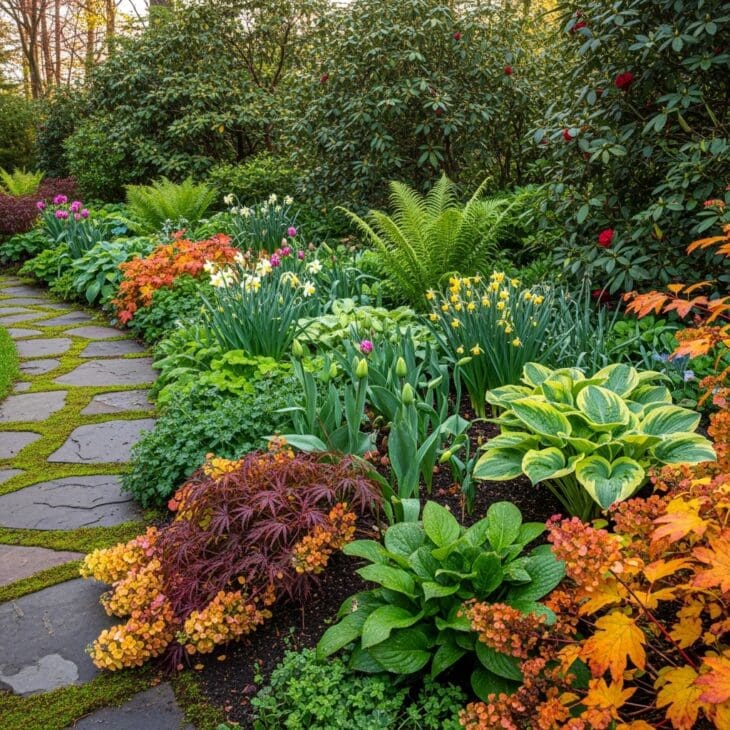
What you see The most satisfying shade garden is one designed to look good in every season, not just at one fleeting peak. Evergreen shrubs hold the structure all year, spring bulbs and hellebores open the season, hostas and ferns build the lush summer mass, and autumn brings tinted foliage and berries before the cycle begins again. Layered together in one border, they ensure there is always something to see.
Why it works Thinking in seasons rather than single plants is what separates a designed garden from a collection. By choosing for each part of the year, you avoid the common trap of a border that dazzles in May and then sits dull and green for months. A shade garden is especially suited to this approach, because its reliance on foliage and structure gives it a long, steady season with subtle changes rather than abrupt highs and lows.
How to get it Plan the bones first with evergreens and a few small trees or large shrubs, then layer in perennials and bulbs for each season around them. Aim for at least one clear point of interest in every month, and repeat key plants through the border to tie it together. Plant in autumn so everything settles before its first growing season, and keep a simple note of what flowers when, filling any gaps you spot. Mulch annually with leaf mould, and your shade garden will only get better with every passing year.