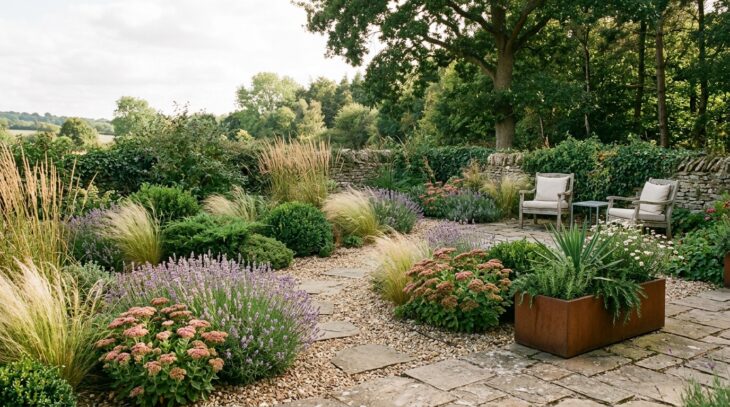
A low-maintenance garden is not a bare garden. The best examples are planted with intention and structured so that the plants do the work: suppressing weeds, filling gaps, and looking good through every season without constant attention.
Contents
- 01. Gravel Garden with Drought-Tolerant Planting
- 02. No-Mow Lawn with Clover and Creeping Thyme
- 03. Evergreen Structural Border
- 04. Native Wildflower Strip
- 05. Self-Watering Container Collection
- 06. Bark Mulch and Shrub Border
- 07. Mediterranean Herb Terrace
- 08. Ornamental Grass Garden
- 09. Ground Cover Carpet
- 10. Shade Garden with Ferns and Hostas
- 11. Japanese-Inspired Minimalist Garden
- 12. Raised Beds with Drip Irrigation
- 13. Prairie-Style Perennial Border
- 14. Paved Courtyard with Specimen Trees
- 15. Succulent and Sempervivum Bed
- 16. Spring Bulb Woodland Garden
- 17. Bamboo Privacy Garden
- 18. Rain Garden
- 19. Clipped Topiary Garden
- 20. Weed-Suppressing Ground Cover Under Trees
- 21. Alpine Rock Garden
- 22. Bog Garden with Architectural Plants
- 23. Wildlife Hedgerow Border
- 24. Hardscape Garden with Planted Gaps
- 25. Smart Irrigation Garden
These 25 ideas range from gravel gardens and no-mow lawns to smart irrigation systems and shade-loving ground covers. Some suit sunny, dry plots; others work in shade or heavy clay. There are ideas here for tiny courtyards, generous borders, and every situation in between.
Pick two or three that match your conditions and start there. Most of the effort in a low-maintenance garden happens at the beginning. Get the structure right once and the garden largely looks after itself.
01. Gravel Garden with Drought-Tolerant Planting
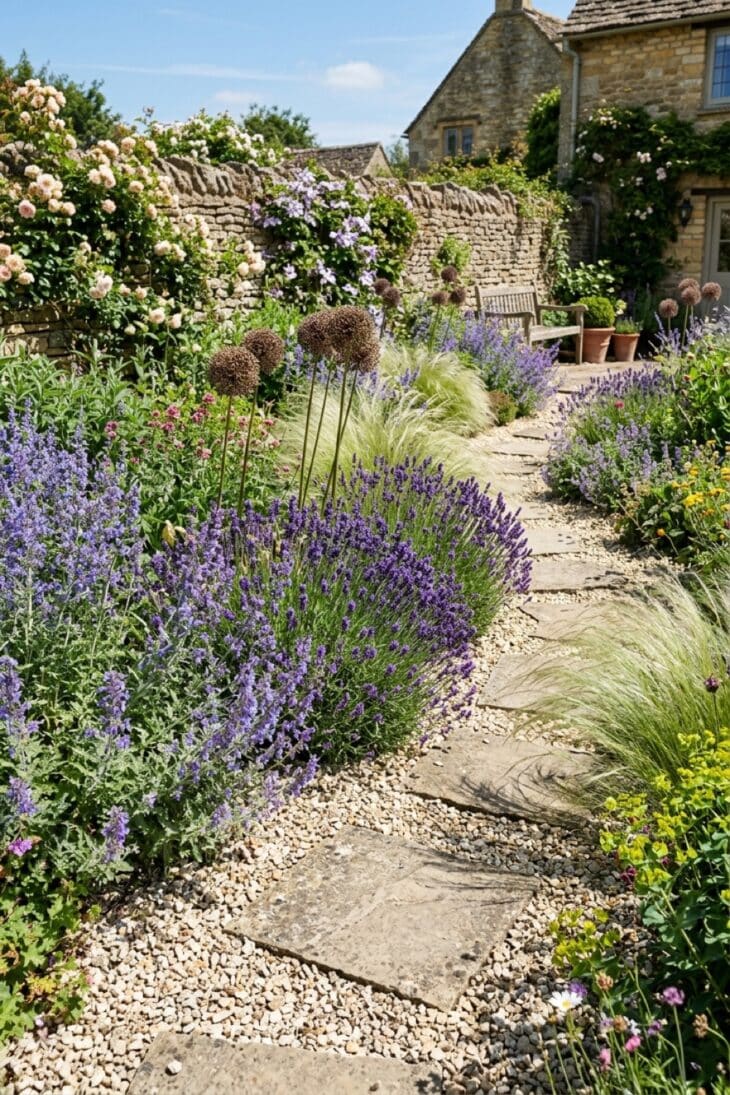
What you see Pale limestone gravel stretches between clumps of lavender and feathery grass, with allium seed heads catching the afternoon light. Russian sage sends up hazy blue spires above the silver mulch, and Stipa tenuissima sways in the slightest breeze. The scene is ordered but relaxed, like a garden that has grown into itself.
Why it works Gravel serves as a permanent mulch, blocking weeds and reflecting warmth back to sun-loving plants. It eliminates the need for annual mulching and regular cultivation, which together account for most of the work in a conventional border. Once the planting knits together, the garden genuinely needs very little.
How to get it Lay gravel 7cm (3in) deep directly over bare, weed-free soil without membrane beneath it. Membrane eventually causes problems and prevents beneficial self-seeding. Plant through the gravel in odd-numbered groups: reliable choices include lavender ‘Hidcote’, Stipa tenuissima, Salvia nemorosa ‘Caradonna’, Echinacea purpurea, and Eryngium x tripartitum. Water thoroughly after planting, then let the plants establish on rainfall alone.
02. No-Mow Lawn with Clover and Creeping Thyme
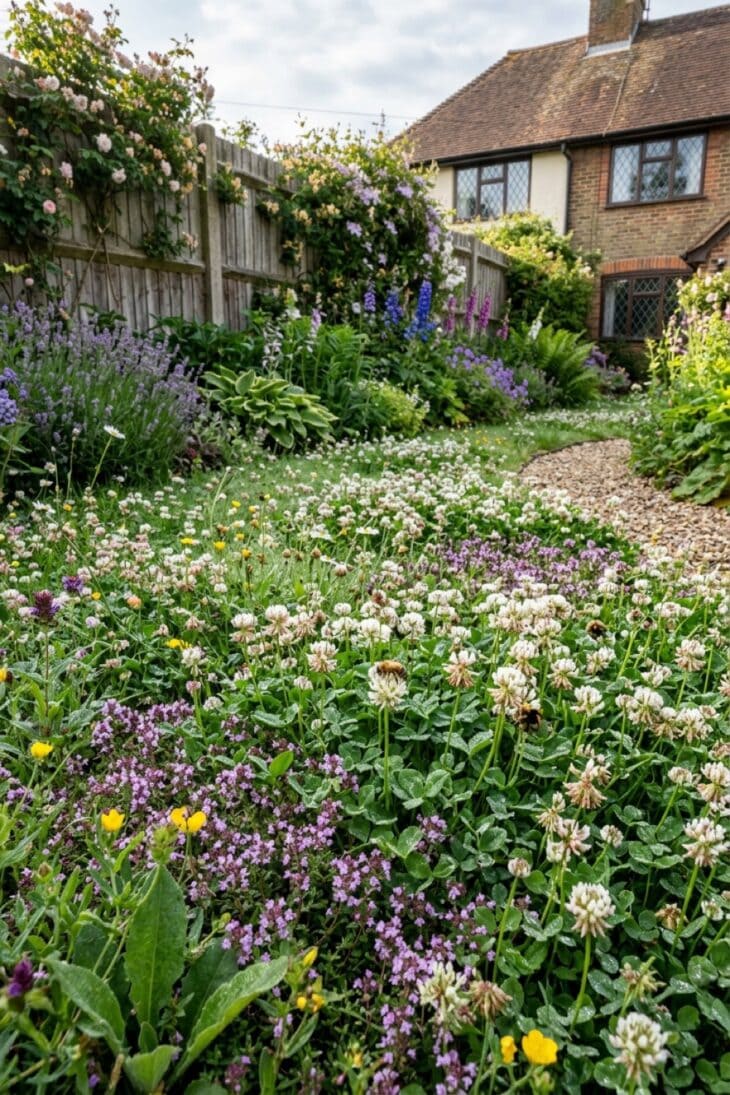
What you see Where a conventional lawn demands weekly mowing, a clover and thyme carpet asks for almost nothing. White clover blooms attract bees all summer, and the low mats of creeping thyme release fragrance underfoot. In between, self-seeded chamomile and speedwell fill the gaps with quiet colour.
Why it works Clover fixes nitrogen from the air, keeping the lawn green without feeding. Creeping thyme tolerates light foot traffic and stays naturally compact, so there is nothing to cut. The result looks wilder than a traditional lawn but far more interesting.
How to get it Overseed an existing lawn in spring or autumn with white clover (Trifolium repens) at around 2g per square metre. For a new planting, combine clover with Thymus serpyllum and chamomile (Chamaemelum nobile ‘Treneague’ for the non-flowering form). Reduce or stop mowing entirely once established. The lawn takes a full season to fill in but needs no feeding, scarifying, or aeration thereafter.
03. Evergreen Structural Border
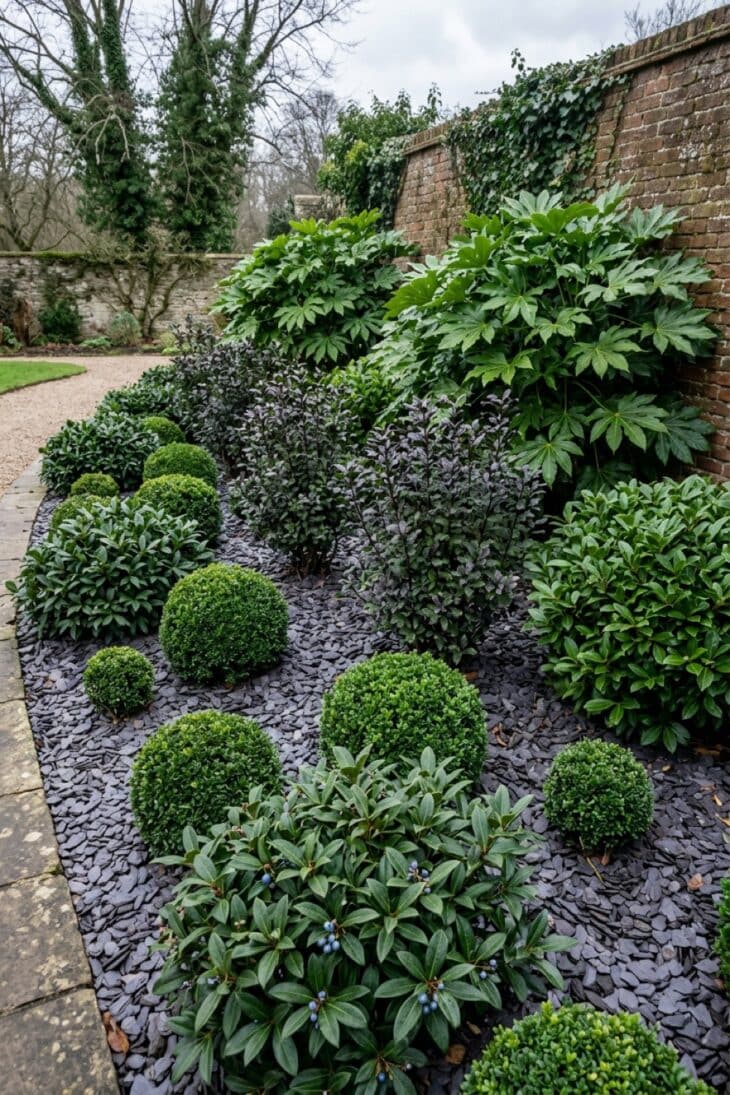
What you see Rounded box balls anchor a planting of dark Viburnum davidii and glossy Fatsia japonica, with an upright Pittosporum rising through the middle. The border looks good on a grey January day just as much as in July. That is the whole point.
Why it works Evergreens provide structure without demanding regular intervention. There are no bare stems in winter, no spent flower heads to cut back in autumn, and no hungry gaps to fill. One light clip per year keeps the shapes crisp.
How to get it Choose a mix of textures and heights to avoid a flat border. Combine fine-textured Pittosporum with bold Fatsia and clipped box for contrast. Good supporting plants include Sarcococca confusa (fragrant in winter), Viburnum tinus, and Choisya ternata ‘Sundance’. Lay slate or bark mulch 7cm (3in) deep to suppress weeds between plants. Clip box once in late June after the summer solstice.
04. Native Wildflower Strip
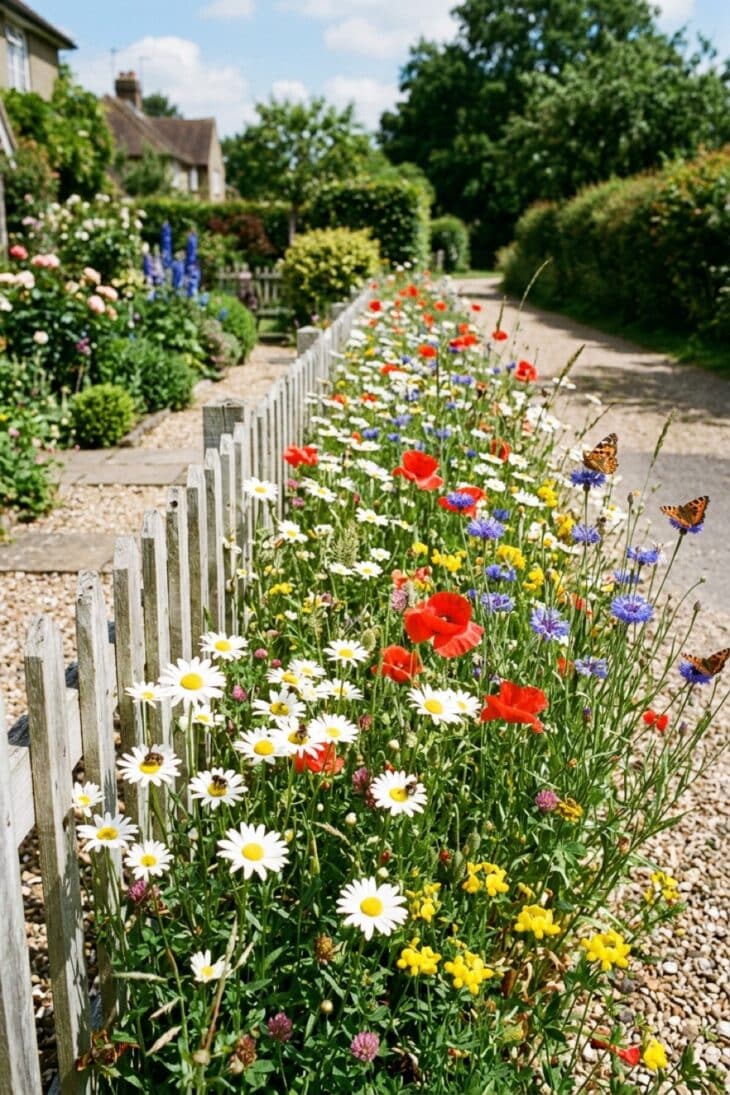
What you see Ox-eye daisies and field poppies jostle with cornflowers and trefoil along a sunny garden edge. The strip is deliberately unruly and all the better for it. Butterflies and bees move through the flowers from June right through to autumn.
Why it works Annual wildflowers self-seed prolifically once established, returning year after year without replanting. The strip asks for one cut per year in autumn, when the seeds have ripened and fallen. That single pass of a strimmer does all the maintenance needed for the following year.
How to get it Prepare the ground by removing all grass and weeds, then scarify the surface to expose bare soil. Sow a native annual mix containing field poppy (Papaver rhoeas), cornflower (Centaurea cyanus), ox-eye daisy (Leucanthemum vulgare), and bird’s-foot trefoil (Lotus corniculatus) in April or September. Rake lightly after sowing and water during dry spells in the first season. Cut to 5cm (2in) height in October and leave the cuttings for two days before removing, so seeds can fall.
05. Self-Watering Container Collection
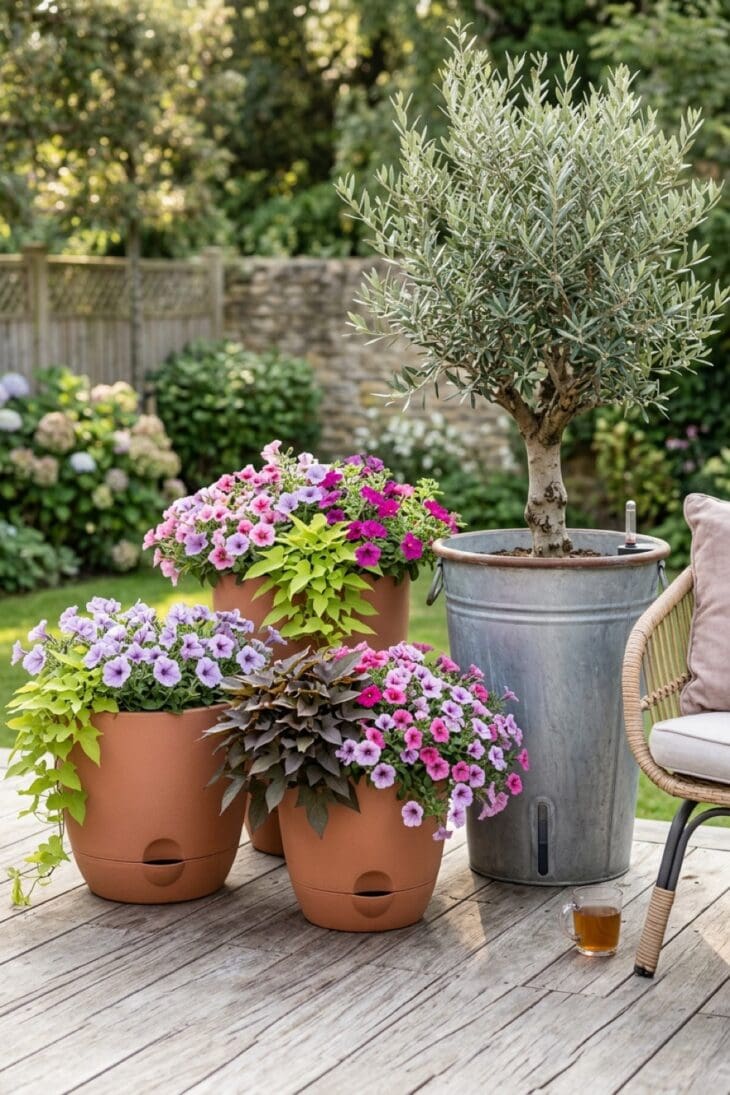
What you see Large containers planted with olives and trailing petunias sit on a clean timber deck, looking polished and cared for. None of them have been watered in a week. The reservoirs at the base of each pot have done it automatically.
Why it works Self-watering containers have a built-in water reservoir that the plant draws from via capillary action, delivering moisture directly to the roots from below. This eliminates the daily watering routine that kills enthusiasm for container gardening. Most reservoirs last three to seven days depending on the plant and the weather.
How to get it Look for containers with a visible water-level indicator and a fill port separate from the main soil chamber. Brands including Lechuza and Stewart Garden offer good ranges in a variety of materials. Fill the reservoir rather than watering from above once plants are established. Use a peat-free compost mixed with 20% perlite for good drainage. Add a liquid feed to the reservoir once a month in summer.
06. Bark Mulch and Shrub Border
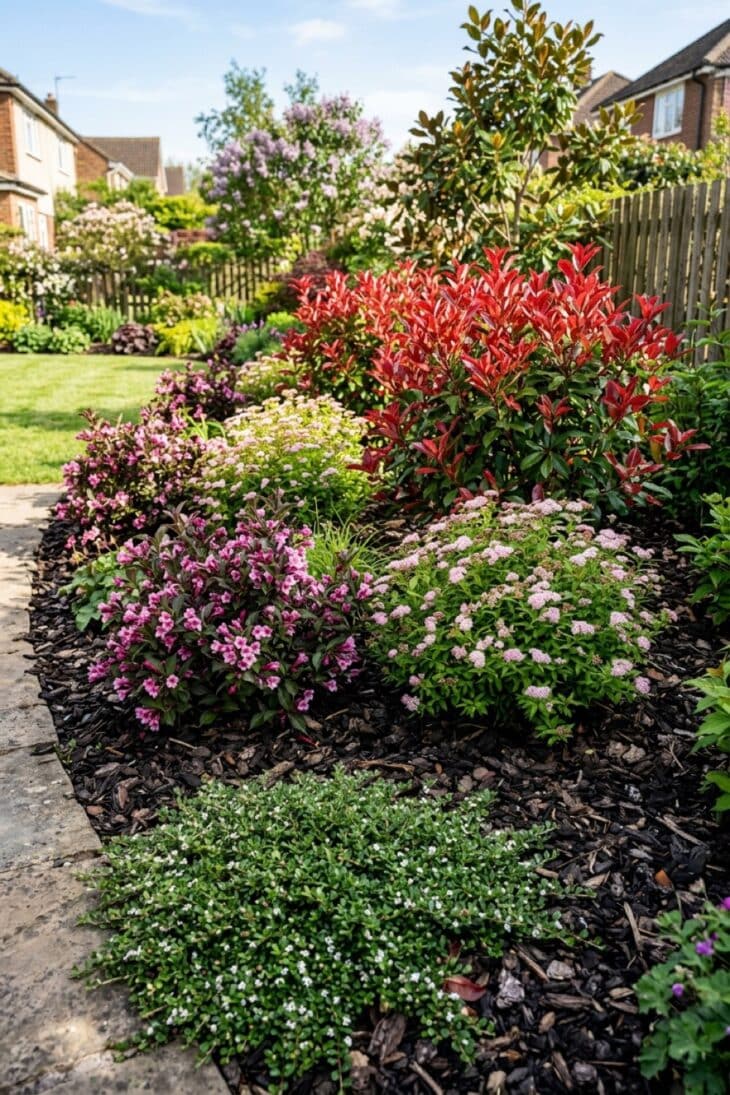
What you see Dark bark chip mulch covers the ground between shrubs, making the planting look cared for while doing most of the maintenance work itself. Photinia puts out flashes of red new growth against the dark surface. At the front, Cotoneaster hugs the ground and needs nothing.
Why it works A 7cm (3in) bark mulch layer blocks almost all weed germination and keeps the soil moist for weeks after rain. It breaks down slowly into the soil, improving structure as it goes. One top-up per year in late winter is all it needs.
How to get it Apply bark after planting in late autumn or early spring, keeping it away from the stems of shrubs to prevent rot. Good shrubs for a low-maintenance border include Photinia x fraseri ‘Red Robin’, Weigela florida ‘Purpurea’, Spiraea japonica ‘Gold Mound’, Cotoneaster horizontalis, and Berberis thunbergii. Check the label for pH and drainage requirements before planting. Once established, these shrubs need pruning no more than once a year.
07. Mediterranean Herb Terrace
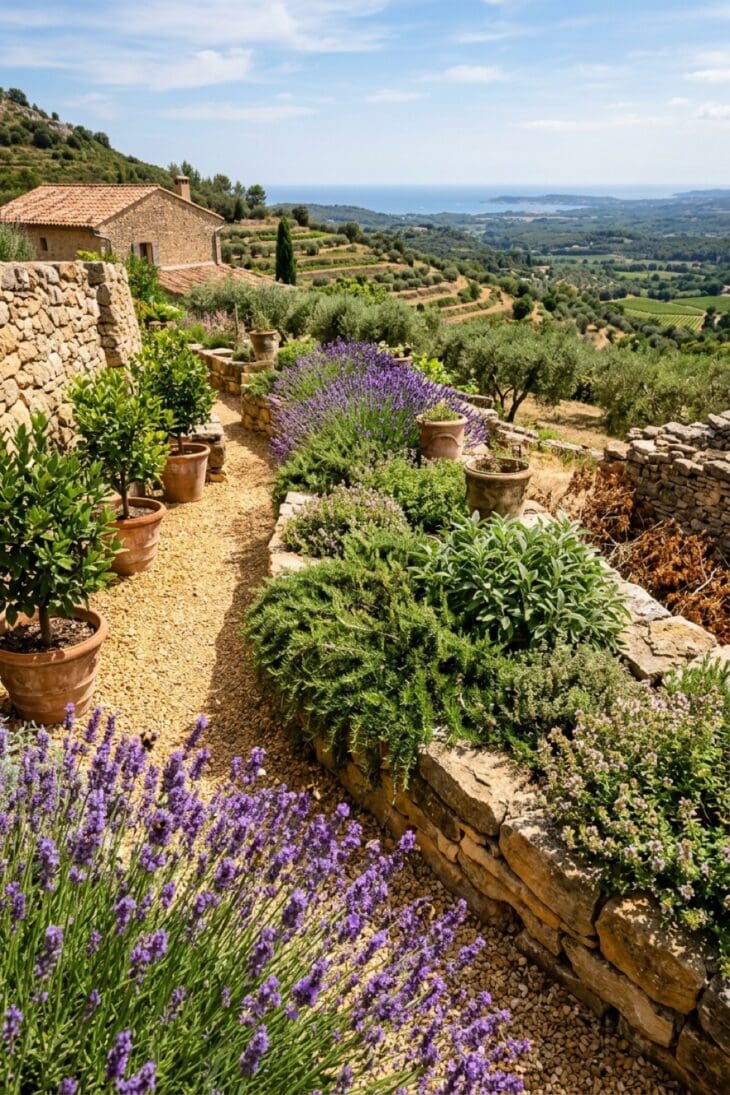
What you see Rosemary spills over warm stone edges alongside lavender, sage, and thyme on a sun-facing terrace. Bay trees in terracotta pots frame the path. Everything smells extraordinary in the afternoon heat.
Why it works Mediterranean herbs evolved in poor, dry, rocky soils and actively resent rich compost and regular watering. Neglect suits them. Once planted in the right position they need nothing but an annual trim after flowering to stop them becoming woody.
How to get it Position on a south or south-west facing slope or raised bed for maximum drainage and warmth. Plant into gritty, free-draining soil or mix horticultural grit into existing soil at a ratio of 1:3. Good combinations include rosemary ‘Miss Jessopp’s Upright’, Salvia officinalis ‘Purpurascens’, Thymus vulgaris, lavender ‘Vera’, and Origanum vulgare ‘Compactum’. Water in well after planting and not again unless there is a prolonged drought. Clip lightly after flowering to keep plants compact.
08. Ornamental Grass Garden
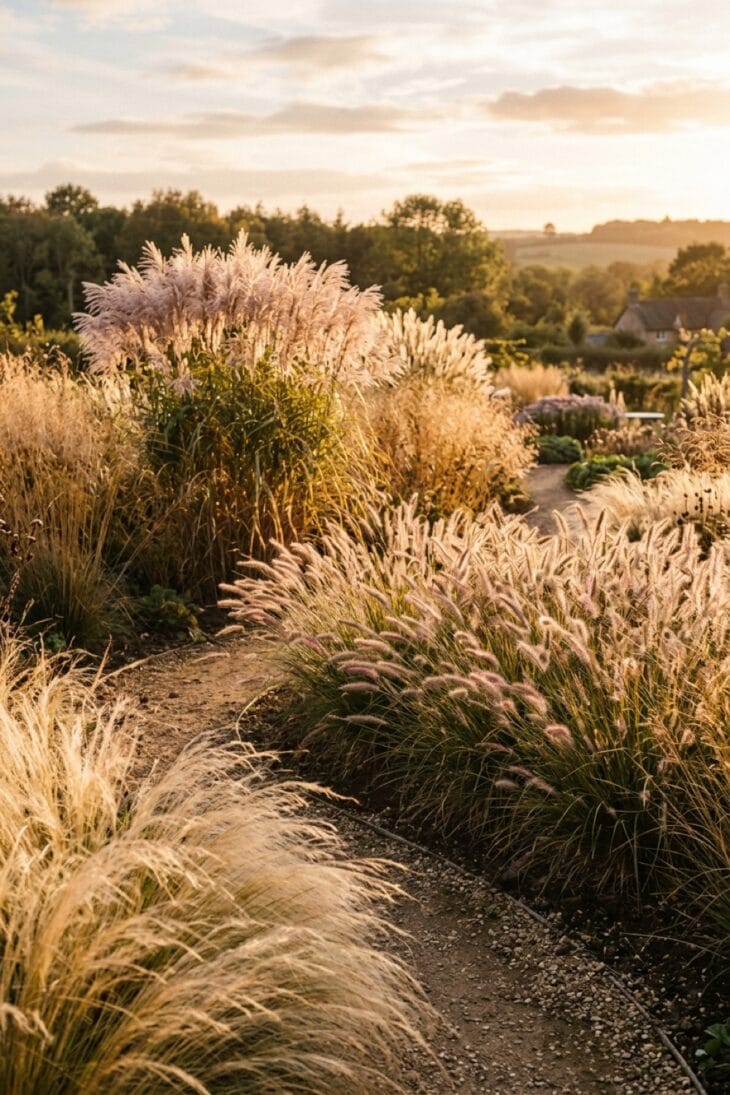
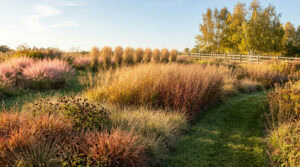
What you see Tall Miscanthus plumes catch the low evening sun in amber and bronze, swaying above shorter Pennisetum seed heads and the fine silk of Stipa tenuissima. The garden is entirely grasses. Nothing else is needed.
Why it works Ornamental grasses need cutting back once a year, fertilising never, and dividing every three to five years. They are impervious to most pests and diseases. From late summer through winter, the dried seed heads and bleached stems provide structure and movement that few other plants can match.
How to get it Cut back deciduous grasses such as Miscanthus and Pennisetum hard to 10cm (4in) in late February before new growth begins. Evergreen grasses including Stipa and Festuca should be combed through with a gloved hand rather than cut hard. Plant in groups of three to five for visual impact. Good choices include Miscanthus sinensis ‘Gracillimus’, Pennisetum alopecuroides ‘Hameln’, Calamagrostis x acutiflora ‘Karl Foerster’, and Deschampsia cespitosa ‘Goldtau’.
09. Ground Cover Carpet
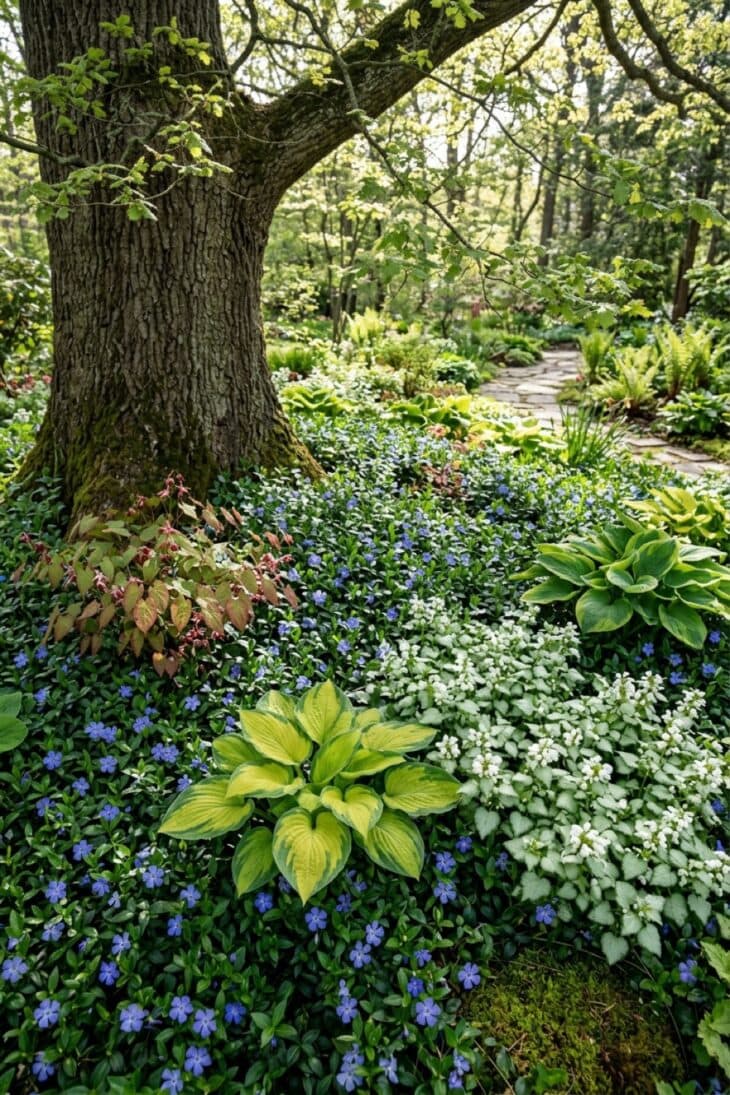
What you see Under a large tree where grass refuses to grow, Vinca minor spreads its dark glossy leaves and small blue flowers across the ground. Hostas push up through the mat in spring, and epimedium adds a delicate second layer. The space that was once a muddy problem has become one of the best parts of the garden.
Why it works Ground cover plants solve the perennial problem of difficult areas by outcompeting weeds. They spread to fill gaps, root as they go, and form a living mulch far more attractive than bare soil or struggling turf. Once established, they need almost no attention.
How to get it Choose ground cover matched to the conditions: Vinca minor and Lamium maculatum for dry shade, Pachysandra terminalis for dense shade, and Geranium macrorrhizum for any aspect. Plant through a bark mulch layer initially to suppress weeds while plants spread. Space at 30 to 45cm (12 to 18in) intervals. Water in the first summer during dry spells; once the carpet is complete, rainfall is sufficient.
10. Shade Garden with Ferns and Hostas
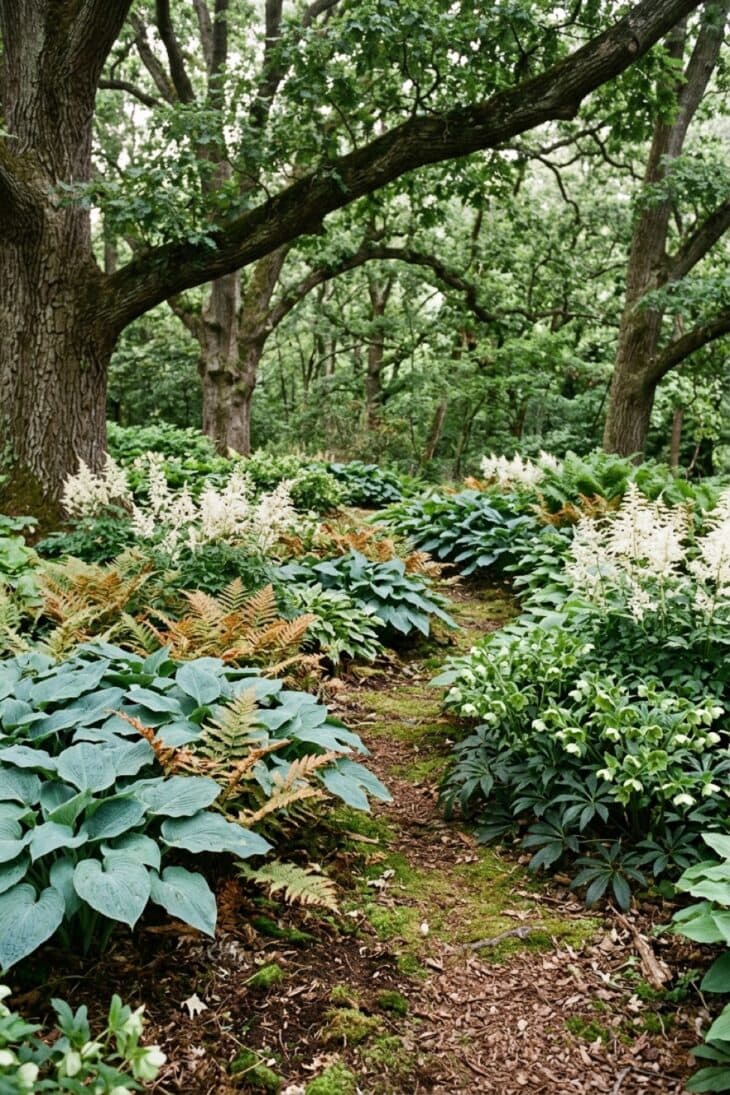
What you see Blue-grey Hosta leaves catch the dappled light under oak trees, with copper-tipped ferns unfurling alongside. Astilbe sends up white plumes in summer, and hellebores nod their green heads in the quieter corners. The whole planting looks cool and considered on a hot day.
Why it works Shade gardens work because the plants chosen for them evolved in woodland conditions: they tolerate low light, prefer moist soil, and most are naturally slug-resistant. Hostas are the main exception; slugs find them irresistible. Choosing thick-leaved varieties, which are less palatable, solves most of the problem.
How to get it Plant in humus-rich, moisture-retentive soil improved with leaf mould or well-rotted compost. The best slug-resistant hostas include ‘Halcyon’, ‘Big Daddy’, and ‘Sum and Substance’. Pair them with Dryopteris erythrosora, Polystichum setiferum, Astilbe x arendsii ‘Brautschleier’, and Helleborus x hybridus. Top-dress with leaf mould each autumn. The main annual task is dividing hostas every three to four years to keep plants vigorous.
11. Japanese-Inspired Minimalist Garden
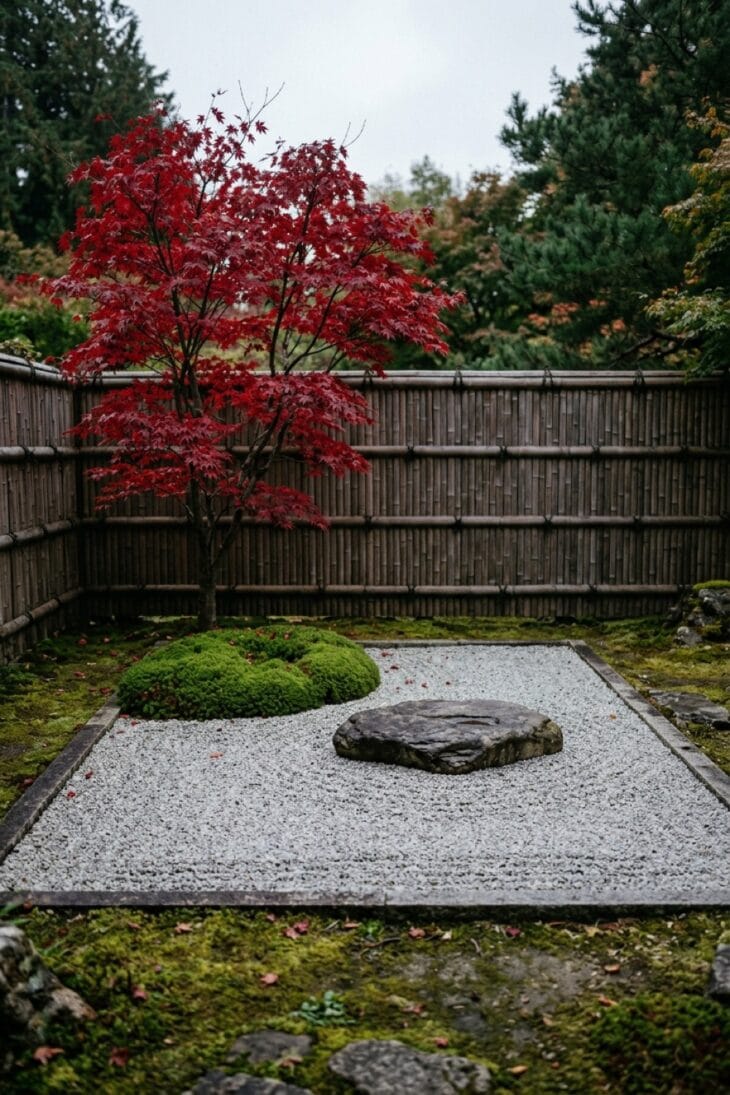
A single Japanese maple in autumn red stands over raked pale gravel and a mossy mound. One flat stone, placed off-centre, is the only other element. The garden is almost silent and completely still.
Japanese-inspired gardens are low maintenance because they use very few plants. The work lies in the initial design; raking the gravel takes ten minutes. The maple, the moss, and the stone need nothing but time.
Use Acer palmatum ‘Bloodgood’ or ‘Osakazuki’ as the focal tree, planted where it has room to develop naturally without pruning. Raked gravel should be 5 to 7cm (2 to 3in) deep in angular, washed flint or granite. Moss can be encouraged by removing competing plants and keeping the area shaded and moist. Avoid the temptation to add more plants: restraint is the whole point.
12. Raised Beds with Drip Irrigation
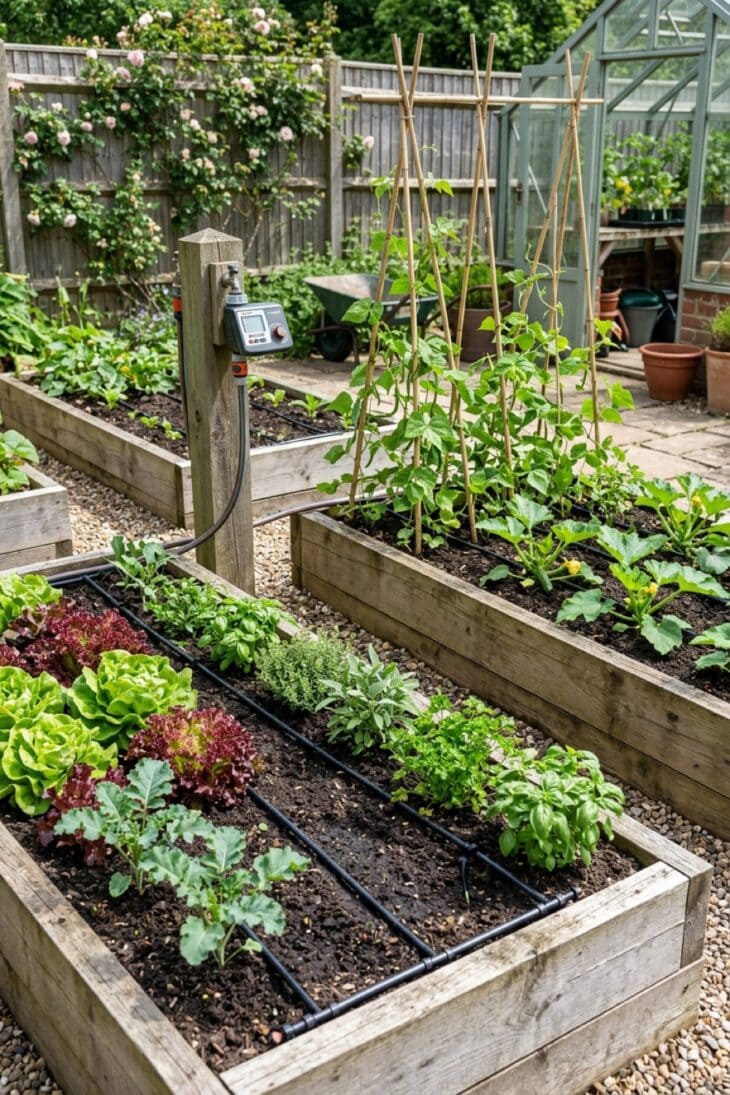
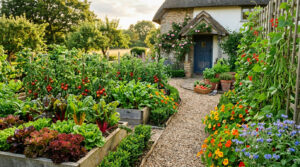
What you see Two raised beds sit in a sunny garden, planted with climbing beans, courgettes, kale, and a row of cut-and-come-again lettuce. Black drip lines run along the soil at the base of each row. The tap timer does the watering every morning.
Why it works Drip irrigation delivers water directly to roots and eliminates the daily watering task that makes vegetable growing feel like a chore. Combined with a raised bed, which warms faster and drains better than open ground, it makes the most productive style of kitchen gardening also the least demanding.
How to get it Install a simple drip kit connected to an outdoor tap timer set to water for 20 minutes each morning. Hozelock and Gardena both make good starter sets. Run 13mm (0.5in) supply tubing along the bed with 4mm (0.15in) drip lines branching off to each plant. Fill raised beds with 50% topsoil and 50% compost. Check the system each spring and replace any blocked emitters. A deep compost mulch on the soil surface further reduces water needs.
13. Prairie-Style Perennial Border
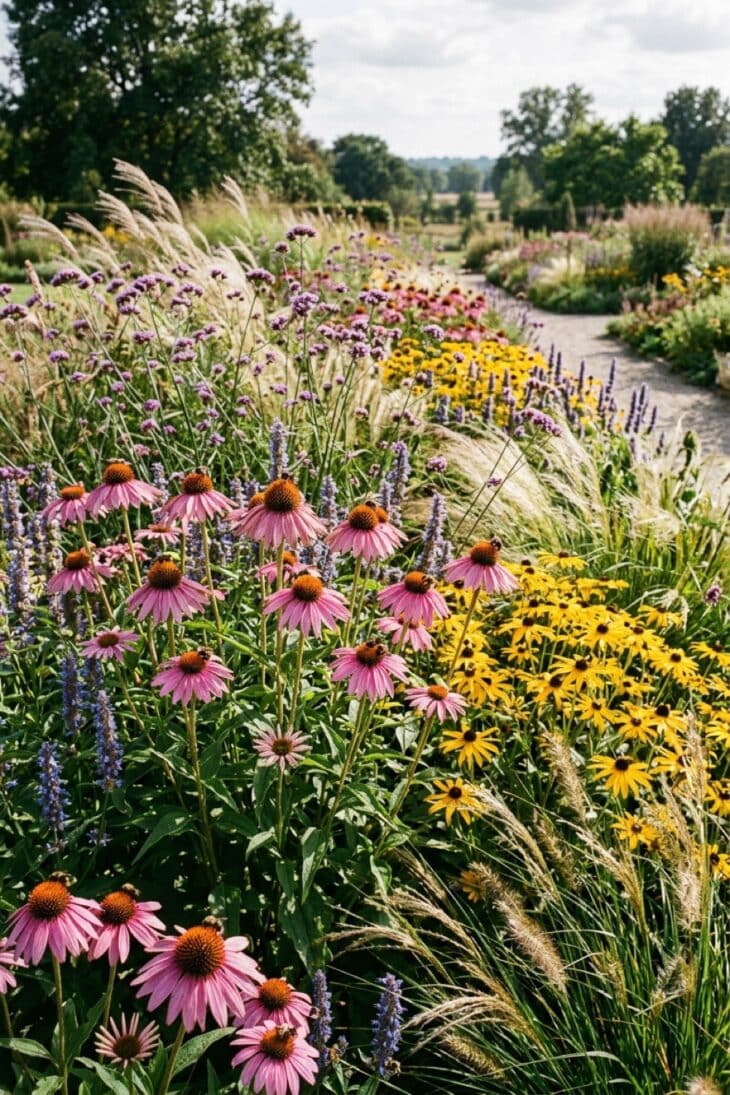
What you see Echinacea and rudbeckia fill the border with pink and yellow, threaded through with purple Verbena bonariensis and ornamental grasses. Bees move from flower to flower in the afternoon sun. The planting looks abundant and complex but was chosen to need very little.
Why it works Prairie planting works because the plants are densely packed, leaving no room for weeds to establish. They are chosen to bloom in succession from June to October, so the border is never without interest. Cut back in late winter and that is the whole year’s maintenance.
How to get it The key to a successful prairie border is soil preparation: enrich poor soil before planting, but avoid over-feeding established plants as they become floppy. Core plants include Echinacea purpurea ‘Magnus’, Rudbeckia fulgida ‘Goldsturm’, Agastache ‘Blue Fortune’, Penstemon ‘Husker Red’, and Verbena bonariensis. Plant at high density, around five plants per square metre, to crowd out weeds. Cut back to 15cm (6in) in late February. Divide clumps every four to five years.
14. Paved Courtyard with Specimen Trees
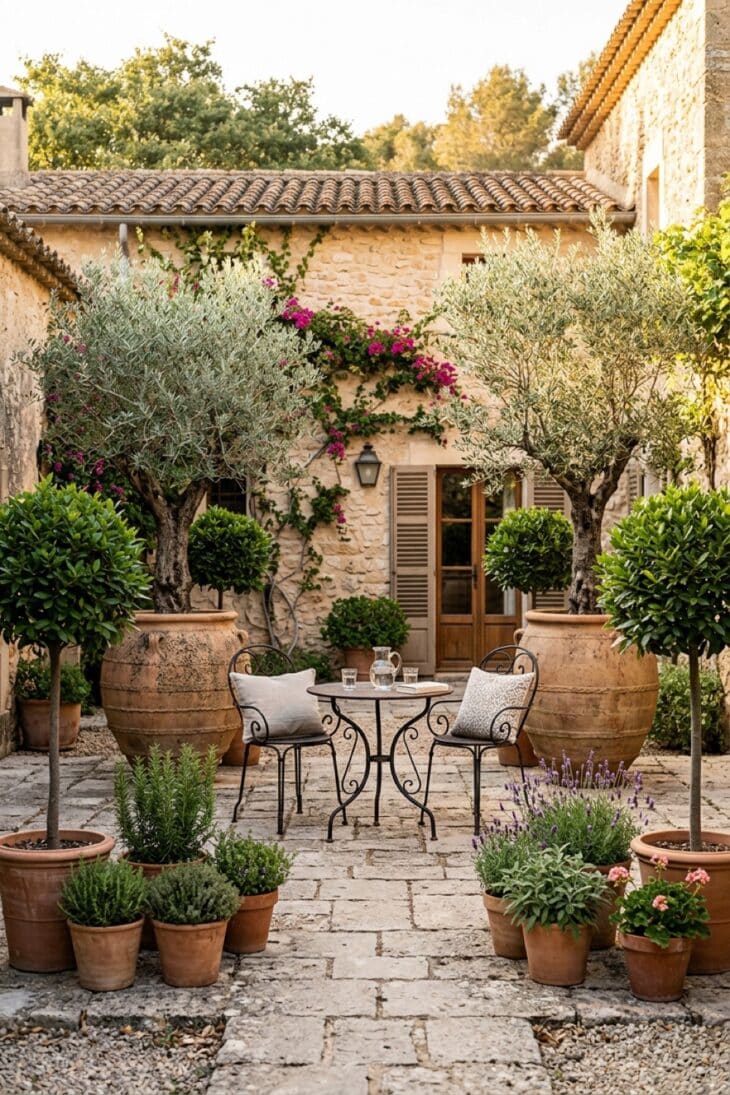
What you see Olive trees in generous terracotta pots frame a limestone-paved courtyard, with clipped bay lollipops adding formality at the corners. A simple table and two chairs sit in the centre. The whole space feels composed and unhurried.
Why it works A paved courtyard with specimen trees in pots asks very little: sweep the paving, water the pots, and clip the bays once in summer. Olives are drought-tolerant and hardy to around minus 10 degrees Celsius (14F) once established. Bay tolerates hard clipping and responds well to a single shaping in July.
How to get it Choose frost-hardy olive varieties such as Olea europaea ‘Cipressino’ for smaller spaces. Plant into large pots of minimum 45cm (18in) diameter in free-draining compost mixed with 20% grit. Water weekly in summer, fortnightly in spring and autumn, and monthly in winter. Feed with a liquid fertiliser once a month from April to September. Clip bay into shape in late July using secateurs rather than shears to avoid browning the cut leaves.
15. Succulent and Sempervivum Bed
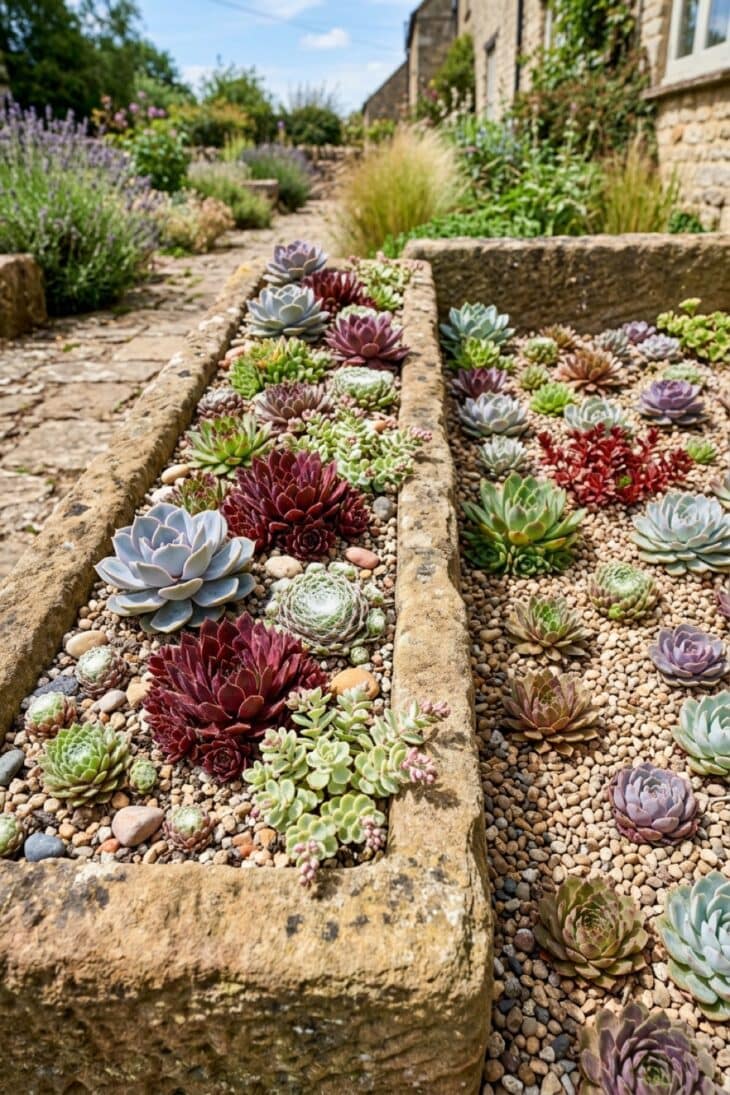
What you see Dozens of succulent rosettes cover the surface of a raised gravel bed, packed shoulder to shoulder in green, burgundy, silver, and copper. Sempervivums push out offsets to fill every gap. The whole bed looks after itself from one year to the next.
Why it works Sempervivums are arguably the most maintenance-free plant in cultivation. They are fully hardy, completely drought-tolerant, and produce offsets that fill empty spaces without any help. They ask only for good drainage and full sun.
How to get it Plant into very free-draining soil or a raised bed filled with 50% horticultural grit and 50% topsoil, and top-dress with fine gravel to show off the rosettes. Good varieties include Sempervivum ‘Commander Hay’ (dark red), ‘Othello’ (burgundy), ‘Silver King’ (silver-green), and ‘Reinhard’ (green with red tips). Sedum spurium ‘Dragon’s Blood’ and Jovibarba sobolifera work well between rosettes. Remove dead flower heads after blooming; the rosette that flowered dies, but offsets immediately replace it.
16. Spring Bulb Woodland Garden
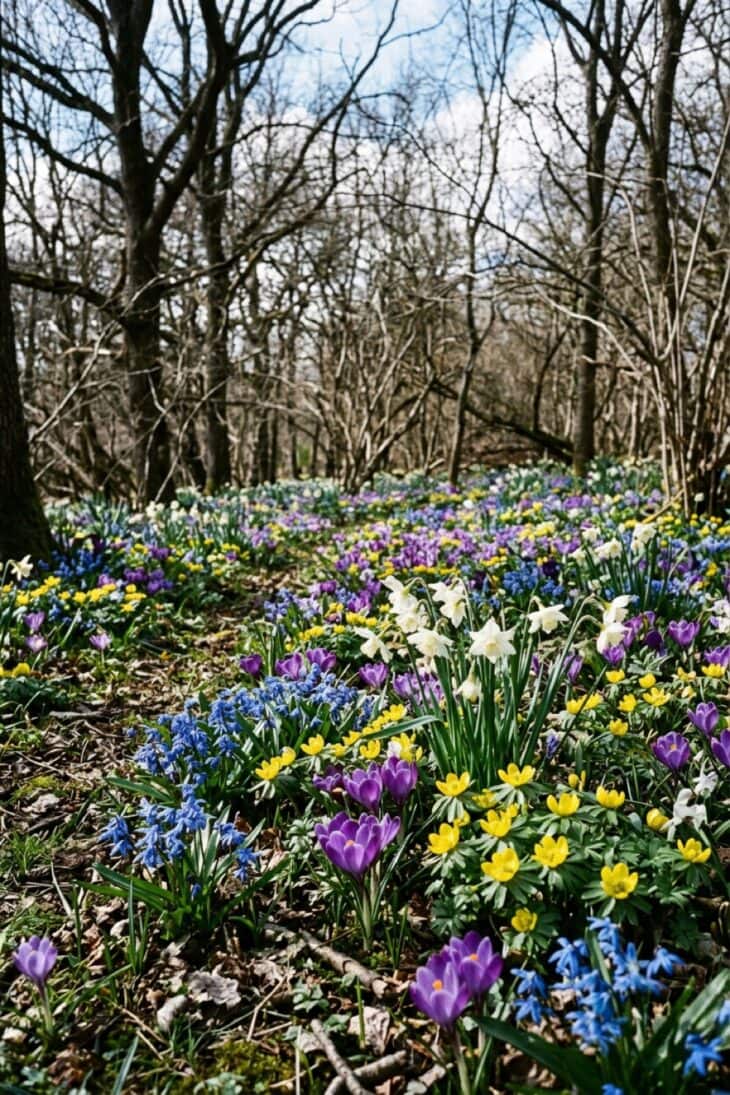
What you see Blue Scilla covers the ground under bare-branched trees in early March, with white narcissus and crocus coming through the leaf litter alongside. By April the show is over and the trees leaf out to hide the dying foliage. The following spring it returns without any intervention.
Why it works Naturalised bulbs are the definition of plant-once, enjoy-for-decades gardening. They multiply year on year, filling bare ground under trees where almost nothing else thrives. The only rule is to leave the foliage until it dies back naturally, which feeds the bulb for the following year.
How to get it Plant in autumn in drifts rather than rows for a natural look, using a bulb planter or pointed spade for large areas. The most reliable naturalisers include Scilla siberica, Crocus tommasinianus, Eranthis hyemalis, Narcissus ‘Thalia’, and Cyclamen coum. Plant at three times the depth of the bulb and leave the area undisturbed. They will multiply each year; divide only if flowering diminishes after many seasons.
17. Bamboo Privacy Garden
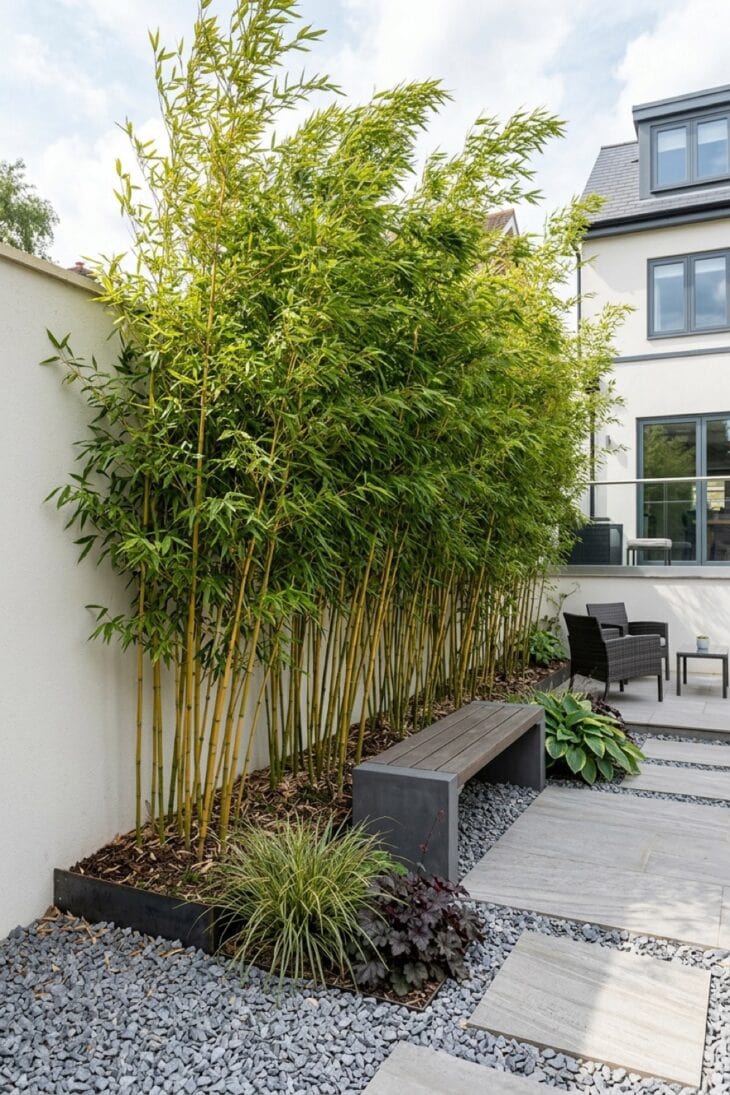
What you see Golden-green bamboo canes rise 4 metres against a rendered wall, forming a dense screen that blocks the view of neighbouring houses entirely. The canes rustle in any breeze. In front, clean gravel extends to a simple wooden bench.
Why it works Bamboo provides the fastest, densest screening of any plant in a temperate garden. It requires no annual cutting and looks good in every season. The essential precaution is containment: running bamboo spreads aggressively if not planted in a root barrier or grown in a container.
How to get it Always use clump-forming bamboo or plant running types inside a bamboo root barrier, a 60cm (24in) deep polypropylene barrier buried in a loop around the planting area. Reliable clump-forming varieties include Fargesia robusta ‘Campbell’, Fargesia murielae ‘Simba’, and Phyllostachys vivax ‘Aureocaulis’ in contained situations. Feed once in spring with a balanced granular fertiliser. Thin out congested canes at ground level every three years by cutting old stems at the base.
18. Rain Garden
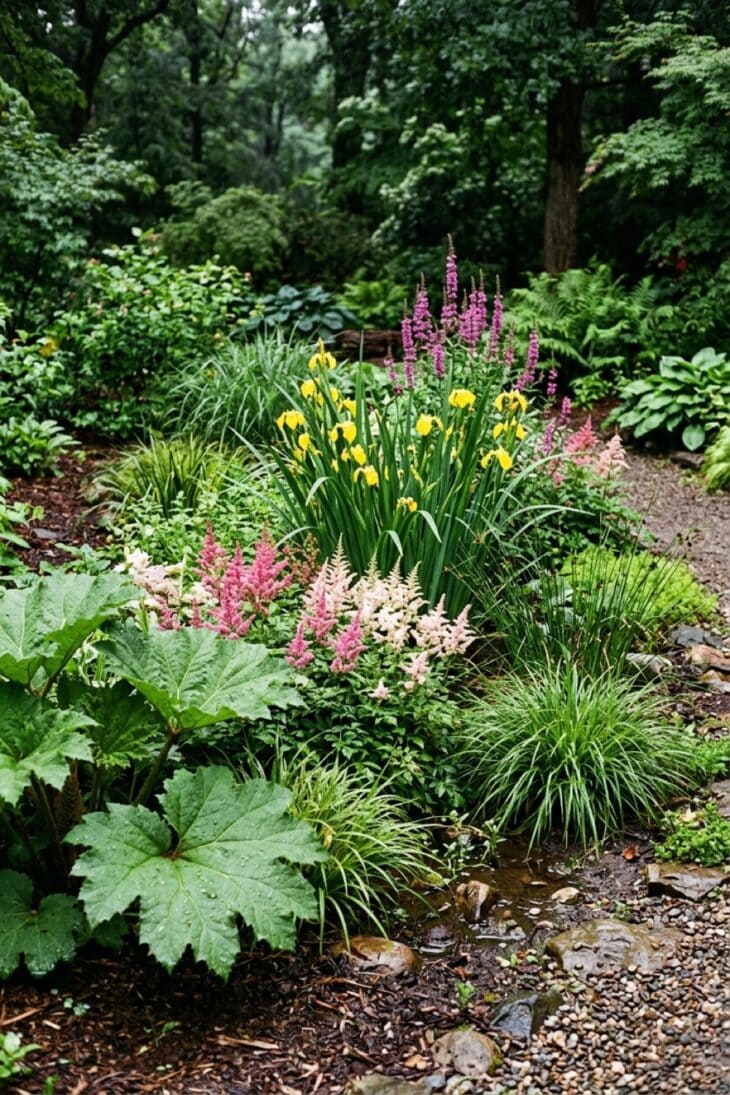
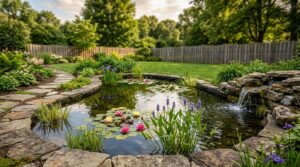
What you see A shallow planted depression captures rainwater from the surrounding garden, channelling it into a lush planting of iris, Lythrum, and Gunnera. After heavy rain the plants stand in water for a day or two, which suits them perfectly. In dry spells the basin empties and the plants wait patiently.
Why it works A rain garden is a planted area designed to capture and slowly absorb surface water runoff. It solves the problem of waterlogged low spots while creating a planting opportunity for plants that tolerate both wet and dry conditions. Once established, rainfall does all the watering.
How to get it Site a rain garden in a natural low point that collects water from paving, a roof, or a lawn. Dig a shallow basin 15 to 30cm (6 to 12in) deep with gently sloping sides, and improve drainage at the base with a layer of coarse gravel. Plant with species tolerant of periodic flooding: Iris pseudacorus, Lythrum salicaria, Caltha palustris, Lobelia cardinalis, Astilbe, and Carex pendula. No irrigation is needed once plants establish in the second season.
19. Clipped Topiary Garden

What you see Yew pyramids anchor the far end of a path edged with low box, and clipped spheres punctuate the planting on either side. Every form is clean and deliberate. The garden looks as good in November as in July because it is made of structure, not flowers.
Why it works Topiary is low maintenance in the truest sense: it requires one or two clips per year and nothing else. Yew is the gold standard for large shapes, growing slowly but reliably and tolerating very hard cutting if renovation is ever needed. Box works well for low edging and balls but is susceptible to blight in humid conditions.
How to get it Clip yew (Taxus baccata) once in late August for a clean shape that holds through winter. Clip box (Buxus sempervirens) twice: once in late May and again in August. For blight-resistant alternatives to box, try Ilex crenata ‘Dark Green’, Euonymus japonicus, or Lonicera nitida ‘Lemon Beauty’. Feed topiary with a slow-release fertiliser in spring, and water young plants in their first two summers. Established specimens need no irrigation.
20. Weed-Suppressing Ground Cover Under Trees
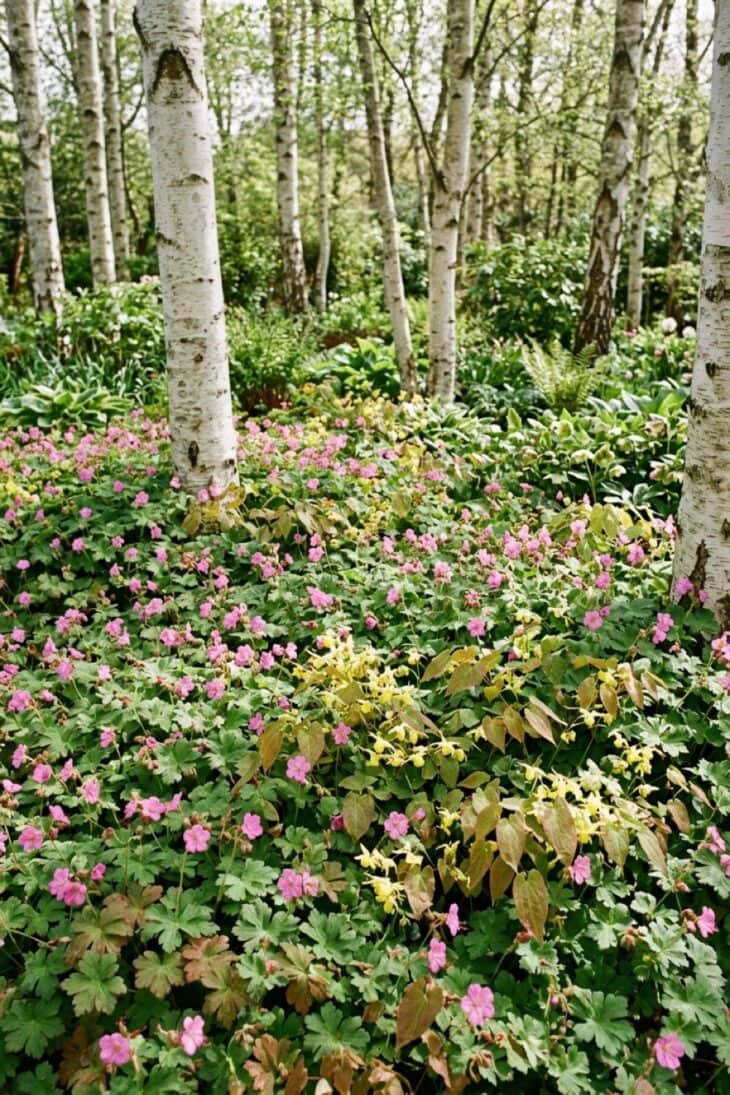
What you see Pink Geranium macrorrhizum and yellow epimedium cover every centimetre of ground beneath a silver birch canopy. Not a weed in sight. The planting has been doing this for three years without any help.
Why it works The two best weed-suppressors for dry shade under trees are Geranium macrorrhizum and Epimedium x versicolor. Both are semi-evergreen, aromatic, and vigorous enough to outcompete almost anything. They spread by rhizome to fill gaps, forming a seamless carpet that needs cutting back at most once a year.
How to get it Plant Geranium macrorrhizum 45cm (18in) apart in autumn or spring: it tolerates very dry, rooty soil once established. Pair with Epimedium x versicolor ‘Sulphureum’ for spring colour; cut the old foliage back to the ground in February before the new flowers emerge. Both plants establish slowly in the first year but spread quickly from the second. Water in dry spells in the first summer only.
21. Alpine Rock Garden
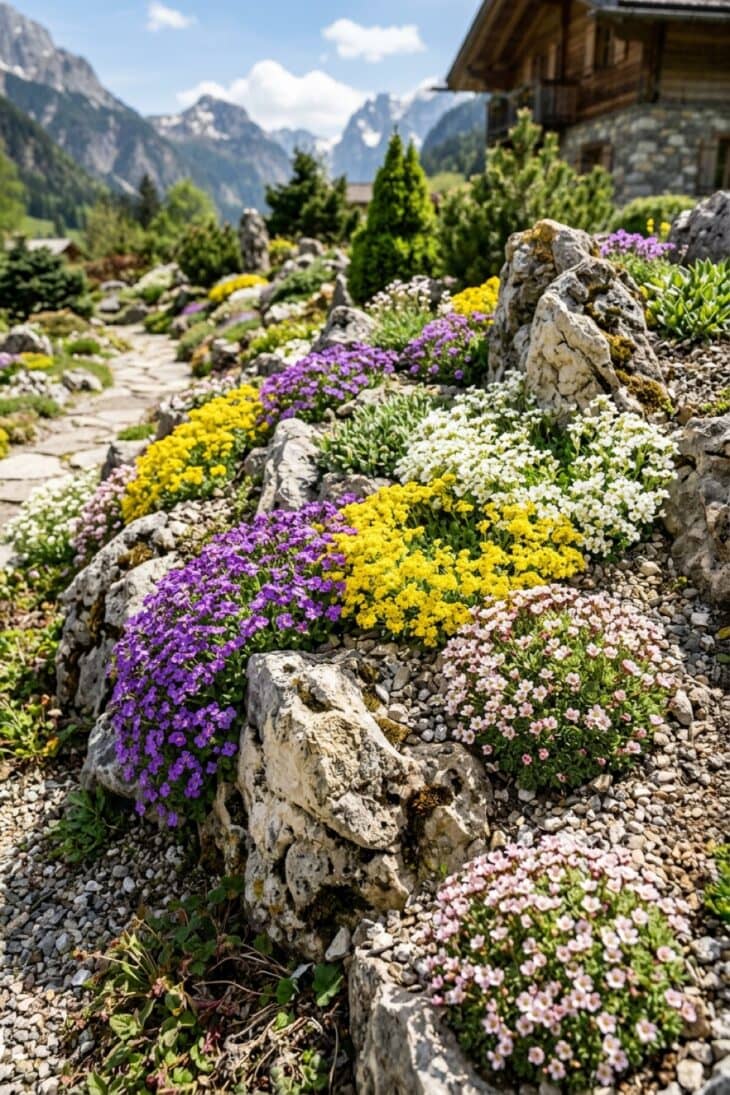
What you see Aubrieta cascades over limestone in purple and mauve, with yellow Alyssum and white Arabis filling the gaps between rocks. The whole assembly looks like a miniature mountain valley. It is at its best in April, and then settles into a neat carpet of foliage for the rest of the year.
Why it works Alpine plants evolved on exposed mountain ridges with thin, rocky soil, blazing sun, and almost no nutrition. They ask for the same in the garden. Give them sharp drainage, full sun, and poor soil, and they thrive with zero attention.
How to get it Build the rock garden on a slight slope for natural drainage. Use limestone or sandstone rocks of a consistent type, embedding them two-thirds into the ground at the angle a natural outcrop would show. Fill between them with 50% grit and 50% John Innes No. 1 compost. Plant alpines densely in the crevices: Aubrieta deltoidea, Alyssum saxatile, Arabis alpina ‘Snowcap’, Phlox subulata, Armeria maritima, and Sempervivum all work beautifully. Trim back lightly after flowering to keep plants compact.
22. Bog Garden with Architectural Plants
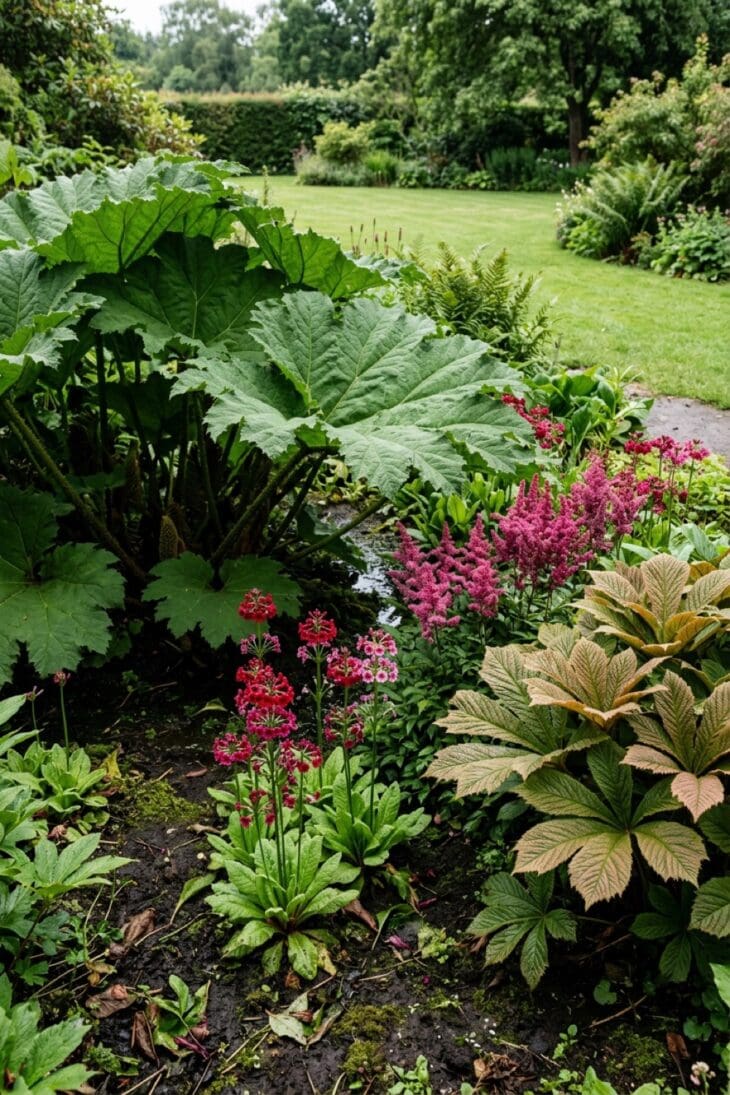
What you see Gunnera leaves the size of parasols shade a planting of Rodgersia, Astilbe, and candelabra primulas at the edge of a permanently damp garden area. The planting is enormous and architectural, and it arrives every year without being asked.
Why it works A bog garden turns a problem area into an asset. Plants chosen for permanently moist soil are among the most dramatic in horticulture. They grow fast, fill space quickly, and need no watering, feeding, or mulching once established in the right conditions.
How to get it A true bog garden sits in naturally moist or seasonally flooded ground. To create one artificially, line a shallow excavation with butyl rubber, puncture it a few times for slow drainage, and backfill with a 50:50 mix of soil and compost. Plant Gunnera manicata only in large gardens where its enormous size is an asset. Rodgersia pinnata ‘Superba’, Astilbe x arendsii varieties, Primula japonica, Iris sibirica, and Ligularia dentata ‘Desdemona’ are all reliable. Cut down in autumn; no other maintenance needed.
23. Wildlife Hedgerow Border
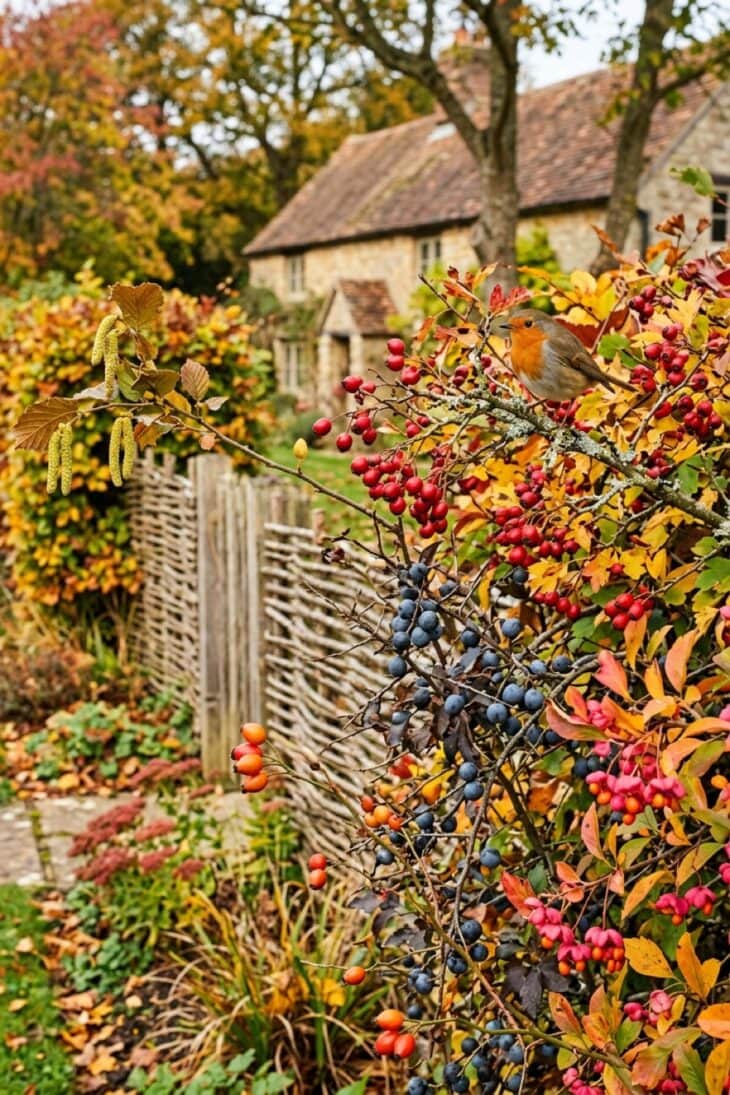
What you see Hawthorn berries hang in clusters alongside blackthorn sloes and rose hips, with a robin perched in the middle. The hedgerow has turned amber and copper in October. It is doing more for the garden’s wildlife than any other feature, and it asked for almost nothing.
Why it works A mixed native hedgerow provides boundary screening, wind shelter, wildlife habitat, and year-round interest in one single planting. It is pruned once a year in winter. Birds, hedgehogs, and insects use it constantly from one end of the year to the other.
How to get it Plant a mix of native species for maximum wildlife value: hawthorn (Crataegus monogyna), blackthorn (Prunus spinosa), field rose (Rosa arvensis), hazel (Corylus avellana), and spindle (Euonymus europaeus). Plant bare-root whips in November to March at 30cm (12in) apart in a double staggered row. Cut back hard after planting to encourage bushy growth from the base. Trim once each winter between January and February after the berries have been eaten. Feed with nothing: native plants perform better in poor soils.
24. Hardscape Garden with Planted Gaps
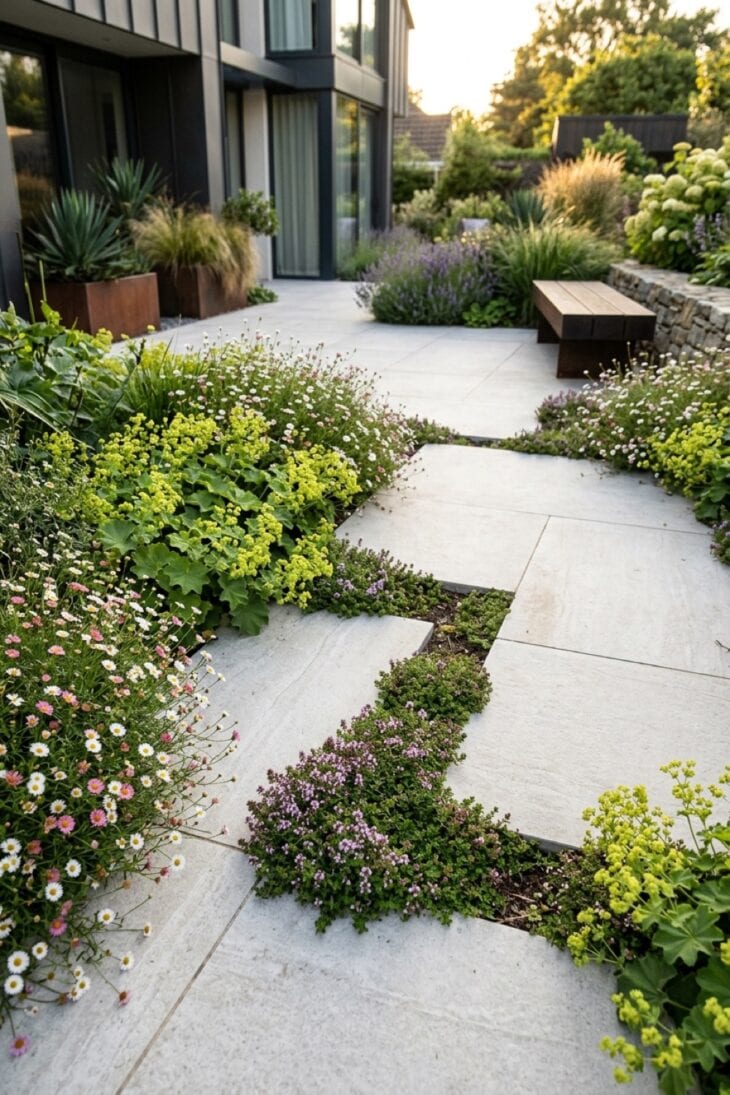
What you see Large pale porcelain tiles cover most of the garden, with Mexican fleabane flowering in the cracks and Alchemilla mollis frothing along the edges. Creeping thyme fills the deliberate gaps, releasing fragrance when brushed. The garden is mostly hard surface, but it does not feel like it.
Why it works A hardscape-heavy garden is the most reliably low-maintenance option because there is simply less growing medium for weeds to colonise. The small planted areas are easy to manage. And well-chosen gap plants, once established, spread to self-maintain.
How to get it Erigeron karvinskianus self-seeds prolifically in cracks, produces flowers from May to November, and needs no deadheading: it is one of the best plants for softening paving. Alchemilla mollis self-seeds similarly and can be cut back hard in July for a fresh flush of foliage. Creeping thyme (Thymus serpyllum) tolerates light foot traffic. Leave 5 to 10cm (2 to 4in) gaps in paving at laying time, or break out existing mortar, and fill with free-draining gritty compost before planting.
25. Smart Irrigation Garden
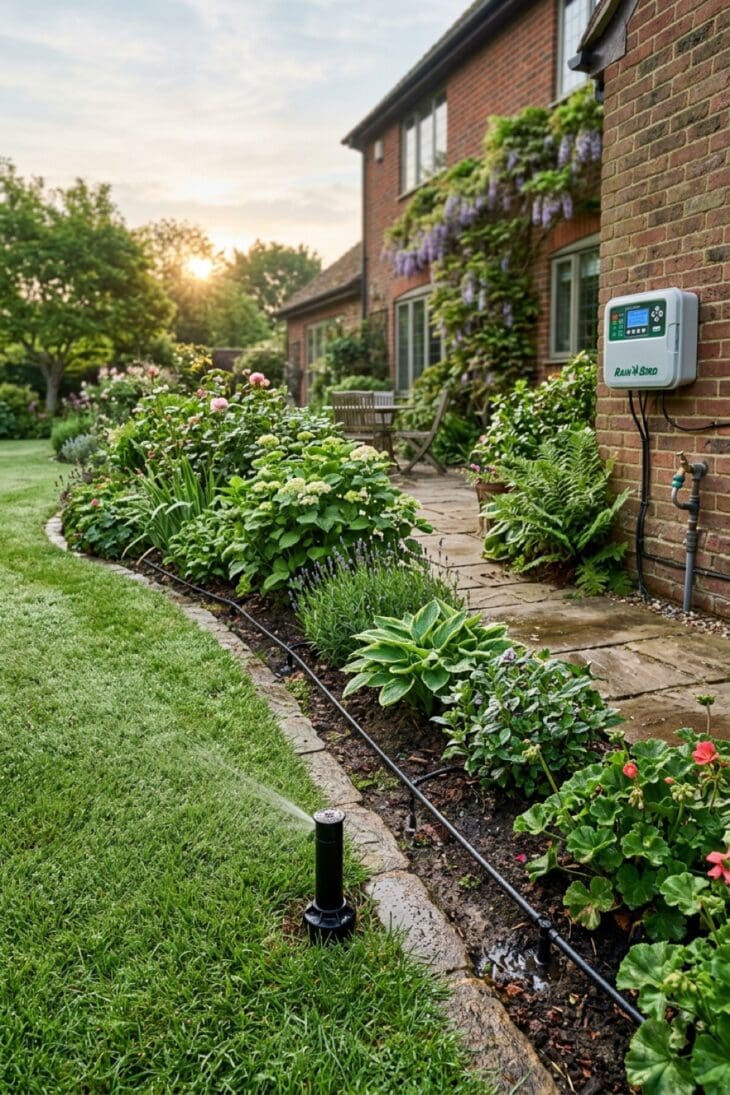
What you see Pop-up sprinklers retract into a perfectly watered lawn at 6am, and drip lines finish the border by 7am, all controlled from a phone app. The garden is lush and green, and no one has held a hose in months. The system monitors rainfall and adjusts automatically.
Why it works Smart irrigation eliminates the biggest time cost in any garden. Modern controllers connect to local weather data and skip scheduled watering if rain is forecast. Installed once, they reduce water use by 30 to 50% compared with manual watering while producing healthier, more consistently watered plants.
How to get it The Rachio 3 and Orbit B-Hyve are both well-regarded smart controllers compatible with most existing irrigation systems. Run separate zones for lawn, borders, and containers with different timing and frequency. Set the lawn to water three times per week for 20 minutes in summer and once per week in spring and autumn. Borders need less: 20 minutes twice a week in summer is usually sufficient. Check heads and emitters each spring before the season starts.