Summers are getting longer and hosepipe bans are getting more common, and a garden built around thirsty lawns and bedding plants starts to look like a losing battle by mid-July. The good news is that the plants which shrug off drought are some of the most beautiful things you can grow: silver foliage, wiry stems, seed heads that catch low sun, and flowers that keep going when everything else has given up.
Contents
- 01. Swap the Thirsty Lawn for a Gravel Garden
- 02. Frame the Driveway with Agave and Boulders
- 03. Build a Mediterranean Terrace Around Olive and Lavender
- 04. Carve a Dry Riverbed Through the Garden
- 05. Group Succulents in Terracotta on a Sunny Step
- 06. Plant a Prairie Sweep of Ornamental Grasses
- 07. Cap the Shed with a Sedum Living Roof
- 08. Set a Rock Garden into a Sun-Baked Bank
- 09. Sow a Pollinator Strip of Nectar-Rich Perennials
- 10. Lay a Deep Grit Mulch and Stop Watering
- 11. Grow a Desert Bed of Cactus and Yucca
- 12. Shade a Seating Corner with a Vine-Clad Pergola
- 13. Terrace a Dry Slope with Low Stone Walls
- 14. Plant a Silver and Blue Foliage Border
- 15. Fill an Old Trough with Houseleeks and Ice Plant
- 16. Grow a Herb Bed That Thrives on Neglect
- 17. Harvest Rainwater and Irrigate by Drip
- 18. Anchor the Planting with Structural Evergreens
- 19. Seed Creeping Thyme into Paving Cracks
- 20. Build a Hot-Color Border for Late Summer
- 21. Turn a Small Courtyard into a Shaded Sun Trap
- 22. Shelter the Plot with a Drought-Tolerant Hedge
- 23. Raise a Free-Draining Gravel Berm
- 24. Let Self-Seeders Colonize the Gaps
- 25. Plant a Multi-Stem Shade Tree and Underplant It
The 25 ideas below run from whole-plot rethinks to a single afternoon’s work. Some suit a baking front drive in Arizona, others a windy slope in Spain or a small paved courtyard that turns into an oven every August. There are cheap fixes (a deep grit mulch, a trough of houseleeks) and bigger projects (a terraced bank, a dry riverbed), so there is something here whether you are starting from bare soil or editing a garden you already love.
Scroll through and pick the ones that match your soil, your sun, and your patience. Most of these ideas layer happily on top of each other, and almost all of them ask for less of your time, not more, once the plants are in and settled.
01. Swap the Thirsty Lawn for a Gravel Garden
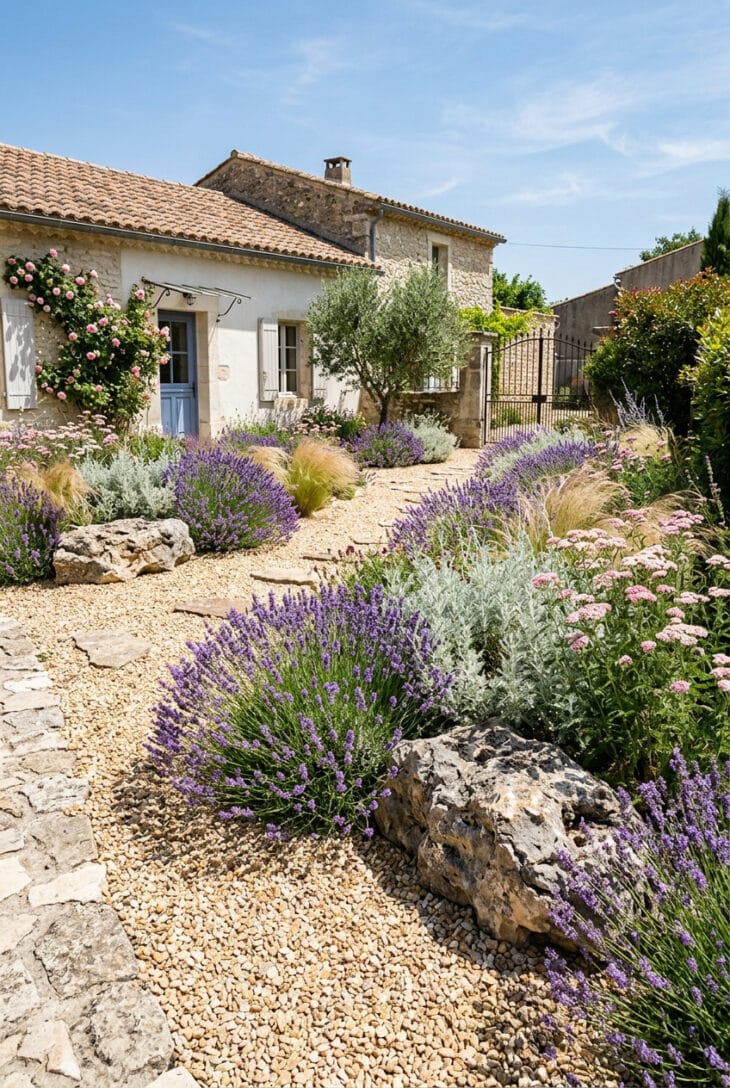
What you see Where a rectangle of tired grass used to be, there is now a sheet of pale honey gravel with plants growing straight out of it. Lavender and silver artemisia sit in loose drifts, achillea holds its flat pink plates above them, and bronze grasses catch the light at the edges. Nothing is edged, nothing is mown, and the whole thing hums in the heat.
Why it works A lawn is the single thirstiest thing in most gardens, and in a dry climate it spends half the year brown anyway. Gravel does the opposite: it keeps the soil surface dry so weed seeds struggle, while the cool damp layer underneath holds moisture at root level exactly where the plants want it. You are trading a feature that needs water, feeding and weekly mowing for one that needs almost nothing.
How to get it Strip the turf, then improve drainage by forking in sharp sand or grit if your soil is heavy. Plant everything first, water it in well, then spread 3 to 4in (8 to 10cm) of 10 to 20mm gravel over the whole area, working it right up to the crowns. Do not lay landscape fabric underneath: it stops self-seeders and blocks the gravel from mixing into the soil surface, which is half the point. Choose a gravel that matches local stone rather than a bright white chip, which glares in strong sun. Our full guide to gravel garden ideas covers the plant palette in more depth.
02. Frame the Driveway with Agave and Boulders
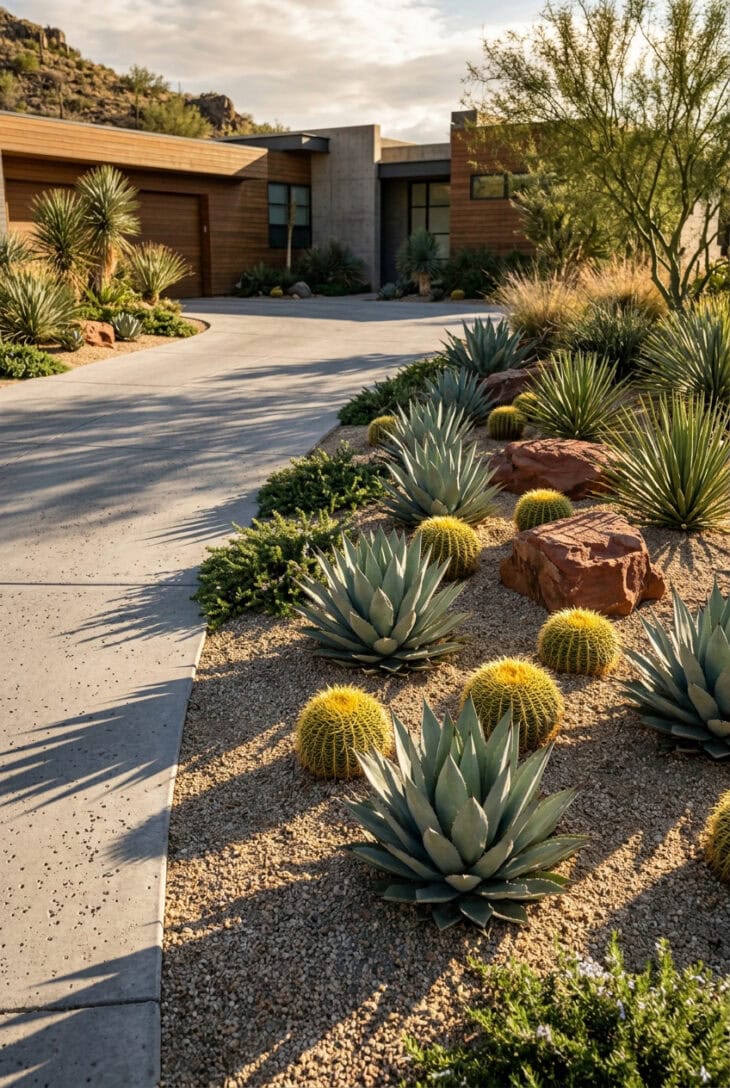
What you see Big blue-gray agave rosettes flank a pale concrete drive like sculpture, each one throwing a hard shadow across decomposed granite. Golden barrel cacti sit low between them, round and fat, and a few rust-red boulders break up the run. In late sun the whole strip glows and the leaf edges look almost drawn on.
Why it works A driveway edge is the hottest, most reflective, worst-drained strip in most gardens, and it kills ordinary bedding within a season. Agave positively enjoys it. Because the shapes are strong and simple, you only need a handful of plants to make the space feel designed, which keeps the cost of a big front garden planting reasonable.
How to get it Use century plant (Agave americana) if you have room, or the smaller Agave parryi in a tighter strip. Plant at least 3ft (90cm) back from where car doors open, because the spines are genuinely dangerous, and snip the terminal spine off with secateurs where children pass. Set each plant slightly proud of the surface on a mound of grit so water runs away from the crown. Space them 4 to 5ft (120 to 150cm) apart and resist filling the gaps: the space between them is what makes it read as design rather than clutter.
03. Build a Mediterranean Terrace Around Olive and Lavender
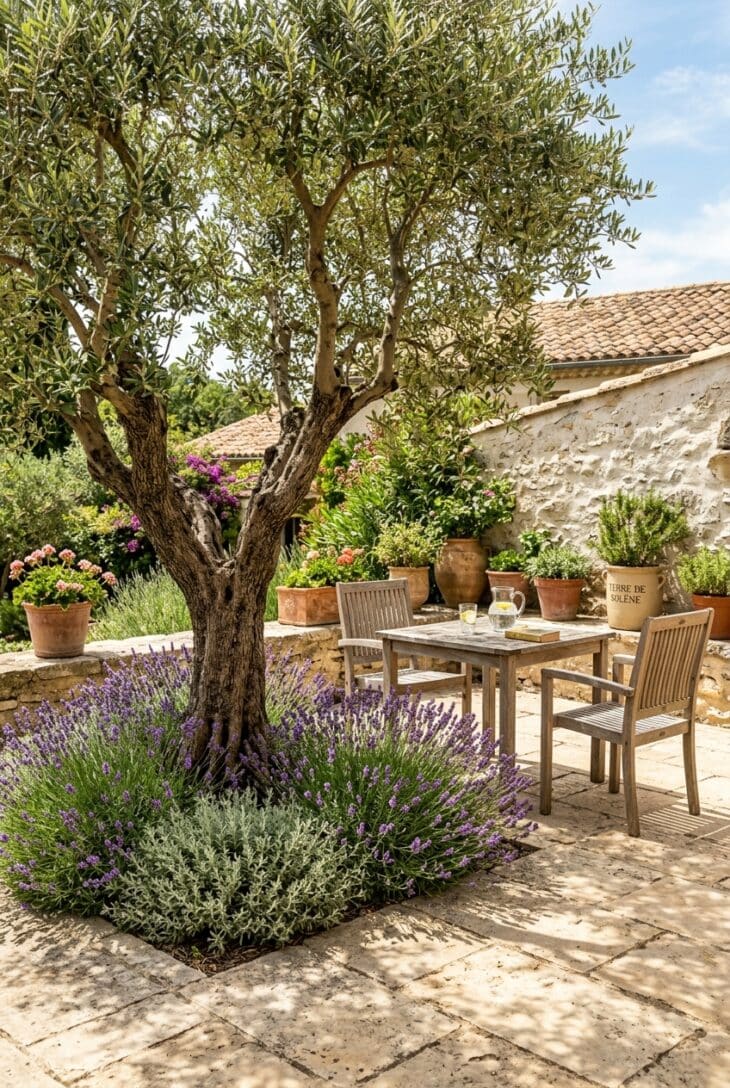
What you see Buff limestone paving, warm underfoot, with a multi-stem olive rising out of a square pocket cut into the stone. Lavender and silver santolina mound over the edges and soften every hard line. A small table sits in the olive’s dappled shade, and the whole terrace smells of resin by mid-afternoon.
Why it works This is the classic dry-climate answer to outdoor living: hard surface for people, tough aromatic plants for everything else, and one tree doing the work of a parasol. Olive, lavender and santolina all evolved in thin stony soil with a long summer drought, so the conditions a terrace creates (fast drainage, reflected heat, no irrigation) are exactly what they want. It ages well too, because the stone weathers and the olive thickens.
How to get it Leave a planting pocket at least 4ft by 4ft (120 by 120cm) for the olive and break out the sub-base properly underneath, not just the top layer. Choose a hardy olive variety if you get frost, and check our roundup of olive tree varieties before you buy, since cold tolerance differs a lot between them. Plant English lavender (Lavandula angustifolia ‘Hidcote’) 18in (45cm) apart along the terrace edge and prune it hard every year after flowering, cutting into green growth but never into bare wood. For more ways to furnish the space, see our patio garden ideas.
04. Carve a Dry Riverbed Through the Garden
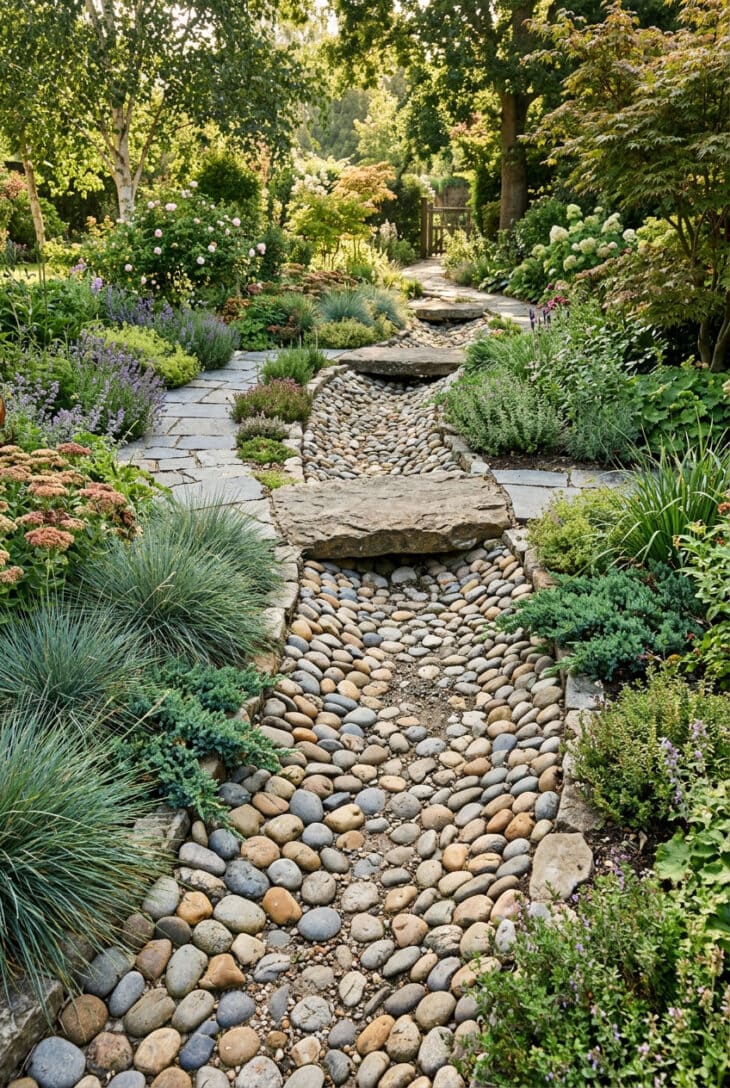
What you see A channel of smooth rounded cobbles snakes through the planting, wide in one place and pinched in another, exactly as water would have left it. Flat stepping stones cross it at one point. Grasses and low junipers lean in over the banks, and although there has not been water in it for months, the eye reads it as a stream.
Why it works A dry riverbed is the rare garden feature that is beautiful and genuinely functional. It gives a flat plot movement and a sense of route, and when a summer downpour does arrive it becomes a working drainage channel that carries runoff away from the house and lets it soak in slowly instead of sheeting off. It also gives you a legitimate reason to plant the things that love a gravelly bank.
How to get it Follow the ground’s natural fall rather than fighting it, and dig a shallow dish 12 to 18in (30 to 45cm) deep and two to three times as wide as it is deep. Line it with permeable membrane, then grade the stone: larger cobbles and the odd boulder at the edges, smaller washed pebbles in the centre where the current would have run. Vary the width as you go, because a channel of constant width reads as a trench. Plant the banks so foliage breaks the outline in three or four places, otherwise the stones look like a delivery rather than a riverbed.
05. Group Succulents in Terracotta on a Sunny Step
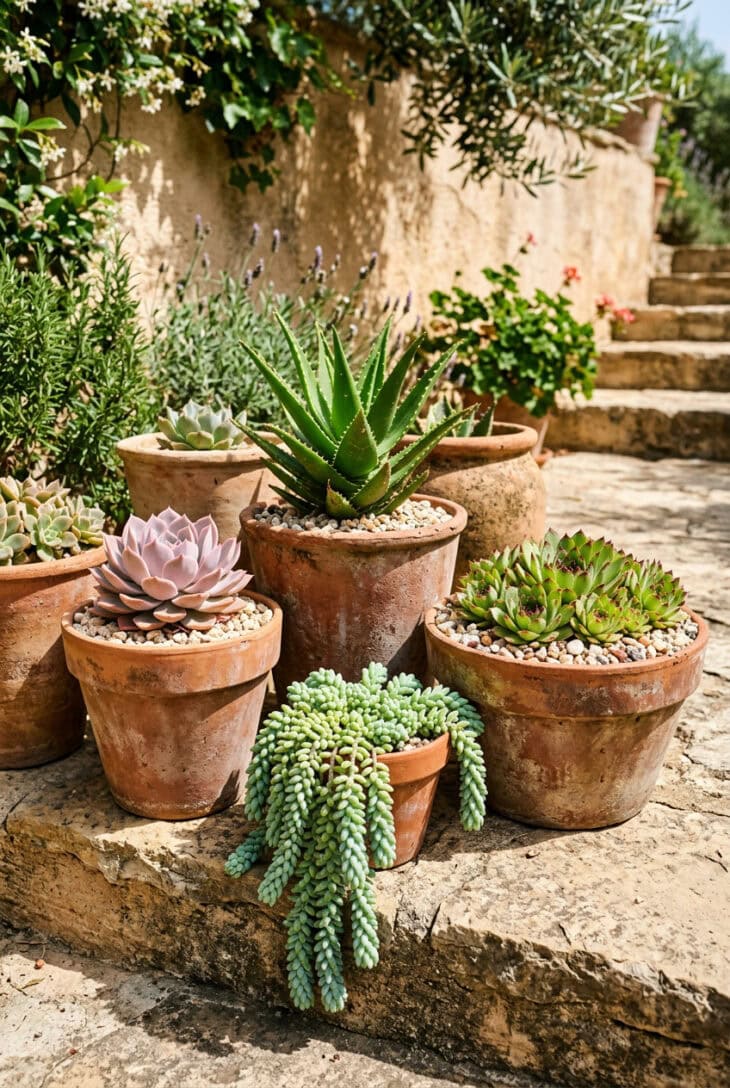
What you see Six or seven weathered terracotta pots of different heights, huddled on a flight of warm stone steps. One holds a dusty pink echeveria rosette, another a spiky aloe, and burro’s tail trails over a rim and down the step below. Every pot is top-dressed with pale grit, which throws light back up into the leaves.
Why it works Succulents in pots are the fastest drought-tolerant win there is: no digging, no irrigation, and you can move the tender ones under cover when the weather turns. Grouping them matters more than the individual plants, because a collection reads as a composition while single pots dotted around read as clutter. Terracotta is the right material precisely because it breathes and dries out fast, which is a bug for most plants and a feature for these.
How to get it Use a gritty mix of two parts peat-free compost to one part sharp sand or perlite, and never leave a pot standing in a saucer of water. Group in odd numbers, vary the heights, and repeat one plant across two or three pots to tie the group together. Aloe vera (Aloe barbadensis miller) is a good anchor because it is upright, forgiving, and useful in the kitchen. Water deeply but only when the compost is bone dry to a finger’s depth, which in high summer may still mean once a week. Our container garden ideas have more on grouping pots well.
06. Plant a Prairie Sweep of Ornamental Grasses

What you see A drift of grasses running away from you, lit from behind by low evening sun so that every seed head is outlined in gold. Fine pale feather grass in front, taller blue-green switchgrass behind, rust-red spikes threaded through. The whole planting moves constantly, and the tips blur as the wind crosses it.
Why it works Prairie and steppe grasses evolved in places with hot dry summers and no irrigation, so they are drought-tolerant by design rather than by compromise. They also solve the biggest problem with a dry garden, which is that it can look static and hard. Grasses bring movement, sound and a long season of interest, holding their shape from June right through to the frosts and often beyond.
How to get it Plant in generous drifts of five or seven of one species rather than singles, and always plant grasses where they will be backlit for part of the day, because that is when they earn their keep. Mexican feather grass (Nassella tenuissima) is superb but self-seeds hard and is invasive in parts of California, so check local guidance and choose blue grama (Bouteloua gracilis) instead where it is a problem. Cut deciduous grasses back to 4in (10cm) in late winter, and simply comb the dead material out of evergreen ones with your fingers rather than cutting them.
07. Cap the Shed with a Sedum Living Roof
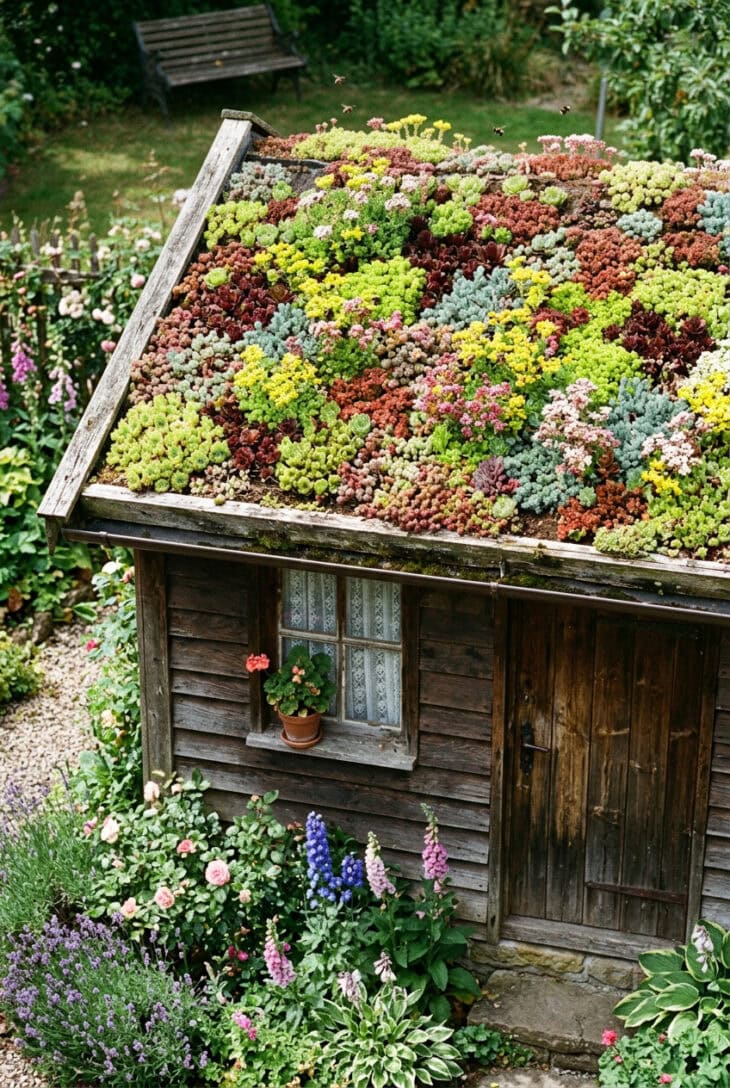
What you see The shed roof has become a low carpet of sedum, a patchwork of lime green, burgundy, rust and gray-blue rosettes with small yellow and pink flowers sitting just above them. The colors shift through the year and intensify in drought, when the plants stress and redden. Bees work it all morning.
Why it works A sedum roof is a garden in the one place you were not using, and it needs nothing: no watering, no mowing, no feeding. Sedums store water in their leaves and can sit through weeks of drought on 2in (5cm) of substrate. The roof also insulates the building, slows rainwater runoff, and gives pollinators a nectar source at head height where nothing competes with it.
How to get it Check the structure first, because a saturated sedum roof weighs around 20 to 25 lb per square foot (100 to 120 kg per square metre) and many sheds need extra rafters. Build up in layers: waterproof membrane, root barrier, drainage layer, then 2 to 4in (5 to 10cm) of free-draining green-roof substrate, which is mostly crushed brick or lightweight aggregate rather than compost. Lay pre-grown sedum mats for instant cover, or scatter cuttings in spring for a slower and much cheaper result. Keep the pitch under 20 degrees, and water it in the first summer only.
08. Set a Rock Garden into a Sun-Baked Bank
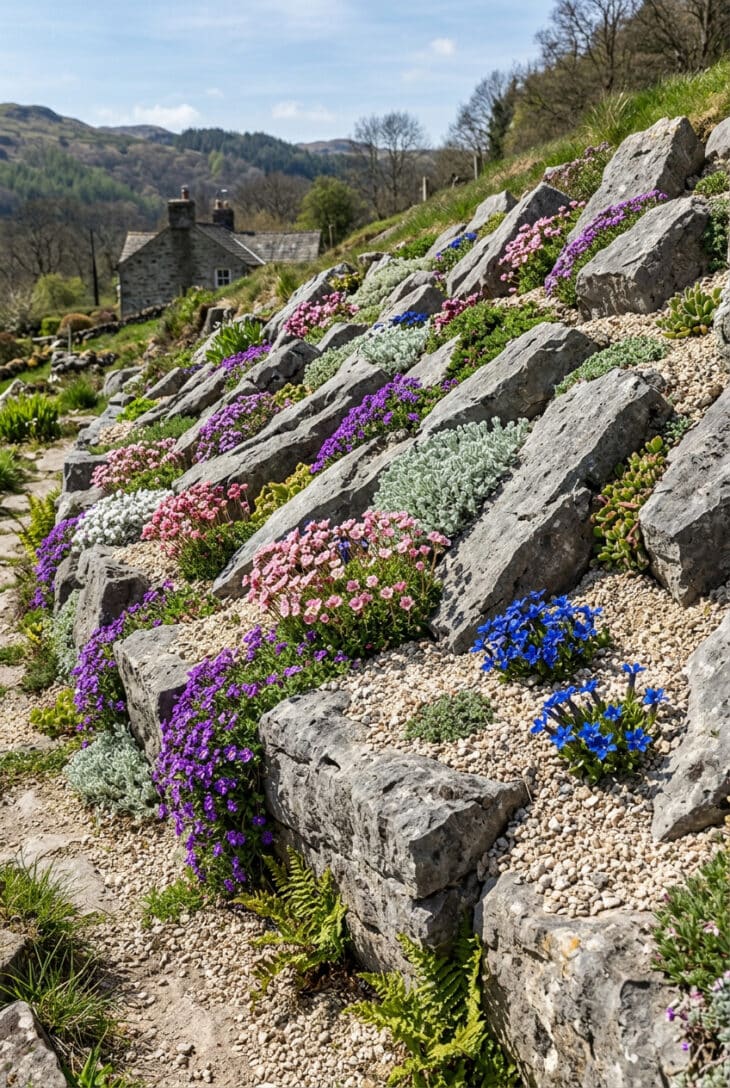
What you see Angular limestone slabs sit half-buried in a sunny bank, all tilting the same way so they read as one outcrop rather than a pile of rocks. Between them, tight cushions of pink saxifrage and silver foliage, with purple aubrieta pouring down over the stone. Pale grit fills every gap, and the whole bank drains within minutes of rain.
Why it works Alpines are drought specialists that most people never think of that way. They come from mountain scree where water drains away instantly and roots must go deep to find it, which is functionally identical to a hot dry bank in a garden. A slope that was a nuisance to mow and impossible to keep watered becomes the one spot where these plants are genuinely happy.
How to get it Bury at least one third of every rock, and set them all with their strata running the same direction, because that single detail is the difference between an outcrop and a rockery. Use one stone type only, ideally local. Backfill with a lean mix of one part topsoil to two parts grit, which sounds brutal but is what alpines want, then top-dress with 1in (2.5cm) of the same grit right up to each plant’s collar to stop the crowns rotting. Plant in autumn or early spring, and never feed.
09. Sow a Pollinator Strip of Nectar-Rich Perennials
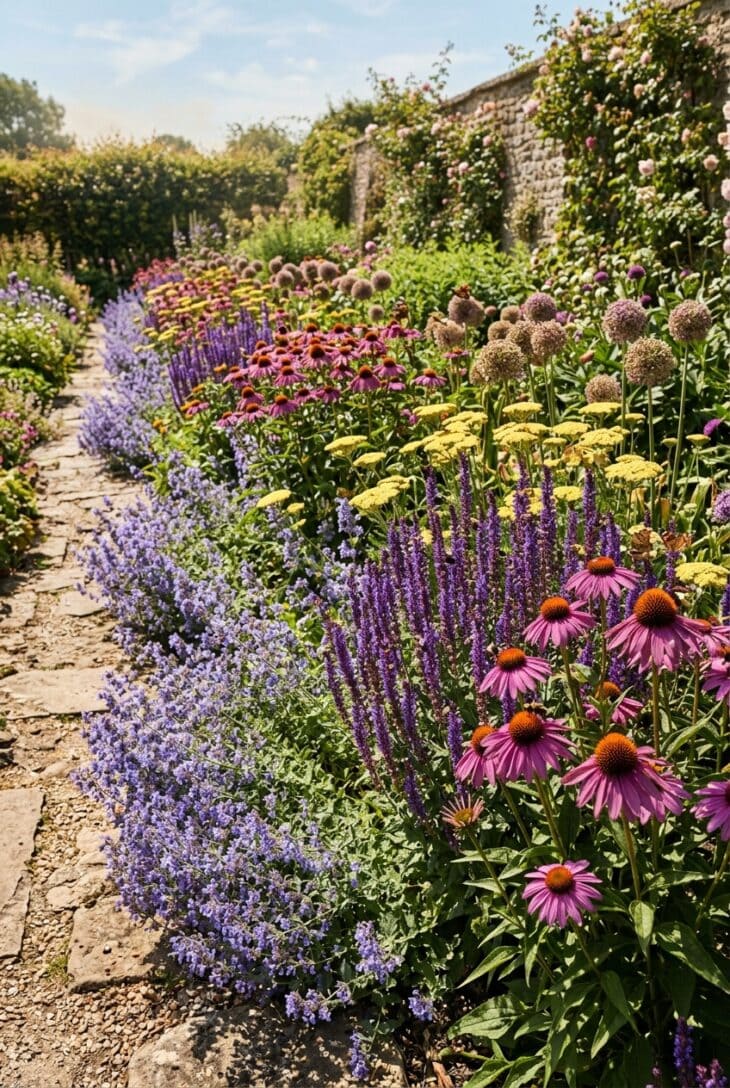
What you see A long strip in full sun, packed to bursting with purple coneflower, hazy blue catmint tumbling over the front edge, violet salvia spikes standing to attention, and flat yellow achillea plates acting as landing pads. Round purple alliums float above it all. On a hot afternoon the whole border is audibly busy.
Why it works There is a happy overlap between plants that tolerate drought and plants that feed pollinators, because both traits come from the same open, sunny, low-fertility habitats. Deep-rooted perennials like these find water long after annual bedding has wilted, and they flower for months rather than weeks. You get a border that survives a dry August and does something useful while it is at it.
How to get it Build the strip around long-flowering workhorses: purple coneflower (Echinacea purpurea), catmint (Nepeta ‘Six Hills Giant’), and Salvia nemorosa ‘Caradonna’. Plant in groups of three or five, 15 to 18in (38 to 45cm) apart, and let them knit into each other rather than leaving bare soil between clumps. Do not deadhead everything in autumn: leave the coneflower seed heads standing for goldfinches and for winter structure. Shear catmint back by half after the first flush and it will flower again within a month. Our wildlife garden ideas go further on what else the strip can support.
10. Lay a Deep Grit Mulch and Stop Watering
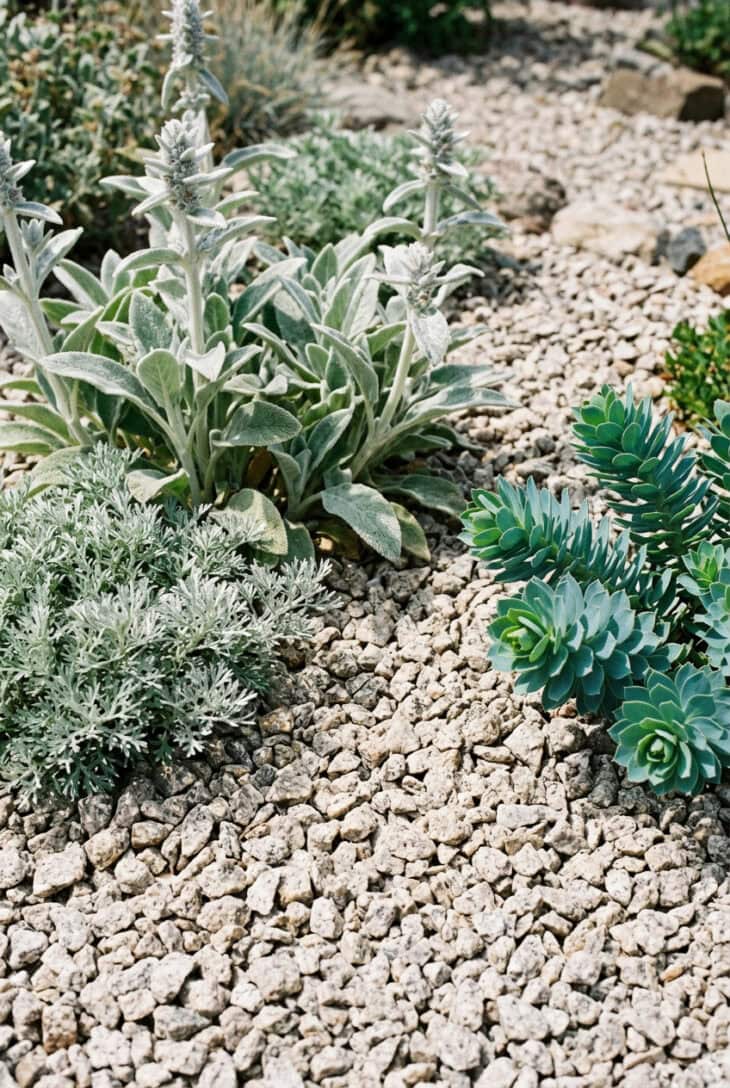
What you see A bed surfaced in several inches of pale angular grit, brought right up to the base of every plant. Silver foliage and a blue-green euphorbia push up through it. The surface is bone dry and bright in the sun, while the plants growing out of it look plump and entirely unbothered.
Why it works Most water lost from a garden never reaches a plant at all: it evaporates straight off bare soil. A deep mineral mulch breaks that path, keeping the soil beneath cool and damp while the surface stays dry and hostile to weed seedlings. Unlike bark, grit does not rot down, does not need topping up every year, and does not feed the soil, which suits dry-climate plants that resent richness.
How to get it Weed thoroughly first, because anything left under the mulch will come back through it. Water the bed deeply, then apply 3in (8cm) of 10 to 20mm grit or gravel, more than feels necessary, and pull it snug against the plant collars rather than leaving a bare ring. Then genuinely stop watering established plants: shallow frequent watering is what creates shallow roots and dependence, and one deep soak in a serious drought beats a daily sprinkle every time. For more in this vein, see our low maintenance garden ideas.
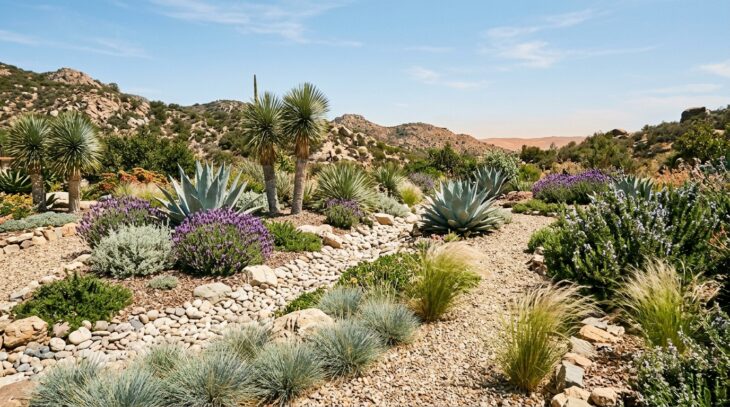
11. Grow a Desert Bed of Cactus and Yucca
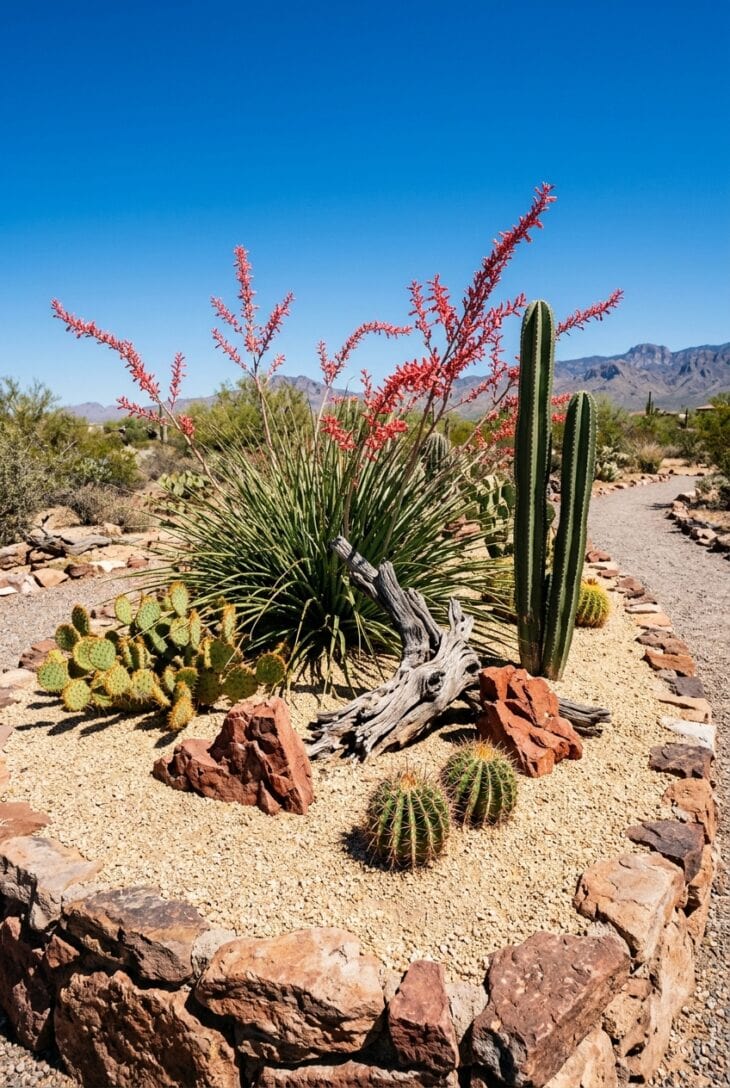
What you see A raised bed of pale decomposed granite planted like a scene from the Southwest: red yucca throwing up arching coral flower spikes, a columnar cactus standing sentry, low prickly pear pads clustering at the front. A piece of weathered dead wood sits among them like sculpture, and the sky behind is hard blue.
Why it works Nothing else gives you this much drama for this little water. The forms are so strong that the bed looks finished with very few plants, and it holds its shape all year, which is more than most perennial borders manage. It is also the correct answer for any spot with reflected heat off a south or west wall, where softer planting simply cooks.
How to get it Drainage is the whole game here, and cold wet soil in winter kills far more of these plants than cold ever does. Raise the bed at least 12in (30cm) and fill it with a very lean mix: roughly 70 percent grit or pumice to 30 percent topsoil, with no compost. Red yucca (Hesperaloe parviflora) is the most forgiving starting point and copes with far more cold than people expect. Plant in late spring so roots establish before winter, wear thick leather gloves, and keep spiny plants well back from paths.
12. Shade a Seating Corner with a Vine-Clad Pergola
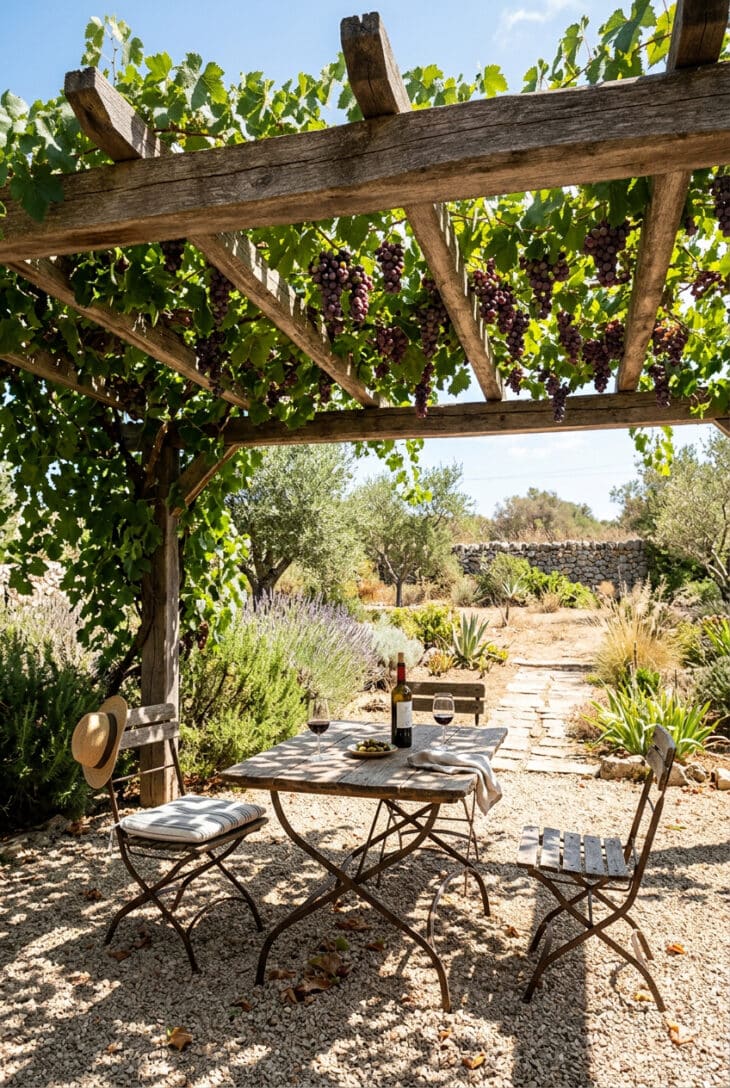
What you see A plain timber pergola smothered in grapevine, its leaves overlapping into a green ceiling that drops dappled shade over the table below. Bunches of grapes hang down between the beams. Beyond the posts the garden is blindingly bright, which makes the shade underneath feel like a different climate.
Why it works In a dry climate, shade is the most valuable thing a garden can produce, and a deciduous vine gives it to you exactly when you need it and then gets out of the way. In summer the canopy is dense and cools the space beneath by several degrees. In winter the leaves drop and low sun reaches the seating area again, which a solid roof or a canopy of evergreens would block all year.
How to get it Build the pergola at least 8ft (240cm) high, because vine growth will hang down 12in (30cm) or more and you do not want to duck. Grapevine (Vitis vinifera) or ornamental Vitis coignetiae both work; wisteria is glorious but needs a much stronger structure and twice the pruning. Plant the vine 18in (45cm) out from a post, not tight against it, and water it well for the first two summers only. Prune hard in midwinter back to a permanent framework, or you will end up with a tangle that keeps the light out and lets the rain through.
13. Terrace a Dry Slope with Low Stone Walls
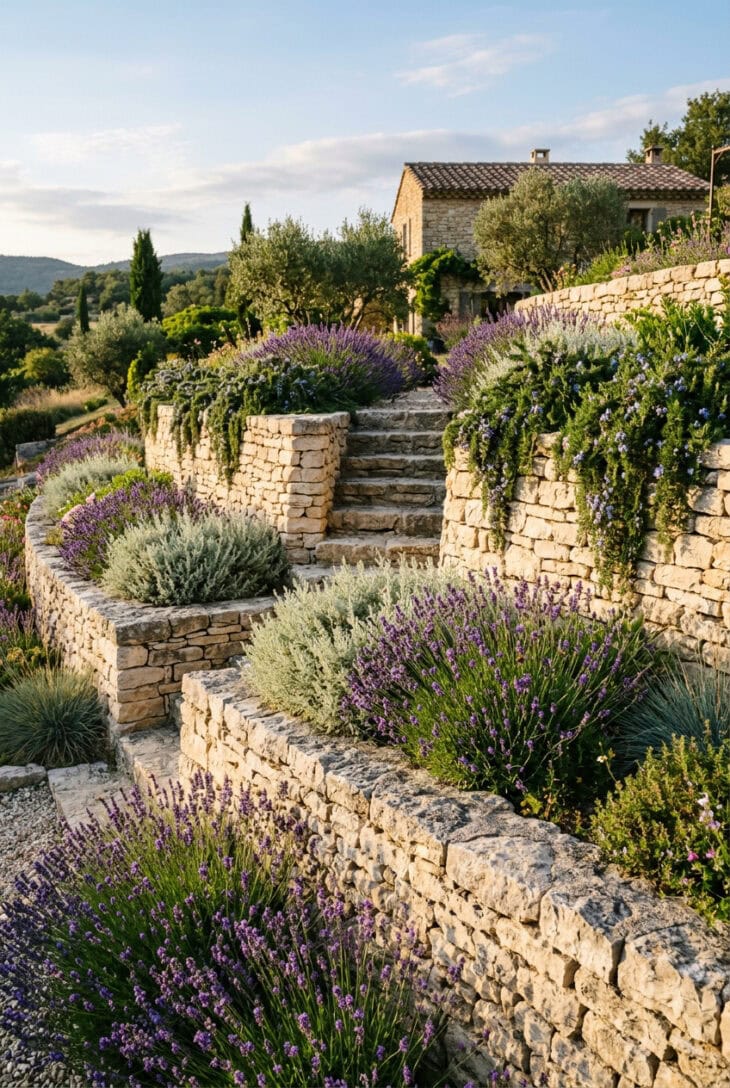
What you see A slope cut into three shallow steps, each held by a low dry-stone wall of pale local stone. Lavender and santolina mound on the flat parts, and rosemary pours over the wall faces and softens them. Stone steps climb through the middle, and in evening light the raking sun picks out every joint in the stonework.
Why it works On a slope, rain runs off before it can soak in, so a bank is always drier than the ground around it and its topsoil is forever heading downhill. Terracing stops both problems at once: each level holds water long enough to be absorbed, and the soil stays where you put it. The walls themselves then become prime planting real estate, since the crevices are hot, sharply drained and exactly what many Mediterranean plants prefer.
How to get it Keep individual walls under 3ft (90cm) high, above which you are into engineering and probably permits. Build dry-stone rather than mortared where you can: the gaps let water drain through instead of building pressure behind the wall, and they give you planting pockets for free. Batter the wall face, meaning lean it back into the slope by around 1in per 12in (2.5cm per 30cm) of height. Plant trailing rosemary or creeping thyme along the top edge so it spills forward and the wall never reads as bare.
14. Plant a Silver and Blue Foliage Border
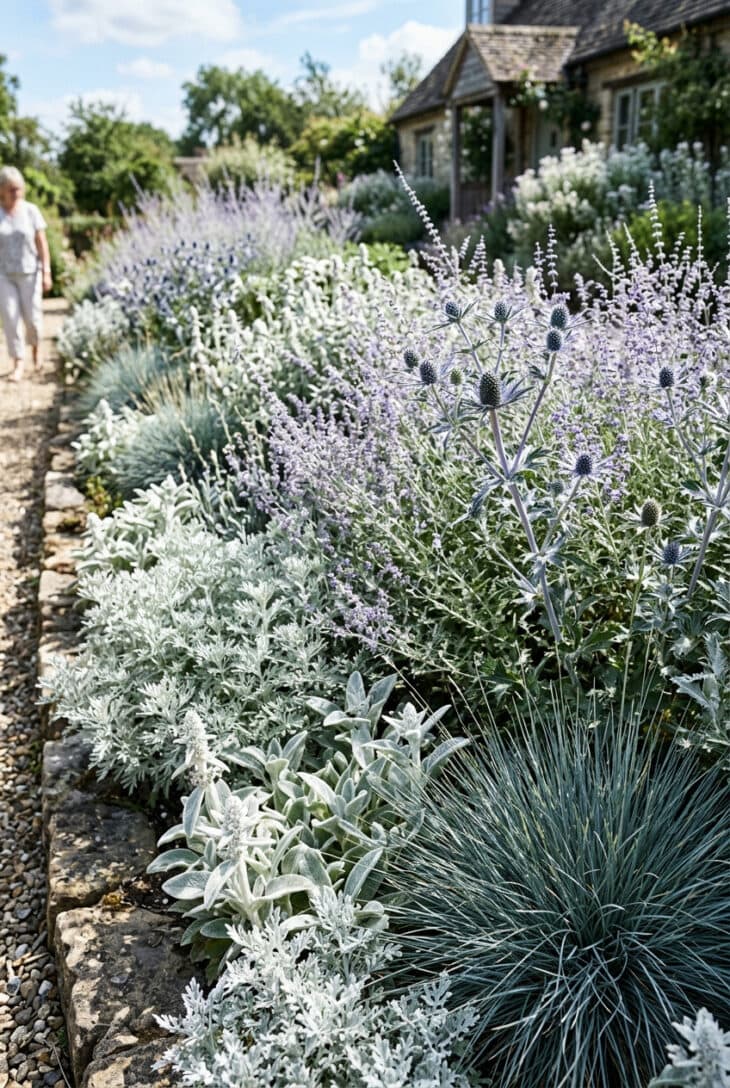
What you see A border that has almost given up on flower color and works entirely in silver, gray and blue. Felted artemisia, woolly lamb’s ear you cannot help touching, metallic sea holly cones, and a haze of Russian sage behind. In full sun the silver leaves glow almost white, and the border looks cool even when the air is not.
Why it works Silver foliage is not a coincidence, it is an adaptation: those leaves are covered in fine hairs or a waxy bloom that reflect sunlight and cut water loss. So a border built on silver is drought-tolerant almost by definition. It also has a practical advantage over a flower-led scheme, which is that foliage does not go over. This border looks the same in August as it did in June.
How to get it Combine textures rather than colors: the felt of lamb’s ear (Stachys byzantina) against the spines of sea holly (Eryngium bourgatii) against the fine haze of Russian sage (Perovskia atriplicifolia ‘Blue Spire’). Give everything full sun and gritty soil, because silver-leaved plants rot fast in winter wet and that, not cold, is what usually kills them. Cut Russian sage back to 6in (15cm) in early spring, never in autumn, since the old stems protect the crown through winter. Avoid rich compost entirely: fed too well, these plants flop and lose their color.
15. Fill an Old Trough with Houseleeks and Ice Plant
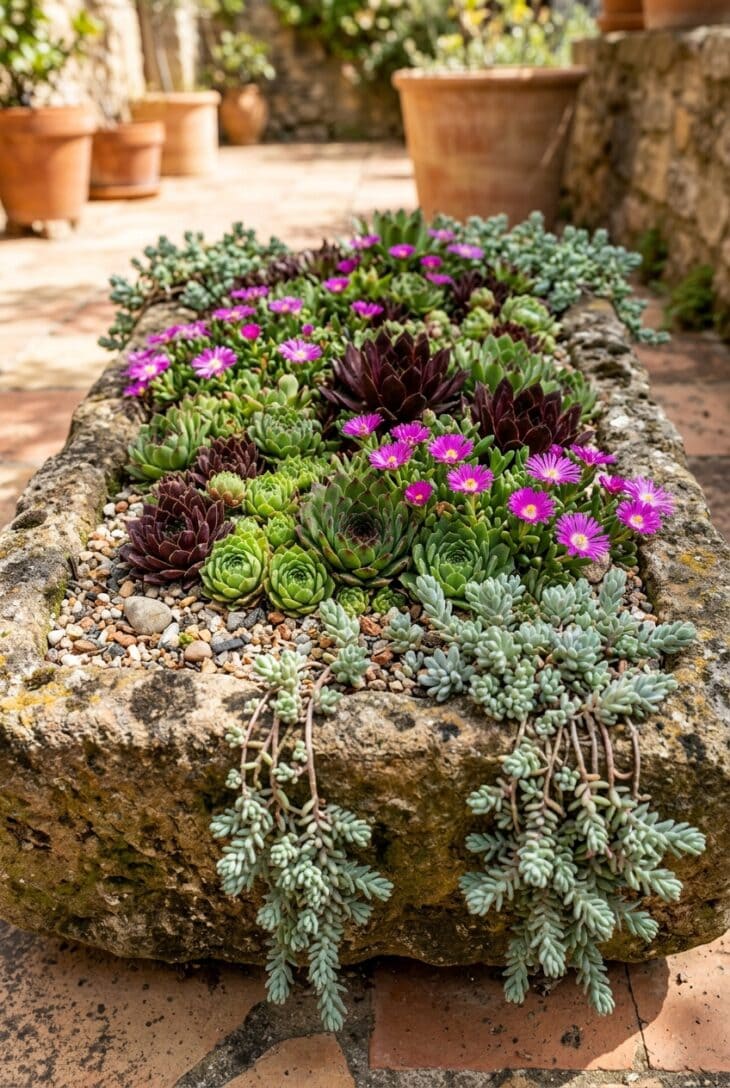
What you see An old stone trough on a sunny terrace, filled edge to edge with tight houseleek rosettes in green and deep burgundy, packed shoulder to shoulder like a mosaic. Shocking magenta ice plant flowers open flat in the sun, and small gray sedums trail over the rim. Fine grit fills every gap between them.
Why it works A trough is a whole garden at knee height, and these plants are so shallow-rooted that 6in (15cm) of gritty mix is genuinely enough. It is the ideal project for a paved yard, a balcony, or anyone who wants something to fuss over that will not die if they go away for a fortnight. Houseleeks in particular can go weeks without a drop of water and simply pull their leaves in tighter.
How to get it Drill or clear generous drainage holes, then fill with a mix of one part compost to two parts grit, topped with 1in (2.5cm) of fine grit. Houseleeks (Sempervivum) come in dozens of forms, so plant several kinds and let them offset into each other over a season or two. Ice plant (Delosperma cooperi) adds the color the succulents lack, and flowers all summer. Stand the trough on feet or bricks so water runs straight out, and tip it slightly if it sits under a roofline that would fill it in winter.
16. Grow a Herb Bed That Thrives on Neglect
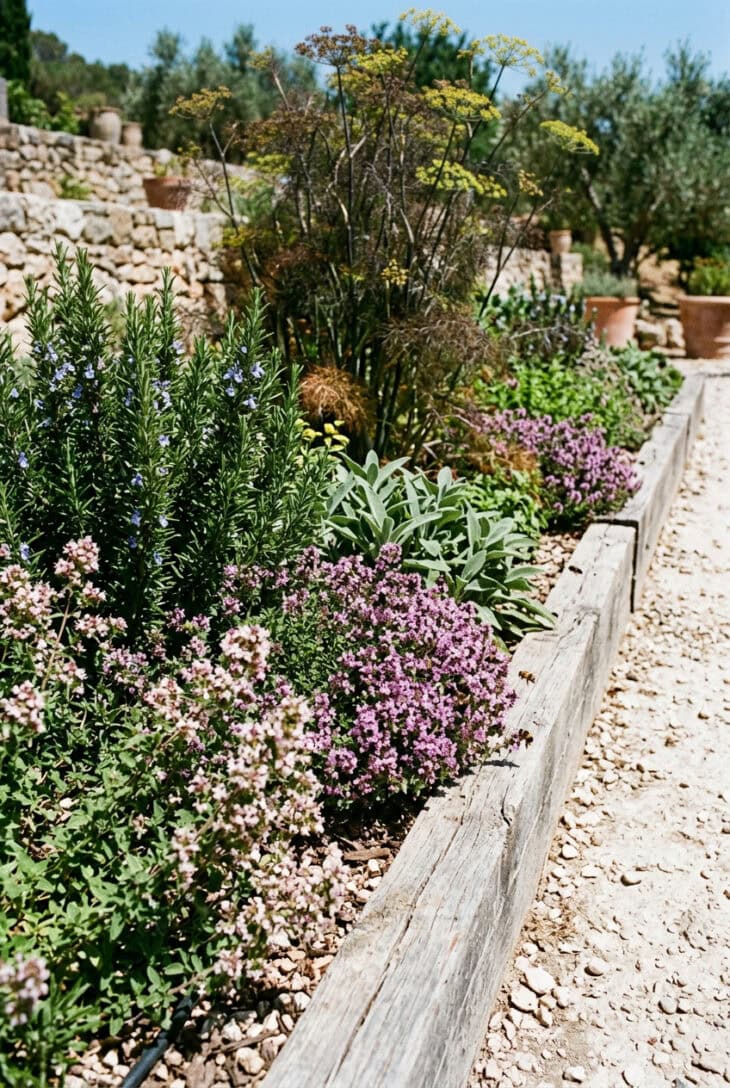
What you see A timber-edged bed in full sun, filled with the woody Mediterranean herbs: upright rosemary at the back, low mounds of thyme covered in purple flowers, soft gray sage leaves, oregano coming into bloom. Bronze fennel sways behind it all. Brush past on the way to the kitchen and the whole bed releases its scent.
Why it works Almost every classic culinary herb is a dry-hillside plant from the Mediterranean, which means the conditions that ruin them are the ones most gardeners provide: rich soil, regular water, and a sheltered damp corner. Grown hard and dry, they are tougher, more compact, and considerably more flavorful, because the essential oils concentrate under stress. This is one of the few beds where neglect is the correct technique.
How to get it Give them the sunniest, sharpest-draining spot you have and add grit rather than compost when you plant. Rosemary (Salvia rosmarinus), thyme (Thymus vulgaris), sage (Salvia officinalis) and oregano (Origanum vulgare) all want the same treatment, so they can share a bed happily. Trim the woody ones lightly every year after flowering to keep them bushy, but never cut back into old bare wood on rosemary or lavender, because they will not reshoot from it. Keep mint out: it needs damp soil and will run through everything.
17. Harvest Rainwater and Irrigate by Drip
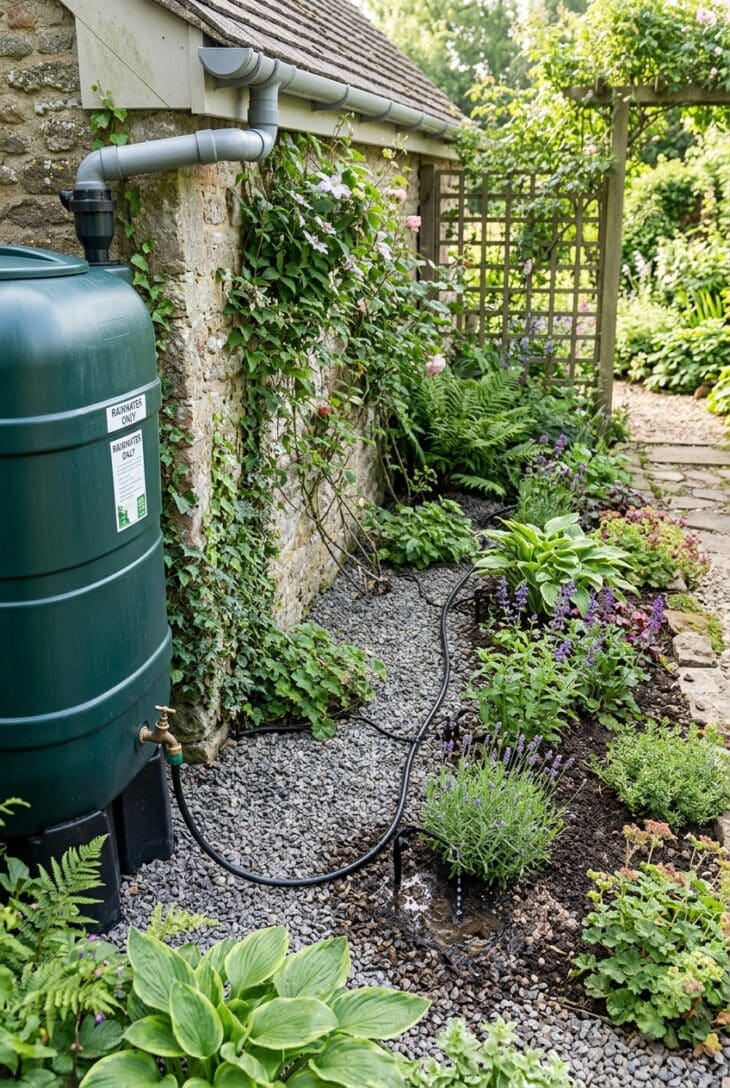
What you see A tall rainwater tank tucked against a wall, fed by the downpipe from the house roof. From its base a slim black drip line runs off into the bed and vanishes under the gravel. Here and there an emitter sits at the foot of a plant, releasing a slow bead of water into the soil rather than the air.
Why it works Drought-tolerant planting still needs water in its first two summers, and this is how to give it without waste. Sprinklers lose a huge share of their output to evaporation and wet the leaves rather than the roots; drip lines put water exactly where it is needed at a rate the soil can absorb. Pair that with a tank, and the water is free and soft, which most plants prefer to hard tap water anyway.
How to get it Size the tank generously, since a modest roof yields more than people expect: roughly 600 gallons (2,300 litres) per 1,000 square feet (93 square metres) of roof for every inch (2.5cm) of rain. Fit a first-flush diverter so the dirty initial runoff does not enter the tank. Lay drip line on the soil surface and cover it with your gravel mulch, which hides it and cuts evaporation further. Run it early in the morning, and run it rarely and long rather than often and briefly, because that is what drives roots downward.
18. Anchor the Planting with Structural Evergreens
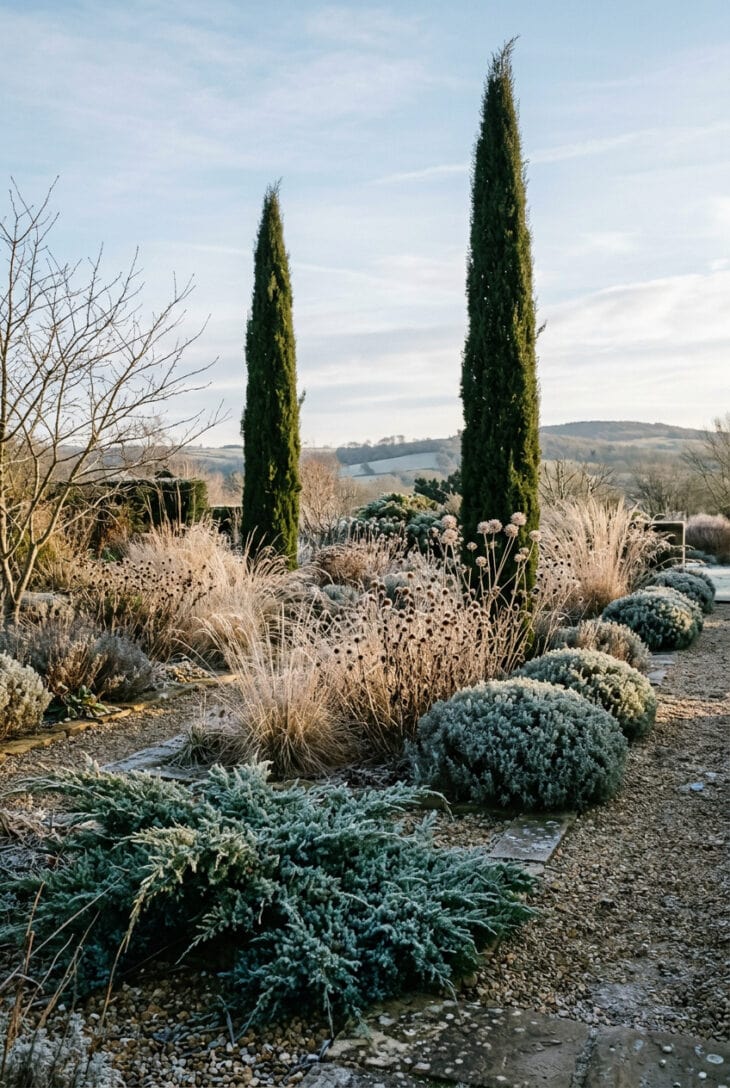
What you see A dry garden in January, and it still works. Two dark columnar cypresses stand like exclamation marks, a low blue-green juniper spreads across the foreground, and clipped santolina mounds hold their shape under a frost. The grasses around them have bleached to straw, and the seed heads are bare, but the bones are all still there.
Why it works The great weakness of a drought-tolerant scheme is winter, when the grasses collapse and the perennials disappear and you are left looking at gravel. A handful of evergreens fixes it permanently. They are the only plants doing structural work twelve months a year, and they give the eye something to hold onto in the months when nothing is flowering. Verticals matter most, because they carry the composition from a distance.
How to get it Use juniper (Juniperus communis) for spreading, textural cover, and Italian cypress (Cupressus sempervirens ‘Stricta’) for height if your climate suits it, though it hates cold wet winters and will brown out in them. Place verticals in odd numbers and off-center, and put them where they will be seen against the sky rather than against a hedge. Three well-placed evergreens will do more than a dozen scattered ones. Clip the mounded plants once in late spring, taking off only the current year’s growth.
19. Seed Creeping Thyme into Paving Cracks

What you see A path of irregular flags where every joint has been colonized by creeping thyme, and in June the cracks are cushions of tiny purple, pink and white flowers. The stone edges have disappeared under it. Step on it and the scent comes up immediately, and the bees do not seem to mind you passing.
Why it works A paving joint is a brutal place to live: a few inches of poor gritty soil, baking heat from the stone on both sides, and almost no water. That is precisely the habitat creeping thyme evolved for, and it will thrive there while sulking in a comfortable border. The stones also act as a mulch, keeping the soil below cooler and damper than the surface suggests, which is why plants in cracks so often outperform the ones in the bed.
How to get it This only works with joints that are not mortared, so it suits flags laid on sand or gravel. Widen the joints to at least 1in (2.5cm), clear out the loose material, and fill with a gritty compost mix. Plant small plugs of Thymus serpyllum or Thymus praecox 12in (30cm) apart and they will run together within two seasons. Water for the first month only. Choose the low mat-forming species rather than culinary thyme, which is woodier and will not take being walked on.
20. Build a Hot-Color Border for Late Summer

What you see September, and this border is at full volume: burnt orange helenium, scarlet and mustard achillea, red hot pokers standing up like flames, and rust-toned grasses catching the low sun behind them. The colors clash gloriously. Everything is a little dry at the edges and none of it seems to care.
Why it works Late summer is when most gardens sag, and it is also when a dry climate is at its most punishing. These plants are built for it: deep-rooted, sun-loving prairie and South African perennials that flower late precisely because that is when their native rainfall arrives. Hot colors also hold up in strong light, where pastels bleach out and look washed and tired by August.
How to get it Anchor the scheme with yarrow (Achillea millefolium ‘Terracotta’), Helenium ‘Moerheim Beauty’ and red hot poker (Kniphofia ‘Tawny King’), then thread rust-colored grasses through to stop the colors shouting over each other. Plant in bold groups of five and repeat each group at least twice down the border so the eye travels. Stake nothing: if these plants flop, they have been fed or watered too well. Leave the seed heads standing over winter. For more on structuring a scheme like this, see our garden border ideas.
21. Turn a Small Courtyard into a Shaded Sun Trap
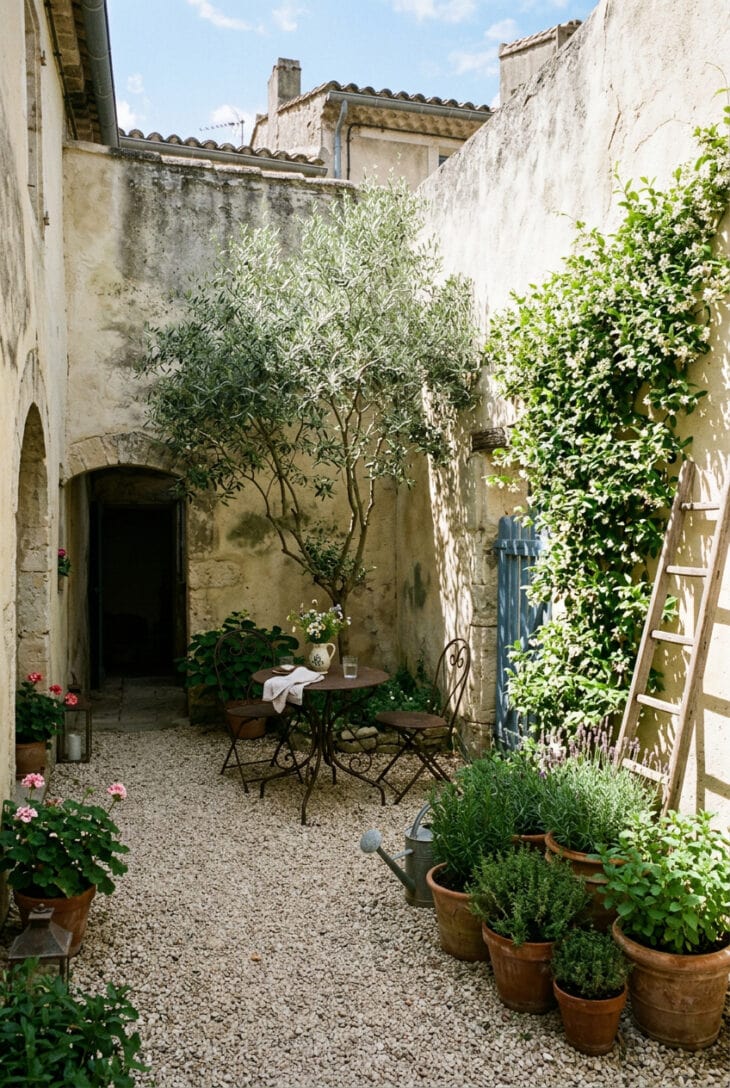
What you see An enclosed courtyard, walls lime-washed white, floor of pale gravel. One multi-stem tree in the corner holds a canopy of dappled shade over a bistro table just big enough for two. Terracotta pots of herbs line the base of the wall, and jasmine climbs behind them. Half the space is in deep shade and half is blazing.
Why it works Small enclosed spaces bake, because the walls store heat all day and release it into the evening. Rather than fight that, this design uses it: the heat is what makes the herbs fragrant and the space usable after dark, and one well-placed tree makes the difference between an oven and a sun trap. Pale surfaces bounce light around so the courtyard never feels gloomy despite the shade.
How to get it Choose one small tree with a light canopy rather than several: a multi-stem strawberry tree (Arbutus unedo) or an olive suits this scale, at 12 to 15ft (360 to 450cm) eventually. Position it to shade the seating between noon and 4pm, which is the only window that matters. Keep the floor a single material throughout, since chopping a small space into zones makes it feel smaller. Grow the fragrant plants at nose height on the walls, not at ground level. There is more on this in our small garden ideas.
22. Shelter the Plot with a Drought-Tolerant Hedge
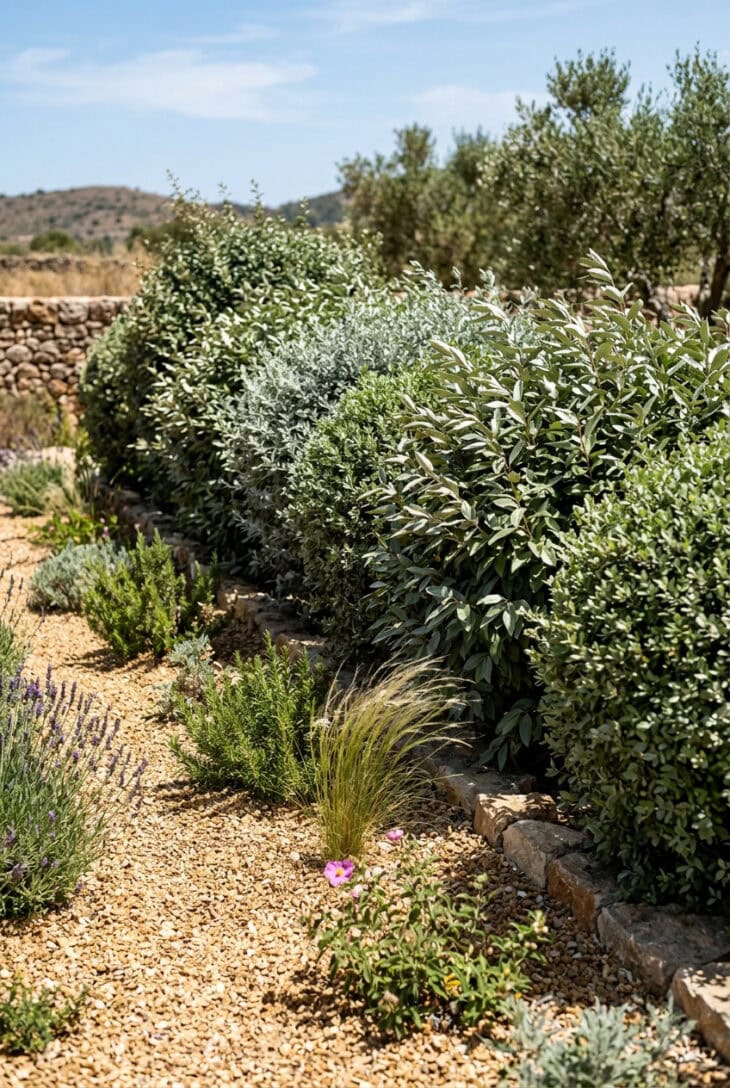
What you see A loose, informal hedge running along the boundary, made of gray-green and silvery shrubs rather than a flat green wall. It is clipped lightly, so it keeps a soft outline and moves in the wind. In front of it the gravel garden sits noticeably calmer than the ground beyond the hedge.
Why it works Wind dries a garden out faster than sun does, stripping moisture from leaves and soil surface alike, and in exposed dry sites it is usually the real problem. A permeable hedge is far better than a solid fence here: a fence creates damaging turbulence on its lee side, while a hedge filters the wind and slows it for a distance of up to ten times its own height. Choose the right shrubs and it does this on no water at all.
How to get it Good candidates are oleaster (Elaeagnus x ebbingei), Mediterranean buckthorn (Rhamnus alaternus), and Phillyrea angustifolia, all of which take drought, wind and salt. Plant at 24in (60cm) spacing in a single row, water through the first two summers to establish, then stop. Clip once a year in late summer and keep the base wider than the top so light reaches the bottom and the hedge does not go bare at the knees. Resist the urge to shear it flat: an informal outline suits a dry garden far better.
23. Raise a Free-Draining Gravel Berm
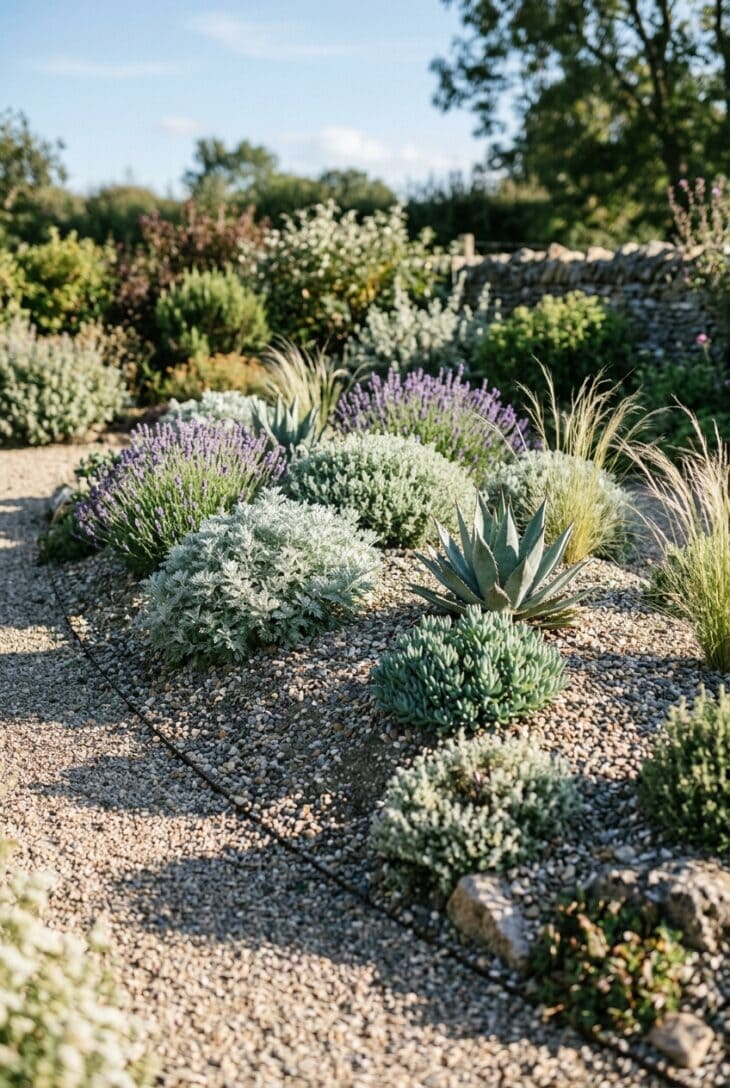
What you see A low mound rising out of otherwise flat ground, maybe 18in (45cm) at its highest, with soft natural contours rather than square edges. It is surfaced in gravel and planted with mounding silver foliage, a few spiky forms, and low grasses running off the sides. The contour catches the light and gives the flat plot somewhere to look.
Why it works If you garden on heavy clay, the thing that kills your drought-tolerant plants is not summer drought at all, it is winter wet sitting around their crowns. A berm solves it without any excavation: you are not improving the bad soil, you are simply building above it. The mound also adds height and shadow to a flat garden, and the extra surface area on the sunny side gives you a genuinely hotter, drier microclimate.
How to get it Break up the ground first so the berm does not sit on a pan, then build up with a lean mix of roughly two parts topsoil, two parts grit and one part compost, to a height of 12 to 24in (30 to 60cm). Make it long and low rather than tall and conical, which reads as a burial mound, and blend the toe of the slope into the surrounding ground. Plant the crown with the plants that most need sharp drainage and work down the sides to less fussy things. It settles by about a fifth in the first year, so build it higher than you want it. If you would rather build up in timber, see our raised bed garden ideas.
24. Let Self-Seeders Colonize the Gaps
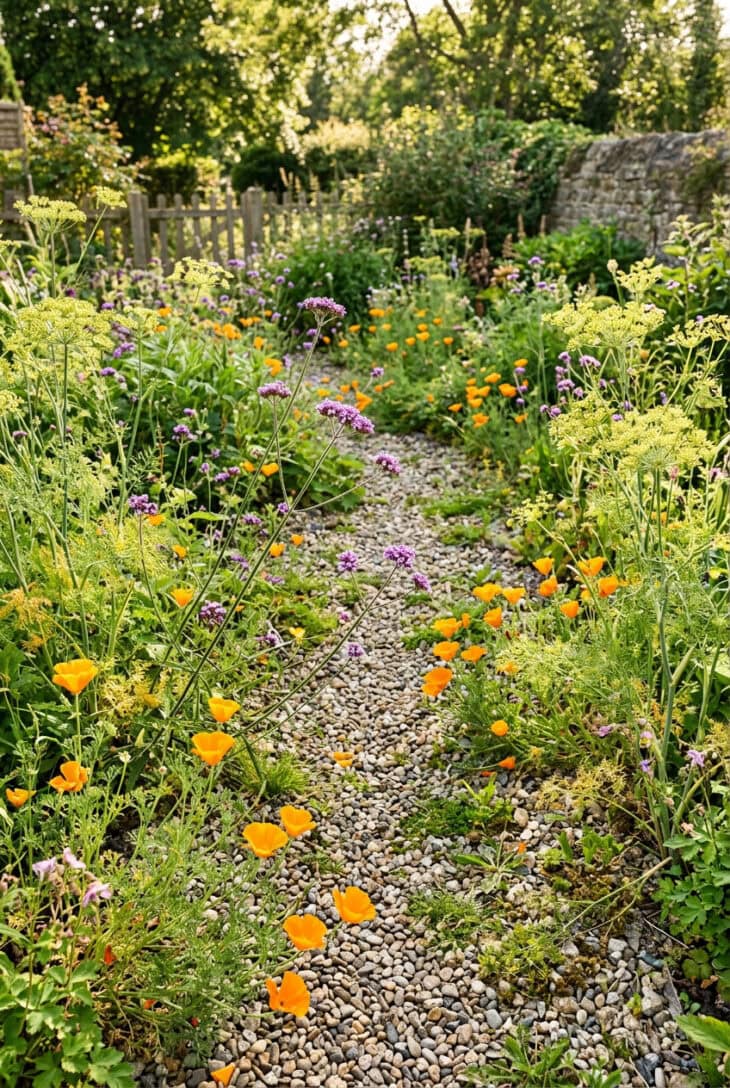
What you see The planting has broken its banks. Orange California poppies have seeded themselves into the middle of the path, tall wiry verbena stems hold their purple heads above everything, and fennel umbels have appeared where nobody put them. It looks unplanned, and it is, and it is better than anything that was planned.
Why it works Gravel is the ideal seedbed: warm, sharply drained, and open enough for seedlings to get a root down before competition arrives. Plants that seed themselves choose the spots that actually suit them, which are often spots you would never have picked, and the result has a coherence that deliberate planting struggles to fake. Self-seeders are also free, and each generation is a little better adapted to your specific conditions.
How to get it Sow California poppy (Eschscholzia californica), Verbena bonariensis, Erigeron karvinskianus and bronze fennel once, directly into the gravel in autumn, and let them take it from there. The one discipline required is editing: go through in late spring and pull out the seedlings you do not want, keeping the ones in good positions, because a self-seeding garden left entirely alone becomes a monoculture of whichever plant seeds hardest. Never lay membrane under the gravel, or none of this can happen.
25. Plant a Multi-Stem Shade Tree and Underplant It
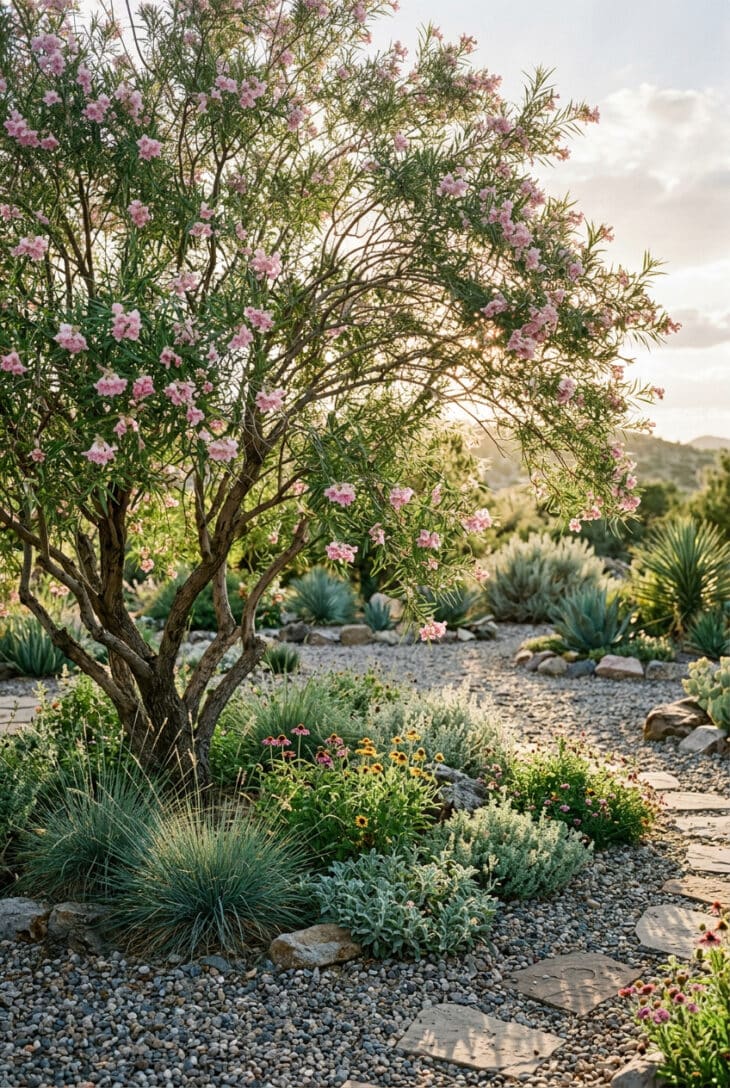
What you see A multi-stem desert willow, its slender branches arching outward and hung with pale pink trumpet flowers, standing in gravel. The shade it casts is light and shifting rather than solid. Underneath, silver foliage and blue-green grasses grow happily in the filtered light, and late sun comes through the canopy in bars.
Why it works One tree changes the whole water budget of a garden. It cuts the soil temperature beneath it by several degrees, slows evaporation across a wide area, and creates a band of dappled shade where you can grow things that would scorch in the open. A multi-stem form is the right choice in a small dry garden because it gives you canopy without a heavy trunk, and its light shade does not stop you planting underneath.
How to get it Desert willow (Chilopsis linearis) is superb in hot dry regions; crape myrtle (Lagerstroemia indica) and strawberry tree (Arbutus unedo) suit slightly cooler ones. Plant in autumn so roots establish over winter, dig a wide shallow hole rather than a deep narrow one, and stake low or not at all so the trunk flexes and thickens. Water deeply once a week for the first two summers, then leave it. Underplant right out to the canopy edge, not just around the trunk, since that is where the rain actually lands.