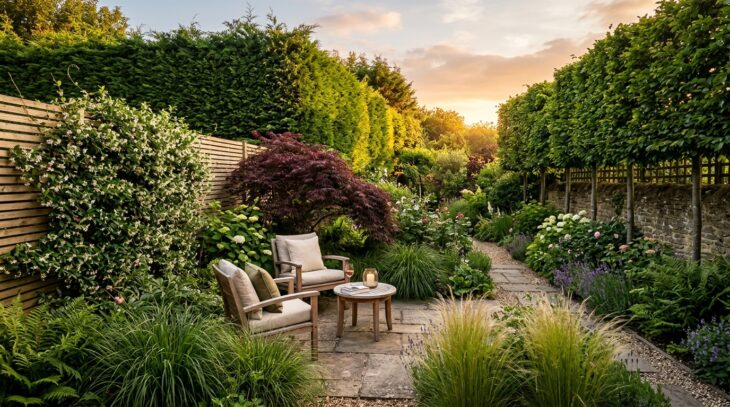
There is a particular kind of tension in a garden you can be seen from. You want to read, eat, or simply sit with a coffee, and instead you feel the windows next door watching. Privacy is what turns a plot you own into a space you can actually relax in.
Contents
- 01. Fast-Growing Evergreen Hedge
- 02. Clumping Bamboo Screen
- 03. Pleached Trees for an Overlooked Boundary
- 04. Slatted Cedar Fence with Climbers
- 05. Living Green Wall Panel
- 06. Pergola with a Leafy Canopy
- 07. Layered Mixed Screen Border
- 08. Trellis Topper on an Existing Fence
- 09. Screen a Patio with Tall Planters
- 10. A Privacy Corner with a Small Tree
- 11. Woven Willow or Hazel Hurdles
- 12. An Overhead Sail or Canopy
- 13. Mixed Native Hedgerow
- 14. Frosted Glass or Acrylic Panels
- 15. Espaliered Trees Along a Wall
- 16. A Planted Berm for Raised Screening
- 17. Corten Steel Privacy Screen
- 18. Climber-Clad Wire Cables
- 19. A Secluded Garden Room or Arbor
- 20. Tall Ornamental Grasses as a Soft Screen
- 21. A Gabion Wall with Planting
- 22. Screen an Overlooked Window from Inside the Bed
- 23. Bamboo or Reed Fencing Roll
- 24. A Mixed Evergreen and Flowering Shrub Bank
- 25. Layer Everything: The Complete Private Garden
The good news is that screening comes in far more forms than a tall fence. This list runs from fast evergreen hedges and bamboo to pleached trees, living walls, pergolas, planted berms, and clever layering that hides a boundary without walling you in. There are ideas for tight budgets and generous ones, for rentals and forever homes, for full sun and deep shade.
Read straight through, or jump to the situations that match yours: an overlooked patio, a see-through fence, a bare boundary, a window with a view straight into your kitchen. Most gardens need two or three of these working together, so pick the ideas that fit and layer them up.
01. Fast-Growing Evergreen Hedge
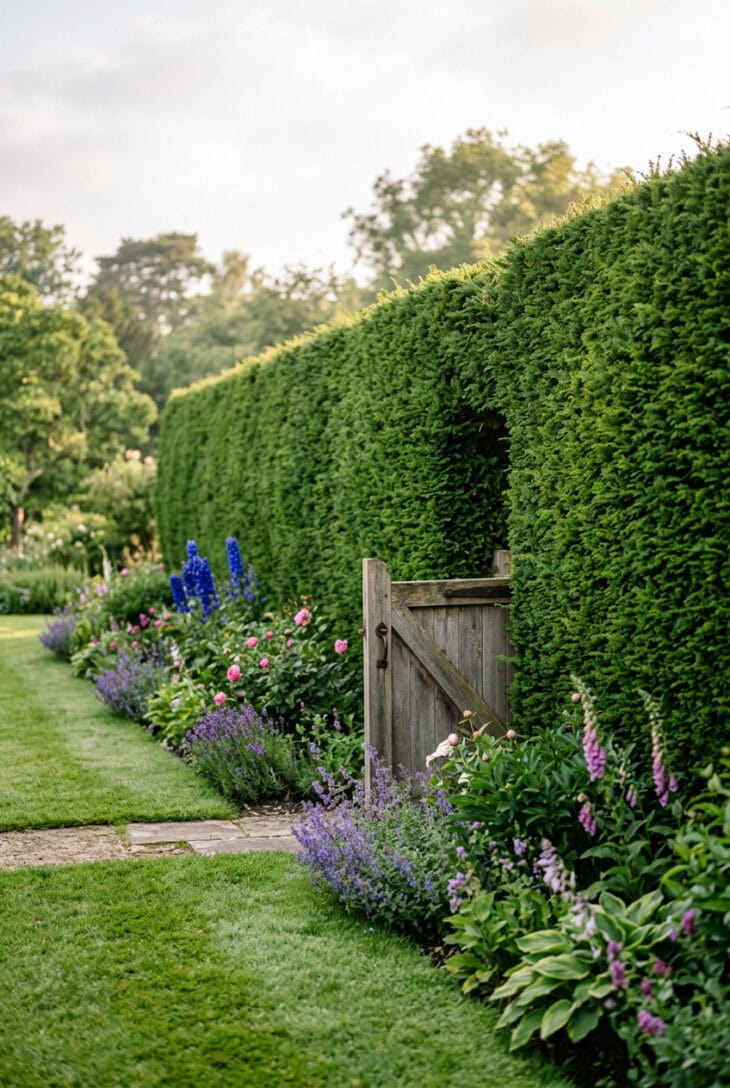
What you see A solid wall of deep green rising well above head height, clipped flat and dense enough that you cannot see a single gap through it. Morning light warms the fresh growth at the top, and a narrow border of shade plants runs along its base. It reads as permanent and calm, a boundary that feels grown rather than built.
Why it works A living hedge screens year round, absorbs noise, and softens wind in a way no fence can, all while giving nesting birds cover. Unlike a 6ft fence, a hedge can legitimately reach 8 to 12ft (2.4 to 3.7m) without looking oppressive, because the texture and depth stop it feeling like a flat barrier. It is the single most effective privacy tool for a boundary you own.
How to get it For speed, plant western red cedar (Thuja plicata ‘Green Giant’) or, in milder zones, cherry laurel (Prunus laurocerasus ‘Rotundifolia’), spacing plants 3ft (90cm) apart. Both put on 2 to 3ft (60 to 90cm) a year once settled. Avoid Leyland cypress unless you will trim it twice a year, as it does not regrow from bare wood. Water deeply through the first two summers, and start light formative trimming in year two to build density from the base up rather than letting it go leggy.
02. Clumping Bamboo Screen
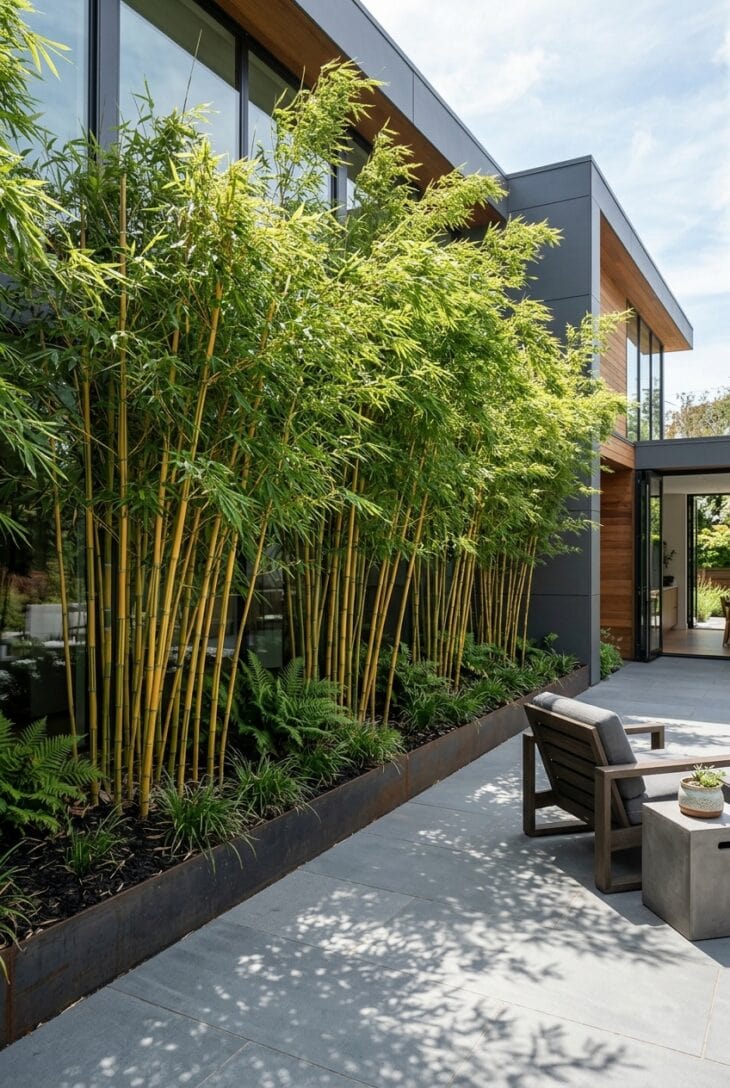
What you see A shimmering vertical curtain of canes and narrow leaves, 10 to 15ft (3 to 4.5m) tall, moving with every breath of wind. Light filters through it rather than being blocked flat, so the screen feels alive and never heavy. Against a modern house the effect is architectural and slightly tropical.
Why it works Bamboo gives instant height in a narrow footprint, which is exactly what a tight side boundary or an overlooked upstairs window needs. The movement and soft rustle add a sensory layer that a static fence cannot, and evergreen species screen all winter. The key is choosing a clumping type so it stays where you put it.
How to get it Use clumping, non-invasive umbrella bamboo (Fargesia robusta ‘Campbell’) or, for warmer zones, Bambusa multiplex, never a running Phyllostachys unless you install a root barrier. Plant 3 to 4ft (90 to 120cm) apart in moist, rich soil, and mulch heavily. Even clumping bamboo appreciates a 24in (60cm) deep barrier along a shared boundary for peace of mind. Water generously in the first year, and thin out older canes each spring to keep the screen looking fresh.
03. Pleached Trees for an Overlooked Boundary
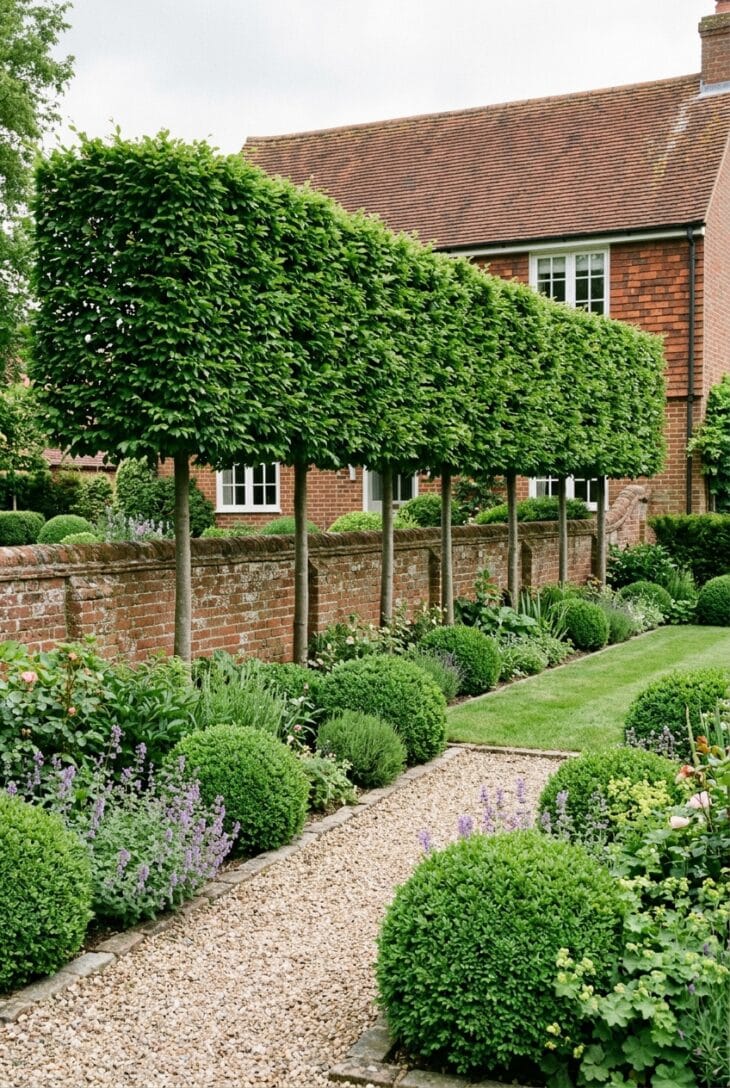
What you see A hedge floating on bare trunks, a flat green rectangle of foliage held 6 to 8ft (1.8 to 2.4m) up in the air with clear stems beneath. Below it, a low wall and clipped box balls keep the ground layer open and formal. It is the most elegant way to block a first-floor window without shading the whole garden.
Why it works Pleaching solves the exact problem most privacy struggles with: you are not overlooked at ground level, you are overlooked from above. Raising the screen to canopy height blocks the sightline from an upstairs window while leaving room for borders, a path, or a bench underneath. It delivers privacy precisely where you need it and nowhere you don’t.
How to get it Buy ready-pleached hornbeam (Carpinus betulus) or evergreen photinia (Photinia x fraseri ‘Red Robin’) on a bamboo frame, spacing them 6 to 8ft (1.8 to 2.4m) apart so canopies meet. Hornbeam holds coppery dead leaves through winter for near-evergreen cover. Tie in new growth along the frame each summer and trim the faces in late summer to keep them flat. It is an investment, but the effect is immediate and unmatched.
04. Slatted Cedar Fence with Climbers
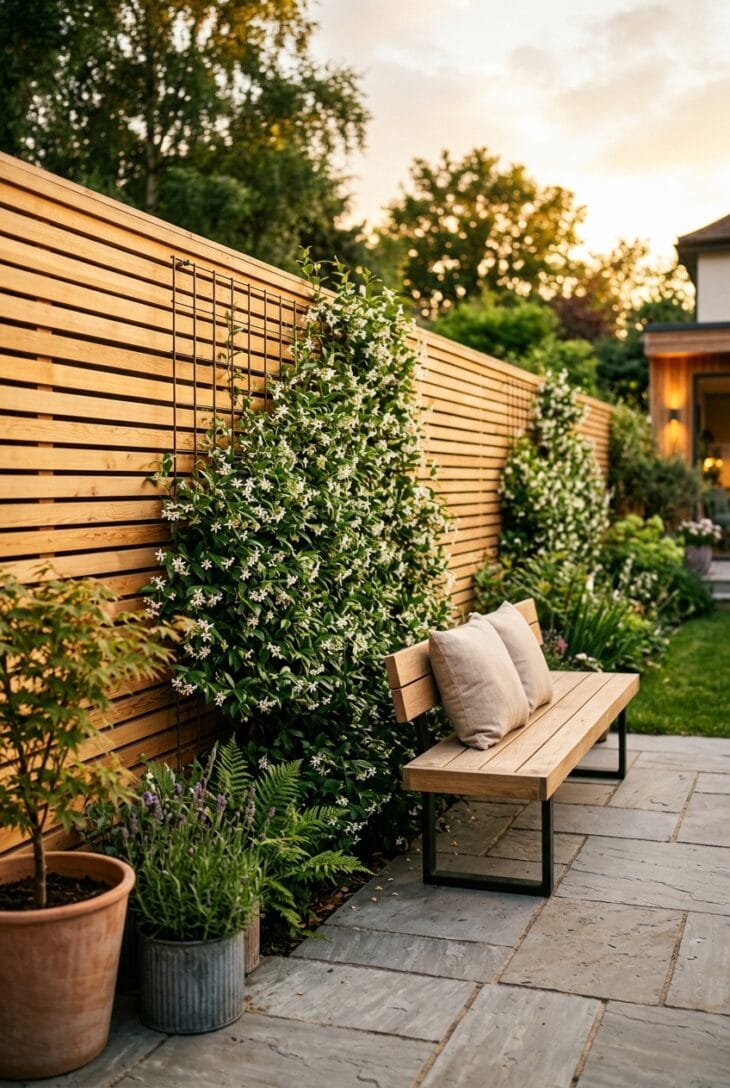
What you see Warm honey-colored cedar boards run horizontally with a slim shadow gap between each one, so the fence reads as a crisp modern plane rather than a solid wall. Star jasmine threads through a hidden wire trellis, scattering small white flowers and glossy green leaves across the timber. In evening light the whole panel glows.
Why it works Horizontal slats give near-total privacy at eye level while the gaps let air and a little light through, so the boundary breathes and does not feel like a stockade. Adding a climber turns hard timber into a living surface, softening the line and doubling the screening as it fills in. It is the most contemporary-looking way to enclose a modern patio.
How to get it Fix 4 to 6in (10 to 15cm) cedar or thermally-treated pine boards with a consistent 0.5in (12mm) gap onto sturdy posts. Run galvanized wire or a slim trellis 2in (5cm) proud of the face and plant evergreen star jasmine (Trachelospermum jasminoides) or, in colder zones, a Clematis armandii at the base. Tie in the leading shoots for the first year, then let it knit into the slats. Treat the timber every two to three years to hold its color.
05. Living Green Wall Panel
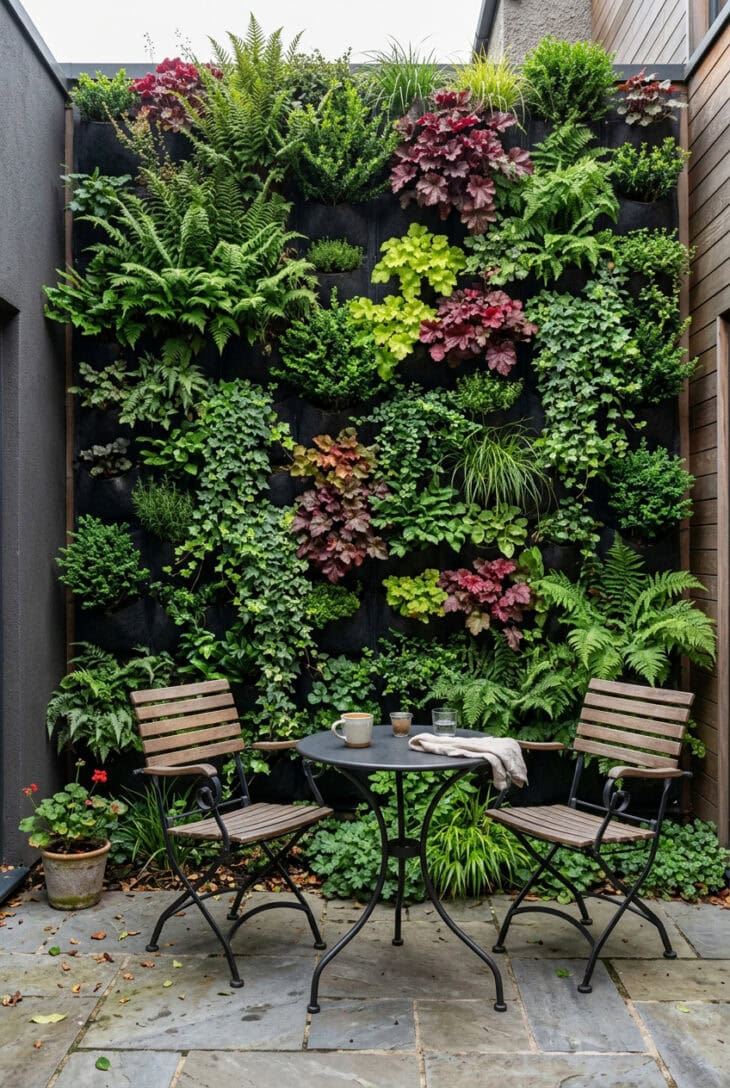
What you see An entire wall dressed in living plants, a tapestry of ferns, burgundy and lime heuchera, and trailing ivy woven so densely that no structure shows through. It turns a flat, overlooked boundary into the garden’s main feature, verdant from top to bottom. In a small courtyard the effect is immersive, like sitting inside greenery.
Why it works A living wall buys privacy and interest without stealing any floor space, which makes it ideal where a bed or hedge simply won’t fit. It raises the green backdrop to full height, drawing the eye up and away from a neighbor’s window, and the sheer plant volume muffles sound. For tiny gardens it is often the only way to add real greenery.
How to get it Fix a modular pocket system or troughed panel to a sound, waterproofed wall, and plan for an automatic drip irrigation line, as vertical planting dries fast. Plant a mix of evergreen ferns, heuchera, bergenia, and trailing ivy (Hedera helix) for year-round cover, keeping thirstier plants low where water collects. Feed monthly through the growing season. It is more maintenance than a hedge, so commit to the irrigation before you build it.
06. Pergola with a Leafy Canopy
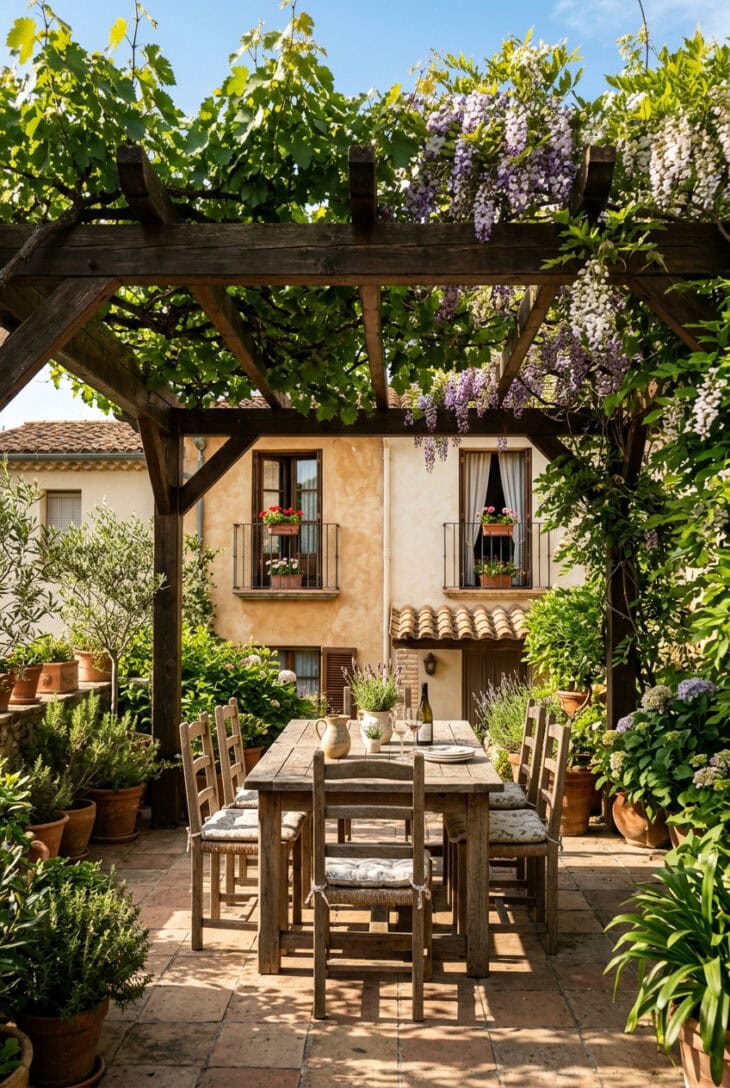
What you see A timber pergola strung overhead with grapevine and wisteria, their leaves knitting into a green ceiling that throws dappled shade over a dining table. Look up and instead of a neighbor’s window you see foliage and sky through the gaps. The space beneath feels like an outdoor room with a roof of its own.
Why it works Overhead screening is the piece most privacy plans forget. When you are overlooked from above, a fence does nothing, but a leafy canopy breaks the downward sightline while you sit. It also creates shade and shelter, so the pergola earns its space three times over: privacy, comfort, and structure.
How to get it Build or buy a sturdy pergola sized to sit over your seating, using posts set in concrete for a vine’s eventual weight. Plant one deciduous climber for summer cover and winter light, such as grapevine (Vitis ‘Boskoop Glory’) or wisteria (Wisteria floribunda), plus an evergreen like star jasmine if you want year-round screening. Guide the stems across the beams for the first few seasons. Prune the grapevine and wisteria twice a year to keep it flowering and off the roof.
07. Layered Mixed Screen Border
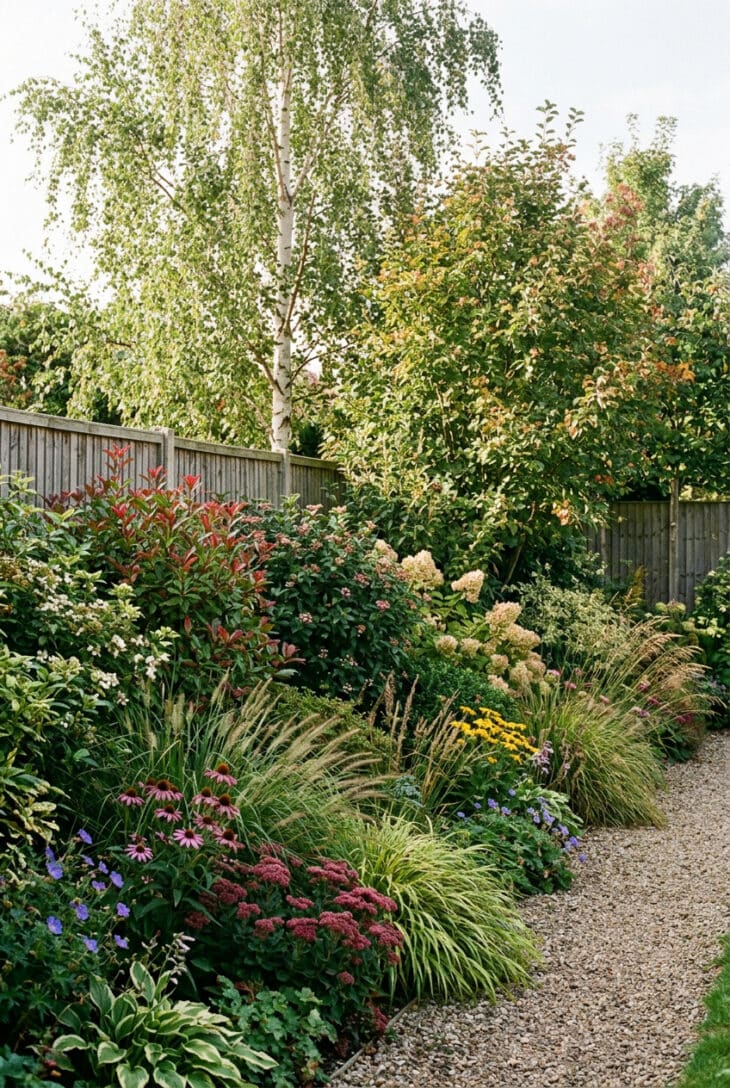
What you see A boundary dissolved into a deep, layered planting: a multi-stemmed birch and an amelanchier reaching up at the back, evergreen viburnum and photinia filling the middle, and grasses and perennials frothing at the front. No single element blocks the view, yet together they make it impossible to see in. It looks like a garden, not a barrier.
Why it works Layering screens by depth rather than height, so it never reads as a wall and never feels oppressive. Because the planting is mixed, there is something in leaf, flower, or berry in every season, and a pest or disease that hits one plant leaves the screen intact. This is the most natural-looking privacy of all, and the best for wildlife.
How to get it Give the border at least 5 to 6ft (1.5 to 1.8m) of depth. Plant a small tree such as birch (Betula utilis var. jacquemontii) or serviceberry (Amelanchier lamarckii) at the back, evergreen shrubs like Viburnum tinus and photinia in the middle, and grasses such as Calamagrostis ‘Karl Foerster’ with perennials at the front. Stagger them rather than lining them up. Mulch well and let it knit together over two or three seasons.
08. Trellis Topper on an Existing Fence
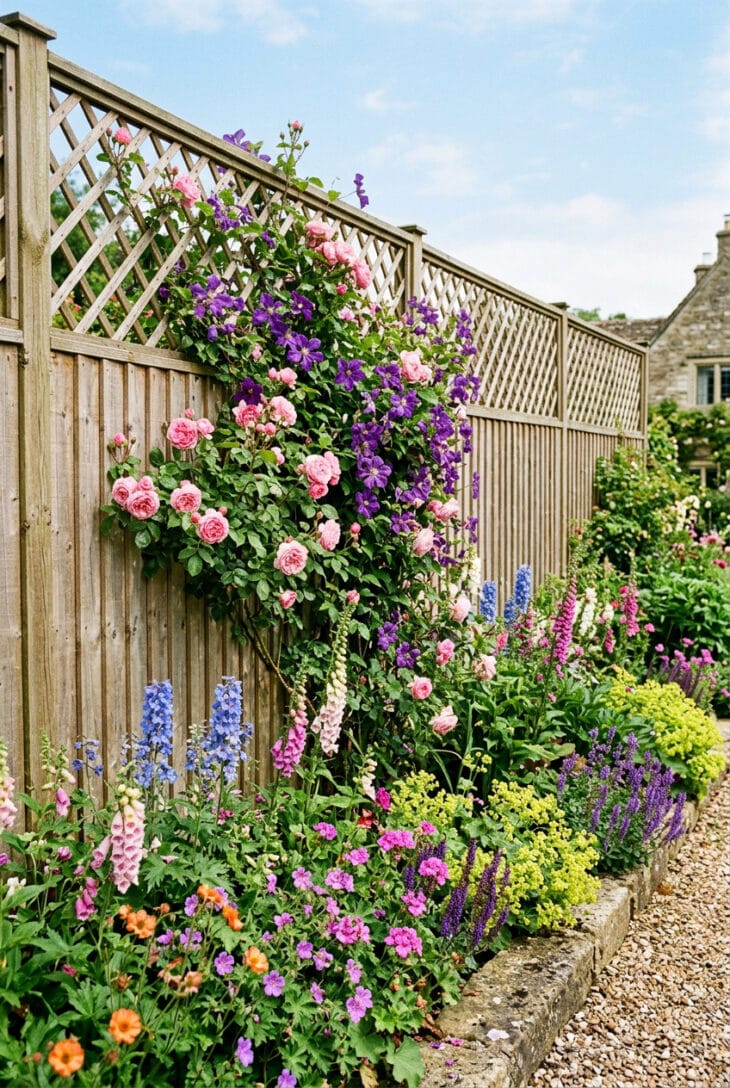
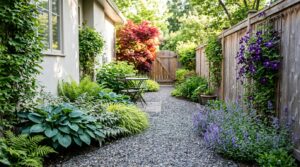
What you see A standard fence lifted by a foot or two of diamond-lattice trellis along its top, with a climbing rose and clematis threading pink and purple flowers through the openwork. The extra height blocks the eye without casting the heavy shadow a solid extension would. Below, a ribbon of cottage perennials completes the picture.
Why it works A trellis topper is the cheapest, fastest way to gain height on a fence that is legal but too low to hide behind. The open lattice keeps within the visual weight most neighbors accept, lets wind pass through so it doesn’t act like a sail, and gives climbers something to grip. Small effort, immediate result.
How to get it Check your local fence-height rules first, then fix 12 to 18in (30 to 45cm) trellis panels to the posts, not the flimsy fence boards, using metal brackets so they can take a climber’s weight. Plant a repeat-flowering climbing rose (Rosa ‘New Dawn’) with a Clematis viticella to weave through it. Tie in shoots horizontally to spread the cover. Keep the climbers fed and the ties checked each spring.
09. Screen a Patio with Tall Planters
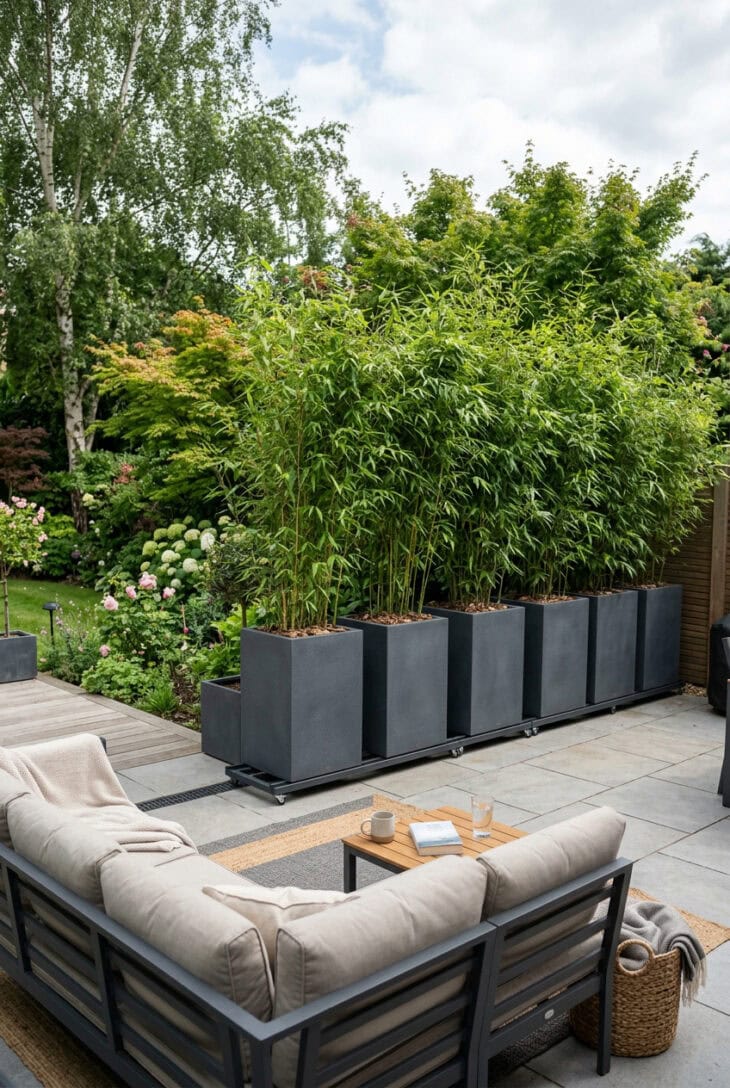
What you see A line of tall, dark planters edging a patio, each holding a slim column of bamboo or photinia that rises to head height and above. Together they draw a soft green screen between the seating and the garden next door, without a single post going into the ground. From the sofa, you see leaves instead of the neighbors.
Why it works Planters make privacy portable, which is exactly what renters and paved courtyards need. You can screen only the angle you’re overlooked from, shuffle them for a party, and take them with you when you move. Raising the plant in a 3ft (90cm) container also means a modest shrub reaches screening height without waiting years.
How to get it Choose planters at least 18 to 24in (45 to 60cm) deep and wide for stability and root room, ideally with a water reservoir. Plant clumping bamboo (Fargesia), columnar photinia, or slim conifers like Italian cypress in milder zones. Use a soil-based compost so they don’t blow over, and set them on pot feet for drainage. Containers dry fast, so plan to water often or fit a drip line, and feed through summer.
10. A Privacy Corner with a Small Tree
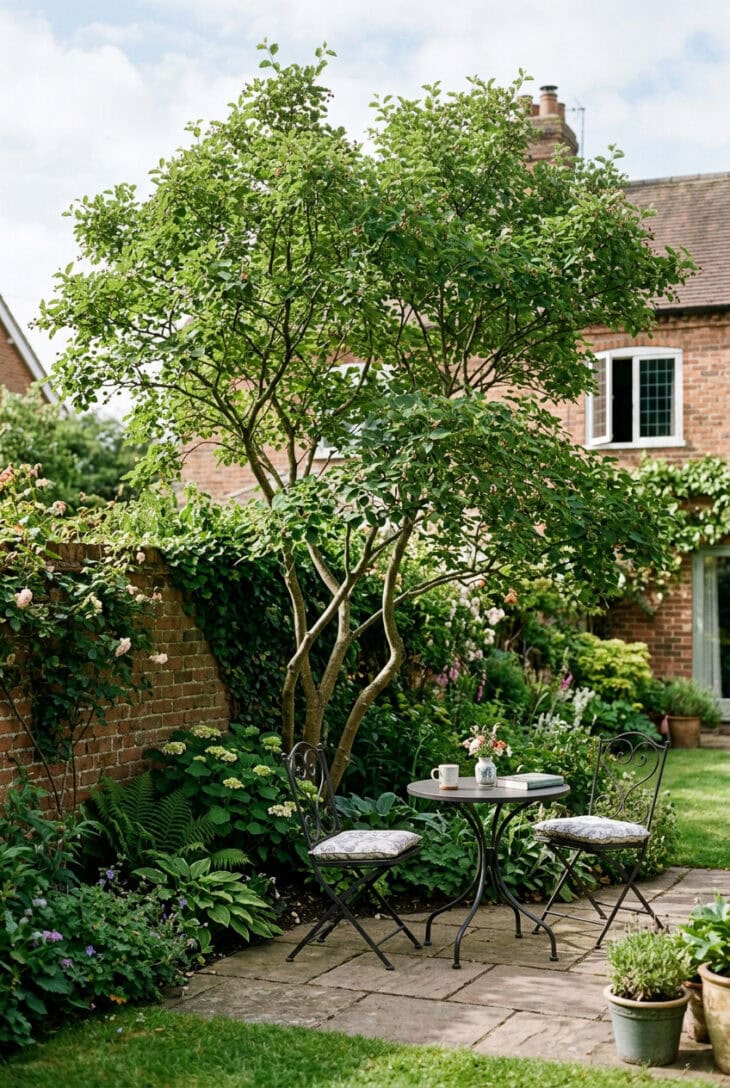
What you see One well-placed small tree, a multi-stemmed serviceberry or crab apple, standing in the corner where its canopy falls exactly across the line between your patio and a neighbor’s upstairs window. Beneath it sits a bistro set in soft dappled shade. It looks like a design choice, not a defensive measure.
Why it works A single tree, positioned with intent, can block one specific sightline more gracefully than an entire fence. The trick is placement: a tree close to your seating screens a distant window far more effectively than one planted on the boundary, because it interrupts the view where you sit. It adds height, shade, and seasonal beauty for the footprint of one trunk.
How to get it Stand where you sit, note the exact window you want gone, and plant the tree on that line, usually nearer the house than the boundary. Choose a compact, well-behaved species: serviceberry (Amelanchier lamarckii), crab apple (Malus ‘Evereste’), or a Japanese maple (Acer palmatum) for a shady spot. Pick a multi-stem for a wider, lower screen. Stake for the first two years and keep it watered while it establishes.
11. Woven Willow or Hazel Hurdles
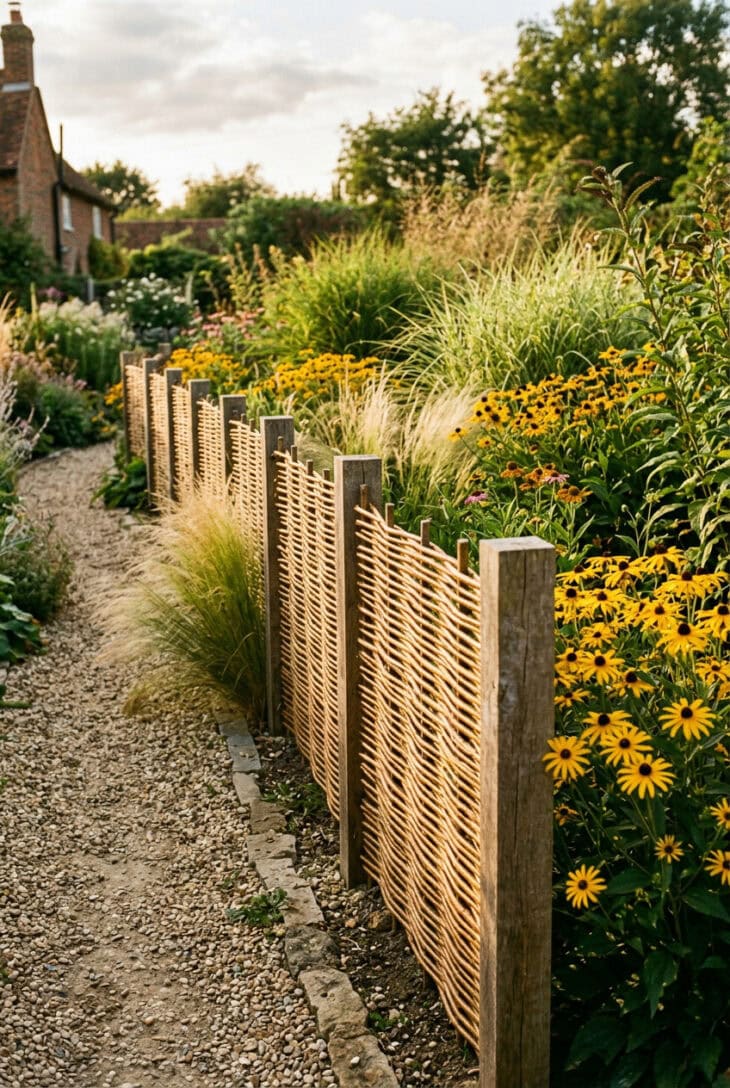
What you see Panels of woven willow or hazel, warm golden-brown and full of handmade texture, running along the boundary like a rustic basket turned on its side. Ornamental grasses and rudbeckia lean against them, softening the line. The whole effect is natural and tactile, a screen that looks grown rather than manufactured.
Why it works Hurdles give instant, inexpensive screening with a soft, informal character that suits cottage and wildlife gardens far better than sawn timber. They filter wind rather than blocking it, so they survive gusts, and their natural color recedes behind planting instead of dominating it. Perfect as a quick fix or a decorative face over an ugly existing fence.
How to get it Wire willow or hazel hurdle panels to sturdy posts set 6ft (1.8m) apart, keeping the panels just clear of the soil so their bases don’t rot. Expect five to ten years of life outdoors, longer if you plant an evergreen climber to grow through and eventually take over. Back them with grasses and cottage perennials for depth. A yearly coat of raw linseed oil slows weathering if you want to keep the color.
12. An Overhead Sail or Canopy
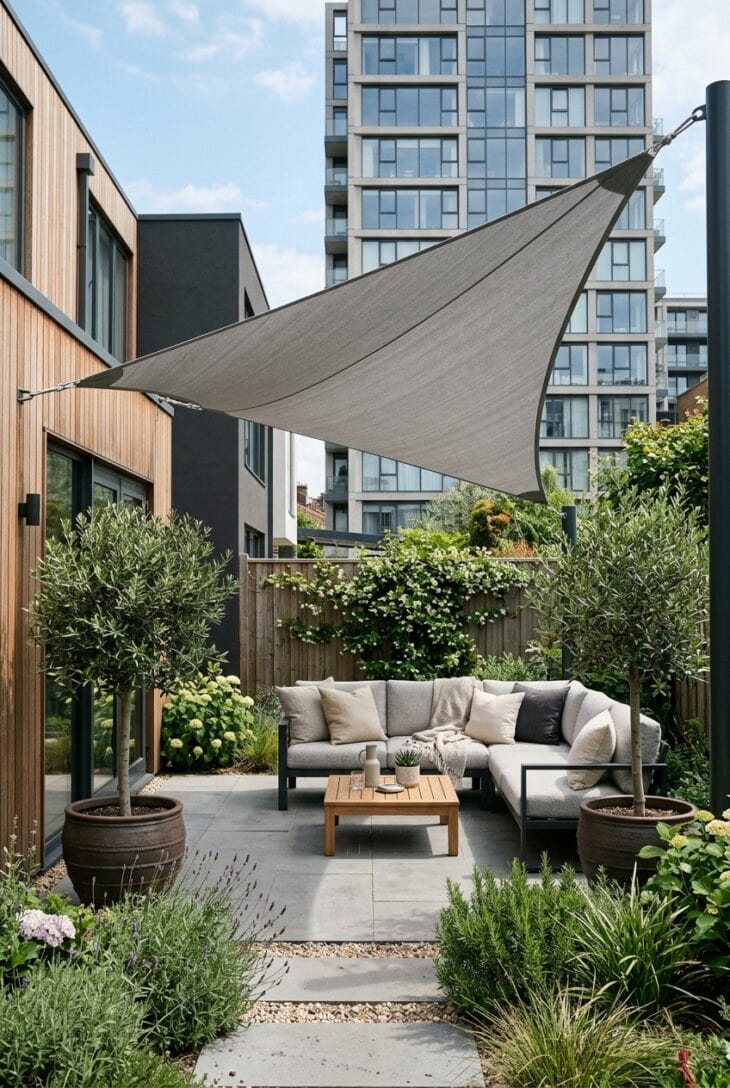
What you see A taut grey shade sail stretched at an angle above a seating area, its clean triangular line cutting off the view down from a tall building behind. Beneath it, an outdoor sofa and potted olives sit in cool, private shade. It is minimal and architectural, more like a piece of design than a garden structure.
Why it works When you are overlooked by a two- or three-story building, nothing at ground level helps, but an angled canopy overhead removes the downward sightline entirely. A sail does this for a fraction of the cost of a pergola and can be tensioned to shed rain to one side. It also delivers instant shade for hot patios.
How to get it Fix strong eye bolts to the house wall and to two or three stout posts set in concrete, then tension a quality shade sail between them with turnbuckles, angling it to block the specific window above. Choose a densely woven, UV-stable fabric for real privacy and rain shedding. Take it down over winter in cold or snowy climates to extend its life. For a permanent version, plant a pergola vine underneath to grow into the same role.
13. Mixed Native Hedgerow
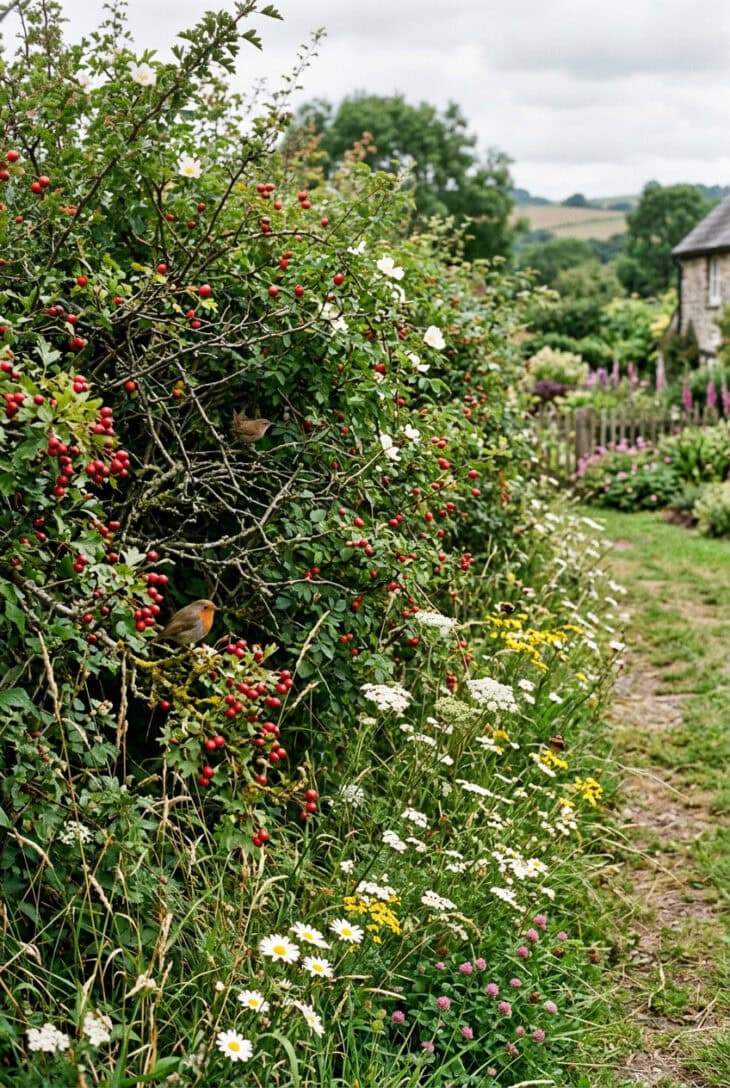
What you see A loose, informal hedgerow of hawthorn, hazel, blackthorn, and dog rose woven together, frothing with white blossom in spring and studded with red haws in autumn. Birds move through the tangle and a wildflower verge runs along its base. It is a screen and a wildlife corridor in one, full of movement and life.
Why it works A native hedgerow is the most wildlife-friendly boundary you can plant, offering nectar, berries, and nesting cover while still screening the garden. Because it is mixed and informal, it shrugs off pests and looks right in a rural or naturalistic setting where a clipped evergreen wall would feel out of place. It is also cheap to plant from bare-root whips.
How to get it Plant bare-root whips in a double staggered row in late fall or winter, five to seven plants per yard, mixing hawthorn (Crataegus monogyna), hazel (Corylus avellana), blackthorn, dog rose, and a little holly for evergreen bulk. It grows fast and needs only one trim a year, ideally after birds have finished nesting and the berries are gone. Mulch the first two years to beat the grass. Within four or five years it is a dense, living boundary.
14. Frosted Glass or Acrylic Panels
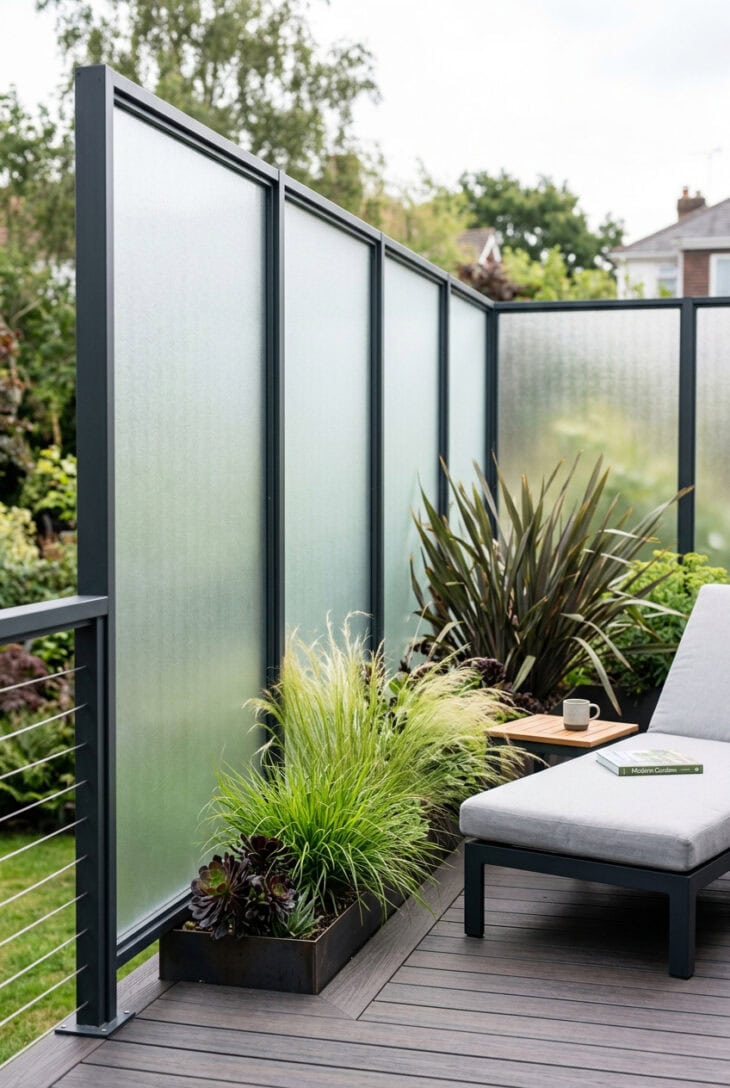
What you see A run of frosted glass panels in slim dark frames, glowing softly as light passes through while any figure behind them dissolves into a blur. Architectural phormium and grasses stand crisply against the milky surface. The effect is bright and modern, privacy without a hint of heaviness.
Why it works Frosted glass screens the view while keeping the light, which is the reason it beats a solid fence in a small or shady spot where a timber wall would make everything gloomy. It suits contemporary gardens perfectly and never needs staining or clipping. On a raised deck, it also acts as a safe, see-nothing balustrade.
How to get it Use toughened, laminated frosted or reeded glass rated for outdoor use, set into a powder-coated aluminum post system rated for wind loading in your area. Reeded glass gives more texture and hides marks better than flat frosted. Keep panels to a size two people can lift for installation. Pair with a single sculptural plant on each side so the glass stays the star. Wipe it down a couple of times a year and it looks new indefinitely.
15. Espaliered Trees Along a Wall
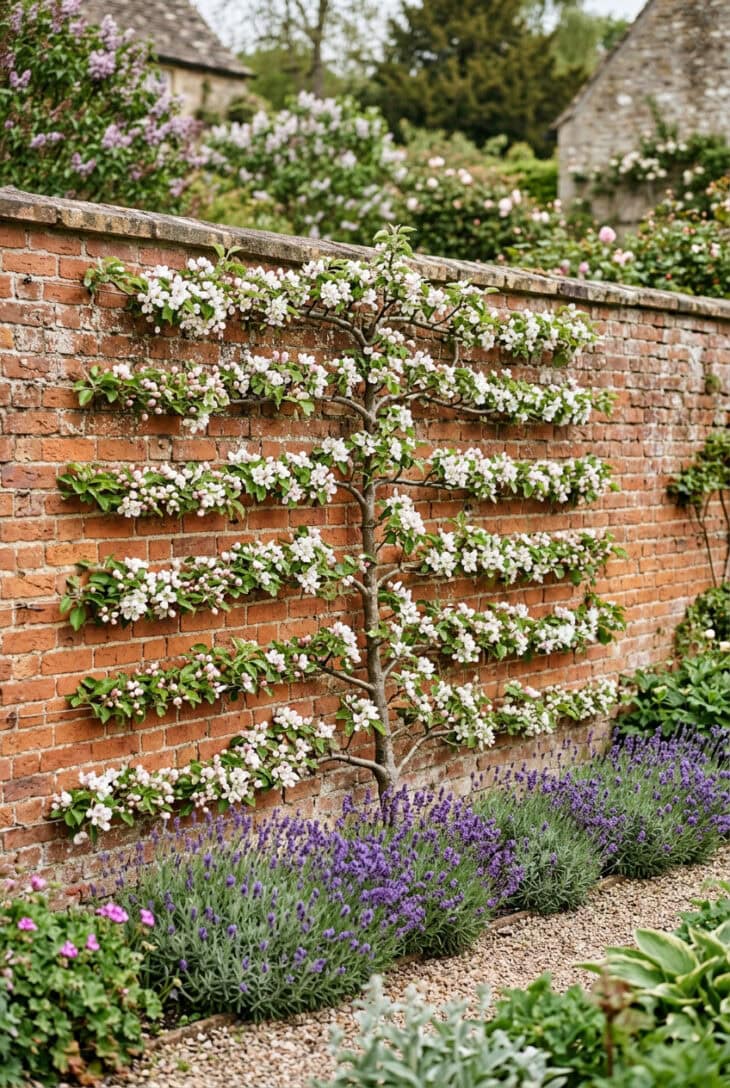
What you see An apple tree trained flat against a brick wall in neat horizontal tiers, its spread branches clothing the masonry in blossom and, later, fruit and leaf. It extends the wall’s greenery upward without projecting into the garden. A line of lavender runs along its foot, and the whole thing reads as living architecture.
Why it works Espaliers add height and screening in almost no depth, which is exactly what a narrow side return or a low boundary wall needs. Training a fruit tree flat also makes it far more productive and easy to pick, so the privacy comes with apples or pears attached. It is the classic solution for turning a bare wall into a green, useful screen.
How to get it Fix horizontal wires 12 to 18in (30 to 45cm) apart, held 3in (7.5cm) off the wall on vine eyes. Buy a ready-started espalier apple or pear on a dwarfing rootstock (M26 for apples), or train a maiden yourself over a few winters. Tie new growth to the wires and prune in late summer to build the tiers and keep it flat. A warm, sunny wall gives the best crop and the densest cover.
16. A Planted Berm for Raised Screening
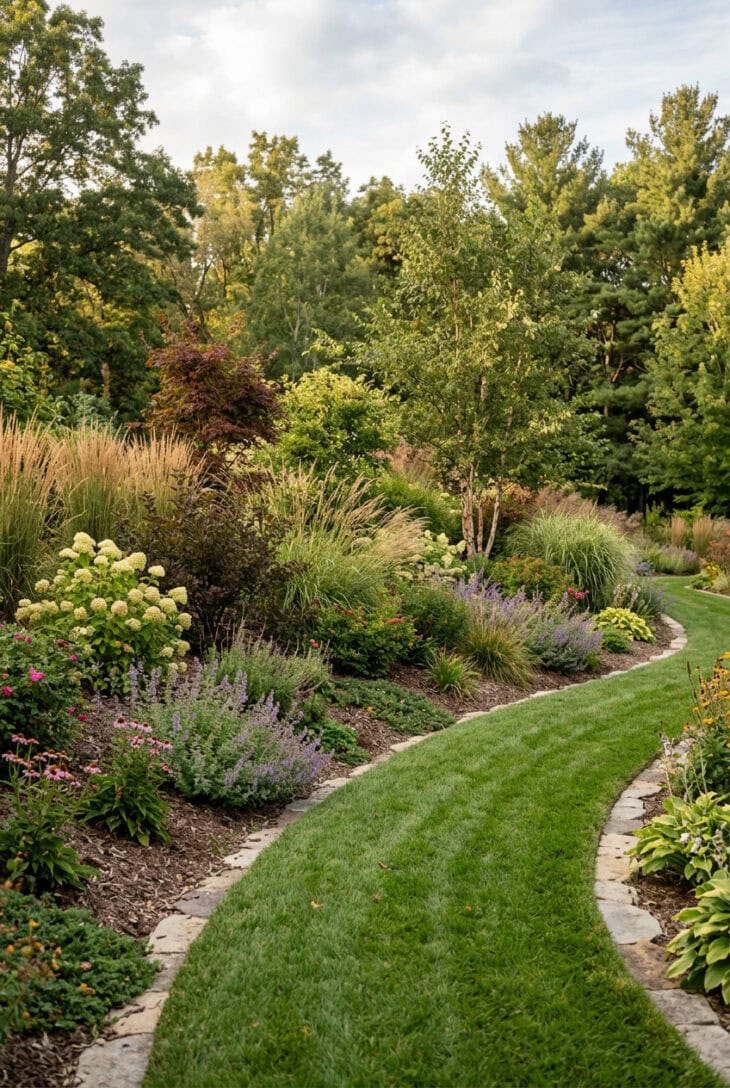
What you see A gently mounded bank of earth, a couple of feet higher than the surrounding ground, planted with drifts of grasses, shrubs, and a few small trees. The raised soil lifts the whole screen up before a single plant grows, so a modest shrub already stands above eye level. A curving lawn edge flows around its foot.
Why it works A berm is a landscaper’s trick for gaining height without waiting or building. By mounding the soil, you start the screen 2 to 3ft (60 to 90cm) up, so plants reach a screening height years sooner. The gentle contour also adds sculptural interest to a flat plot and improves drainage for the planting on top.
How to get it Build the berm from good topsoil in a long, gentle mound at least four times as wide as it is high, so it looks natural and won’t erode. Firm it in layers, let it settle, then plant deep-rooting grasses and shrubs to bind the soil, such as Miscanthus, viburnum, and a small birch. Mulch heavily and water well the first year while roots knit it together. Avoid steep sides, which dry out and slump.
17. Corten Steel Privacy Screen
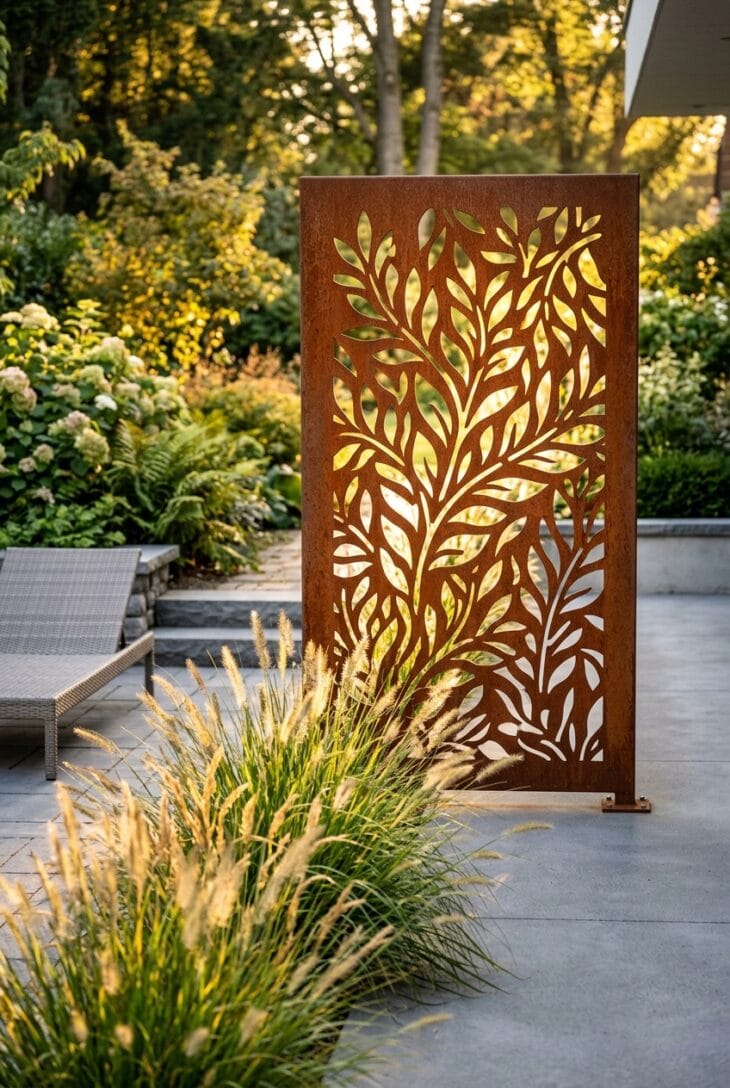
What you see A panel of corten steel in warm rusted orange, laser-cut with a botanical leaf pattern, standing between the patio and the garden beyond. As the evening light drops behind it, the cutouts glow and throw patterned shadows across the paving. Ornamental grasses catch the same light in front. It is part screen, part sculpture.
Why it works A decorative metal screen blocks a sightline while staying visually light, because the cut pattern lets glimpses and evening light pass through. Corten’s rich rust tone flatters green planting and needs no upkeep, weathering to a stable finish that never rots or needs painting. It is the choice when you want the screen itself to be a feature, not a background.
How to get it Order powder-primed corten panels sized to your gap, and set the supporting posts in concrete, as steel panels catch the wind. Position them where the low sun will backlight the pattern for that evening glow. Let new corten weather for a few months, and keep it off pale paving at first, since early rust run-off can stain (a gravel or planted base hides it). Once stable, it is entirely maintenance-free.
18. Climber-Clad Wire Cables
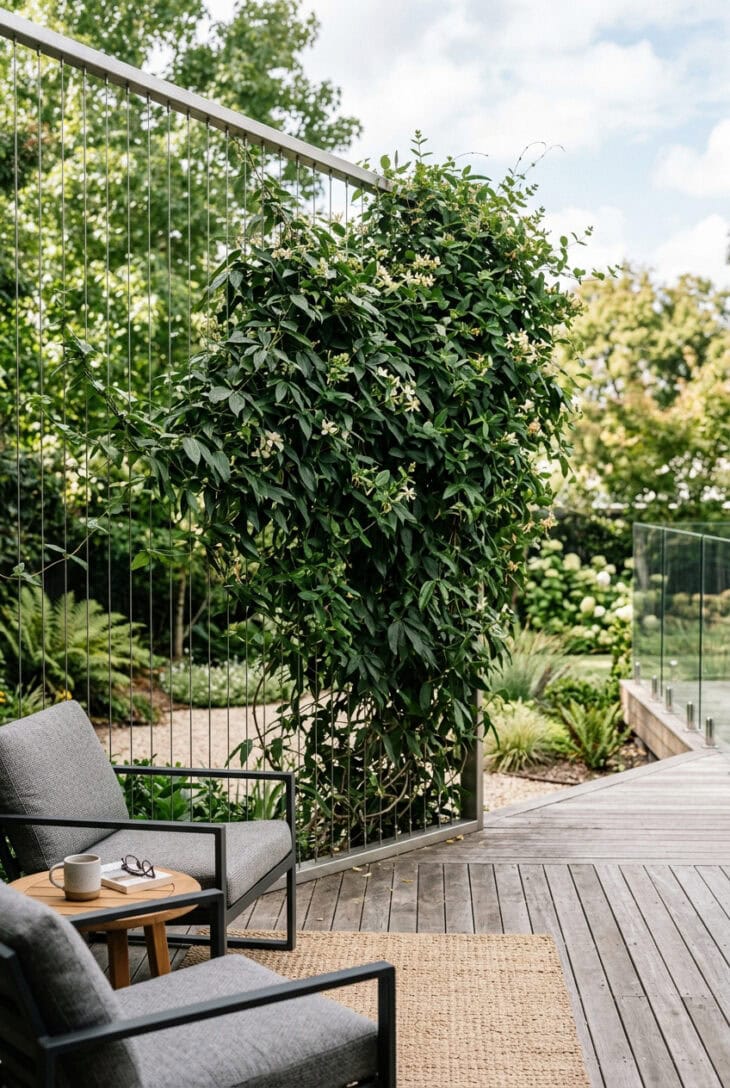
What you see A near-invisible frame of tensioned steel cables running floor to ceiling, with an evergreen clematis and honeysuckle scrambling up them into a soft green curtain. The support disappears, so the screen looks like a free-standing wall of foliage. Beside it, a deck and lounge chairs sit in green-filtered privacy.
Why it works A cable trellis gives climbers a strong, unobtrusive structure to make a living screen in the slimmest possible footprint, ideal against a house wall or across an open side of a deck. Because the framework is minimal, the plant becomes the whole feature, and you get real green screening without the bulk of a hedge or the flatness of a fence.
How to get it Fix a stainless steel cable kit between a top and bottom rail or between wall anchors, tensioned so the wires stay taut under the plant’s weight. Plant self-clinging or twining evergreens like Clematis armandii, evergreen honeysuckle (Lonicera henryi), or star jasmine, one every 3ft (90cm). Guide the first shoots onto the wires and spread them wide. Trim once a year after flowering to keep the curtain dense and flat.
19. A Secluded Garden Room or Arbor
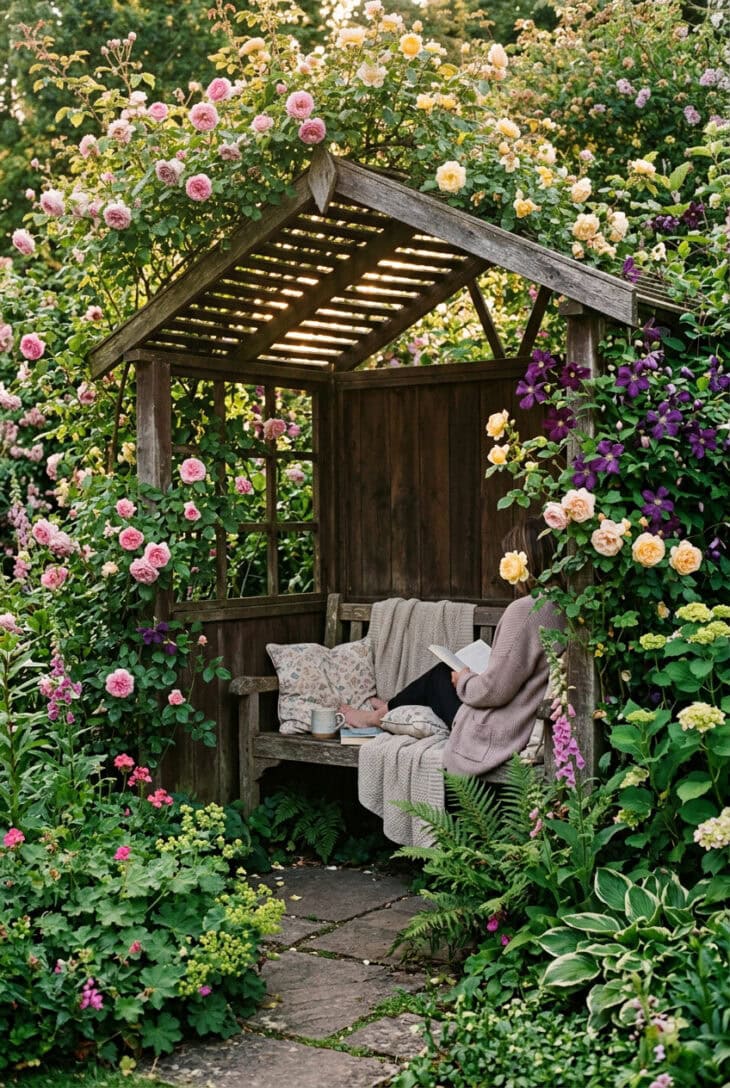
What you see A timber arbor with solid back and sides tucked into a leafy corner, a bench inside framed by climbing roses and clematis. Rather than screen the whole plot, it wraps a single private seat in structure and greenery, open only to the view you actually want. Step inside and the neighbors simply vanish.
Why it works Sometimes you don’t need to screen the entire garden, just to create one spot where you can’t be seen. An arbor or garden room does this by enclosing you rather than the boundary, which is far cheaper and quicker than screening a whole perimeter. Aimed at your best view and backed against the overlooked side, it gives instant, focused seclusion.
How to get it Site the arbor with its solid back to the direction you’re overlooked from and its opening facing your favorite outlook. A ready-made cedar or oak arbor sets up in an afternoon; a fully enclosed garden room needs foundations. Clothe the outside in a scented climber such as Rosa ‘Gertrude Jekyll’ with a Clematis ‘Etoile Violette’ for a long season. Add a solid roof panel if you want it usable in rain.
20. Tall Ornamental Grasses as a Soft Screen
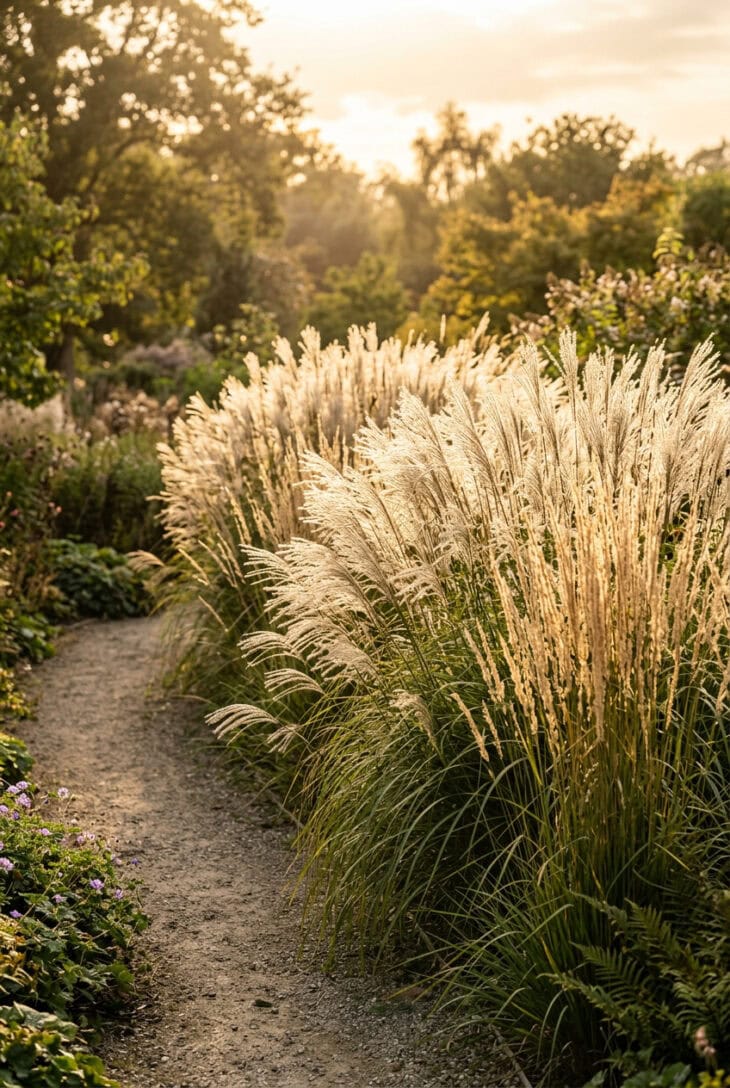
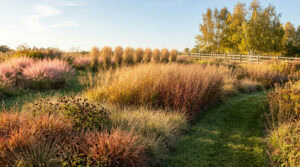
What you see A block of tall grasses, miscanthus and calamagrostis, rising 6 to 8ft (1.8 to 2.4m) into a soft, feathery wall, their plumes lit gold by the low sun and swaying with every breeze. It screens the boundary behind a veil of movement and sound. Nothing about it feels solid, yet you cannot see through.
Why it works Tall grasses give a season of privacy that is airy and alive, screening from late spring through winter when you leave the stems standing. They fill a wide gap fast and cheaply, sway instead of fighting the wind, and add sound and light to the boundary that a hedge cannot. It is the most naturalistic, low-cost soft screen going.
How to get it Plant a block, not a line, of maiden grass (Miscanthus sinensis ‘Malepartus’) or feather reed grass (Calamagrostis ‘Karl Foerster’), spacing 24 to 30in (60 to 75cm) apart so they knit into a mass. They die back in winter but hold their bleached plumes for structure, so cut them down only in late winter just before new growth. Give them full sun and they need almost nothing else. For evergreen winter cover, plant a few Fargesia bamboo among them.
21. A Gabion Wall with Planting
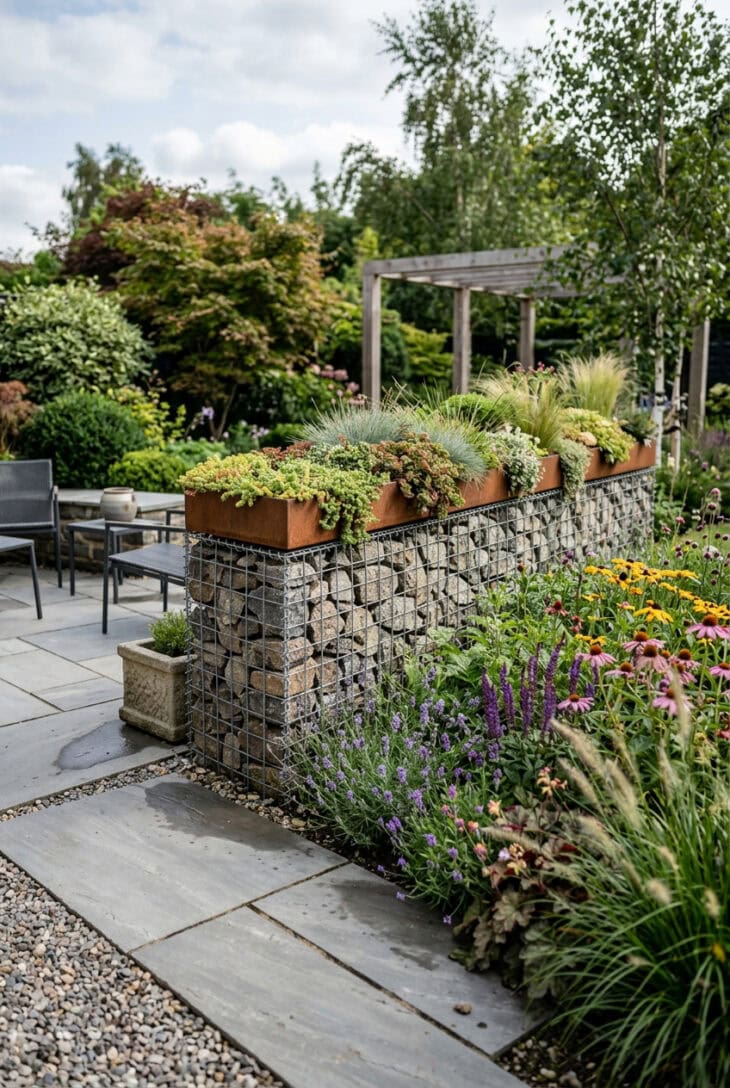
What you see A wall of stone-filled steel cages, its rugged texture reading as both industrial and natural, forming a solid, permanent boundary. A trough of trailing sedum and grasses runs along its top, and ornamental planting softens the base. It has real mass and presence, a screen that also feels like a piece of landscape.
Why it works A gabion wall gives the solidity and sound-blocking of masonry with a fraction of the skill and cost, since it is essentially cages filled with stone. It is exceptionally sturdy, needs no foundations to the depth a brick wall would, and its thermal mass shelters tender plants. The textured stone suits modern and rural gardens alike, and planting the top keeps it from feeling severe.
How to get it Set galvanized gabion baskets on a compacted, level base and fill them by hand with angular local stone, packing the visible faces tightest. Keep walls under about 3ft (90cm) unless you engineer them properly, and add a slatted or trellis topper if you need more height for privacy. Fit a planted trough or let the top course hold soil for sedum and thyme. Once built, it is effectively maintenance-free for decades.
22. Screen an Overlooked Window from Inside the Bed
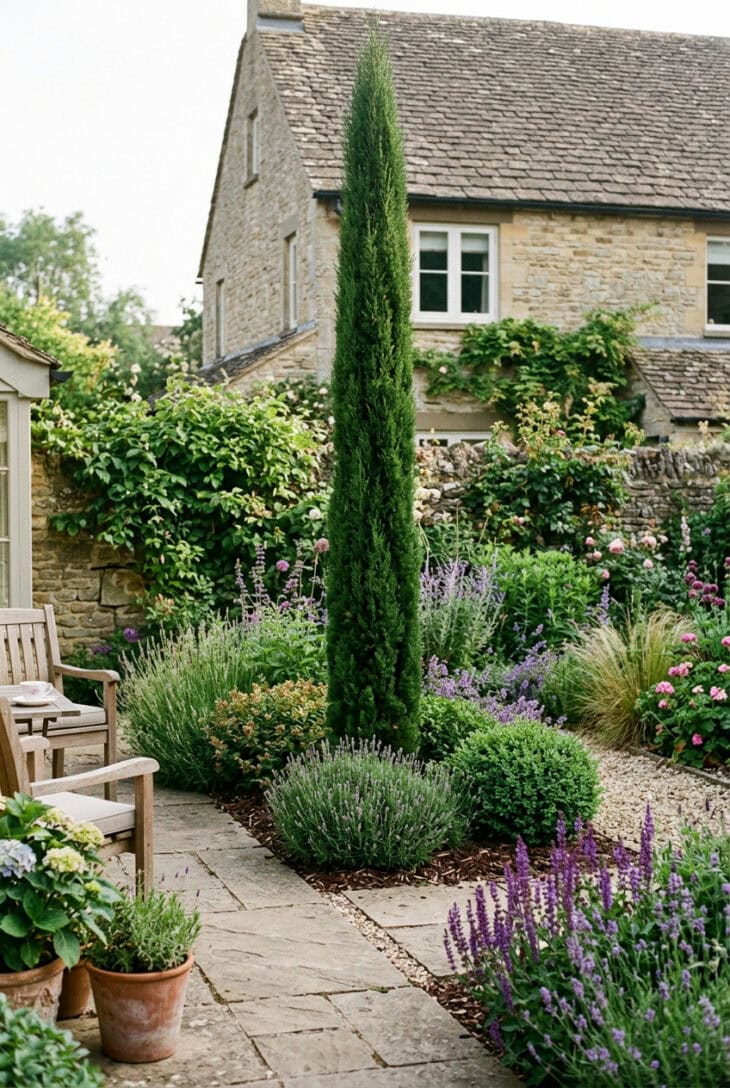
What you see A single slim columnar evergreen, an Italian cypress or narrow conifer, rising like an exclamation mark from a border, placed exactly on the line between your seat and one troublesome window. Lower shrubs and perennials flow around its base. It is a vertical accent doing a very specific job.
Why it works You rarely need to block the whole neighborhood, just one window or one angle. A narrow, tall plant set at the right point in a bed screens that single sightline while taking up almost no ground, a technique landscapers call a “privacy column.” Because it is slim and deliberate, it reads as design rather than defense, and it doesn’t shade the border around it.
How to get it Sit where you want privacy, sight the offending window, and mark the spot in the bed that falls on that line, usually closer to you than to the boundary. Plant a naturally narrow evergreen: Italian cypress (Cupressus sempervirens ‘Totem’) in mild zones, or ‘Sky Pencil’ holly (Ilex crenata ‘Sky Pencil’) or slender juniper elsewhere. Keep it fed and, for holly or juniper, lightly clipped to hold its shape. One or two well-placed columns often solve the whole problem.
23. Bamboo or Reed Fencing Roll
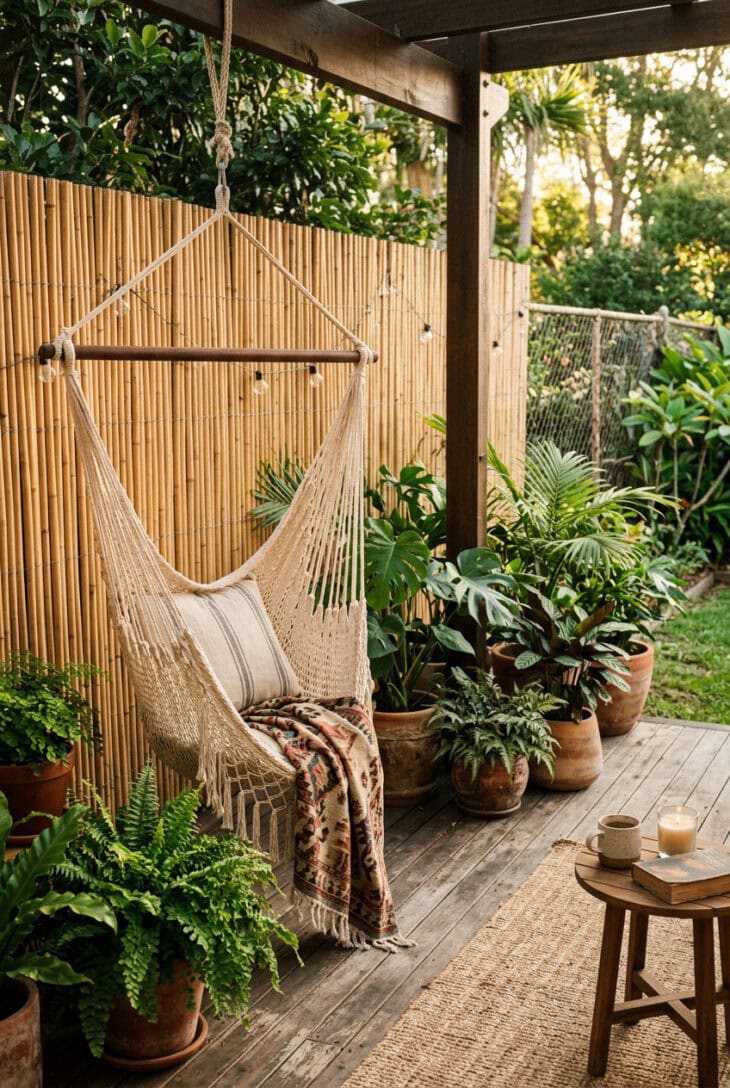
What you see A roll of warm tan bamboo canes wired over a tired chain-link or wire fence, instantly turning a see-through boundary into a solid, natural-looking screen. Potted ferns and a hanging chair sit in front, giving the corner a relaxed, tropical-boho feel. It looks intentional, not like a cover-up.
Why it works A bamboo or reed roll is the fastest, cheapest privacy fix there is: it hides an ugly existing fence in an afternoon for very little money. The natural material warms up a hard boundary and suits courtyard, tropical, and rental gardens where you can’t rebuild the fence. It buys you instant screening while a slower planted solution grows in behind it.
How to get it Unroll bamboo or reed screening over a sound existing fence or a run of posts and wire, fixing it every 12in (30cm) with UV-stable cable ties or galvanized wire. Choose a thicker, better-quality roll, as cheap ones fade and shatter within a season or two. Expect three to five years of life outdoors, longer if you keep it off wet ground. Plant an evergreen climber to take over as it ages, and it never has to be the permanent answer.
24. A Mixed Evergreen and Flowering Shrub Bank
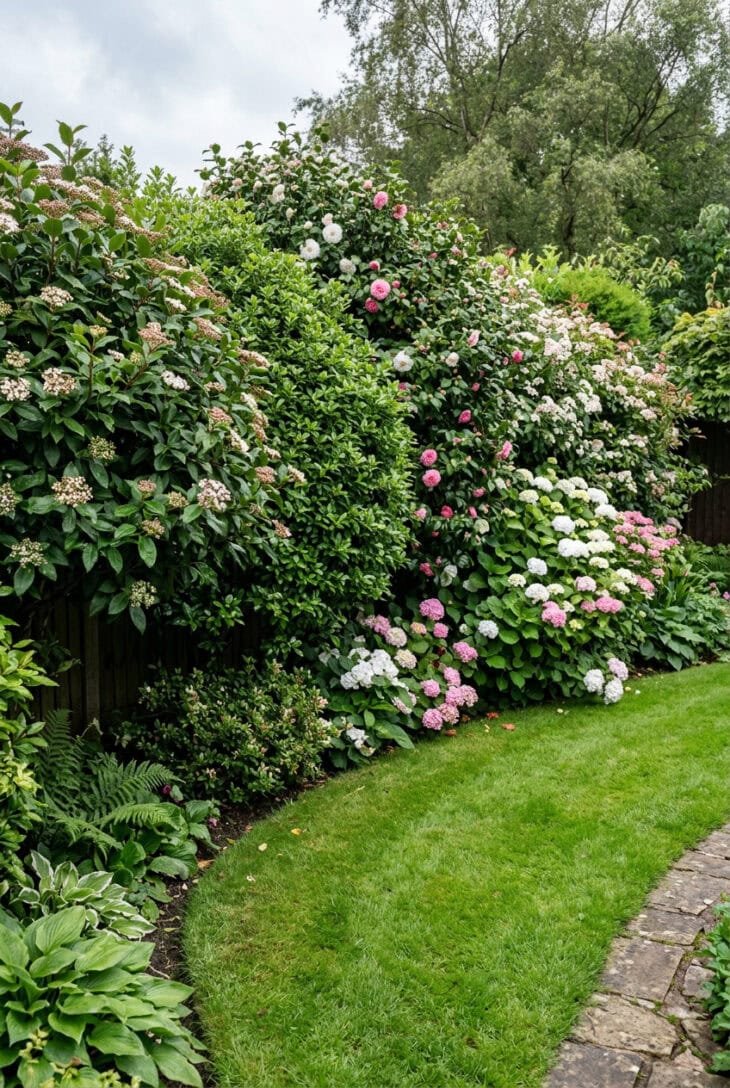
What you see A deep, informal bank of shrubs layered along the boundary: glossy viburnum and pittosporum for evergreen bulk, hydrangea and camellia threaded through for white and pink flowers across the seasons. It reads as a full, relaxed border rather than a hedge, and it is impossible to see through. A lawn curves gently in front.
Why it works A shrub bank gives you an evergreen screen that also flowers, so the boundary earns its keep as a display, not just a barrier. Mixing species means continuous cover if one struggles and a longer season of interest than any single hedge. Because you never clip it into a wall, it stays soft and informal, ideal for a relaxed or cottage-style garden.
How to get it Plant evergreen backbone shrubs 3 to 4ft (90 to 120cm) apart, such as Viburnum tinus, pittosporum, and Portugal laurel, then weave in flowering shrubs like hydrangea (Hydrangea paniculata) and camellia for a shadier stretch. Stagger the planting for depth and let each shrub grow to its natural size with only light shaping. Mulch well and water through the first two summers. Within three or four years it becomes a dense, flowering wall of green.
25. Layer Everything: The Complete Private Garden
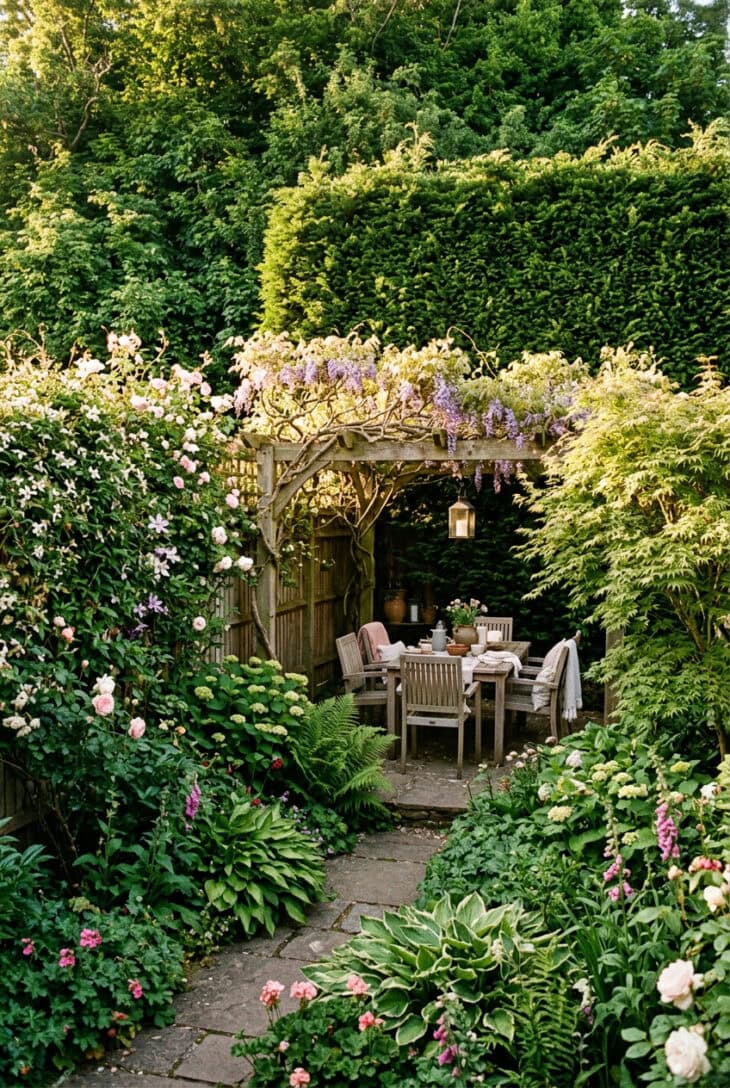
What you see A garden that feels completely enclosed, but not by any one thing: a hedge along the back, a climber-clad fence to one side, a pergola over the seating, and a small tree filling the corner, all working at once. Green surrounds you at every height, and the dining area at its heart feels like a private room. You simply cannot tell where the neighbors are.
Why it works Real privacy almost never comes from a single tall barrier; it comes from layering several modest ones so every sightline is broken by something. A hedge handles the ground level, a pergola or tree handles the view from above, and climbers and planting fill the gaps between. The result feels lush and generous rather than defensive, because no one element has to do all the work.
How to get it Start by sitting in your main seating spot and noting every angle you feel exposed from, at ground level and above. Match each one to the right idea from this list: a hedge or shrub bank for the boundary, pleached trees or a pergola for overhead, a corner tree or privacy column for a single window, planters or a screen for the patio itself. Build it up over a couple of seasons rather than all at once, and let the planting knit the layers into one green whole.