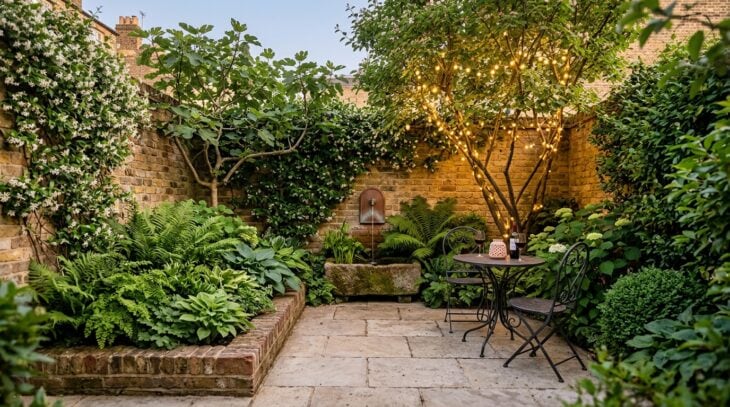
A courtyard is a garden with walls on every side, and that enclosure is its gift rather than its limit. Sheltered from wind, warmed by the surrounding brick, and completely private, it can hold plants and moods that an open garden never could.
Contents
- 01. Green Living Wall
- 02. Central Water Feature
- 03. Multi-Stem Tree as Centerpiece
- 04. Climbers to Clothe the Walls
- 05. Symmetrical Formal Layout
- 06. Shade-Loving Green Retreat
- 07. Mediterranean Sun Trap
- 08. Cozy Fire-Lit Corner
- 09. Potted Tree and Shrub Collection
- 10. Raised Beds Around the Edges
- 11. Overhead Pergola Canopy
- 12. Mirror to Double the Space
- 13. Wall-Mounted Fountain Spout
- 14. Lush Tropical Jungle Courtyard
- 15. Statement Floor Tiles
- 16. Built-In Bench Seating
- 17. Scented Planting by the Door
- 18. Minimalist Zen Courtyard
- 19. Espaliered Fruit on the Walls
- 20. Courtyard Herb and Kitchen Garden
- 21. Uplighting and Evening Drama
- 22. Cottage-Style Courtyard Overflow
- 23. Modern Rendered Walls and Grasses
- 24. Wildlife-Friendly Green Corner
- 25. Tiled Rill or Reflecting Pool
The ideas below cover the full range: bright sun-trap terraces and cool shady wells, formal symmetry and loose green jungle, hard-working city spaces and quiet retreats. Some are weekend projects with a few pots, others are full makeovers with paving and built-in beds, so there is something whether you rent a tiny light-well or own a walled garden.
Read through and pick the ideas that suit your walls, your light, and how you want the space to feel. Most combine happily, and in a courtyard even one strong idea, a single tree or a wall of green, can change everything.
01. Green Living Wall
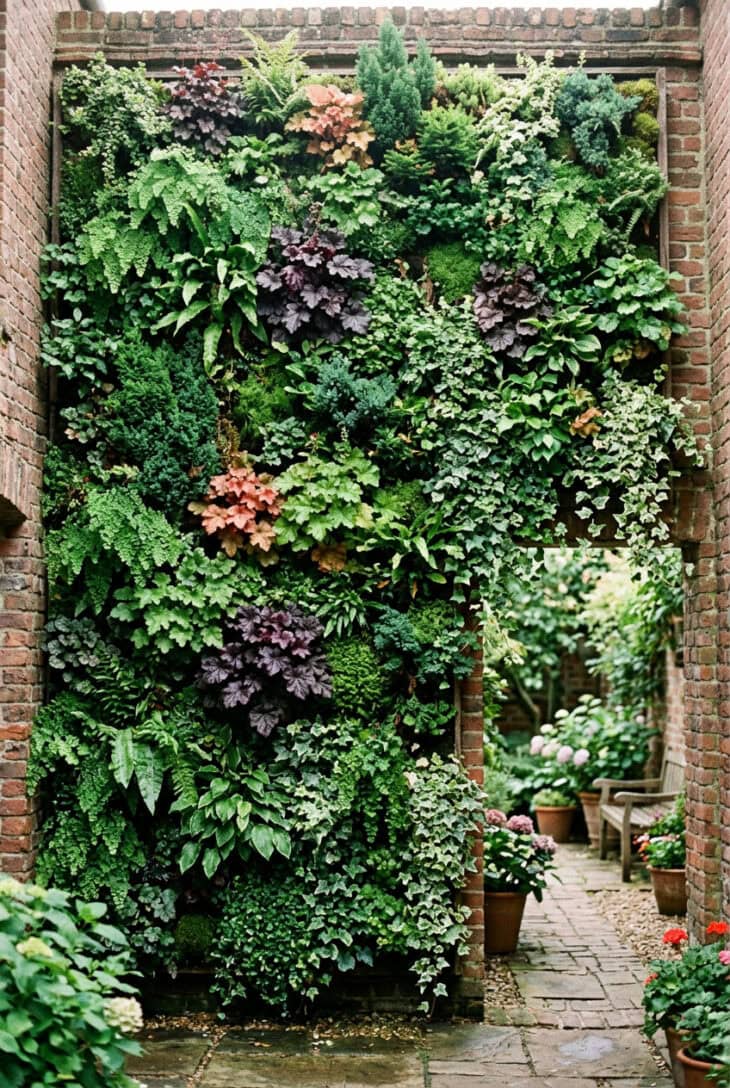
What you see An entire courtyard wall turned into a vertical carpet of green: feathery ferns, ruffled heuchera (Heuchera), threads of trailing ivy (Hedera helix) and small evergreens woven into one dense tapestry, framed by the old brick. It feels less like a wall and more like a hedge stood on end.
Why it works A courtyard has more wall than floor, so planting the vertical surfaces is the single biggest thing you can do to make it feel like a garden. A living wall softens the hard boundaries, muffles noise, and packs a huge amount of greenery into a footprint of almost nothing.
How to get it Fit a modular living-wall system or a run of felt planting pockets onto a frame held off the wall so the brick can breathe. Choose shade-tolerant, shallow-rooted plants like ferns, heuchera and small evergreens, and mix leaf shapes for texture. Install a simple drip irrigation line on a timer, because hand-watering a vertical wall evenly is nearly impossible, and this is the courtyard-scale version of a full vertical garden.
02. Central Water Feature
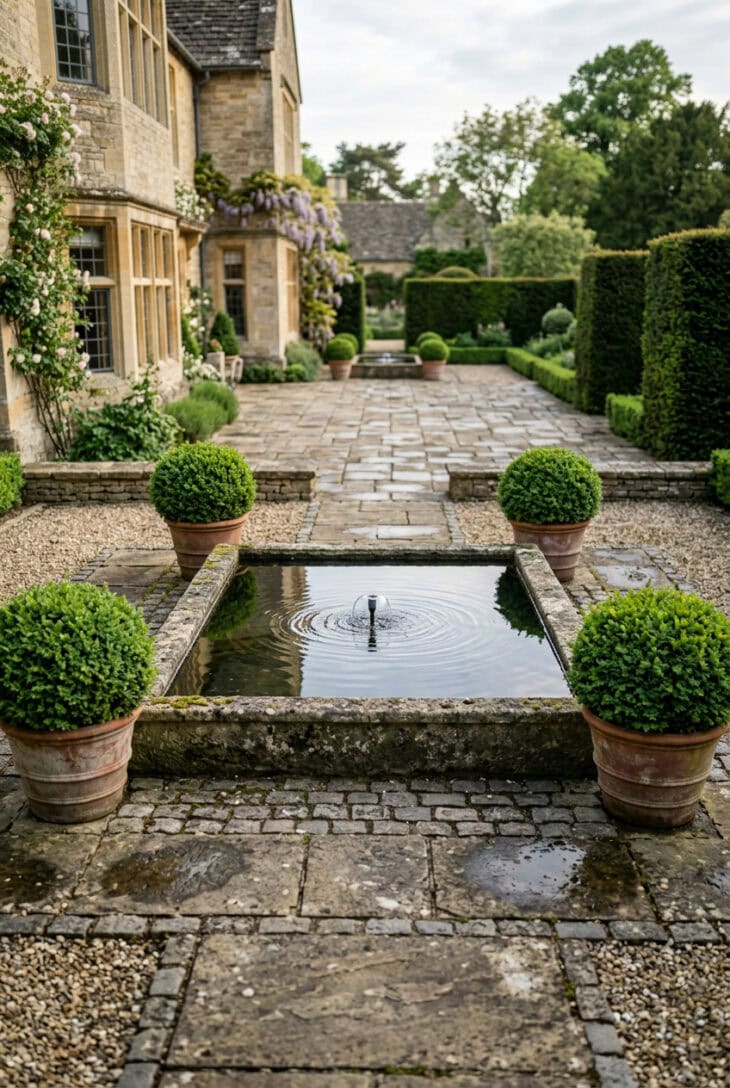
What you see A square stone basin at the heart of the courtyard, water bubbling gently at its center and lying still and reflective at the edges, ringed by symmetrical clipped box (Buxus sempervirens) balls. The whole space organizes itself around this quiet central point.
Why it works Enclosing walls trap sound, so the soft trickle of water fills a courtyard beautifully and masks the city beyond. A central feature also gives a small square space a natural focus, and reflective water bounces light into what can otherwise be a dim well.
How to get it Choose a self-contained, recirculating feature so you are not plumbing in fresh water, and keep the sound gentle rather than gushing in a small enclosed space. Center it on the main sightline from the house, and use a formal shape (square or round) for a courtyard that suits it. Keep it topped up in summer, clean the pump each season, and drain or heat it before winter so it does not crack. A courtyard is the perfect place to start with water garden features on a manageable scale.
03. Multi-Stem Tree as Centerpiece
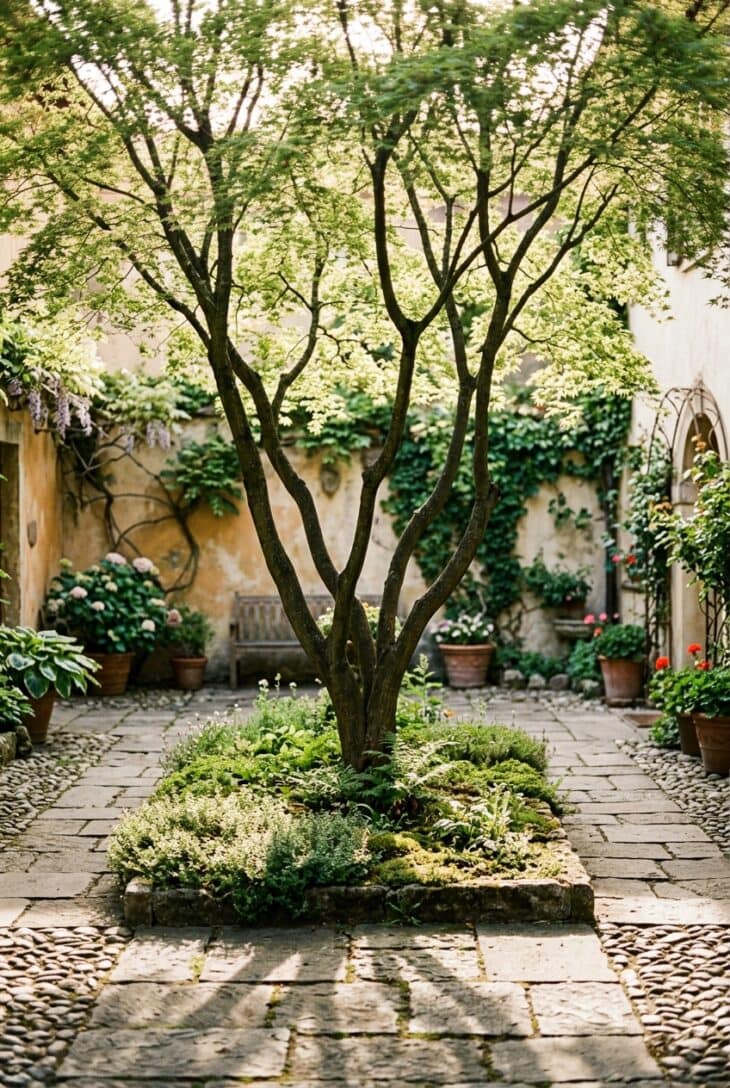
What you see One graceful multi-stem tree rising from a bed of low ground cover, its several slim trunks lifting an airy canopy that dapples the paving with shifting shade. It gives the courtyard a living roof and a clear, sculptural centerpiece.
Why it works A single well-chosen tree brings the height, shade and seasonal change a courtyard needs, and a multi-stem form gives more character in less space than a standard trunk. Its canopy makes the enclosed space feel like a room with a ceiling rather than an open box.
How to get it Choose a small, well-behaved tree with a light canopy: an Amelanchier (Amelanchier lamarckii), a multi-stem birch (Betula utilis jacquemontii) or a Japanese maple (Acer palmatum) for a shadier spot. Plant it slightly off-center so it frames rather than blocks the space, and give the roots a generous bed or a very large container. Avoid anything vigorous or thirsty near walls and drains, and underplant with shade-tolerant ground cover to finish the base.
04. Climbers to Clothe the Walls
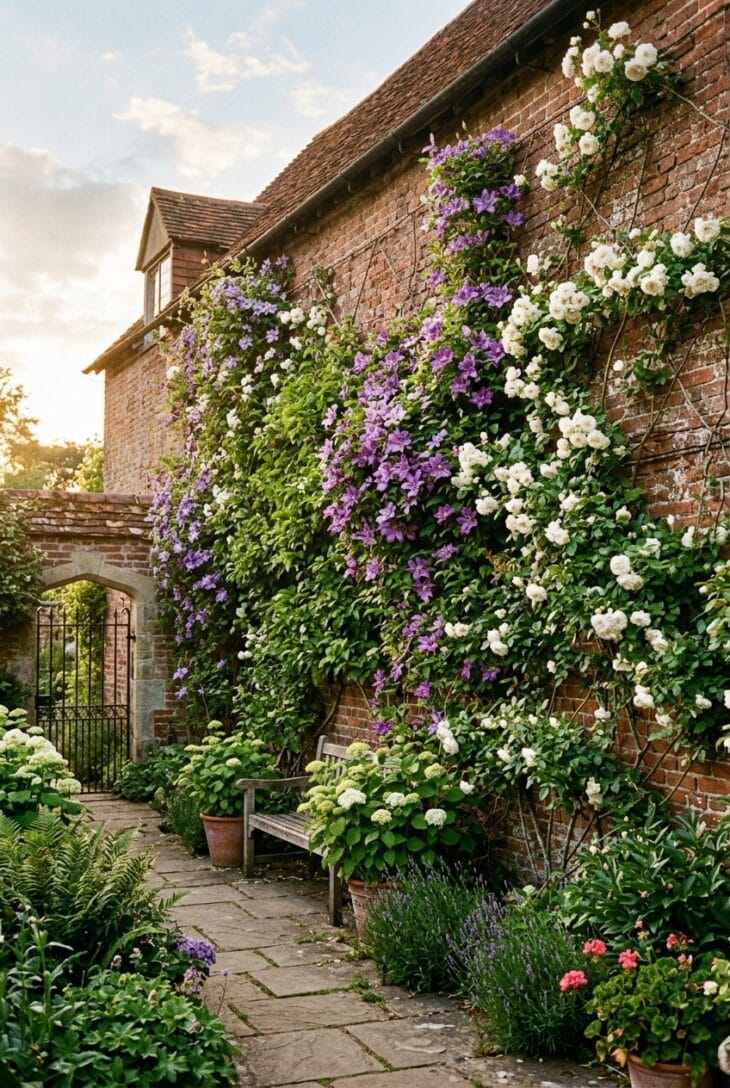
What you see Brick walls dressed in climbing plants: purple clematis (Clematis) flowers threading through white climbing roses (Rosa) and glossy green leaves that scale wires all the way up the brick. The walls disappear behind flower and foliage, and the courtyard feels wrapped in growth.
Why it works Climbers give the biggest return on the least ground, turning bare vertical brick into flowering, living surface. In a courtyard those walls are your largest planting canvas, and clothing them is what stops the space feeling like a paved box.
How to get it Fix horizontal wires or trellis 2in (5cm) off the wall to let air circulate, and match the climber to the aspect: climbing roses and clematis for sun, climbing hydrangea (Hydrangea anomala petiolaris) for shade. Combine an evergreen for year-round cover with a flowering climber for seasonal show, and plant roots at least 12in (30cm) out from the wall base where soil is less dry. Tie in and prune each year so it stays lush rather than a tangle.
05. Symmetrical Formal Layout
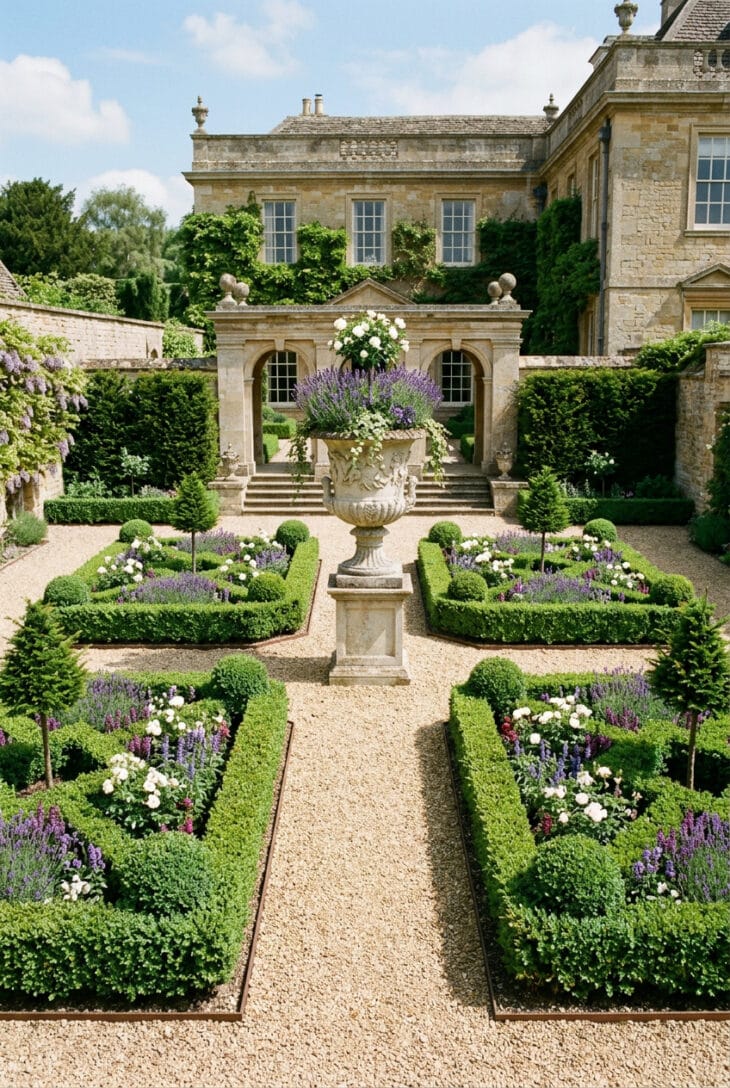
What you see A courtyard laid out with strict symmetry: four matching square beds of clipped box hedging arranged around a central urn, with neat gravel paths dividing them into a tidy grid. Each quarter mirrors the others, and the effect is calm and orderly.
Why it works The regular geometry of a courtyard lends itself perfectly to formal design, and symmetry brings an instant sense of order and elegance. A clear structure of hedges and paths also looks good all year, holding the space together even when nothing is in flower.
How to get it Draw a central axis on the main view and mirror everything across it: matched beds, paired pots, a single focal point at the center. Use clipped evergreens like box (Buxus sempervirens) or, if box blight is a worry, small-leaved holly (Ilex crenata) for the low hedges, and keep the plant palette tight and repeated. Edge the beds crisply, top the paths with fine gravel, and trim the hedges twice a year to keep the lines sharp.
06. Shade-Loving Green Retreat
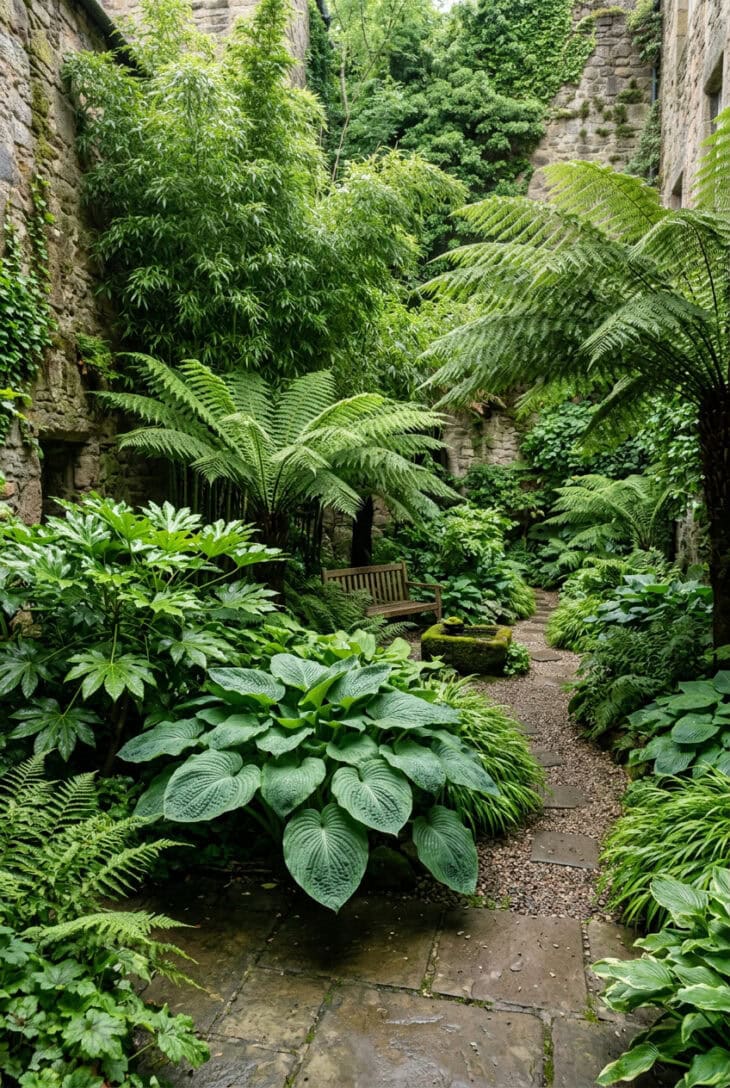
What you see A cool green well with no direct sun: broad-leaved hostas (Hosta), the arching fronds of a tree fern (Dicksonia antarctica), tall bamboo and the glossy hands of a fatsia (Fatsia japonica), layered into deep, restful greens. It reads like a shaded jungle clearing.
Why it works Many courtyards are overshadowed by surrounding buildings, and rather than fighting that, a shade scheme makes it the whole point. Bold foliage plants relish the cool, still, humid conditions enclosed shade provides, and layered leaves feel lush where flowers would sulk.
How to get it Build in layers: tall bamboo or a tree fern for height, fatsia and hostas at mid-level, and ferns and ground cover below. Contrast big bold leaves with fine ferny ones, and use pale variegated foliage to lift the darkest corners. Keep everything well watered and mulched, since shade under walls can also be dry, and lean on this shade planting palette to turn a gloomy corner into the best part of the garden.
07. Mediterranean Sun Trap
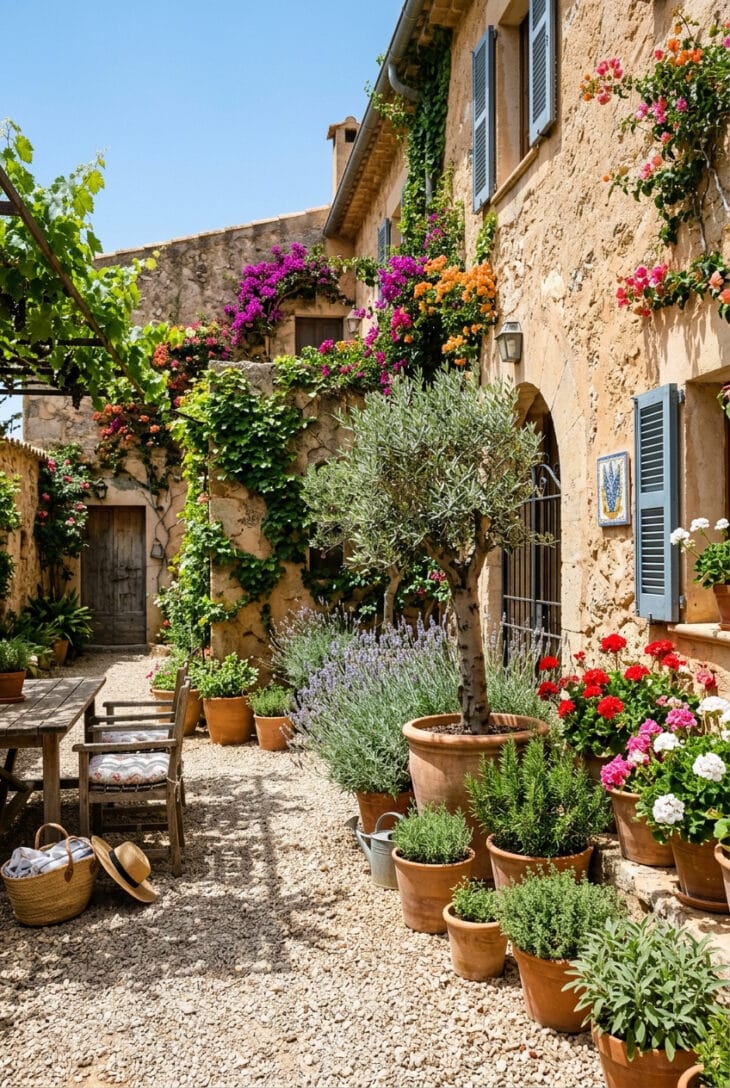
What you see A walled sun trap that feels straight off the Mediterranean coast: terracotta pots of silvery lavender (Lavandula angustifolia), a potted olive (Olea europaea), bushes of rosemary and bright pelargoniums against sun-baked stone, with gravel crunching underfoot. The heat seems to radiate from the walls.
Why it works A south-facing courtyard collects and holds heat like a suntrap, creating a warm microclimate that suits drought-loving Mediterranean plants perfectly. Their silvery, aromatic foliage and the terracotta and gravel echo hot, dry gardens and make the enclosed space feel like a holiday.
How to get it Plant lavender, rosemary, santolina (Santolina chamaecyparissus) and an olive in terracotta with plenty of grit for sharp drainage, and let them dry out between waterings. Use pale gravel or stone underfoot to reflect light and heat, and keep the palette to silver, terracotta and one or two hot flower colors. The warm walls will help tender plants through winter, and the look borrows straight from a classic Mediterranean planting scheme.
08. Cozy Fire-Lit Corner
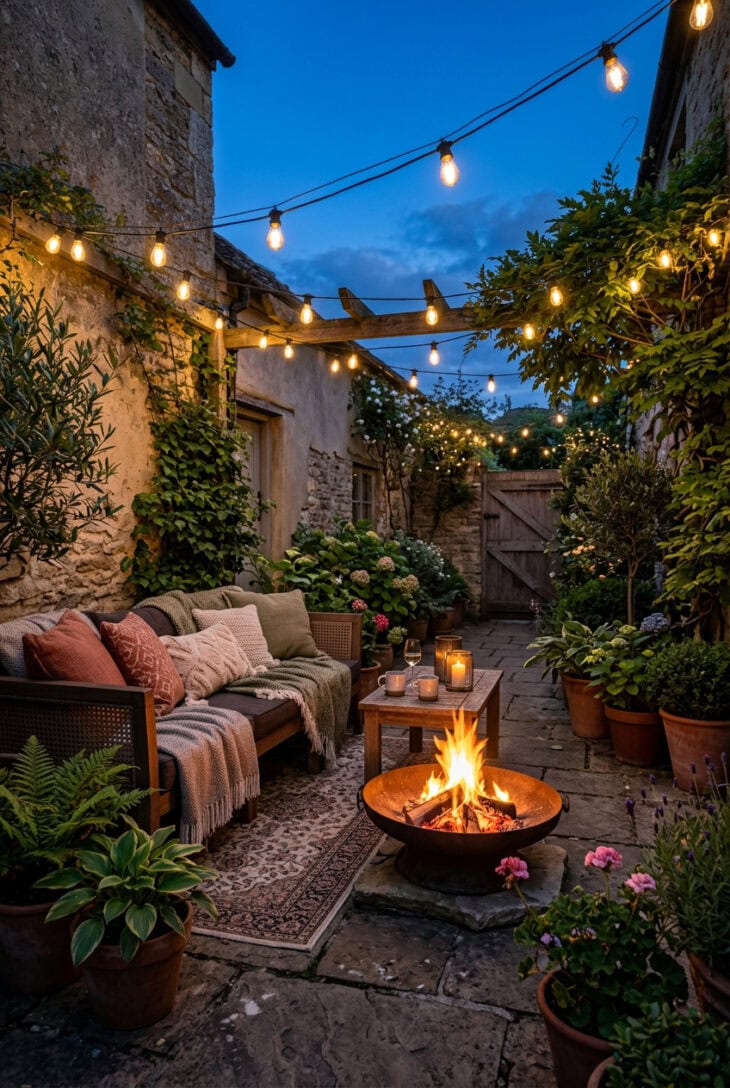
What you see A snug corner at dusk built around a glowing fire bowl, with a low cushioned sofa, pots of greenery close around, and string lights warming the air overhead. Against the deep blue evening the enclosed walls hold the heat and the glow, and it feels like an outdoor living room.
Why it works A courtyard’s walls hold warmth and shelter a fire from wind, making it the ideal spot to sit out into the evening and the cooler months. Fire draws people together and extends the hours you can use the space, turning a daytime garden into a nighttime room.
How to get it Choose a fire bowl, chiminea or a built-in gas feature sized to the space, and set it on a non-combustible base with clear room around it, well away from overhanging climbers. Surround it with weatherproof seating and soft cushions you can store away, and layer in lanterns and warm string lights for the after-dark glow. Always check ventilation in an enclosed courtyard, and keep the flame modest so smoke and heat stay comfortable.
09. Potted Tree and Shrub Collection
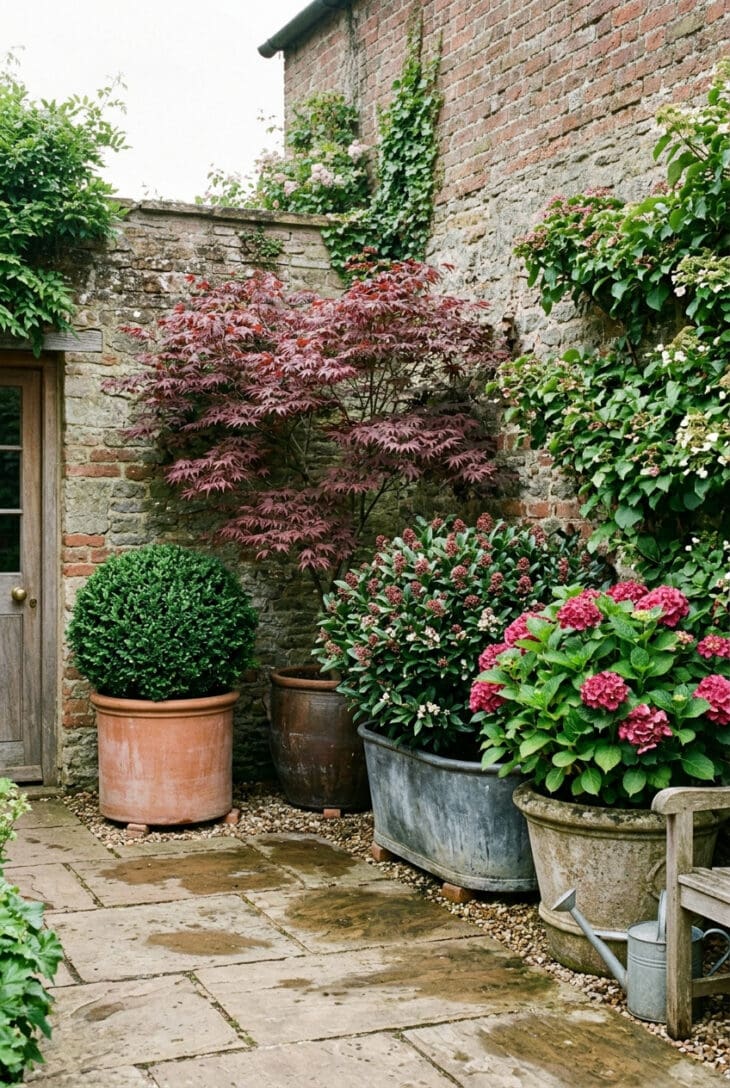
What you see A group of large containers along one wall, each holding something with structure: a clipped bay (Laurus nobilis), a potted acer, a dark evergreen and a flowering shrub, arranged in a green still life on the paving. It brings the substance of a border to a space with no open ground.
Why it works Many courtyards are fully paved, and generous containers let you grow real trees and shrubs where there is no soil at all. Big pots also give flexibility: you can rearrange the whole garden in an afternoon and swap plants in and out as they peak.
How to get it Go as large as you can lift and site the pots before filling, because a planted container is extremely heavy. Use a soil-based compost that holds moisture and nutrients, group pots in odd numbers with varied heights, and repeat a material or color so the collection reads as one scheme. Water and feed regularly through summer, since pots dry fast against warm walls, and this container planting approach lets even a paved yard feel fully gardened.
10. Raised Beds Around the Edges
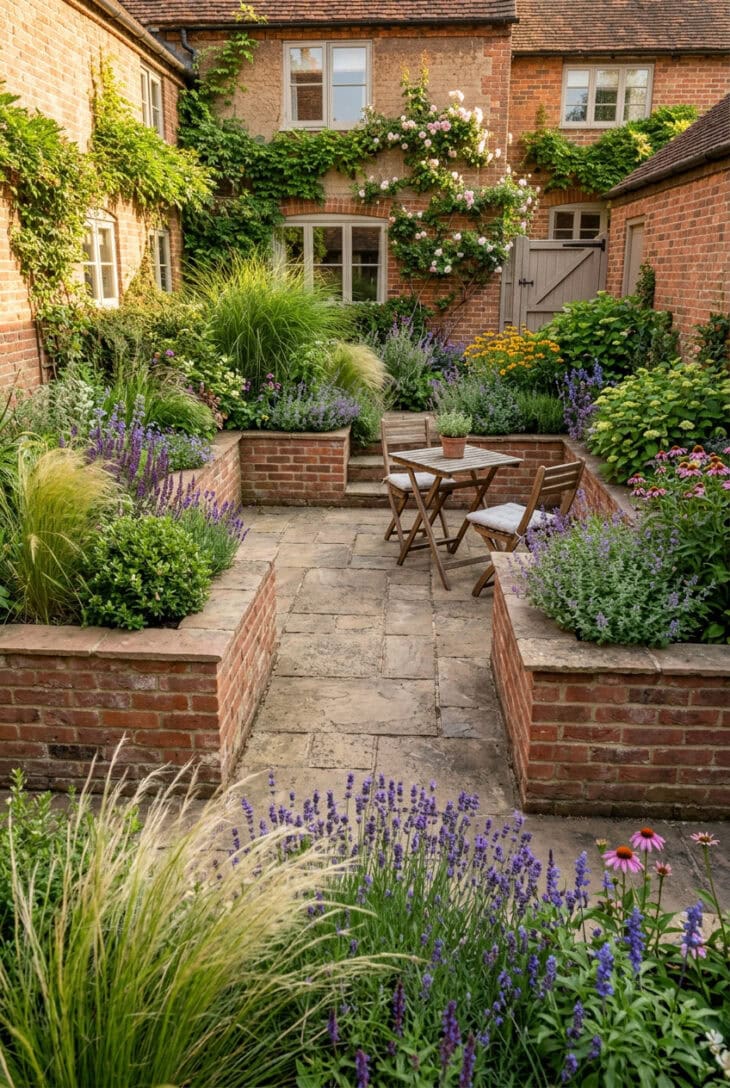
What you see Built-in beds running around the courtyard edges, faced in brick or smooth render to match the walls, brimming with layered grasses, perennials and small shrubs. The center stays open and paved, so the planting frames a clear, usable space.
Why it works Perimeter raised beds put the greenery where it screens and softens the walls while leaving the middle free to live in, which is exactly how a small enclosed space works best. Raising the soil also improves drainage and brings the planting up closer to eye level.
How to get it Build the beds at least 18in (45cm) deep against the walls, with a damp-proof membrane between soil and brick so moisture does not track into the house. Face them to match the courtyard, top the walls at a comfortable 18in (45cm) so they double as casual seating, and fill with good topsoil. Layer evergreen structure with seasonal perennials, and the same raised bed planting logic that works in a veg plot builds a lush green frame here.
11. Overhead Pergola Canopy
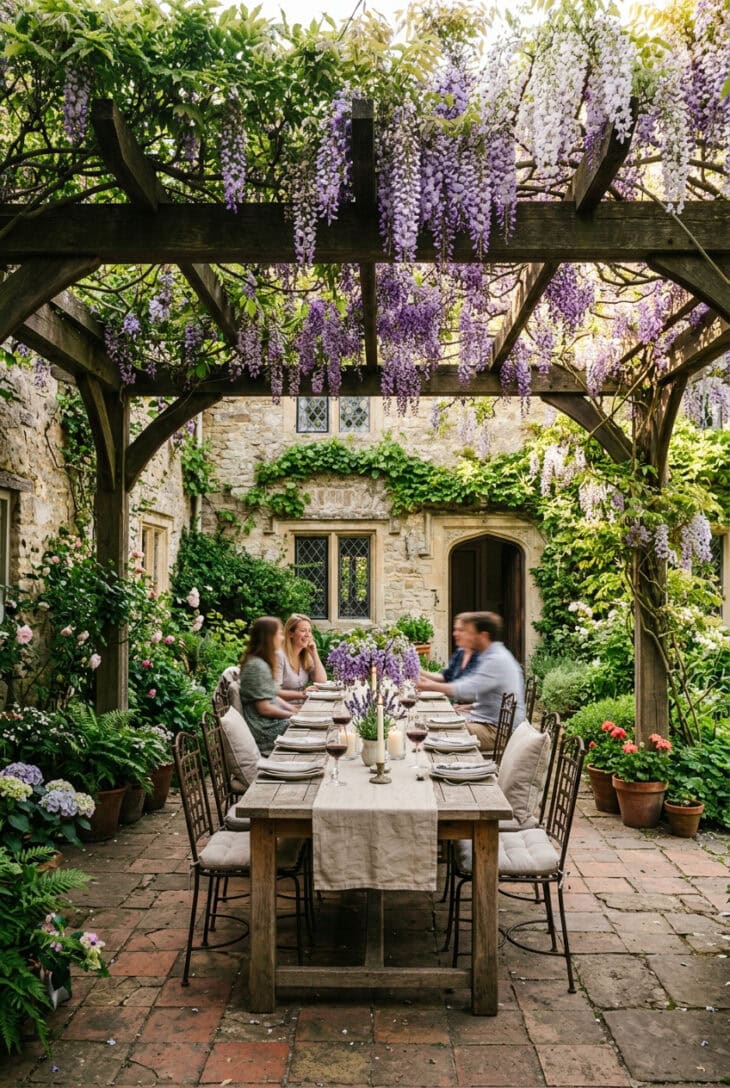
What you see A timber pergola spanning the courtyard walls overhead, draped in wisteria (Wisteria sinensis) whose hanging purple flowers filter the light onto a dining table below. It gives the open top of the courtyard a green ceiling and turns the whole space into an outdoor room.
Why it works A courtyard is walled but open to the sky, which can feel exposed or leave it baking at midday. A pergola adds the missing overhead plane, providing shade, privacy from windows above, and a frame for climbers, so the space feels enclosed and complete on all sides.
How to get it Fix a sturdy pergola to the walls or set it on posts sized to carry a heavy mature climber like wisteria or grape vine (Vitis vinifera). Run the beams to cast good shade over the seating area, and choose a deciduous climber so winter light still reaches the space. Keep it in scale with the courtyard so it frames rather than crowds, and prune the climber twice a year to keep flowers coming and weight in check.
12. Mirror to Double the Space
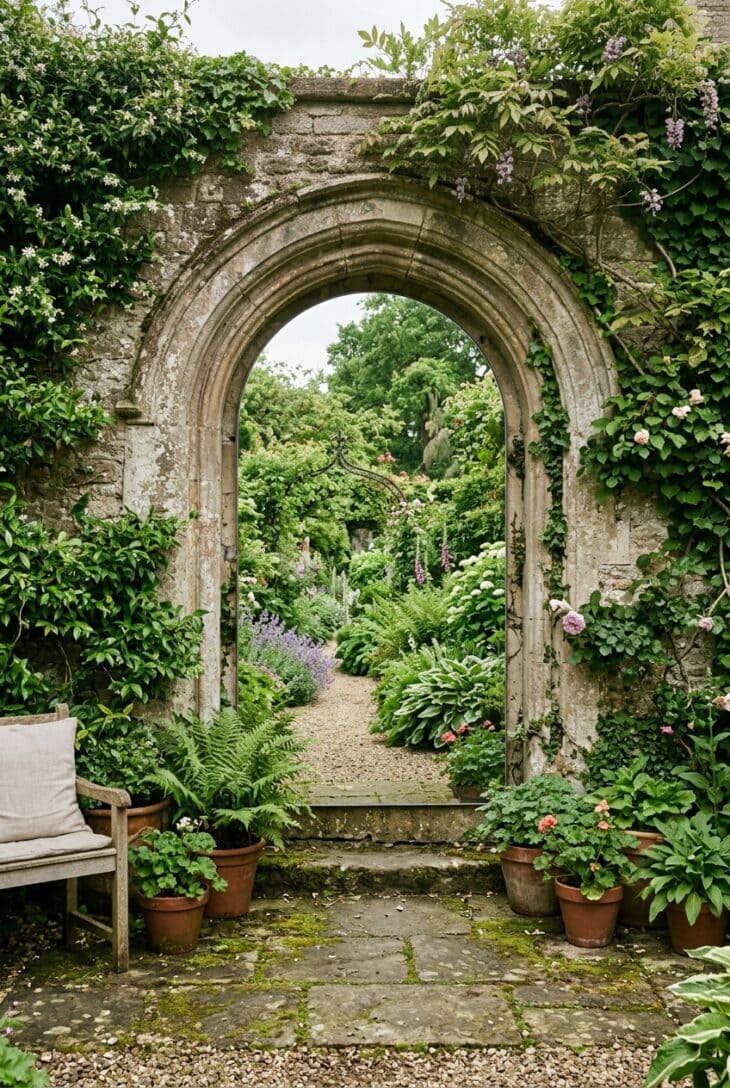
What you see An outdoor mirror set into the wall behind an arched frame and half-hidden by climbing foliage, reflecting the planting and paving so the brick seems to open into another garden beyond. The eye is fooled, and the small courtyard suddenly reads as twice its size.
Why it works Mirrors are the classic trick for small enclosed spaces because they double the sense of depth and bounce precious light into shady corners. Framed as a false doorway or window, a mirror adds a note of intrigue and makes the walls feel less confining.
How to get it Use a proper weatherproof outdoor acrylic or glass mirror, and set it where it reflects greenery rather than a doorway or a person walking toward it. Frame it as an arch or old window and part-drape it with a climber so the illusion is subtle, not obvious. Angle it slightly to catch a bright part of the sky, and keep it clean so the reflection stays convincing. It is one of the best small garden tricks there is.
13. Wall-Mounted Fountain Spout
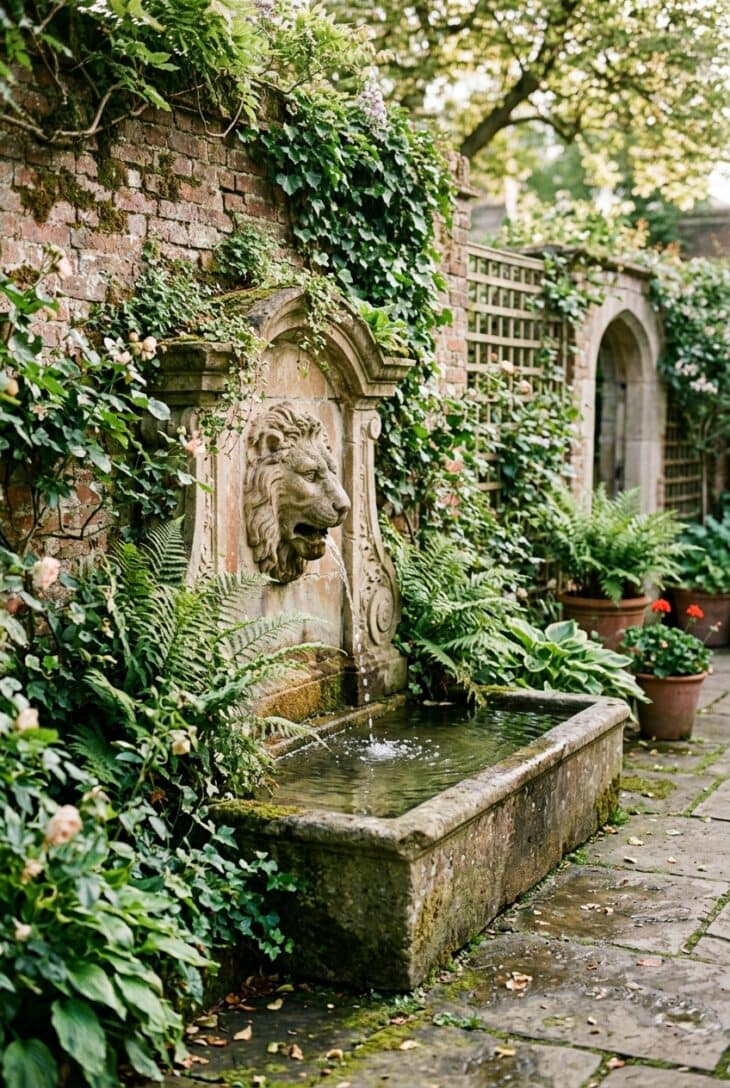
What you see A wall fountain set against the brick, water spilling from a decorative spout into a stone trough below, framed by ferns and trailing greenery. It brings the sound and movement of water to the space without using any floor at all.
Why it works When the floor of a courtyard is spoken for, a wall-mounted fountain adds water on the vertical plane instead. It turns a blank stretch of wall into a feature, and the gentle trickle brings the same calming, noise-masking effect as a pool in a fraction of the space.
How to get it Choose a self-contained wall fountain with a hidden reservoir and recirculating pump, and fix it securely to a solid wall, since a full trough is heavy. Hide the pump cable and provide a discreet outdoor socket or opt for a solar model, and set the flow to a soft trickle. Keep the reservoir topped up in summer, clean it seasonally, and surround the trough with moisture-loving ferns to blend it into the planting.
14. Lush Tropical Jungle Courtyard
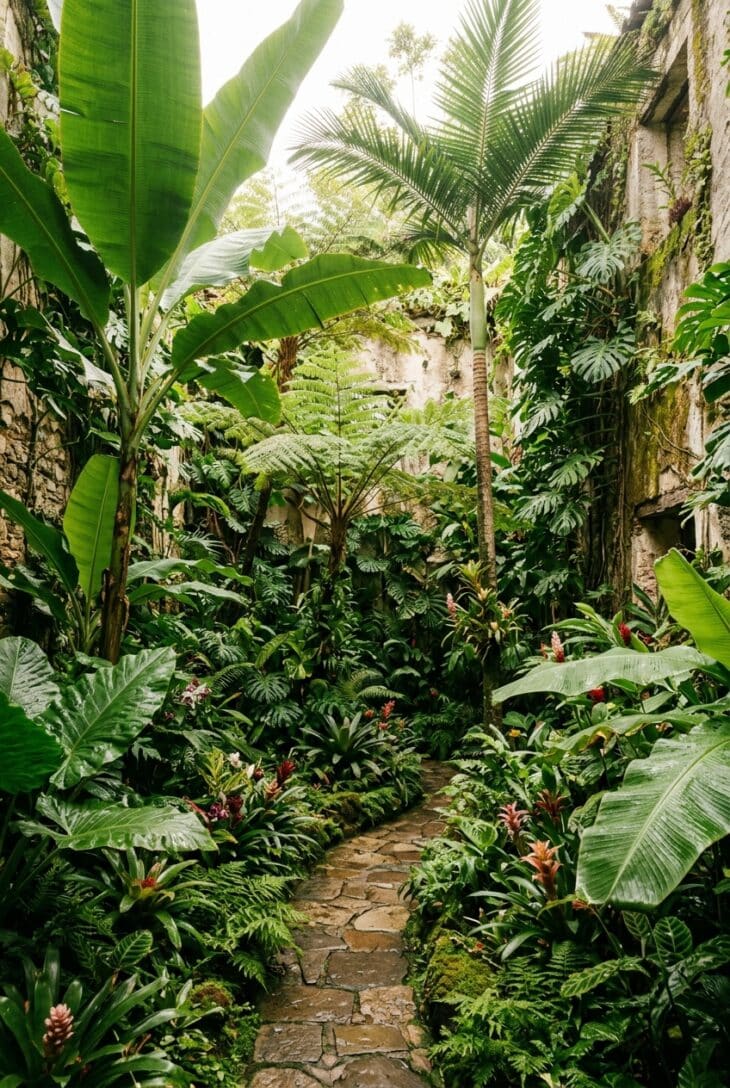
What you see A courtyard turned jungle: huge paddle leaves of a banana (Musa basjoo), the fronds of a tree fern, a tall palm and masses of big glossy foliage crowding in from every wall. The greens layer thick and exotic, and the enclosed space feels tropical and immersive.
Why it works The sheltered, warm, humid microclimate of a walled courtyard is exactly what tender exotics need, so it can grow a jungle that would fail in an open garden. Big bold leaves fill the vertical space fast and make a small courtyard feel like a lush green world of its own.
How to get it Build the canopy with hardy exotics: hardy banana, tree fern, palms like Chusan palm (Trachycarpus fortunei), and fill in with fatsia, bamboo and cannas (Canna) for color. Layer heights so leaves overlap and pack plants closer than usual for instant density. Water and feed generously in summer, wrap the tender crowns over winter, and lean into a full tropical planting look, which the warm walls make genuinely achievable.
15. Statement Floor Tiles
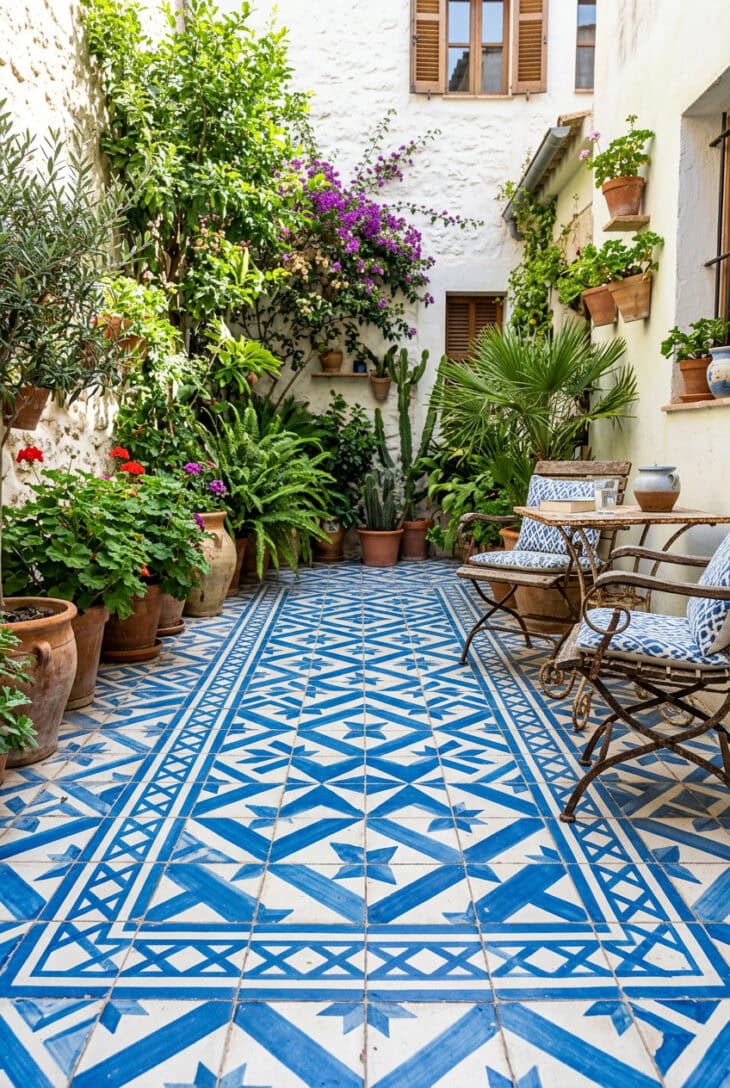
What you see A courtyard floor laid with bold patterned tiles, blue and white geometric designs running wall to wall, framed by a few pots of greenery and a pair of chairs. The floor itself becomes the feature, giving the enclosed space real personality.
Why it works A courtyard is small enough to see the whole floor at once, which makes a patterned surface high-impact and affordable in a way it would not be across a large garden. Bold tiles bring color and character to a space that might otherwise rely entirely on plants.
How to get it Choose frost-proof, outdoor-rated porcelain or genuine encaustic tiles with a slip-resistant finish, and seal them if the maker recommends it. Lay them over a solid, well-drained base with a slight fall for runoff, and keep the pattern in scale with the space so it does not overwhelm. Let the floor be the star and keep the planting simple and green around it, so the two do not compete.
16. Built-In Bench Seating
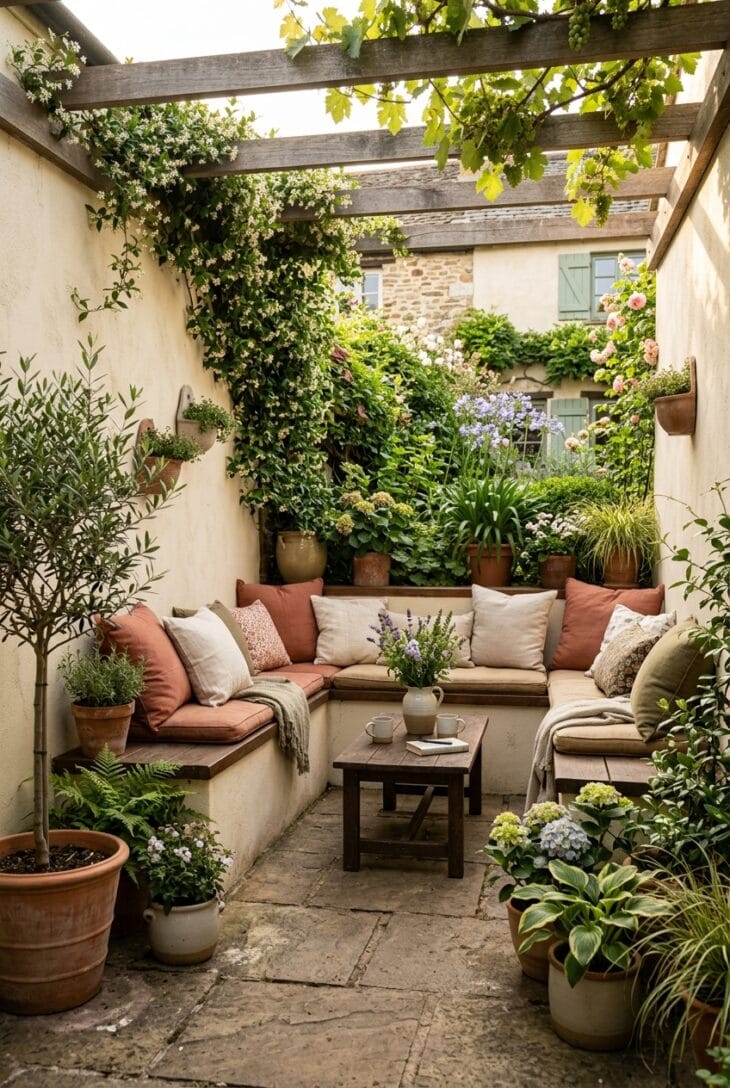
What you see Bench seating built right into two walls of the courtyard, rendered masonry topped with warm timber and cushions, wrapping around a low table and softened by pots. It hugs the perimeter and turns the corners into comfortable, permanent seating.
Why it works Built-in seating runs along the walls where loose chairs waste space, seating more people while keeping the center of the courtyard open. Because it is fixed and part of the architecture, it looks intentional and tidy in a way scattered furniture never does.
How to get it Build the bench from rendered blockwork or exterior timber at a comfortable 17in (43cm) seat height, and cap it with a hardwood top or thick slabs. Make it an L or U shape to wrap a corner, and design the base with storage or gaps so it does not trap water. Add weatherproof cushions for comfort, and back the bench with pots or a planted bed so you sit surrounded by green.
17. Scented Planting by the Door
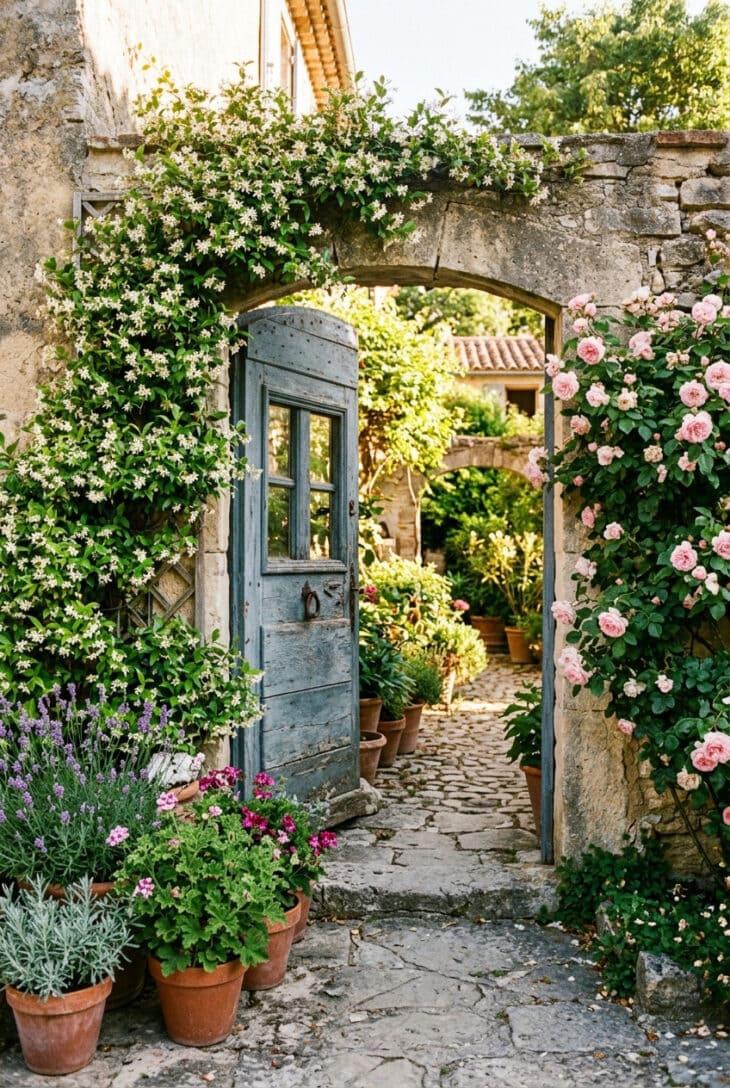
What you see A doorway framed in fragrance: star jasmine (Trachelospermum jasminoides) climbing the frame, pots of lavender and scented-leaf pelargoniums beside the threshold, a rose nearby. Every time someone passes, the enclosed air fills with perfume.
Why it works A courtyard’s walls trap and concentrate scent instead of letting it drift away on the breeze, so fragrant plants have far more impact here than in the open. Placed by the door or seating, where you brush past daily, they make the space a pleasure to move through.
How to get it Group scented plants at nose height and at the points you use most: a climber like jasmine or honeysuckle (Lonicera periclymenum) on the wall, lavender and scented pelargoniums in pots, and night-scented plants for the evening. Combine a few different fragrances that peak at different times so there is always something in the air. Keep them well fed and deadheaded to prolong the flowering, and site the strongest perfumes where you sit.
18. Minimalist Zen Courtyard
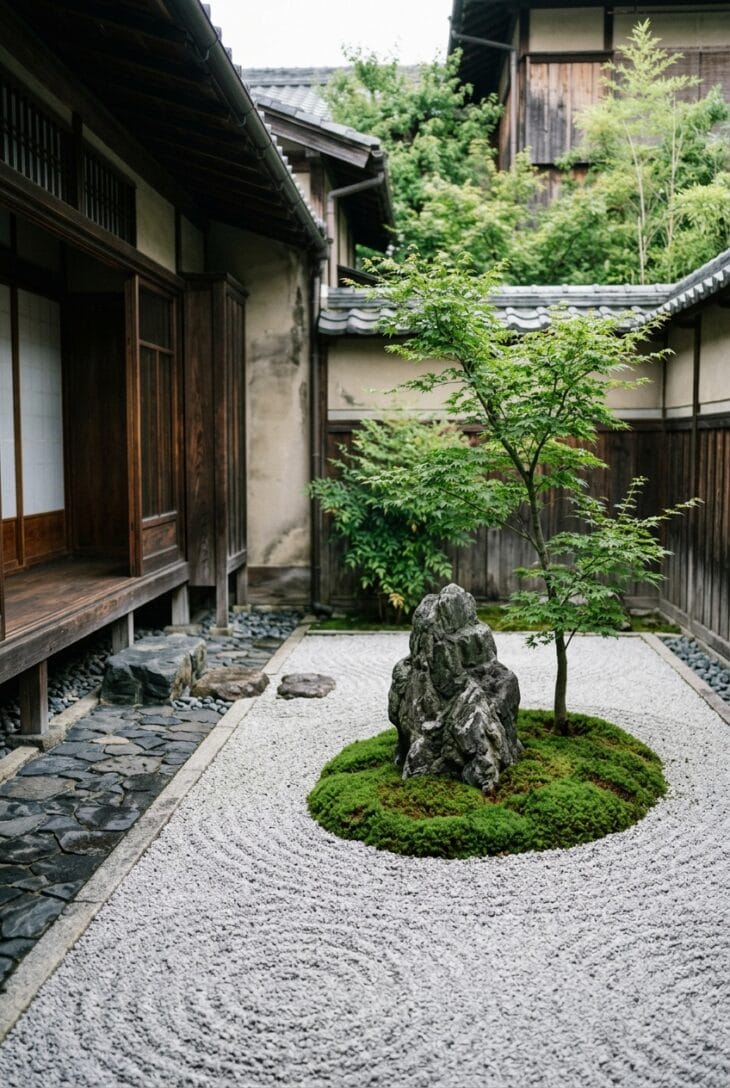
What you see A pared-back Japanese-style space: a rectangle of raked gravel, one sculptural rock, a clipped mound of moss and a single small maple, all in quiet greys, greens and stone. Nothing is busy, and the empty space feels as considered as the objects in it.
Why it works The contained, contemplative nature of a courtyard suits a minimalist Japanese design perfectly, offering a quiet retreat from a busy home. Restraint makes a small space feel calm and intentional, where clutter would make it feel cramped, and every element carries weight.
How to get it Choose a handful of elements and place each deliberately: raked gravel for the ground plane, one good rock or group of rocks, moss or a low mound of mind-your-own-business (Soleirolia soleirolii), and a single maple (Acer palmatum). Keep the palette to green, grey and natural wood, leave generous empty space, and resist adding more. The discipline of a Japanese garden is exactly what makes this work in a small courtyard.
19. Espaliered Fruit on the Walls
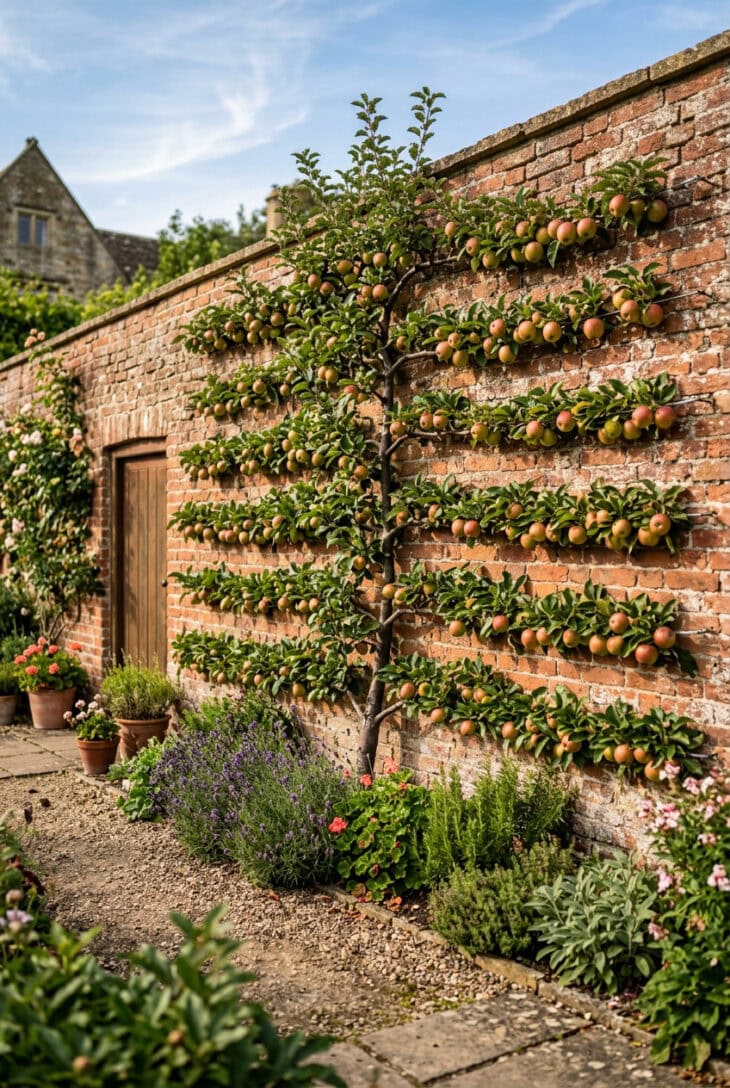
What you see Fruit trees trained flat against the brick in neat horizontal tiers, an espaliered apple (Malus domestica) or pear (Pyrus communis) with fruit ripening along its outstretched branches. It is part orchard, part living sculpture, growing on a wall that was doing nothing.
Why it works Espalier lets you grow real fruit in a courtyard with no room for a standard tree, using only a few inches of depth against a wall. The warm brick ripens the fruit beautifully, and the formal trained shape looks handsome even in winter when the branches are bare.
How to get it Buy a ready-trained espalier or start a young tree on a dwarfing rootstock against horizontal wires fixed to the wall. Give it a sunny aspect for the sweetest fruit, choose self-fertile varieties so you do not need a partner tree, and tie in and prune in summer to keep the tiers flat and neat. Feed and water through the growing season, since a wall base is dry, and enjoy a crop from a footprint of almost nothing.
20. Courtyard Herb and Kitchen Garden
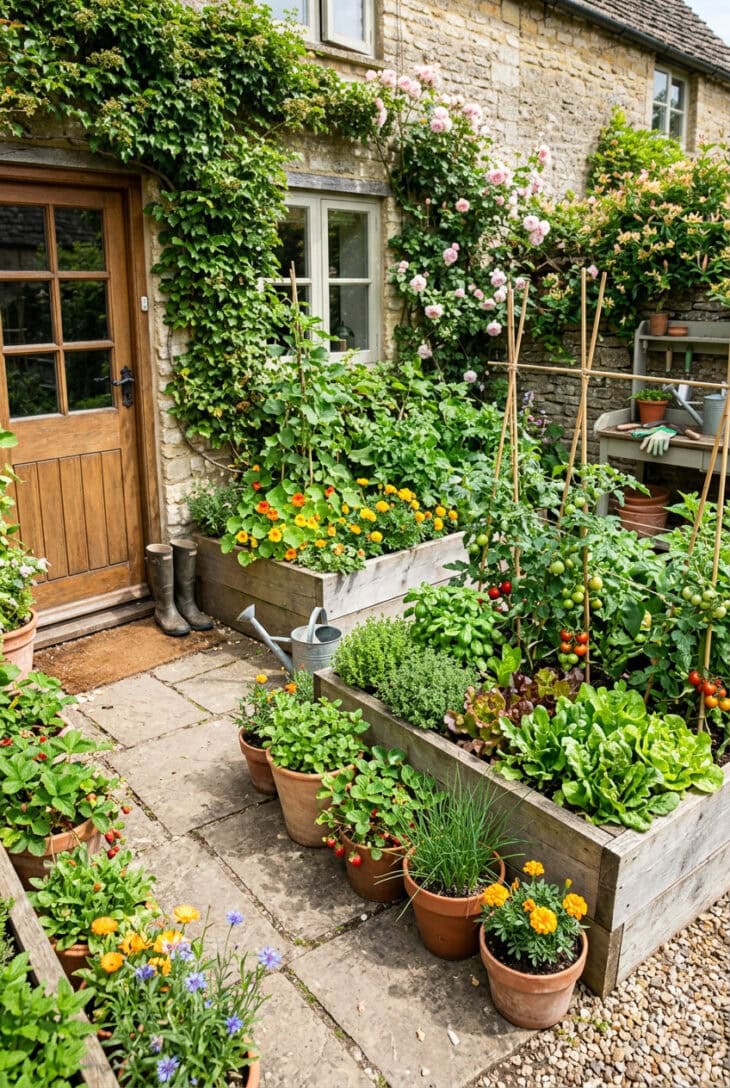
What you see A working kitchen garden tucked into the courtyard: raised beds and pots of herbs, cut-and-come-again salad, a staked tomato and a scatter of edible flowers, all within a few steps of the back door. It is neat, abundant and genuinely useful.
Why it works A courtyard next to the kitchen is the most convenient place to grow food, close to hand for a quick harvest and sheltered enough to extend the season. The warm walls and still air help herbs and salads thrive, and edible plants earn their place while still looking good.
How to get it Put the herbs you pick most, basil (Ocimum basilicum), parsley, mint and thyme, nearest the door, and use raised beds or big pots for salads and a bush tomato. Keep it decorative by mixing in edible flowers and choosing handsome varieties, and rotate quick crops through the season. Feed and water consistently against the warm walls, and this compact kitchen garden turns an enclosed yard into a productive potager.
21. Uplighting and Evening Drama
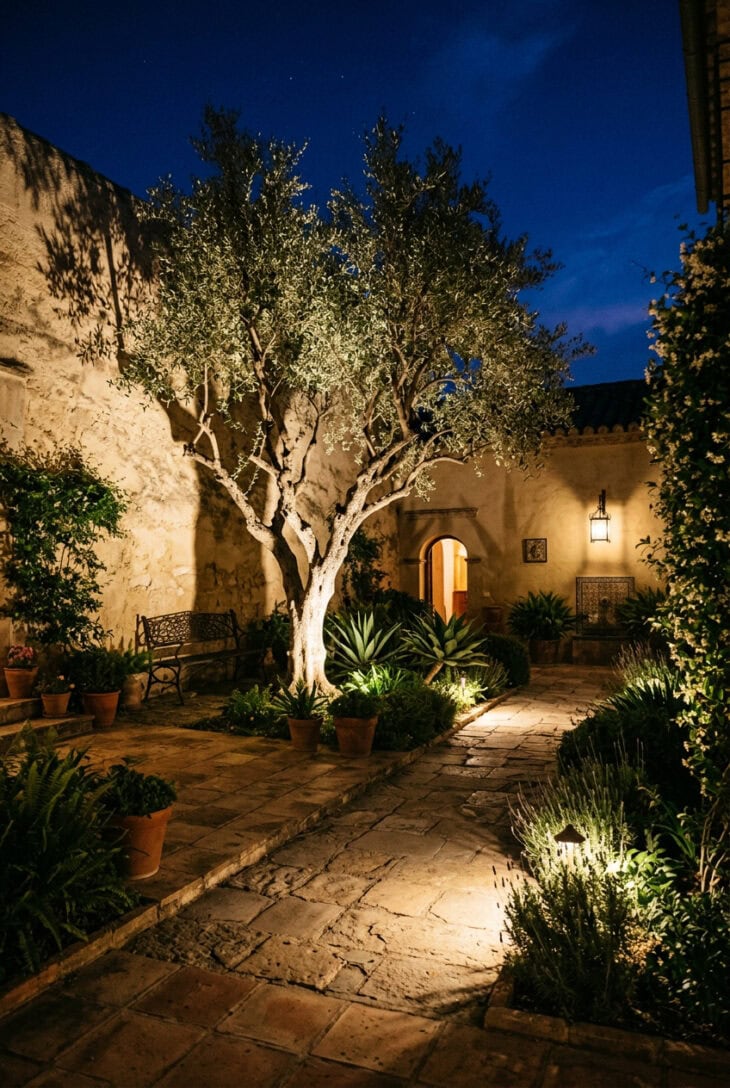
What you see A courtyard after dark brought to life by lighting: uplights at the base of a tree throwing its branches as huge shadows across a wall, a soft glow washing the planting, warm pools on the paving. The enclosed walls become a canvas, and the space feels theatrical.
Why it works Enclosing walls give lighting something to play on, so a courtyard responds to uplighting and shadow far more dramatically than an open garden. Good lighting also doubles the usable hours and, seen from the windows above, turns the courtyard into a living picture at night.
How to get it Layer the light: uplight a tree or a piece of sculpture, graze a textured wall to reveal it, and wash the planting softly, all in warm white (around 2700K). Keep the fittings hidden and the sources low and glare-free, aiming for pools of light and shadow rather than flat brightness. Put it on a dimmer or timer, and use these garden lighting techniques to make the space as good after dark as it is by day.
22. Cottage-Style Courtyard Overflow
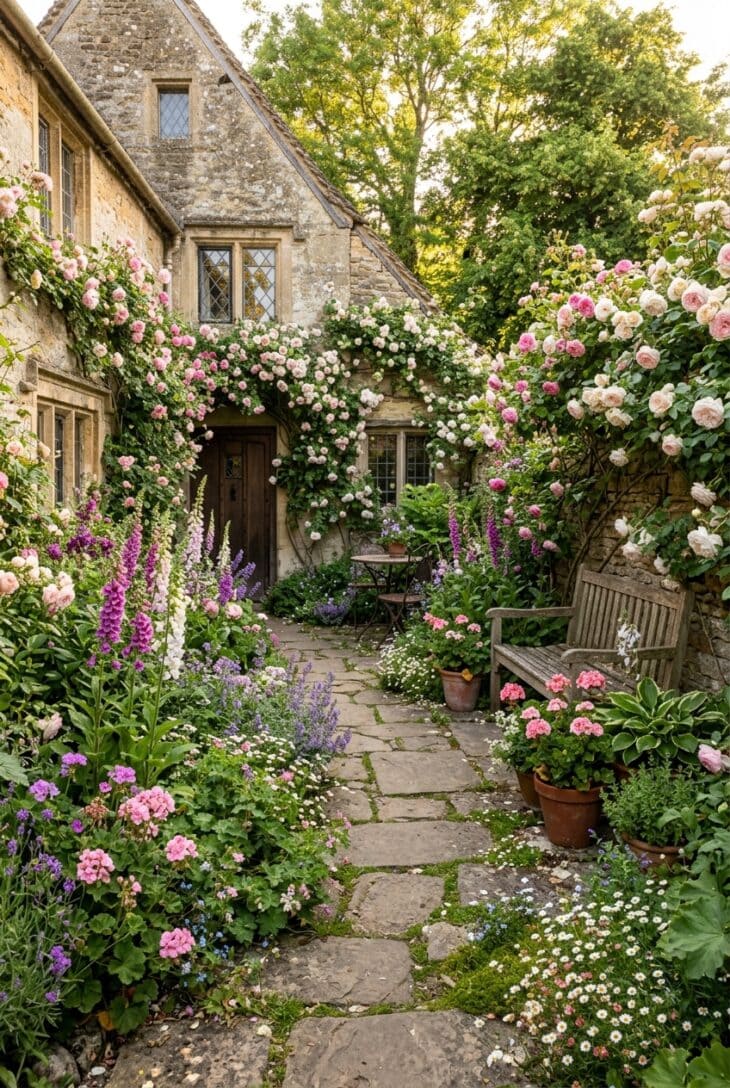
What you see A courtyard brimming with soft, informal flowers: climbing roses (Rosa) scaling the walls, tall foxgloves (Digitalis purpurea), mounds of hardy geranium (Geranium) and self-seeders spilling out of the cracks between the paving. It looks romantic, generous and a little wild.
Why it works The loose, abundant cottage style softens the hard lines of an enclosed courtyard and hides the walls behind flower. Letting plants self-seed into the paving cracks turns the very hardness of the space into part of the charm, so it feels settled and long-established.
How to get it Cover the walls with climbing roses and clematis, then fill beds and pots with foxgloves, hardy geraniums, lady’s mantle (Alchemilla mollis) and other easy cottage staples. Let a few tough plants seed into the paving joints, and pack everything close so there is no bare ground. Deadhead for a long show but leave some seedheads to spread, and lean into a relaxed cottage garden feel that suits the enclosure.
23. Modern Rendered Walls and Grasses
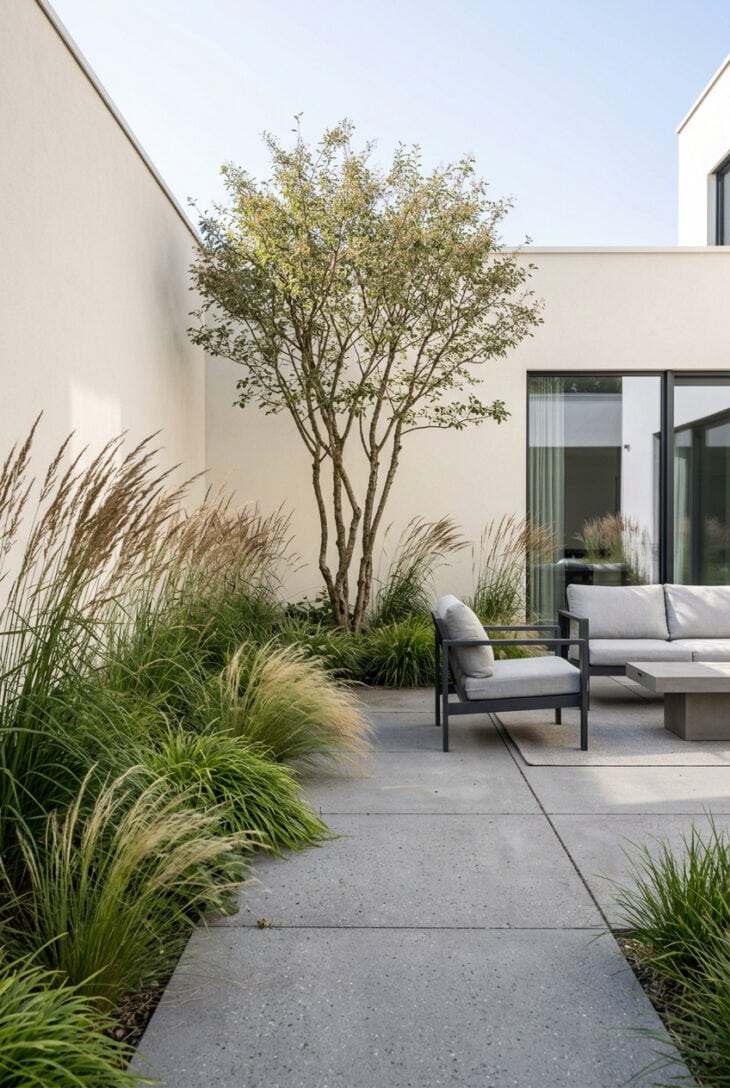
What you see A crisp contemporary courtyard: smooth off-white rendered walls, a bed of ornamental grasses swaying in the light, a single multi-stem tree and minimalist grey furniture on clean paving. The look is calm, architectural and deliberately spare.
Why it works Smooth rendered walls turn the courtyard’s boundaries into clean planes that make a small space feel bigger and more modern. Set against them, the soft movement and fine texture of grasses reads beautifully, and a restrained palette keeps the enclosed space feeling calm rather than busy.
How to get it Render the walls in a warm neutral and pair them with large-format paving and a tight material palette. Plant drifts of ornamental grasses like Mexican feather grass (Stipa tenuissima) or moor grass (Molinia) for movement, punctuated by a single specimen tree or a clipped evergreen. Keep the colors muted and the lines simple, and let form and texture carry the scheme the way a good modern garden does.
24. Wildlife-Friendly Green Corner
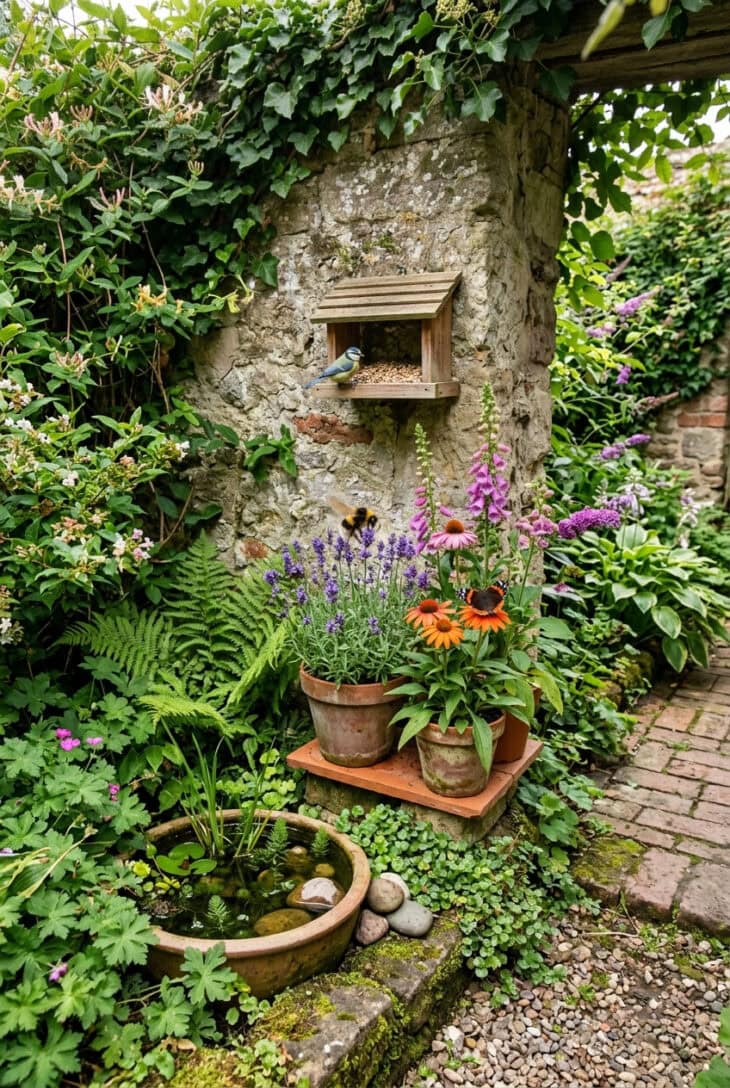
What you see A courtyard corner alive with wildlife: a wall-mounted bird feeder, pots of nectar flowers with a bee and a butterfly working the blooms, a small container pond and dense green cover. Even walled in on every side, it hums and flickers with movement.
Why it works A courtyard can be a genuine haven in a built-up area, an oasis of green that birds and insects find and use even several stories up. Bringing in nectar plants, water and cover is rewarding, good for the local ecology, and fills the enclosed space with life.
How to get it Pack in single, nectar-rich flowers like lavender, salvia and verbena (Verbena bonariensis), and add a small container pond, even a half-barrel, as a water source and breeding site. Include a bird feeder and some dense evergreen cover for shelter, and skip pesticides entirely. A little log or leaf pile in a shady corner adds habitat, and the same principles behind any wildlife garden work just as well in a walled space.
25. Tiled Rill or Reflecting Pool
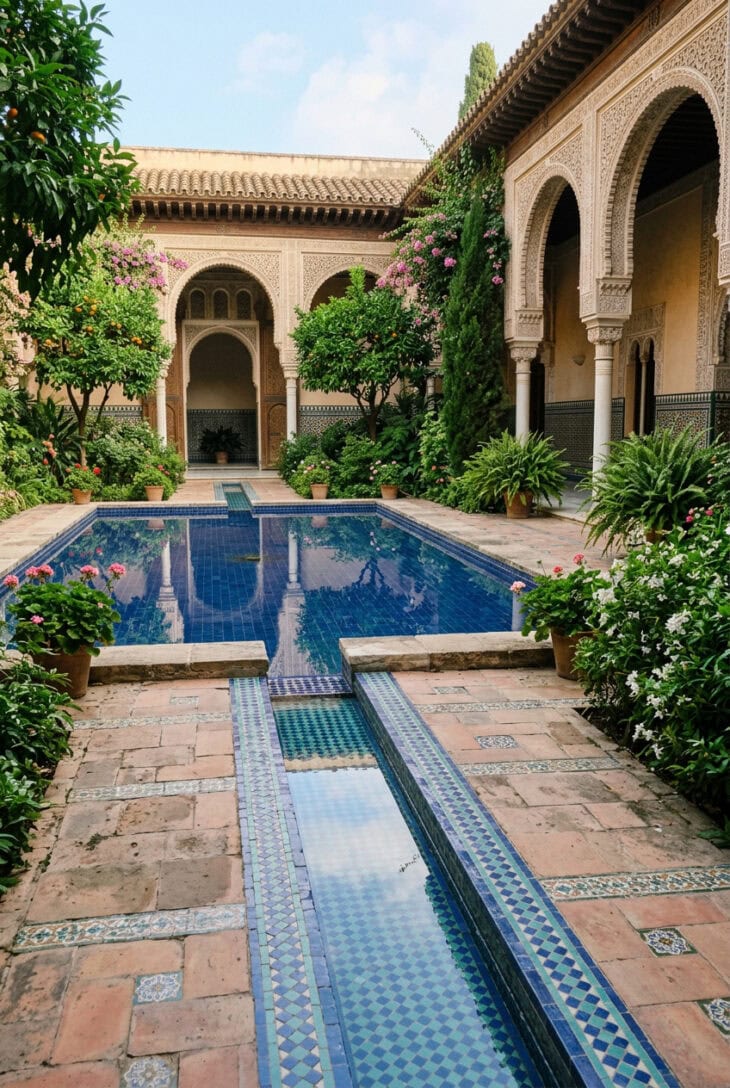
What you see A still, shallow reflecting pool set into the courtyard floor, its blue-tiled base mirroring the sky and the surrounding greenery, or a narrow rill running quietly along the paving. The water lies calm and glassy, doubling the light and the planting in its surface.
Why it works A courtyard’s enclosure and symmetry suit the ancient Moorish tradition of still water in a walled garden, where a reflecting pool brings serenity and light. A calm sheet of water makes a small space feel larger and cooler, and mirrors the sky into an otherwise shaded well.
How to get it Set a shallow, dark or blue-tiled pool on the main axis of the courtyard, keeping it still rather than splashing so the reflection stays clear. Line it well and keep the water clean with a small hidden pump or a few oxygenating plants, and site it to catch a bright patch of sky. Keep the edges crisp and the surroundings simple, and this is one of the most elegant water garden ideas a courtyard can hold.