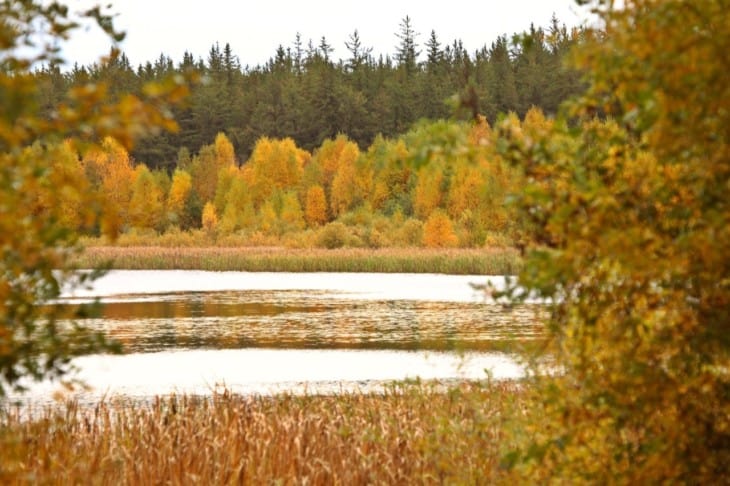
The most common trees in Canada are the conifers and hardy broadleaf trees of the boreal forest, which covers most of the country. Black spruce is the most abundant, followed by white spruce, balsam fir, jack pine, trembling aspen, paper birch and tamarack. On the West Coast, Douglas fir, western redcedar and western hemlock dominate. In the East, the most common trees include sugar maple, red maple, eastern white pine, eastern white cedar and yellow birch.
Contents
- Trees of the Boreal Forest and Northern Mountains
- Black Spruce (Picea mariana)
- White Spruce (Picea glauca)
- Balsam Fir (Abies balsamea)
- Jack Pine (Pinus banksiana)
- Lodgepole Pine (Pinus contorta)
- Tamarack (Larix laricina)
- Subalpine Fir (Abies lasiocarpa)
- Trembling Aspen (Populus tremuloides)
- Paper Birch (Betula papyrifera)
- Balsam Poplar (Populus balsamifera)
- Trees of British Columbia and the West Coast
- Trees of Eastern Canada
- Sugar Maple (Acer saccharum)
- Red Maple (Acer rubrum)
- Eastern White Pine (Pinus strobus)
- Eastern Hemlock (Tsuga canadensis)
- Eastern White Cedar (Thuja occidentalis)
- Yellow Birch (Betula alleghaniensis)
- Red Oak (Quercus rubra)
- American Beech (Fagus grandifolia)
- Bur Oak (Quercus macrocarpa)
- Basswood (Tilia americana)
- American Elm (Ulmus americana)
- Rare Southern Trees of the Carolinian Zone
Canada has about 140 native tree species, and most are found across huge areas. Trembling aspen, for example, grows from Newfoundland to the Yukon. The trees below are grouped by the forest region where they are most common, with the provincial trees noted.
- Trees of the Boreal Forest and Northern Mountains
- Trees of British Columbia and the West Coast
- Trees of Eastern Canada
- Rare Southern Trees of the Carolinian Zone
| Tree | Botanical name | Type | Height | Where it grows |
|---|---|---|---|---|
| Black Spruce | Picea mariana | Conifer | 30–50 ft | All provinces and territories |
| White Spruce | Picea glauca | Conifer | 50–80 ft | All provinces and territories |
| Balsam Fir | Abies balsamea | Conifer | 40–60 ft | Alberta to Newfoundland |
| Jack Pine | Pinus banksiana | Conifer | 50–70 ft | Alberta to Nova Scotia, NWT |
| Lodgepole Pine | Pinus contorta | Conifer | 70–100 ft | British Columbia, Alberta, Yukon |
| Tamarack | Larix laricina | Deciduous conifer | 40–65 ft | All provinces and territories |
| Subalpine Fir | Abies lasiocarpa | Conifer | 50–100 ft | BC, Alberta, Yukon |
| Trembling Aspen | Populus tremuloides | Broadleaf | 50–80 ft | All provinces and territories |
| Paper Birch | Betula papyrifera | Broadleaf | 50–70 ft | All provinces and territories |
| Balsam Poplar | Populus balsamifera | Broadleaf | 60–80 ft | All provinces and territories |
| Douglas Fir | Pseudotsuga menziesii | Conifer | 150–230 ft (coast) | British Columbia, Alberta Rockies |
| Western Redcedar | Thuja plicata | Conifer | 150–200 ft | British Columbia, Alberta Rockies |
| Western Hemlock | Tsuga heterophylla | Conifer | 100–200 ft | British Columbia |
| Black Cottonwood | Populus trichocarpa | Broadleaf | 100–150 ft | British Columbia, Alberta, Yukon |
| Arbutus | Arbutus menziesii | Broadleaf evergreen | 30–80 ft | Southern BC coast |
| Garry Oak | Quercus garryana | Broadleaf | 50–80 ft | Southern Vancouver Island, Gulf Islands |
| Sugar Maple | Acer saccharum | Broadleaf | 60–100 ft | Ontario to Nova Scotia |
| Red Maple | Acer rubrum | Broadleaf | 50–70 ft | Manitoba to Newfoundland |
| Eastern White Pine | Pinus strobus | Conifer | 80–150 ft | Manitoba to Newfoundland |
| Eastern Hemlock | Tsuga canadensis | Conifer | 60–100 ft | Ontario to Nova Scotia |
| Eastern White Cedar | Thuja occidentalis | Conifer | 30–50 ft | Manitoba to Nova Scotia |
| Yellow Birch | Betula alleghaniensis | Broadleaf | 60–80 ft | Ontario to Newfoundland |
| Red Oak | Quercus rubra | Broadleaf | 60–80 ft | Ontario to Nova Scotia |
| American Beech | Fagus grandifolia | Broadleaf | 60–80 ft | Ontario to Nova Scotia |
| Bur Oak | Quercus macrocarpa | Broadleaf | 50–80 ft | Saskatchewan to New Brunswick |
| Basswood | Tilia americana | Broadleaf | 60–80 ft | Manitoba to New Brunswick |
| American Elm | Ulmus americana | Broadleaf | 60–80 ft | Saskatchewan to Nova Scotia |
Trees of the Boreal Forest and Northern Mountains
Black Spruce (Picea mariana)
Read our guide to Black Spruce

Black spruce is the most common tree in Canada. It grows across the whole boreal forest, from Newfoundland to the Yukon, in bogs, muskeg and cold, wet soils where few other trees survive. It is a slender tree 30 to 50 feet tall with a narrow, spire-shaped crown, a club-like top, and short, blue-green needles. Its small cones stay on the tree for years and open after fire. It is the provincial tree of Newfoundland and Labrador.
White Spruce (Picea glauca)

White spruce grows across the boreal forest on better-drained soils than black spruce, reaching 50 to 80 feet. Its needles are stiff, four-sided and blue-green, and they have a sharp smell when crushed, which gives it the nickname “cat spruce”. It is one of Canada’s most important timber trees and the provincial tree of Manitoba.
Balsam Fir (Abies balsamea)

Balsam fir is a narrow, cone-shaped tree 40 to 60 feet tall with flat, soft, fragrant needles and resin blisters on its smooth gray bark. Its upright cones fall apart on the tree. It is common in the eastern boreal forest and the Maritimes and is one of Canada’s favorite Christmas trees. It is the provincial tree of New Brunswick.
Jack Pine (Pinus banksiana)

Jack pine grows on dry, sandy and rocky ground across the boreal forest east of the Rockies. It has short, twisted needles in pairs and curved cones that stay sealed with resin until a forest fire opens them, so it quickly reseeds burned land. Tom Thomson’s painting The Jack Pine made its windswept shape a symbol of the Canadian Shield.
Lodgepole Pine (Pinus contorta)

Lodgepole pine is the western counterpart of jack pine and the most common tree in the interior of British Columbia and the Alberta foothills. It is tall and straight, with needles in pairs and cones that often need fire to open. Indigenous peoples used its trunks as poles for lodges, which gave it its name. It is the provincial tree of Alberta.
Tamarack (Larix laricina)

Tamarack, or eastern larch, is a conifer that loses its needles every fall. In autumn its soft, bright green needles, in tufts of 10 to 20, turn golden yellow before they drop. It grows in bogs and wet ground across the whole boreal forest, reaching farther north than almost any other tree. It is the territorial tree of the Northwest Territories.
Subalpine Fir (Abies lasiocarpa)
Subalpine fir is the fir of the Rocky Mountains and the Yukon, growing up to the tree line. It has a very narrow, spire-like crown that sheds heavy snow, and near the tree line it grows as a low, twisted shrub. It is the territorial tree of Yukon.
Trembling Aspen (Populus tremuloides)
Read our guide to Trembling Aspen

Trembling aspen is the most widespread broadleaf tree in Canada and in all of North America. Its round leaves have flattened stalks, so they shake in the slightest breeze and turn bright gold in fall. It has smooth, white-green bark and spreads by root suckers into huge groves of genetically identical trees. It is the main tree of the aspen parkland between the prairies and the boreal forest.
Paper Birch (Betula papyrifera)

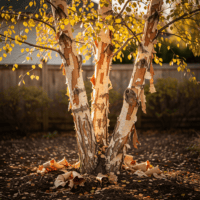
Paper birch, also called white birch or canoe birch, is known for its white bark, which peels in papery sheets. Indigenous peoples used the bark to make canoes and containers. It is one of the first trees to grow back after fire or logging, and it usually lives 80 to 140 years. It is the provincial tree of Saskatchewan. See the pros and cons of birch trees for garden use.
Balsam Poplar (Populus balsamifera)

Balsam poplar grows along rivers and in moist lowlands across the boreal forest. Its sticky buds smell strongly of balsam in spring, which gives it its name and the old nickname “balm of Gilead”. It has glossy, pointed leaves that are pale and rusty underneath, and it grows as far north as the Arctic tree line.
Trees of British Columbia and the West Coast
Douglas Fir (Pseudotsuga menziesii)

Douglas fir is not a true fir. Its cones have three-pointed bracts that stick out between the scales, like the back half of a mouse. On the BC coast it is one of the largest trees in the world, and the tallest trees are over 230 feet tall and some are around 1,000 years old. It is Canada’s most valuable timber tree. A smaller interior variety grows in the southern BC interior and the Alberta Rockies.
Western Redcedar (Thuja plicata)

Western redcedar is a huge, long-lived tree of wet coastal and interior rainforests, with flat sprays of scale-like leaves, stringy red-brown bark and a buttressed trunk. It has been called the “tree of life” by the Indigenous peoples of the Northwest Coast, who used it for canoes, houses, totem poles and clothing. It is the provincial tree of British Columbia.
Western Hemlock (Tsuga heterophylla)

Western hemlock is the most common tree in the coastal forests of British Columbia. It is easy to spot by its drooping top leader and its short, flat needles of uneven lengths. It grows well in deep shade, so it often takes over as older forests age.
Black Cottonwood (Populus trichocarpa)

Black cottonwood is the largest broadleaf tree in western Canada, growing along rivers and floodplains up to 150 feet tall. In early summer its seeds float away on fluffy white “cotton”. Its large, pointed leaves are dark green on top and silvery underneath.
Arbutus (Arbutus menziesii)

Arbutus is Canada’s only native broadleaf evergreen tree. It grows only on dry, rocky shores of southern Vancouver Island, the Gulf Islands and the nearby mainland. Its red-orange bark peels in thin sheets to show smooth, green-gold bark underneath. It has white, bell-shaped flowers in spring and orange-red berries in fall. In the U.S. it is called Pacific madrone.
Garry Oak (Quercus garryana)

Garry oak is British Columbia’s only native oak. It grows in open meadows on southeast Vancouver Island and the Gulf Islands, with a small population in the Fraser Valley. Garry oak meadows, famous for their spring wildflowers, are among Canada’s most endangered ecosystems, and less than 10% of them remain in near-natural condition.
Trees of Eastern Canada
Sugar Maple (Acer saccharum)
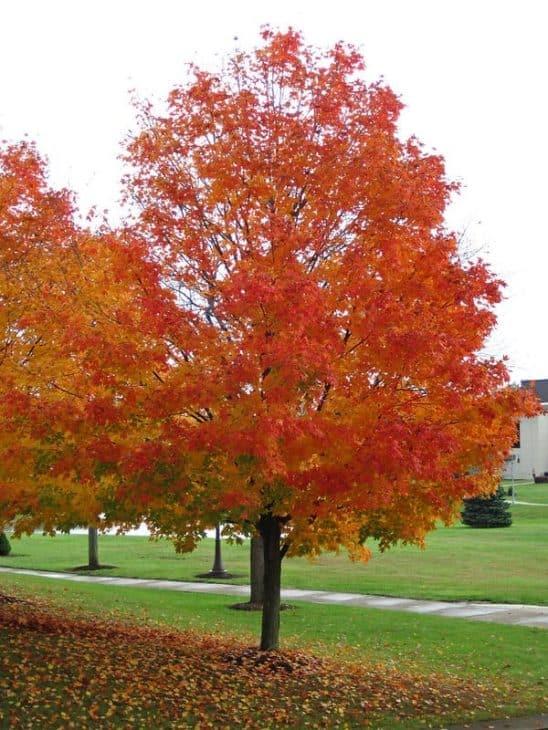
Sugar maple is the tree most Canadians connect with the maple leaf on the flag. It grows in southern Ontario, southern Quebec and the Maritimes, and its sap is boiled into maple syrup every spring. Quebec alone makes about 70% of the world’s maple syrup. Its fall color is brilliant orange, red and yellow. Canada has 10 native maple species, and the maple genus as a whole is Canada’s national arboreal emblem.
Red Maple (Acer rubrum)

Red maple has the widest range of any tree in eastern North America. In Canada it grows from southeastern Manitoba to Newfoundland. It has red flowers in early spring, red leaf stalks and some of the brightest scarlet fall color of any tree. It grows in both swamps and dry uplands.
Eastern White Pine (Pinus strobus)

Eastern white pine is the tallest tree in eastern Canada. It has soft, blue-green needles in bundles of five and long, slender cones. In the 1700s and 1800s its tall, straight trunks were cut for the masts of the British navy. It is the provincial tree of Ontario.
Eastern Hemlock (Tsuga canadensis)

Eastern hemlock is a long-lived, shade-tolerant conifer of cool ravines and north-facing slopes, with short, flat needles that have two white lines underneath. Some trees are more than 400 years old. It is threatened by the hemlock woolly adelgid, an invasive insect that has reached southern Ontario and Nova Scotia.
Eastern White Cedar (Thuja occidentalis)

Eastern white cedar, or arborvitae, grows in swamps and on limestone cliffs. It has flat sprays of scale-like leaves and red-brown bark that peels in long strips. Stunted cedars on Ontario’s Niagara Escarpment are among the oldest trees in eastern North America, some more than 1,000 years old. It is also one of the most common hedge plants in Canada.
Yellow Birch (Betula alleghaniensis)
Yellow birch has shiny, bronze-yellow bark that peels in thin, curly strips, and its twigs smell of wintergreen when scratched. It grows in mixed forests with sugar maple, beech and hemlock and is an important hardwood for furniture and flooring. It is the provincial tree of Quebec.
Red Oak (Quercus rubra)

Red oak is the most common oak in eastern Canada, growing from southern Ontario to the Maritimes. It has pointed, bristle-tipped leaves that turn red to russet in fall, and acorns that take two years to ripen. It is prized for flooring and furniture. It is the provincial tree of Prince Edward Island.
American Beech (Fagus grandifolia)

American beech is easy to spot by its smooth, silver-gray bark and its papery leaves, which often hang on the tree through winter. Its beechnuts feed bears, deer and birds. Many beeches are now dying from beech bark disease, and since 2017 from beech leaf disease, which has spread through southern Ontario.
Bur Oak (Quercus macrocarpa)

Bur oak is the hardiest oak in Canada and the only oak that grows wild on the prairies, in river valleys in Manitoba and southeastern Saskatchewan. It has deeply lobed leaves, thick, corky bark that resists fire, and large acorns with a fringed, mossy cup. It is a popular, tough shade tree in prairie cities.
Basswood (Tilia americana)

Basswood has large, heart-shaped leaves and clusters of very fragrant, cream-colored flowers in early summer that attract so many bees it is also called the bee tree. Its soft, light wood is a favorite for carving. It grows fast and often sprouts several trunks from the base.
American Elm (Ulmus americana)

American elm, with its tall, vase-shaped crown, once lined the streets of cities across Canada. Dutch elm disease has killed most of the large trees since the 1940s, but young elms are still common in the wild. Winnipeg and Edmonton protect some of the largest surviving urban elm forests in North America.
Rare Southern Trees of the Carolinian Zone
A thin strip of southwestern Ontario along Lake Erie, called the Carolinian zone, has trees found nowhere else in Canada. They include tulip tree, shagbark hickory, black walnut, sassafras, Kentucky coffeetree and cucumber tree. Most are rare in Canada, and several, such as Kentucky coffeetree and cucumber tree, are listed as endangered or threatened.
For trees south of the border, see the most common trees in North America and the most common trees in New England.