Almost half of Oregon is forest, and conifers dominate it. West of the Cascades, where rain is heavy, the forests are Douglas fir, western hemlock and western red cedar, with Sitka spruce along the foggy coast and red alder and bigleaf maple along streams and in logged areas. East of the Cascades the climate is dry, and ponderosa pine, lodgepole pine, western larch and western juniper take over. Douglas fir, the most common and most valuable tree in the state, has been Oregon’s state tree since 1936.
Contents
- Western Oregon Forests: Coast Range and Western Cascades
- Douglas Fir (Pseudotsuga menziesii)
- Western Hemlock (Tsuga heterophylla)
- Western Red Cedar (Thuja plicata)
- Sitka Spruce (Picea sitchensis)
- Grand Fir (Abies grandis)
- Noble Fir (Abies procera)
- Red Alder (Alnus rubra)
- Bigleaf Maple (Acer macrophyllum)
- Vine Maple (Acer circinatum)
- Pacific Dogwood (Cornus nuttallii)
- Pacific Yew (Taxus brevifolia)
- Pacific Madrone (Arbutus menziesii)
- Willamette Valley and Southern Oregon
- Oregon White Oak (Garry Oak) (Quercus garryana)
- California Black Oak (Quercus kelloggii)
- Black Cottonwood (Populus trichocarpa)
- Oregon Ash (Fraxinus latifolia)
- Oregon Crabapple (Pacific Crabapple) (Malus fusca)
- Oregon Myrtle (California Bay Laurel) (Umbellularia californica)
- Tanoak (Notholithocarpus densiflorus)
- Port Orford Cedar (Chamaecyparis lawsoniana)
- Incense Cedar (Calocedrus decurrens)
- Coast Redwood (Sequoia sempervirens)
- Sugar Pine (Pinus lambertiana)
- Eastern Oregon and the Mountains
- Ponderosa Pine (Pinus ponderosa)
- Lodgepole Pine (Shore Pine) (Pinus contorta)
- Western Larch (Larix occidentalis)
- Western Juniper (Juniperus occidentalis)
- Quaking Aspen (Populus tremuloides)
- Engelmann Spruce (Picea engelmannii)
- Mountain Hemlock (Tsuga mertensiana)
- Western White Pine (Pinus monticola)
- Black Hawthorn (Crataegus douglasii)
- Don’t Plant These Invasive Trees
- How to Identify Oregon’s Common Conifers
This guide covers the 32 native trees you are most likely to see in Oregon, grouped by region, and 3 widely planted trees you shouldn’t plant because they invade Oregon’s forests.
- Western Oregon Forests: Coast Range and Western Cascades
- Willamette Valley and Southern Oregon
- Eastern Oregon and the Mountains
- Don’t Plant These Invasive Trees
- How to Identify Oregon’s Common Conifers
| Tree | Botanical name | Native to OR | Where you’ll see it |
|---|---|---|---|
| Douglas Fir | Pseudotsuga menziesii | Yes | Forests statewide, dominant west of the Cascades; the state tree |
| Western Hemlock | Tsuga heterophylla | Yes | Moist forests of the Coast Range and western Cascades |
| Western Red Cedar | Thuja plicata | Yes | Moist and wet forests west of the Cascades; also the Blue Mountains |
| Sitka Spruce | Picea sitchensis | Yes | Coastal fog belt, within a few miles of the ocean |
| Grand Fir | Abies grandis | Yes | Valleys and lower slopes on both sides of the Cascades |
| Noble Fir | Abies procera | Yes | High Cascades and Coast Range peaks |
| Red Alder | Alnus rubra | Yes | Streams, wet slopes and logged land west of the Cascades |
| Bigleaf Maple | Acer macrophyllum | Yes | Stream banks and mixed forests west of the Cascades |
| Vine Maple | Acer circinatum | Yes | Forest understory and clearings west of the Cascades |
| Pacific Dogwood | Cornus nuttallii | Yes | Understory of mixed forests west of the Cascades |
| Pacific Yew | Taxus brevifolia | Yes | Shady, moist understory of old forests |
| Pacific Madrone | Arbutus menziesii | Yes | Dry slopes of the Willamette Valley margins, southern Oregon and the coast |
| Oregon White Oak (Garry Oak) | Quercus garryana | Yes | Willamette, Umpqua and Rogue valleys; Columbia Gorge |
| California Black Oak | Quercus kelloggii | Yes | Southern Oregon valleys and foothills, north to about Eugene |
| Black Cottonwood | Populus trichocarpa | Yes | Rivers and floodplains statewide |
| Oregon Ash | Fraxinus latifolia | Yes | Wet bottomlands and stream banks west of the Cascades |
| Oregon Crabapple (Pacific Crabapple) | Malus fusca | Yes | Wetland edges, stream banks and coastal thickets west of the Cascades |
| Oregon Myrtle (California Bay Laurel) | Umbellularia californica | Yes | Southwestern Oregon: Coast Range, Umpqua and Rogue valleys |
| Tanoak | Notholithocarpus densiflorus | Yes | Southwestern Oregon forests |
| Port Orford Cedar | Chamaecyparis lawsoniana | Yes | Southwestern Oregon coast and mountains |
| Incense Cedar | Calocedrus decurrens | Yes | Southern Oregon and the Cascades, on dry sites |
| Coast Redwood | Sequoia sempervirens | Yes (rare) | Only the far southwest corner, along the Chetco River near Brookings |
| Sugar Pine | Pinus lambertiana | Yes | Southern Cascades and Siskiyou Mountains |
| Ponderosa Pine | Pinus ponderosa | Yes | Dominant east of the Cascades; also scattered in the Willamette Valley |
| Lodgepole Pine (Shore Pine) | Pinus contorta | Yes | High plateaus of central Oregon; shore pine along the coast |
| Western Larch | Larix occidentalis | Yes | Blue and Wallowa mountains; eastern slopes of the northern Cascades |
| Western Juniper | Juniperus occidentalis | Yes | High desert of central and eastern Oregon |
| Quaking Aspen | Populus tremuloides | Yes | Mountains of eastern Oregon, especially the Steens and Wallowas |
| Engelmann Spruce | Picea engelmannii | Yes | High, cold valleys and slopes of the Cascades and eastern mountains |
| Mountain Hemlock | Tsuga mertensiana | Yes | Near the tree line in the Cascades, including Crater Lake |
| Western White Pine | Pinus monticola | Yes | Cascades, Siskiyous and Blue Mountains, mid to high elevations |
| Black Hawthorn | Crataegus douglasii | Yes | Stream sides, meadows and fence rows statewide |
| English Holly | Ilex aquifolium | No, invasive | Yards, old farms and holly orchards; spreading into forests west of the Cascades |
| English Hawthorn | Crataegus monogyna | No, invasive | Pastures, fence rows and oak woodlands of the Willamette Valley |
| Tree of Heaven | Ailanthus altissima | No, invasive | Roadsides, railways and vacant lots, especially in southern and eastern Oregon |
Western Oregon Forests: Coast Range and Western Cascades
Douglas Fir (Pseudotsuga menziesii)

Douglas fir is Oregon’s state tree and its most important timber tree. In the rainy west it commonly grows 150 to 250 feet tall. One of the tallest known, the Doerner Fir in Coos County, is over 320 feet. Its soft, flat needles spread all around the twig. The cones are the best ID feature: they hang down, and three-pointed bracts stick out from under each scale, like the back legs and tail of a mouse. Old trees have bark up to a foot thick, which protects them from fire. Despite the name, it is not a true fir.
Western Hemlock (Tsuga heterophylla)

Western hemlock grows 125 to 200 feet tall and is easy to recognize from a distance by its drooping top. The short, flat needles are of different lengths on the same twig and have two white stripes underneath. It is the most shade-tolerant large tree in the region, so it grows up under Douglas firs and slowly replaces them in old forests. Its seedlings often sprout on rotting logs, called nurse logs. It is Washington’s state tree.
Western Red Cedar (Thuja plicata)

Western red cedar is not a true cedar but a member of the cypress family. It grows 150 to 200 feet tall, with a flared, buttressed base and reddish-brown, stringy bark that peels in long strips. Its scale-like leaves grow in flat, drooping sprays, and the underside has white markings shaped like a bow tie. Trees can live more than 1,000 years. The rot-resistant wood is used for siding, shingles and decks, and it was the most important tree for the Native peoples of the coast.
Sitka Spruce (Picea sitchensis)

Sitka spruce is the largest spruce in the world, commonly 160 to 230 feet tall and sometimes taller. In Oregon it grows only in a narrow strip along the coast, where fog keeps the air moist all summer. Its stiff, sharp needles stick out all around the twig and hurt to grab. The bark is thin and gray, flaking in small round scales. Its light, strong wood was used to build airplanes in both world wars.
Grand Fir (Abies grandis)
Grand fir is a tall true fir, 130 to 200 feet, with glossy, flat needles that lie in two neat rows on the sides of the twig, like the teeth of a comb. The needles have a notched tip and smell of citrus when crushed. Its upright cones fall apart on the tree, so you rarely find them whole on the ground. It is common in the Willamette Valley foothills and in the mixed forests of eastern Oregon.
Noble Fir (Abies procera)

Noble fir grows at higher elevations, 150 to 200 feet tall, with stiff, blue-green needles that curve upward like a hockey stick. It is the largest native true fir. Its sturdy branches and long-lasting needles make it a favorite Christmas tree, and Oregon grows more Christmas trees than any other state, most of them noble and Douglas fir.
Red Alder (Alnus rubra)

Red alder is the most common hardwood in the Pacific Northwest. It grows 40 to 80 feet tall and quickly fills in logged or burned land and stream banks. Its smooth bark is gray, often with white patches of lichen. When cut, the inner bark turns bright red-orange, which gives the tree its name. Its oval, toothed leaves have edges that roll under slightly. Bacteria in its roots fix nitrogen, so alder enriches the soil for the conifers that follow. Its wood is used for furniture and smoking salmon.
Bigleaf Maple (Acer macrophyllum)

Bigleaf maple has the largest leaves of any maple, usually 6 to 12 inches across and sometimes up to 2 feet, with 5 deep lobes. It grows 50 to 100 feet tall. In the wet forests of western Oregon its trunks and branches are often covered in thick moss and licorice ferns. The leaves turn yellow in fall. Its paired, winged seeds are hairy at the base. Its wood, especially burled or “quilted” wood, is prized for guitars and furniture.
Vine Maple (Acer circinatum)

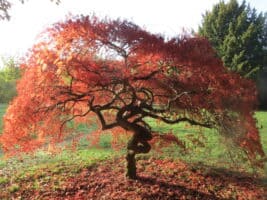
Vine maple is a small, multi-stemmed tree or shrub, 15 to 25 feet tall, that often grows in dense thickets under conifers. Its leaves are almost round, with 7 to 9 shallow, pointed lobes, like a Japanese maple. It is the brightest fall color in western Oregon forests, turning orange and red in the open and yellow in shade. It makes a good native alternative to Japanese maple in gardens.
Pacific Dogwood (Cornus nuttallii)

Pacific dogwood is a small to medium tree, 20 to 40 feet tall, in the understory of Douglas fir and oak forests. In April and May it carries showy white “flowers” 4 to 6 inches across. What look like petals are 4 to 6 white bracts around a button of tiny true flowers. It often flowers again lightly in fall, when its leaves turn pink to red and its red berries ripen. Dogwood anthracnose, a fungal disease, has killed many trees in the wild.
Pacific Yew (Taxus brevifolia)

Pacific yew is a slow-growing understory tree, 20 to 50 feet tall, with flat, dark green needles in two rows and thin, purplish, peeling bark. Female trees carry single seeds in a soft red cup called an aril. The bark is the original source of the cancer drug taxol (paclitaxel). The needles and seeds are poisonous to people and livestock.
Pacific Madrone (Arbutus menziesii)

Pacific madrone is a broadleaf evergreen 20 to 80 feet tall, with a leaning, twisting trunk. Its thin red-orange bark peels in papery curls to reveal smooth, green-tan wood underneath. The large, leathery leaves are glossy dark green. In spring it has clusters of white, bell-shaped flowers, and in fall bright orange-red berries that birds love. It grows on dry, rocky, well-drained sites and does poorly if watered in summer.
Willamette Valley and Southern Oregon
Oregon White Oak (Garry Oak) (Quercus garryana)
Read our guide to Oregon White Oak (Garry Oak)

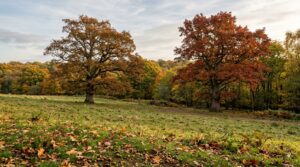
Oregon white oak is the main tree of the Willamette Valley’s oak savannas and woodlands. It is usually 40 to 80 feet tall, with a broad, spreading crown and thick, gray, furrowed bark. Its leathery leaves have 5 to 7 rounded lobes. It is very drought-tolerant and can live for 500 years. Less than 10 percent of the valley’s original oak habitat remains, so old oaks are worth protecting.
California Black Oak (Quercus kelloggii)

California black oak grows 30 to 80 feet tall in the foothills of southern Oregon, often with ponderosa pine and Oregon white oak. Its leaves are deeply lobed, with bristle-tipped points, and they emerge pinkish-red in spring and turn yellow-orange in fall. Its bark is dark and becomes blocky with age. Its acorns were an important food for Native peoples.
Black Cottonwood (Populus trichocarpa)

Black cottonwood is the tallest hardwood in the West, often 100 to 150 feet tall, and it grows along nearly every major river in Oregon. Its leaves are shiny dark green on top and silvery-white underneath. In spring, its sticky buds give the air a sweet balsam smell, and in early summer female trees release fluffy, cottony seeds. It grows fast, and it is one of the parents of the hybrid poplars grown on farms in the Columbia Basin.
Oregon Ash (Fraxinus latifolia)

Oregon ash is the only ash native to the Pacific Northwest. It grows 40 to 80 feet tall in wet, seasonally flooded ground, with compound leaves of 5 to 7 leaflets that turn yellow in fall. It is now at risk: the emerald ash borer, an invasive beetle that has killed hundreds of millions of ash trees in the East, was found in Forest Grove in 2022, its first detection in the western U.S.
Oregon Crabapple (Pacific Crabapple) (Malus fusca)
Oregon crabapple is a small, often thicket-forming tree, 20 to 40 feet tall. Its leaves are toothed and sometimes have one or two small lobes. In spring it has clusters of white to pinkish flowers, and in fall small oval apples, about half an inch long, that ripen yellow to red. Native peoples ate the tart fruit and used the wood for tools. It is one of only a few apples native to North America.
Oregon Myrtle (California Bay Laurel) (Umbellularia californica)

Oregon myrtle is the same tree that Californians call California bay laurel. It is a broadleaf evergreen 40 to 80 feet tall, with narrow, glossy leaves that smell strongly of bay and pepper when crushed. Too much of the smell can cause headaches. In Oregon it grows naturally only in the southwest. Its beautifully figured wood, sold as myrtlewood, is made into bowls and crafts along the south coast.
Tanoak (Notholithocarpus densiflorus)

Tanoak is a broadleaf evergreen related to oaks and chestnuts, 60 to 100 feet tall in the forests of Curry and Josephine counties. Its leathery leaves are toothed and have rusty hairs underneath, and its acorns sit in bristly cups. Sudden oak death, caused by the pathogen Phytophthora ramorum, has killed tanoaks in southwestern Oregon since 2001, and the state runs a quarantine around the infested area near Brookings.
Port Orford Cedar (Chamaecyparis lawsoniana)

Port Orford cedar grows naturally only in southwestern Oregon and northwestern California. It is a tall conifer, 150 to 200 feet, with flat sprays of scale-like leaves marked with white X shapes underneath. Its fine, aromatic wood is so valued in Japan that it was exported there for temple building. An introduced root disease, Phytophthora lateralis, spreads in water and mud and has killed many trees along roads and streams. Garden forms are sold as Lawson cypress.
Incense Cedar (Calocedrus decurrens)

Incense cedar grows 60 to 150 feet tall with a narrow, cone-shaped crown. Its cinnamon-red bark is deeply furrowed, and its bright green, scale-like leaves grow in flat sprays, with each segment longer than it is wide. The wood is aromatic, soft and even, and it is the main wood used for pencils. It tolerates heat and drought better than most western conifers.
Coast Redwood (Sequoia sempervirens)

The coast redwood, the tallest tree species in the world, reaches the northern end of its range in Oregon. Only a few groves grow wild here, along the Chetco and Winchuck rivers in Curry County. The Oregon Redwoods Trail in the Rogue River-Siskiyou National Forest is the easiest place to see them. Elsewhere in Oregon it is grown as a planted tree. Its flat, pointed needles in two rows look a bit like yew or hemlock needles.
Sugar Pine (Pinus lambertiana)

Sugar pine is the tallest and largest pine in the world, 150 to 200 feet tall, with long, horizontal branches near the top. It has the longest cones of any conifer, 10 to 20 inches, which hang from the tips of the branches. Its needles grow in bundles of 5. In Oregon it grows mainly in the southwest and the southern Cascades. White pine blister rust, a fungus from Asia, has killed many sugar pines.
Eastern Oregon and the Mountains
Ponderosa Pine (Pinus ponderosa)

Ponderosa pine is the most common tree on the dry east side of the Cascades, around Bend, Sisters, Klamath Falls and in the Blue Mountains. It grows 100 to 180 feet tall. Its needles are 5 to 10 inches long in bundles of 3, and mature trees have thick, orange-brown bark in large plates shaped like jigsaw pieces. On a warm day the bark smells of vanilla or butterscotch. A separate Willamette Valley form grows in the wetter western valleys.
Lodgepole Pine (Shore Pine) (Pinus contorta)

Lodgepole pine has short needles in bundles of 2. Inland it forms dense stands of straight, thin trees, 50 to 80 feet tall, on the pumice plateaus of central Oregon and in the mountains, and Native peoples used the poles for lodges. On the coast the same species grows as shore pine, a short, twisted, windswept tree. Many of its cones stay closed until a fire opens them.
Western Larch (Larix occidentalis)

Western larch is a deciduous conifer: its soft needles, in clusters of 15 to 30, turn bright gold in October and then fall. It is the largest larch in the world, 100 to 180 feet tall, with thick, fire-resistant bark. In autumn, the gold larches stand out among the dark green pines and firs of northeastern Oregon’s mountains.
Western Juniper (Juniperus occidentalis)
Western juniper is a small, bushy tree, usually 15 to 30 feet tall, of the sagebrush country in central and eastern Oregon. It has scale-like leaves in whorls of three, shaggy reddish bark and blue, berry-like cones that feed birds through winter. Some trees are more than 1,000 years old. With less wildfire over the last 150 years, juniper has spread far into former grassland and sagebrush. Land managers now cut it to restore habitat and water for sage-grouse and other wildlife.
Quaking Aspen (Populus tremuloides)
Read our guide to Quaking Aspen

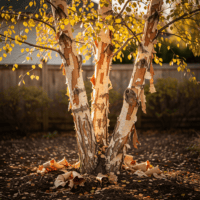
Quaking aspen is the most widely distributed tree in North America. In Oregon it grows mostly in groves in the eastern mountains, and it is less common in the Cascades. It grows 40 to 60 feet tall with smooth, pale, whitish bark. Its round leaves have flat stems, so they flutter in the slightest breeze, and they turn gold in fall. A grove is often a single clone connected by its roots.
Engelmann Spruce (Picea engelmannii)

Engelmann spruce grows at high elevations, usually along cold streams and in frost pockets, 80 to 130 feet tall, with a narrow, spire-shaped crown. Its needles are four-sided and sharp but more flexible than Sitka spruce, and they smell unpleasant when crushed. Its small cones have thin, papery scales.
Mountain Hemlock (Tsuga mertensiana)

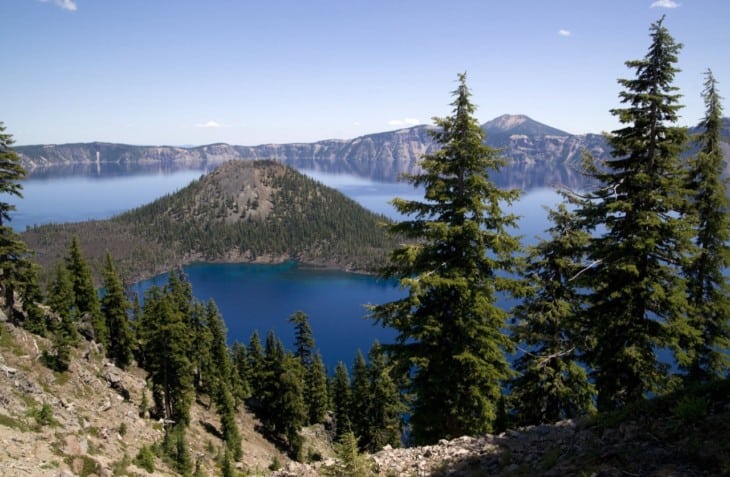
Mountain hemlock grows near the tree line in the Cascades, where snowpack lasts into summer. It is often the main tree around Crater Lake and on the upper slopes of Mount Hood. Its blue-green needles grow all around the twig, like a star, not in flat rows like western hemlock. Its cones are longer, 1 to 3 inches. It grows 50 to 100 feet tall in sheltered spots, but near the tree line it is often a twisted, windswept shrub.
Western White Pine (Pinus monticola)

Western white pine grows 100 to 180 feet tall, with soft, blue-green needles in bundles of 5 and long, slender, curved cones 6 to 10 inches long. It was once a major timber tree. Since the 1920s, white pine blister rust, a fungus from Asia, has killed most of the older trees, and foresters now plant rust-resistant seedlings.
Black Hawthorn (Crataegus douglasii)

Black hawthorn is a small tree or large shrub, 15 to 30 feet tall, with short, stout thorns and toothed leaves. In spring it has flat clusters of white flowers, and in late summer its small berry-like fruit ripens to shiny black. That makes it easy to tell from the red-fruited English hawthorn, which is invasive in the Willamette Valley. Its thickets shelter birds, and the fruit feeds them in fall.
Don’t Plant These Invasive Trees
These three trees are still sold or common in Oregon yards, but they spread into forests and natural areas. The Oregon Invasive Species Council and local soil and water conservation districts ask gardeners not to plant them and to remove seedlings.
English Holly (Ilex aquifolium)

English holly was widely planted in western Oregon for its glossy, spiny leaves and red berries, and it was grown commercially for Christmas greenery. Birds spread the berries into forests, where the shade-tolerant seedlings grow into dense thickets that crowd out native plants. It is now one of the most common invasive plants in the forests around Portland. Remove seedlings while they are small. For a native evergreen with berries, plant tall Oregon grape or evergreen huckleberry instead.
English Hawthorn (Crataegus monogyna)

English hawthorn is a European hedge tree, 15 to 30 feet tall, with deeply lobed leaves, thorns, white flowers in spring and red berries in fall. Birds spread it into pastures and oak savannas, where it forms thorny thickets. It also crosses with the native black hawthorn. Native black hawthorn or Pacific crabapple are better choices.
Tree of Heaven (Ailanthus altissima)

Tree of heaven is a fast-growing Chinese tree with long compound leaves, similar to sumac, and a strong, rank smell when its leaves or twigs are crushed. It spreads by seed and by root suckers and is extremely hard to kill: cutting it just causes dozens of new shoots. It is also the preferred host of the spotted lanternfly, an invasive pest that has spread across the eastern U.S. Never plant it. Control needs herbicide on the stem or cut stump, followed by repeated follow-up.
How to Identify Oregon’s Common Conifers
| If the needles… | It’s probably |
|---|---|
| Are flat and soft, spread all around the twig, and the cones have three-pointed bracts | Douglas fir |
| Are flat, in two rows, of mixed lengths, and the tree has a drooping top | Western hemlock |
| Are flat, glossy, in two neat rows, and smell of citrus | Grand fir |
| Are scale-like in flat sprays with white bow-tie marks underneath | Western red cedar |
| Are stiff and sharp enough to hurt, near the coast | Sitka spruce |
| Come in bundles of 3, 5 to 10 in. long | Ponderosa pine |
| Come in bundles of 2, short and twisted | Lodgepole / shore pine |
| Come in bundles of 5 | Western white pine or sugar pine |
| Turn gold and fall off in autumn | Western larch |
Oregon’s neighbor to the north shares most of these trees; see our guide to trees in Washington State.