
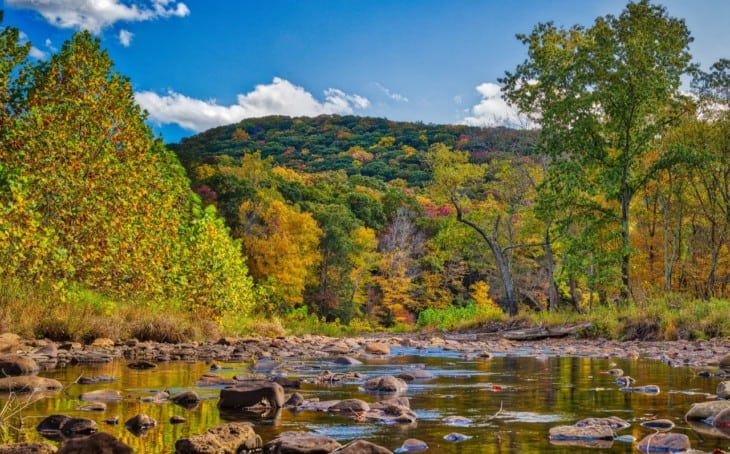
About three-quarters of West Virginia is forest, making it one of the most heavily forested states in the country, behind only Maine and New Hampshire by share of land. Most of it is oak-hickory forest: white, red, chestnut and black oaks with several hickories on the slopes and ridges. Sheltered coves and north-facing slopes grow rich mixed hardwoods, with yellow-poplar, sugar maple, black cherry, basswood and beech. Red maple grows almost everywhere. The sugar maple has been the state tree since 1949. Conifers are a minor part of the forest: eastern hemlock in cool ravines, pines on dry ridges, and red spruce on the highest mountains.
Contents
- Oaks and Hickories
- Maples and Cove Hardwoods
- Sugar Maple (Acer saccharum)
- Red Maple (Acer rubrum)
- Yellow-Poplar (Tulip Tree) (Liriodendron tulipifera)
- Black Cherry (Prunus serotina)
- American Beech (Fagus grandifolia)
- American Basswood (Tilia americana)
- Cucumber Tree (Magnolia acuminata)
- White Ash (Fraxinus americana)
- Black Walnut (Juglans nigra)
- Sweet Birch (Black Birch) (Betula lenta)
- Yellow Birch (Betula alleghaniensis)
- American Sycamore (Platanus occidentalis)
- American Elm (Ulmus americana)
- Black Locust (Robinia pseudoacacia)
- Small Flowering Trees
- Conifers
- Don’t Plant These Invasive Trees
- How to Identify West Virginia’s Common Oaks and Maples
This guide covers the 30 native trees you are most likely to see in West Virginia, grouped by type, and 2 invasive trees you shouldn’t plant.
- Oaks and Hickories
- Maples and Cove Hardwoods
- Small Flowering Trees
- Conifers
- Don’t Plant These Invasive Trees
- How to Identify West Virginia’s Common Oaks and Maples
| Tree | Botanical name | Native to WV | Where you’ll see it |
|---|---|---|---|
| White Oak | Quercus alba | Yes | Slopes and ridges statewide |
| Northern Red Oak | Quercus rubra | Yes | Moist slopes and coves, especially at higher elevations |
| Chestnut Oak | Quercus montana | Yes | Dry, rocky ridgetops and upper slopes |
| Black Oak | Quercus velutina | Yes | Dry slopes and ridges, mostly at lower elevations |
| Hickories | Carya spp. | Yes | Slopes and ridges with the oaks statewide |
| Sugar Maple | Acer saccharum | Yes | Coves, moist slopes and northern hardwood forests; the state tree |
| Red Maple | Acer rubrum | Yes | Everywhere, from wet bottoms to dry ridges |
| Yellow-Poplar (Tulip Tree) | Liriodendron tulipifera | Yes | Coves, lower slopes and old fields |
| Black Cherry | Prunus serotina | Yes | Allegheny Plateau and mountains; old fields statewide |
| American Beech | Fagus grandifolia | Yes | Moist slopes and coves, with sugar maple |
| American Basswood | Tilia americana | Yes | Rich coves and moist lower slopes |
| Cucumber Tree | Magnolia acuminata | Yes | Rich coves and moist slopes, mostly in the mountains |
| White Ash | Fraxinus americana | Yes, declining | Moist slopes and coves statewide |
| Black Walnut | Juglans nigra | Yes | Bottomlands, coves and old farm fields |
| Sweet Birch (Black Birch) | Betula lenta | Yes | Moist slopes and rocky coves, mostly in the mountains |
| Yellow Birch | Betula alleghaniensis | Yes | Cool, moist forests at high elevations |
| American Sycamore | Platanus occidentalis | Yes | Riverbanks and bottomlands statewide |
| American Elm | Ulmus americana | Yes, declining | Bottomlands and moist slopes |
| Black Locust | Robinia pseudoacacia | Yes | Old fields, roadsides, reclaimed mine land |
| Flowering Dogwood | Cornus florida | Yes | Understory of oak forests; yards |
| Eastern Redbud | Cercis canadensis | Yes | Forest edges and roadsides, especially on limestone soils |
| Downy Serviceberry | Amelanchier arborea | Yes | Forest edges, ridges and slopes statewide |
| Sassafras | Sassafras albidum | Yes | Old fields, forest edges and roadsides |
| Sourwood | Oxydendrum arboreum | Yes | Dry slopes and ridges with oaks and pines |
| Eastern Hemlock | Tsuga canadensis | Yes, threatened | Cool, shady ravines and stream banks |
| Eastern White Pine | Pinus strobus | Yes | Mountains and slopes, especially in the east and north |
| Red Spruce | Picea rubens | Yes | High mountains above about 3,500 feet |
| Pitch Pine | Pinus rigida | Yes | Dry, rocky ridges and poor soils |
| Virginia Pine | Pinus virginiana | Yes | Old fields and dry slopes, mostly in the east and south |
| Eastern Redcedar | Juniperus virginiana | Yes | Old fields, fence rows and limestone outcrops |
| Tree of Heaven | Ailanthus altissima | No, invasive | Roadsides, railways, mine land and forest edges statewide |
| Princess Tree | Paulownia tomentosa | No, invasive | Roadsides, stream banks, rocky slopes and burned areas |
Oaks and Hickories
Before the early 1900s, the American chestnut made up a large share of the trees in West Virginia’s forests. A fungal blight from Asia killed almost all of them within a few decades, and oaks and hickories took their place. Chestnut sprouts still come up from old roots but rarely live long enough to bear nuts.
White Oak (Quercus alba)

White oak is one of the most common and valuable trees in the state, 60 to 100 feet tall with a broad crown on open ground. Its leaves have 7 to 9 rounded lobes with no bristles, and the light gray bark breaks into loose, scaly plates. The acorns are sweet and mature in a single year, so deer, turkeys, bears and squirrels eat them first. Its wood is used for barrels, flooring and furniture.
Northern Red Oak (Quercus rubra)

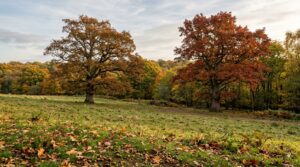
Northern red oak grows 60 to 90 feet tall and is the most important timber oak in the Appalachians. Its leaves have 7 to 11 pointed lobes, each ending in a small bristle. The best ID feature is the bark: on the upper trunk it forms long, flat, shiny ridges that look like ski trails. The large acorns have a shallow, saucer-like cap. Its leaves turn russet to deep red in fall.
Chestnut Oak (Quercus montana)

Chestnut oak is the oak of West Virginia’s dry, rocky ridges, where few other large trees grow well. Its leaves have no lobes, only wavy, rounded teeth along the edges, like an American chestnut’s leaves. The bark is very thick, dark and deeply furrowed into hard ridges. It grows 60 to 80 feet tall and bears large, glossy acorns. Its bark was once the main source of tannin for leather tanning in the region.
Black Oak (Quercus velutina)

Black oak grows 50 to 80 feet tall on dry, poor soils. Its leaves are glossy dark green above with bristle-tipped lobes and vary a lot in shape, even on one tree. The outer bark is dark and blocky, and the inner bark is bright orange-yellow if you nick it, which is the best way to separate it from red oak. It crosses with other red oaks, so some trees are hard to name.
Hickories (Carya spp.)

West Virginia has four common hickories: shagbark, pignut, mockernut and bitternut. All have compound leaves with 5 to 9 leaflets, hard, heavy wood and nuts in thick husks, and their leaves turn golden yellow in fall. Shagbark hickory is easy to recognize by its gray bark, which peels off in long strips curling out at the ends. Bitternut hickory has bright sulfur-yellow buds in winter. Pignut and mockernut have tight, furrowed bark and are best told apart by their nuts and leaflets.
Maples and Cove Hardwoods
Sugar Maple (Acer saccharum)
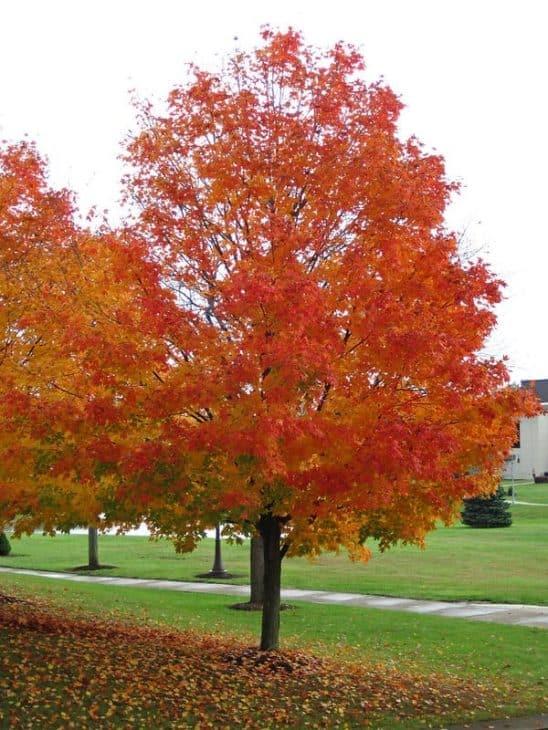
Sugar maple is West Virginia’s state tree and a big part of its famous fall color, turning yellow, orange and red in October. It grows 60 to 80 feet tall, most commonly in the northern hardwood forests of the higher mountains. Its leaves have 5 lobes with smooth, not toothed, edges separated by rounded, U-shaped notches. Its sap is the main source of maple syrup, and the state has a small but growing syrup industry.
Red Maple (Acer rubrum)

Red maple is one of the most abundant trees in West Virginia because it grows in almost any soil, wet or dry. It is 40 to 70 feet tall and has something red in every season: red flowers on bare twigs in late winter, red leaf stalks in summer, brilliant red or orange leaves in fall and red twigs and buds in winter. Its leaves have 3 main lobes with toothed edges and sharp, V-shaped notches.
Yellow-Poplar (Tulip Tree) (Liriodendron tulipifera)

Yellow-poplar is the tallest hardwood in the eastern U.S. and one of West Virginia’s most abundant timber trees. In rich coves it grows well over 100 feet tall with a straight trunk free of branches for much of its height. It isn’t a poplar but a magnolia relative. Its leaves are unique: 4 lobes with a square-cut, notched tip, like a tulip in outline. In May and June it has tulip-shaped green and orange flowers, often high in the tree. It grows fast and quickly fills old fields and logged land.
Black Cherry (Prunus serotina)

Black cherry grows 50 to 80 feet tall, and the Allegheny region of northern West Virginia and Pennsylvania produces some of the world’s finest cherry wood for furniture. The leaves are narrow, glossy and finely toothed. The bark of older trees is dark and breaks into small, curled plates that look like burnt potato chips. In May it has drooping clusters of small white flowers, followed by dark purple cherries in late summer that birds love. The wilted leaves are poisonous to livestock.
American Beech (Fagus grandifolia)

American beech is easy to recognize by its smooth, light gray bark, which stays smooth even on old trees. It grows 50 to 80 feet tall. Its leaves are oval with a sharp tip, straight parallel veins and a small tooth at the end of each vein. In fall they turn golden bronze, and on young trees many dry tan leaves hang on all winter. The small, three-sided nuts are an important food for wildlife. Beech bark disease, spread by a scale insect, has killed many large beeches in the state.
American Basswood (Tilia americana)

Basswood grows 60 to 80 feet tall, often with several trunks from one base. Its large, heart-shaped leaves are toothed and have an uneven, lopsided base. In June and July it has hanging clusters of fragrant, pale yellow flowers attached to a narrow, leafy wing. Bees work the flowers so heavily that it is also called the bee tree, and basswood honey is prized. Its soft, pale wood is a favorite of wood carvers.
Cucumber Tree (Magnolia acuminata)

Cucumber tree is the largest and hardiest native magnolia, 60 to 80 feet tall. Its leaves are large, 6 to 10 inches long, oval and smooth-edged. The greenish-yellow flowers in late spring are easy to miss because they are high in the tree and blend in with the leaves. The name comes from the fruit: green, knobby and about the size and shape of a small cucumber, turning red in late summer when the seeds ripen.
White Ash (Fraxinus americana)

White ash grows 60 to 80 feet tall and was once common in the state’s cove forests. Its leaves are compound, with 5 to 9 leaflets that are pale underneath, and they grow in opposite pairs along the twig. The gray bark has a regular pattern of diamond-shaped ridges. The emerald ash borer, an Asian beetle first found in West Virginia in 2007, has since killed most mature ash trees in the state. Its wood is used for baseball bats and tool handles.
Black Walnut (Juglans nigra)

Black walnut grows 50 to 75 feet tall with a rounded crown. Its compound leaves have 15 to 23 leaflets. The nuts come in a thick green husk that turns black and stains hands and pavement. Its roots release juglone, a chemical that stunts tomatoes and many other plants growing near it. Its dark wood is among the most valuable in North America. The town of Spencer holds a Black Walnut Festival every October.
Sweet Birch (Black Birch) (Betula lenta)

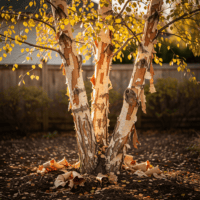
Sweet birch grows 50 to 60 feet tall. Unlike most birches, its bark doesn’t peel: it is smooth and dark gray to almost black on young trees, marked with thin horizontal lines, and cracks into plates with age. Scratch a twig and it smells strongly of wintergreen. Oil distilled from its bark was once the source of wintergreen flavoring, and people made birch beer from its sap. Its leaves turn golden yellow in fall.
Yellow Birch (Betula alleghaniensis)
Yellow birch grows 60 to 80 feet tall in the cool northern hardwood and spruce forests of the high Allegheny Mountains. Its bark is shiny, yellowish-bronze to silvery gray and peels in thin, curly strips. The twigs smell faintly of wintergreen. Its seeds often sprout on rotting logs and stumps, so old trees sometimes stand on stilt-like roots where the log has rotted away.
American Sycamore (Platanus occidentalis)

American sycamore lines the rivers and creeks of West Virginia. It grows 70 to 100 feet tall and has the largest trunk diameter of any eastern hardwood. The bark peels off in patches, leaving a patchwork of brown, green and cream, and the upper branches are almost white. They stand out along streams in winter. The leaves are broad and maple-like, 4 to 8 inches wide. The round, bristly seed balls hang on long stalks through the winter.
American Elm (Ulmus americana)

American elm once shaded streets and farms with its tall, vase-shaped crown, 60 to 80 feet high. Its leaves are oval and double-toothed, with an uneven, lopsided base. Dutch elm disease, a fungus spread by bark beetles, has killed most large elms since the 1930s, but young elms are still common along streams and fence rows.
Black Locust (Robinia pseudoacacia)

Black locust is native to the Appalachians and grows 40 to 70 feet tall. It spreads by root sprouts and quickly takes over open ground, including old fields and reclaimed strip mines. Its compound leaves have 7 to 19 small, oval leaflets, and pairs of sharp thorns grow on the twigs where the leaves attach. In May it has hanging clusters of fragrant white flowers. The wood is extremely hard and rot-resistant, used for fence posts. The bark, seeds and leaves are poisonous to people and livestock.
Small Flowering Trees
Flowering Dogwood (Cornus florida)

Flowering dogwood is a small understory tree, 15 to 30 feet tall. In April and May it is covered in white “flowers”, which are really four bracts around a small cluster of true flowers. Its leaves have veins that curve toward the leaf tip, turn red-purple in fall, and it has glossy red berries that birds eat. A fungal disease, dogwood anthracnose, has killed many wild dogwoods in cool, shady mountain forests.
Eastern Redbud (Cercis canadensis)

Eastern redbud is one of the first trees to bloom in spring, covering its bare branches with small pink-purple flowers in March and April, even on its trunk. It grows 20 to 30 feet tall with heart-shaped leaves and flat, bean-like pods. It is most common on limestone soils in the Eastern Panhandle and the Greenbrier Valley.
Downy Serviceberry (Amelanchier arborea)

Downy serviceberry, called “sarvis” in the Appalachians, is a small tree, 15 to 30 feet tall. It is one of the first trees to bloom, with clouds of white flowers in early April before its leaves come out. The young leaves are covered in soft, downy hairs. In June it has small, dark purple, edible berries that taste like blueberries with almonds. Its smooth gray bark has faint vertical stripes.
Sassafras (Sassafras albidum)

Sassafras grows 30 to 60 feet tall and has three leaf shapes on the same tree: oval, mitten-shaped and three-lobed. Its twigs, leaves and roots have a spicy, citrus smell when scratched or crushed. Its roots were once used to make root beer, until the FDA banned safrole, the main compound in its oil, as a food additive in 1960. Its leaves turn orange, red and yellow in fall.
Sourwood (Oxydendrum arboreum)

Sourwood is a small to medium tree, 20 to 50 feet tall, often with a leaning trunk. In July, when few other trees bloom, it has drooping sprays of small, white, bell-shaped flowers, and bees make a sought-after light honey from them. The leaves taste sour, which gives the tree its name. In fall it is one of the first trees to turn, a deep scarlet.
Conifers
Eastern Hemlock (Tsuga canadensis)

Eastern hemlock grows 60 to 100 feet tall and shades many of West Virginia’s trout streams. Its short, flat needles have two white stripes underneath and grow on tiny stalks in two rows. The cones are only about 3/4 inch long. The hemlock woolly adelgid, a tiny Asian insect that leaves white, cottony tufts under the needles, is killing hemlocks across the state. Foresters are treating key stands and releasing beetles that eat the adelgids.
Eastern White Pine (Pinus strobus)

Eastern white pine is the largest pine in the East, 80 to 100 feet tall or more, with long, level branches in whorls. It is the only native pine in West Virginia with soft needles in bundles of 5, each 3 to 5 inches long. The cones are long and slender, 4 to 8 inches. It is also widely planted for timber and as a windbreak.
Red Spruce (Picea rubens)

Red spruce grows 60 to 80 feet tall on the highest ridges of the Allegheny Mountains, such as Spruce Knob, the state’s highest point, which is named after it. Its short, stiff, four-sided needles are yellow-green and grow all around the twig. Logging and fires in the late 1800s and early 1900s destroyed most of the original spruce forest, and restoration projects are now replanting it.
Pitch Pine (Pinus rigida)
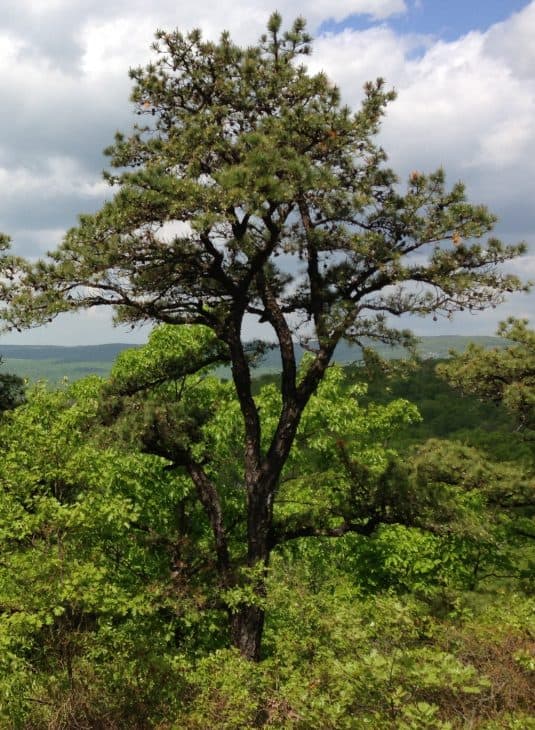
Pitch pine is a gnarled, irregular pine, 40 to 60 feet tall, on dry ridges and rocky slopes. Its stiff, yellow-green needles come in bundles of 3, 3 to 5 inches long. Tufts of needles often sprout straight from the trunk, a trait few other pines have. It also sprouts back after fire. The small cones have prickles and can stay on the tree for years.
Virginia Pine (Pinus virginiana)

Virginia pine is a small, scrubby pine, 30 to 50 feet tall, that quickly takes over old fields and poor, dry soils. Its short, twisted needles, 1.5 to 3 inches long, come in bundles of 2. The small cones have a sharp prickle on each scale and stay on the branches for years, so trees look cluttered. It is common in the Eastern Panhandle and southern counties.
Eastern Redcedar (Juniperus virginiana)

Eastern redcedar is a juniper, not a true cedar. It grows 30 to 50 feet tall, usually in a narrow, dense cone shape. Young shoots have sharp, needle-like leaves, while older ones have tiny, overlapping scales. Female trees bear small, dusty blue, berry-like cones that birds eat and spread along fences. Its aromatic reddish wood is used for cedar chests and closets. It also hosts cedar-apple rust, a disease of apple trees.
Don’t Plant These Invasive Trees
Tree of Heaven (Ailanthus altissima)

Tree of heaven is a fast-growing Chinese tree that now grows along roads and in disturbed ground across West Virginia. Its long, compound leaves look like sumac or black walnut, but each leaflet has a small, glandular notch near the base, and crushed leaves smell rank, like burnt peanut butter. It spreads by seed and by root suckers, and cutting it only causes new shoots. It is also the favorite host of the spotted lanternfly, an invasive pest spreading through the eastern U.S. Control it with herbicide applied to the bark or a fresh cut, and follow up for several years.
Princess Tree (Paulownia tomentosa)
Read our guide to Princess Tree

Princess tree, or royal empress tree, is an Asian tree sold for its clusters of fragrant, lavender flowers in April and May, before the leaves. Its huge, heart-shaped leaves can be a foot or more wide. Each tree makes millions of tiny, winged seeds that blow into roadsides, rocky slopes and disturbed forests, where it grows very fast and crowds out native trees. For spring flowers, plant redbud, serviceberry or dogwood instead.
How to Identify West Virginia’s Common Oaks and Maples
| If the leaves… | It’s probably |
|---|---|
| Have rounded lobes without bristles | White oak |
| Have wavy, rounded teeth instead of lobes, and the bark is thick and deeply furrowed | Chestnut oak |
| Have pointed, bristle-tipped lobes, and the bark has flat, shiny stripes | Northern red oak |
| Have pointed, bristle-tipped lobes, and the inner bark is orange | Black oak |
| Have 5 lobes with smooth edges and U-shaped notches | Sugar maple |
| Have 3 lobes with toothed edges and red stalks | Red maple |
| Have 4 lobes and a square-cut tip | Yellow-poplar |
| Are compound, and the bark peels in long strips | Shagbark hickory |
West Virginia’s neighbor to the north shares most of these trees; see our guide to trees in Pennsylvania.



.jpg)


