The plants that look most like hydrangeas are the viburnums. Chinese snowball, Japanese snowball and the European snowball bush all carry white globes the size and shape of a mophead hydrangea, and doublefile and American cranberrybush viburnums produce flat lacecap heads with showy outer flowers, exactly like a lacecap hydrangea. Beyond the viburnums, lilac, panicle-flowered spirea, butterfly bush, crape myrtle and elderberry are mistaken for hydrangeas at a distance, and mountain laurel, pentas and rhododendron fool people up close.
Contents
- Viburnums: The Closest Lookalikes
- Chinese Snowball Viburnum (Viburnum macrocephalum)
- Japanese Snowball (Viburnum plicatum f. plicatum)
- Doublefile Viburnum (Viburnum plicatum f. tomentosum)
- European Cranberrybush and Snowball Bush (Viburnum opulus)
- American Cranberrybush (Viburnum trilobum (V. opulus var. americanum))
- Blackhaw Viburnum (Viburnum prunifolium)
- Arrowwood Viburnum (Viburnum dentatum)
- Plants With Cone-Shaped Flower Heads
- Lookalikes Up Close
- How to Tell a Hydrangea From a Lookalike
The quickest way to settle it is the leaves. Hydrangea leaves grow in opposite pairs, are large, simple and coarsely toothed, and have strongly impressed veins. If a shrub with globe-shaped white flowers has small, fine-toothed, maple-lobed leaves, it is a viburnum. Then look at the flower head: a hydrangea’s showy “petals” are sepals, four of them, arranged around a tiny fertile flower, and they persist and dry on the plant into winter rather than dropping.

- Viburnums: The Closest Lookalikes
- Plants With Cone-Shaped Flower Heads
- Lookalikes Up Close
- How to Tell a Hydrangea From a Lookalike
| Plant | Botanical name | Flower shape | Size | How to tell it apart |
|---|---|---|---|---|
| Chinese Snowball Viburnum | Viburnum macrocephalum | Globes 6–8 in across | 12–20 ft | Flowers open lime green, age pure white, and drop; leaves are small and fine-toothed |
| Japanese Snowball | Viburnum plicatum f. plicatum | Globes 2–3 in across, in rows along the branch | 8–12 ft | Small white balls lined up along horizontal tiered branches |
| Doublefile Viburnum | Viburnum plicatum f. tomentosum | Flat lacecap heads with large outer florets | 8–12 ft | Lacecap heads in two rows along tiered branches; red then black fruit |
| European Cranberrybush and Snowball Bush | Viburnum opulus | Lacecaps, or globes in the ‘Roseum’ form | 8–12 ft | Three-lobed, maple-like leaves; translucent red berries |
| American Cranberrybush | Viburnum trilobum (V. opulus var. americanum) | Flat lacecap heads | 8–12 ft | Maple-like leaves; edible tart red fruit that holds all winter |
| Blackhaw Viburnum | Viburnum prunifolium | Flat clusters 2–4 in across | 12–15 ft | Small, neat, glossy oval leaves; blue-black edible fruit |
| Arrowwood Viburnum | Viburnum dentatum | Flat clusters 2–4 in across | 6–10 ft | Coarsely toothed round leaves; straight stems; blue fruit |
| Common Lilac | Syringa vulgaris | Cone-shaped panicles 4–8 in long | 8–15 ft | Heart-shaped leaves, powerful fragrance, blooms in May and stops |
| Panicle Hydrangea, For Comparison | Hydrangea paniculata | Cone-shaped panicles 6–18 in long | 6–15 ft | It is a hydrangea: opposite, coarsely toothed leaves; flowers age pink and dry on the plant |
| Butterfly Bush | Buddleja davidii | Slender cones 4–10 in long | 6–12 ft | Long, narrow, gray-green leaves; strong honey scent; flowers drop as they fade |
| Crape Myrtle | Lagerstroemia indica | Loose cones 6–12 in long | 6–25 ft | Crinkled, crepe-paper petals; smooth peeling cinnamon bark |
| Spirea | Spiraea japonica and S. prunifolia | Flat pink clusters, or white sprays along the stems | 2–8 ft | Small, fine leaves; flowers cover the branches themselves |
| Elderberry | Sambucus canadensis | Flat plates 6–10 in across | 8–12 ft | Compound leaves divided into 5–11 leaflets; purple-black fruit |
| Ninebark | Physocarpus opulifolius | Rounded clusters 1–2 in across | 5–10 ft | Three-lobed leaves; peeling papery bark in layers |
| Mountain Laurel | Kalmia latifolia | Domed clusters of cupped flowers | 6–15 ft | Evergreen leathery leaves; cup-shaped flowers with ten spring-loaded stamens |
| Rhododendron | Rhododendron species | Domed trusses of funnel-shaped flowers | 3–15 ft | Evergreen leathery leaves; large funnel-shaped flowers with spotted throats |
| Pentas (Egyptian Star Flower) | Pentas lanceolata | Domed clusters 3–4 in across | 2–3 ft | Star-shaped five-petaled flowers; a tender perennial, not a shrub |
Viburnums: The Closest Lookalikes
Chinese Snowball Viburnum (Viburnum macrocephalum)
Read our guide to Chinese Snowball Viburnum

Chinese snowball is the plant most often photographed and captioned as a hydrangea. Its flower heads are 6 to 8 inches across, bigger than most mopheads, and they open apple green in April and fade to pure white, weeks before any hydrangea blooms. It is a large shrub, 12 to 20 feet tall and wide, far bigger than the 6-foot shrub most people expect. All its flowers are sterile, so it never sets fruit. It is hardy in zones 6 to 9 and wants full sun to part shade.
Japanese Snowball (Viburnum plicatum f. plicatum)
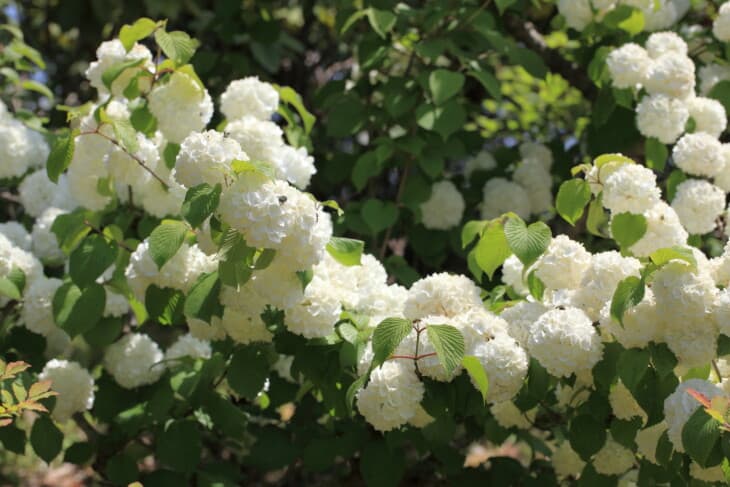
Japanese snowball carries dozens of 2- to 3-inch white pompoms in neat rows along strongly horizontal branches, which gives the whole shrub a tiered, layered look no hydrangea has. It blooms in May, its pleated leaves turn purple-red in fall, and it is hardy in zones 5 to 8. Like Chinese snowball, its flowers are all sterile. It is more compact than the Chinese species at 8 to 12 feet.
Doublefile Viburnum (Viburnum plicatum f. tomentosum)

Doublefile viburnum is the wild form of the Japanese snowball, and it is the plant most often mistaken for a lacecap hydrangea. Each flat head has a ring of large sterile white florets around a center of tiny fertile ones, exactly like a lacecap, but they are carried in two conspicuous rows along horizontal branches. Unlike the snowball form, it sets bright red fruit that ripens black and feeds birds. It is hardy in zones 5 to 8.
European Cranberrybush and Snowball Bush (Viburnum opulus)

Viburnum opulus comes in two forms that confuse people differently. The wild form carries flat lacecap heads and hangs translucent red berries into winter; the cultivar ‘Roseum’, the old-fashioned snowball bush, carries pure white globes and no fruit at all. Both have distinctly three-lobed, maple-like leaves, which no hydrangea has. European cranberrybush has naturalized and is invasive in parts of the Northeast and Midwest; plant the American species instead.
American Cranberrybush (Viburnum trilobum (V. opulus var. americanum))

American cranberrybush is the native alternative to the European species and is now usually treated as a variety of it. It looks nearly identical in flower, with flat white lacecap heads in May, but its fruit is edible, intensely tart, and hangs on through winter for cedar waxwings and robins. Fall color is red to purple. It is hardy in zones 2 to 7 and tolerates wet ground, which hydrangeas do not.
Blackhaw Viburnum (Viburnum prunifolium)

Blackhaw is a tough native small tree or large shrub with flat-topped clusters of creamy white flowers in April and May, blue-black fruit in fall and deep burgundy autumn color. Its clusters are flatter and less showy than a lacecap hydrangea’s, without the ring of large sterile florets, and its leaves are small, neat and finely toothed. It handles drought, clay and part shade, and it is hardy in zones 3 to 9.
Arrowwood Viburnum (Viburnum dentatum)
Arrowwood is the most widely planted native viburnum, a dense, rounded 6- to 10-foot shrub with flat creamy flower clusters in late spring and heavy crops of blue-black fruit. Its name comes from the perfectly straight young stems, which were used for arrow shafts. It is hardy in zones 3 to 8 and tolerates almost any soil and light. Plant two different cultivars for good fruit set, since it fruits poorly alone.
Plants With Cone-Shaped Flower Heads
Common Lilac (Syringa vulgaris)

Lilac is mistaken for hydrangea only in photographs, because the flower heads are dense cones of small flowers rather than globes or flat plates, and the scent settles it instantly: no hydrangea is fragrant. Lilacs are much taller than most people assume, 8 to 15 feet, with heart-shaped leaves, and they flower for about two weeks in May and then do nothing. They need full sun, alkaline to neutral soil and hard pruning right after flowering.
Panicle Hydrangea, For Comparison (Hydrangea paniculata)

Worth naming, because several plants below get confused specifically with this one. Panicle hydrangea, including ‘Limelight’ and ‘Pee Gee’, carries long white cones that age to pink and rust and stay on the plant through winter. It is the hardiest and most sun-tolerant hydrangea, good in zones 3 to 8, and it flowers on new wood, so it can be cut back hard in spring without losing bloom. If a cone-flowered shrub does what that describes, it is a hydrangea.
Butterfly Bush (Buddleja davidii)

Butterfly bush produces tapering spikes of small, sweetly scented flowers from midsummer to frost, and butterflies cover it. Its leaves are the giveaway: long, narrow and gray-felted beneath, nothing like a hydrangea’s broad toothed leaf. It is invasive in Oregon, Washington and parts of the Northeast and mid-Atlantic, where it seeds into riverbanks; plant a sterile cultivar such as the Lo & Behold or ‘Miss’ series, or a native shrub, and deadhead it.
Crape Myrtle (Lagerstroemia indica)

Crape myrtle is a summer-flowering small tree with cone-shaped clusters of crumpled, crepe-textured flowers in watermelon pink, red, lavender and white, and it is confused with panicle hydrangea rather than mophead. Its bark is unmistakable: smooth, mottled and peeling to cinnamon and gray. It needs full sun and heat and is hardy in zones 7 to 9, dying back to the ground in zone 6. Do not “crape murder” it by topping the branches each spring.
Spirea (Spiraea japonica and S. prunifolia)

Two different shrubs are sold as spirea. Japanese spirea is a low 2- to 3-foot mound with flat pink flower clusters through summer, and it is the one confused with a dwarf hydrangea; it is also invasive in parts of the East, so choose a sterile cultivar. Bridal wreath spirea is a 6- to 8-foot fountain wreathed in small white flowers in April along arching stems. Neither has hydrangea’s big paired leaves.
Elderberry (Sambucus canadensis)

Elderberry carries broad, flat, creamy plates of tiny flowers in June that look strikingly like a white lacecap hydrangea head from across a field. Its leaves settle it: they are compound, divided into five to eleven toothed leaflets, where every hydrangea leaf is simple. It is a fast, suckering 8- to 12-foot native shrub of damp ground, and its purple-black fruit makes syrup and wine. Raw berries, leaves and stems contain cyanogenic compounds and should be cooked.
Ninebark (Physocarpus opulifolius)

Ninebark is a tough native shrub grown mostly for its burgundy or gold foliage, with small domed clusters of white or pink flowers in early summer. It gets mistaken for hydrangea mainly in the dark-leaved cultivars sold alongside them, such as ‘Diabolo’ and the Summer Wine series. Its bark peels in papery layers, which is where the name comes from, and its leaves are three-lobed like a currant’s. It is hardy in zones 2 to 8 and tolerates drought and poor soil.
Lookalikes Up Close
Mountain Laurel (Kalmia latifolia)

Mountain laurel carries rounded clusters of pink or white flowers in May and June that read as hydrangea-like from a distance, but every flower is a small cup with ten stamens held under tension in pockets in the petals; a visiting bee trips them and gets dusted with pollen. Its leaves are evergreen, leathery and glossy, unlike any hydrangea. It is the state flower of Connecticut and Pennsylvania, native to eastern woodlands, and every part of it is poisonous to people, dogs, cattle and horses.
Rhododendron (Rhododendron species)

Rhododendrons carry their flowers in dense domed trusses that are genuinely hydrangea-sized, and they grow in the same acidic, part-shaded gardens, so the two are often planted together and confused. Each flower is a broad funnel an inch or more across with a spotted upper throat, and most species keep large leathery leaves all winter. They need acidic, sharply drained soil and shelter from wind. Like mountain laurel, they are poisonous, including the honey made from them.
Pentas (Egyptian Star Flower) (Pentas lanceolata)

Pentas holds tight domed clusters of small flowers above deeply veined leaves, which is the source of the resemblance, but each flower is a distinct five-pointed star and the plant is a soft-stemmed tender perennial 2 to 3 feet tall, not a woody shrub. It is grown as an annual outside zones 10 and 11, it flowers nonstop in heat, and it is one of the best butterfly and hummingbird plants for a hot sunny bed.
How to Tell a Hydrangea From a Lookalike
- Check the leaves first. Hydrangea leaves are simple, large, in opposite pairs, coarsely toothed and strongly veined. Lobed leaves mean viburnum or ninebark; compound leaves mean elderberry; narrow gray leaves mean butterfly bush; leathery evergreen leaves mean laurel or rhododendron.
- Look at the showy parts. A hydrangea’s “petals” are four sepals around a tiny true flower. They have a papery texture even when fresh.
- Wait for fall. Hydrangea flower heads dry and hold on the plant into winter. Viburnum, lilac and spirea flowers drop and are replaced by fruit.
- Test for scent. No hydrangea is fragrant. Lilac, elderberry and butterfly bush are strongly so.
- Note the bloom date. Snowball viburnums flower in April and May; mophead hydrangeas start in June. In the Northeast, anything carrying white globes before Memorial Day is a viburnum.
- Check for fruit. Hydrangeas produce only dry, insignificant capsules. Red, blue or black berries mean viburnum or elderberry.
For related reading, see our guides to Chinese snowball shrub and snowball hydrangea.